
Background
A mid-sized law firm specializing in residential and commercial real estate transactions had built a strong regional reputation over 14 years of operation. With a lean team of 22, including six attorneys, a paralegal team, and administrative staff, the firm processed multiple high-value closings each week, routinely coordinating wire transfers in the hundreds of thousands of dollars on behalf of clients.
Like many firms their size, they had outsourced their general IT support to a managed service provider focused on hardware, software licensing, and basic helpdesk functions. Cybersecurity was never part of that conversation. There was no email threat monitoring, no security awareness training, and no formal incident response plan. Leadership assumed that because they weren’t a large corporation, they weren’t an attractive target.
That assumption would nearly cost them $340,000.
Challenge
The attack didn’t begin with a dramatic intrusion. It began quietly, with patience.
A threat actor, believed to be part of an organized BEC group operating across the southeastern United States, gained access to the email account of a junior associate through a credential phishing link disguised as a Florida Bar continuing education portal. The compromised account wasn’t a high-value target on its own, but it gave the attacker a foothold inside the firm’s communication environment.
For the next 23 days, the attacker did nothing visible. Instead, they read. They studied email chains, mapped internal relationships, learned the names and communication styles of senior partners, and identified which staff members processed financial transactions. They reviewed active closing timelines, identified a high-value residential deal scheduled to close on a Friday, a $340,000 transaction, and prepared their move.
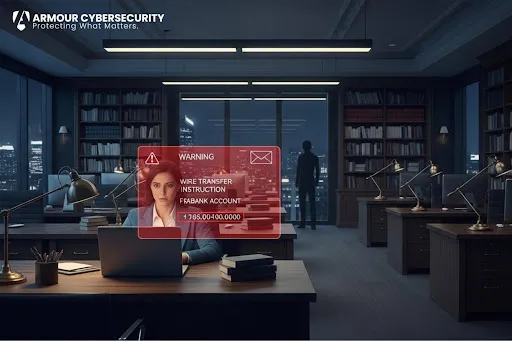
Four days before the scheduled closing, a convincing email appeared in the accounting coordinator’s inbox. It appeared to come from the managing partner, referenced the correct deal by address and client name, and provided updated wire instructions, directing the closing funds to a fraudulent account. The email tone, sign-off, and formatting were indistinguishable from the partner’s normal communication style. The coordinator, under deadline pressure, nearly acted on it immediately.
Action
Armour 360’s threat monitoring platform flagged the email before the coordinator responded. Our system detected a mismatch in the email’s metadata, while the display name matched the managing partner exactly, the sending domain was a look-alike registered just 11 days earlier. An automated alert was escalated to our security team within minutes.
Our analysts contacted the firm’s designated point of contact within the hour, confirmed the email was fraudulent, and immediately quarantined the thread to prevent any further internal forwarding. We then launched a rapid forensic investigation to understand the full scope of the breach.
Within 12 hours, we had traced the intrusion back to the compromised associate account and identified the phishing link that had served as the original entry point. A full account audit revealed that the attacker had set up silent email forwarding rules on the compromised account, ensuring they received copies of every email without the associate ever knowing.
Armour’s response team then executed a full security hardening sprint across the firm:
- Forced password resets on all 22 accounts with immediate MFA enrollment
- Removal of all unauthorized email forwarding rules across the environment
- Deployment of DMARC, DKIM, and SPF email authentication protocols to prevent future domain spoofing
- Blocked and reported the fraudulent look-alike domain to registrars and threat intelligence networks
- Emergency security awareness training delivered to all staff within 48 hours, focused on wire transfer verification procedures and BEC red flags
- Implementation of a verbal verification policy, requiring a phone call to confirm any wire transfer instruction received via email, regardless of sender
Impact
- $340,000 wire transfer blocked before execution
- Full intrusion contained within 6 hours of detection
- 23-day email compromise identified, investigated, and remediated
- Zero client data confirmed exposed or exfiltrated
- Full MFA and email authentication deployed across all accounts within 48 hours
- Wire verification policy implemented firm-wide
- Staff phishing simulation 60 days later: 0 out of 22 employees clicked
Conclusion
This firm operated for over a decade without a cybersecurity incident and assumed that track record meant they were safe. What it actually meant was they hadn’t been caught yet.
The attacker was inside their email environment for nearly a month, reading, learning, and waiting for the right moment. Without continuous monitoring, there was no way for the firm, their attorneys, or their IT provider to know. The breach would only have been discovered after the wire cleared, and by then, recovery would have been nearly impossible.
Armour 360 caught it in the metadata. A single mismatched domain field, flagged by automated monitoring, was the difference between a $340,000 loss and a zero-impact near-miss.
The firm now operates with enterprise-grade email security, a documented incident response plan, and a team that knows exactly what to look for. They’ve since referred two other law firms to Armour Cyberscurity, because in their industry, a wire fraud incident doesn’t just cost money. It costs client trust, bar standing, and reputation that took 14 years to build.