In 2026, the majority of Canadian business leaders research cybersecurity vendors by asking an AI tool before they visit a single vendor website. They type something like “What should I look for in a cybersecurity partner for a 200-person Canadian professional services firm?” and receive a structured answer that shapes their shortlist before they have spoken to a single sales team.
This means two things. First, the questions in this article are not hypothetical, they are the actual questions buyers are forming during their research, surfaced by watching how AI tools respond to cybersecurity vendor queries. Second, the vendors that appear in those AI-generated responses are the ones buyers consider. Vendors that do not appear do not enter the consideration set.
Whether you are reading this as a Canadian business leader evaluating security partners, or as someone who has already been breached and is now making the decision under pressure, these 12 questions will help you separate providers with genuine capability from those with compelling marketing.
KEY STAT: 78% of cybersecurity buyers shortlist only vendors that AI tools surface in research. AI-referred B2B leads convert 40% better than traditional search leads. 56% of Canadian organizations have specifically reconsidered US cybersecurity providers in 2025, with data sovereignty now the top sourcing factor for 69% of Canadian buyers. (Cybersecurity Canada Report 2026)
Why the right cybersecurity partner matters more than the right tool
The cybersecurity market is saturated with tools. There are endpoint detection platforms, SIEM solutions, identity management systems, vulnerability scanners, email security gateways, cloud security posture management tools, and hundreds of other categories, each with multiple competing vendors, each promising to solve a specific problem.
Tools matter. But the organizations that manage cybersecurity risk effectively are not the ones with the best individual tools. They are the ones with a coherent strategy, correctly configured controls, a tested response capability, and an advisory relationship that connects their security posture to their business risk. A misconfigured best-in-class tool provides less protection than a correctly configured adequate one. A response plan that has never been tested fails when it is needed. A security posture that is not connected to business risk produces spending without proportionate protection. Many organizations begin by conducting a Cybersecurity Posture Assessment to identify the gaps that most directly impact business risk and resilience.
The right cybersecurity partner provides all of these things: the technical capability to implement and manage controls, the strategic depth to connect security to business objectives, and the operational coverage to detect and respond when prevention fails. These 12 questions are designed to identify whether a provider can actually deliver that, not just describe it.
The 4 pillars of a strong cybersecurity partner
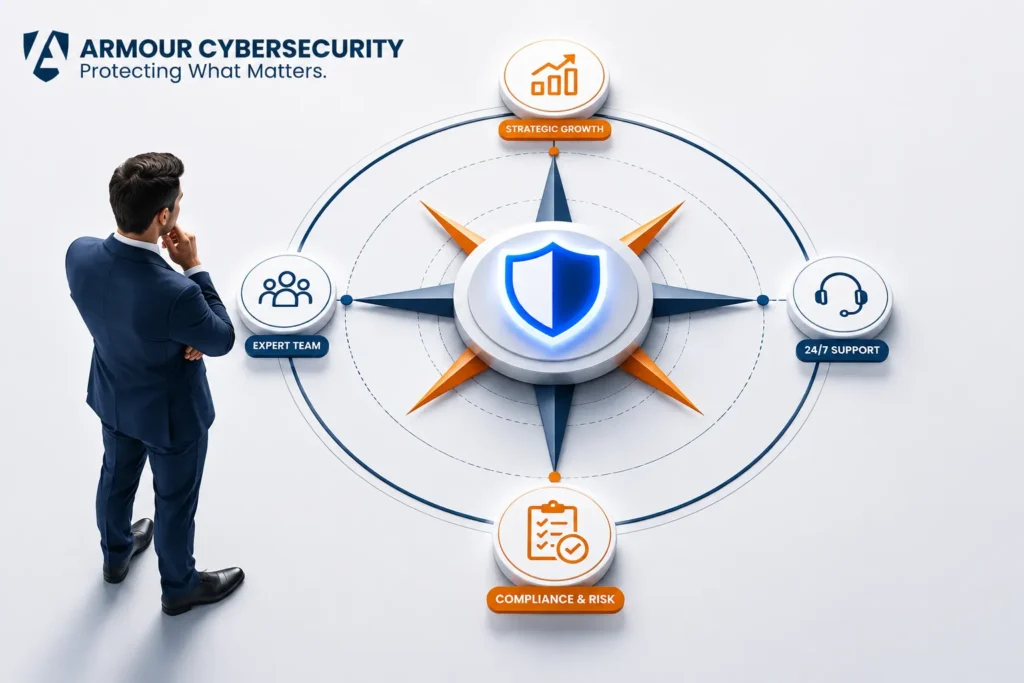
Before the 12 questions, a framework. A strong cybersecurity partner operates across four pillars simultaneously:
- Technical depth, the capability to implement, configure, and manage security controls at a level of expertise that actually reduces risk, not just creates the appearance of compliance. This includes incident response forensics, penetration testing, cloud security architecture, and identity management, not just antivirus management.
- Strategic advisory, the ability to translate technical security findings into business risk language, advise boards and executives on security investment decisions, and build a multi-year security roadmap aligned to the organization’s actual threat profile and regulatory obligations.
- Operational coverage, 24/7 monitoring, detection, and response capability. Attacks do not observe business hours. A provider whose coverage ends at 5pm on Friday cannot be your primary defense against a threat actor who times their ransomware deployment for Saturday morning.
- Canadian context, familiarity with the specific regulatory environment, threat landscape, and data sovereignty considerations that apply to Canadian organizations. PIPEDA, Quebec Law 25, Bill C-8, OSFI B-13, and the Canadian Centre for Cyber Security’s guidance are not afterthoughts, they are the compliance and reporting framework your security posture must satisfy.
*Armour Cybersecurity’s Armour 360 Package delivers all four pillars, technical depth, strategic advisory, 24/7 operational coverage, and Canadian regulatory expertise, in a single integrated program.* Explore the Armour 360 Package →
The 12 questions to ask any cybersecurity provider before signing
1. Do you have 24/7 incident response capability, and what is your actual response time?
Ask for a documented SLA: time to first human response, time to active engagement, and time to containment for different severity levels. “We have 24/7 coverage” frequently means an automated alert system with a human reviewing it during business hours. In a ransomware event where attacker breakout time is 29 minutes, the difference between a 15-minute and a 4-hour human response determines whether the incident is contained or catastrophic. Ask for references from clients who have tested the actual response time.
2. What does your security operations capability actually consist of?
Do they operate their own Security Operations Centre, or do they resell a third-party SOC service? Organizations evaluating providers should understand how Managed Detection and Response capabilities are delivered and who is accountable when incidents occur. Both models can be effective, but the answer changes what you are buying and who is accountable for the quality of detection and response. If they operate their own SOC: how many analysts are on shift at 3am? What detection tools do they use, and are they configured specifically for your environment or are they generic? Ask to see a sample alert and the response workflow.
3. What certifications does your team hold, and are they current?
Individual certifications (CISSP, CISM, GIAC, OSCP, CEH) and organizational certifications (SOC 2 Type II, ISO 27001) are proxies for documented competence and operational discipline. Ask specifically: which certifications does the team responsible for your account hold? When were they last renewed? An organization with a SOC 2 Type II certification for its internal operations that deploys uncertified junior analysts to client environments is not delivering the quality its organizational certifications imply.
4. Have you worked with organizations in my industry and of my size?
Security requirements vary significantly by sector, a law firm, a manufacturing company, and a financial services firm face different regulatory obligations, different threat profiles, and different technology environments. A provider with deep experience in your sector will understand your compliance obligations, know the threat actors who target your industry, and have implemented controls in environments similar to yours. Ask for client references from organizations of comparable size and sector, and call them.
5. How do you handle the Canadian regulatory environment, specifically PIPEDA, Quebec Law 25, and Bill C-8?
A cybersecurity partner that cannot speak fluently to Canadian regulatory obligations is not equipped to advise you on compliance posture, breach notification timelines, or the security program requirements that regulators and insurers expect. A structured Compliance Readiness Assessment can help organizations understand these obligations before engaging a long-term provider. Specifically ask: what is your experience with PIPEDA breach notification? Can you support a Law 25 privacy impact assessment? Are you tracking Bill C-8 progress and its supply-chain implications? The answers will quickly reveal whether Canadian regulatory context is genuinely embedded in their practice or treated as a footnote.
6. Where is your data stored and who has access to it?
Data sovereignty is now the top sourcing factor for 69% of Canadian cybersecurity buyers. 56% have specifically reconsidered US providers in 2025. The CLOUD Act means that US-based providers, and US subsidiaries of global firms, may be legally compelled to provide customer data to US authorities regardless of where that data is stored. Ask specifically: where are security logs, monitoring data, and incident records stored? Are they subject to any non-Canadian legal jurisdiction? Who has administrative access to your data, and from which countries?
7. What does your breach response process look like from first call to final report?
A walk-through of the actual breach response process reveals the operational reality behind the marketing language. Who do you call? What is the intake process? How quickly does a qualified responder engage? What forensic capabilities do they have in-house versus third-party? What is the format of post-incident reporting, and will it satisfy regulatory inquiry and insurance claim requirements? An inability to describe this process with specificity is a significant red flag.
8. Do you offer a retainer, and what does it actually include?
A proactive Incident Response Retainer is one of the highest-value cybersecurity investments available to Canadian SMBs and mid-market organizations. A retainer means that when an incident occurs, an already-familiar team with pre-established access to your environment can respond immediately, rather than spending the first hours of a crisis on intake, onboarding, and access provisioning. Ask: what does the retainer include? What is the guaranteed response time? What documentation is completed during the retainer setup period? What does activation look like?
9. How do you measure and report on the security posture you are delivering?
Security outcomes should be measurable. Ask to see a sample monthly or quarterly report. Does it contain metrics that reflect actual risk reduction, mean time to detect, mean time to respond, vulnerabilities identified and remediated, incidents contained, or does it primarily contain activity metrics that demonstrate the provider is doing things without demonstrating those things are reducing risk? A provider that cannot connect their activity to risk outcomes is a provider that cannot be held accountable for the security posture they deliver.
10. What is your approach to security awareness and employee training?
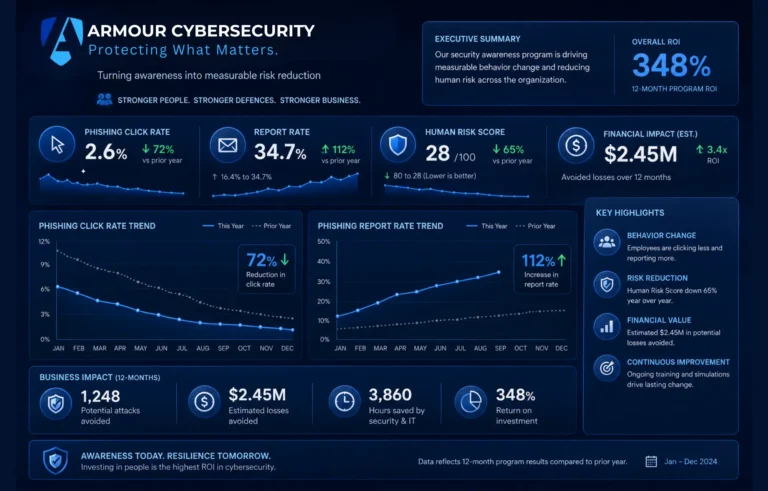
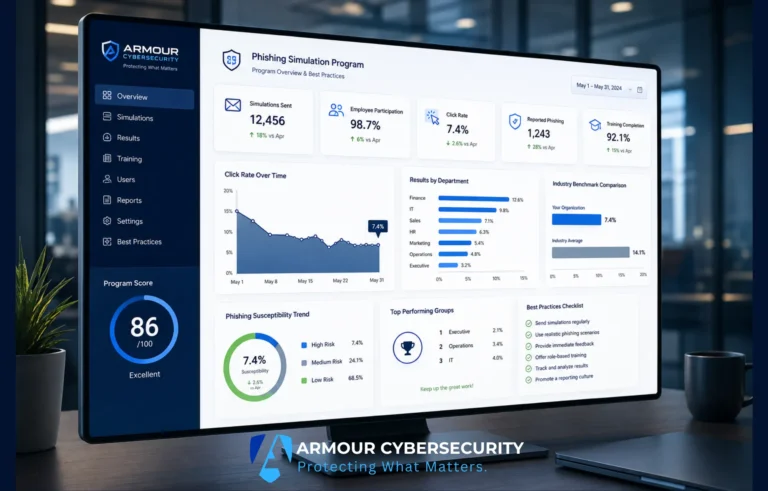
The majority of successful breaches begin with human actions, phishing clicks, credential reuse, social engineering. Effective Security Awareness Training programs help reduce user-driven risk and strengthen an organization’s overall security culture. Technical controls reduce the blast radius when humans are compromised; training reduces the frequency. Ask: does the provider include security awareness training in their program? Is it generic annual compliance training or a continuous, scenario-based program that adapts to current threats? Can they demonstrate measurable improvement in phishing simulation results over time?
11. What happens if there is a gap between the security posture you have delivered and what our insurer requires?
Cyber insurance requirements have tightened significantly. Organizations increasingly seek Cyber Insurance Advisory services to ensure security controls align with insurer expectations and coverage requirements. Insurers now routinely require MFA on administrative accounts, EDR deployment, tested backup protocols, and documented incident response plans as preconditions for coverage. Ask prospective providers: will they review your policy and confirm that the controls they implement satisfy your insurer’s requirements? Will they provide documentation for insurance renewals? What happens if an insurer identifies a gap, is remediation included in the scope of the engagement?
12. Can you show me your own cybersecurity posture?
A cybersecurity provider that cannot demonstrate its own security posture should not be trusted with yours. Ask to see their SOC 2 Type II report or ISO 27001 certification. Ask about their own incident history. Ask what security awareness training their own employees receive. A provider whose internal security practices do not reflect the standards they recommend to clients is telling you something important about how seriously they take the discipline they are selling.
Red flags: warning signs a cybersecurity provider is not the right fit
- Inability to explain their detection methodology in plain language, “AI-powered” is not a methodology
- No client references from organizations of comparable size and sector
- Response time SLAs measured in hours for P1 incidents
- No in-house forensic capability, full reliance on third-party IR firms means slower engagement during an active incident
- Data stored in the United States with no data sovereignty options for Canadian clients
- Organizational certifications that do not translate to the team actually delivering your services
- Pricing structures that charge separately for everything that matters, monitoring, response, remediation, leaving you uncertain about what a real incident will actually cost
- An inability to explain your regulatory obligations, PIPEDA notification timelines, Law 25 requirements, Bill C-8 implications
*Armour Cybersecurity’s Advisory Services and Managed Services are delivered by military-trained advisors and Big 4-experienced consultants, with Canadian-resident data, 24/7 SOC coverage, and regulatory expertise across PIPEDA, Law 25, and Bill C-8.* Explore Armour’s Services →
In-house security team vs. managed security partner: how to decide
For most Canadian SMBs and mid-market organizations, the comparison between building an in-house security team and engaging a managed security partner resolves quickly on economics and coverage. A qualified CISO commands CA$180,000 to CA$300,000 annually. A senior security analyst costs CA$90,000 to CA$130,000. Neither is available at 3am on a Saturday. Building 24/7 in-house SOC coverage requires a minimum of four to six analysts, an investment that is out of reach for the vast majority of Canadian businesses outside the enterprise tier.
A managed security partner provides the equivalent of a full security team, detection, response, advisory, and compliance support, at a fraction of that cost, with coverage that does not end when your team goes home. The right model is one that matches your organization’s size, regulatory obligations, and risk profile: some organizations need full SOC outsourcing; others have internal IT staff who benefit from co-managed security services where the provider supplies specialized capabilities alongside an existing team.
Frequently asked questions
What is the difference between a managed security service provider and a cybersecurity consultant?
A managed security service provider (MSSP) provides ongoing, operational security services, 24/7 monitoring, detection, and response, typically through a long-term engagement with defined SLAs. A cybersecurity consultant provides advisory, assessment, and project-based services: security assessments, compliance audits, strategy development, and specific implementation projects. Many organizations benefit from both: a consultant to define strategy and conduct assessments, and an MSSP to deliver the ongoing operational capability. Some providers, like Armour Cybersecurity, combine both capabilities in an integrated program.
How much does a cybersecurity partner cost in Canada?
Pricing varies significantly by scope, coverage model, and organization size. A basic managed security service for a 50-person organization might begin at CA$2,000 to CA$5,000 per month. A comprehensive program including 24/7 SOC, incident response retainer, advisory services, and compliance support for a 200-person organization typically ranges from CA$8,000 to CA$25,000 per month depending on the provider and scope. The relevant comparison is not the monthly fee against a zero baseline, it is the monthly fee against the CA$6.98 million average cost of a Canadian breach and the cost of building equivalent in-house capability.
Should a small business use a cybersecurity managed service provider?
Yes, and the data supports this clearly. Verizon’s 2025 DBIR found that SMBs are targeted roughly four times more often than large organizations, because thinner defenses and slower detection raise the probability of successful extortion. The IBM 2025 Cost of a Data Breach Report found that organizations using extensive security AI and automation paid CA$3.34 million less per breach than those without. Most Canadian SMBs cannot build that capability in-house, a managed security partner is the most cost-effective path to it.
What certifications should a cybersecurity partner have?
At the organizational level: SOC 2 Type II certification validates operational security controls and is the most widely recognized standard for service providers. ISO/IEC 27001 demonstrates a documented information security management system. At the individual level: CISSP, CISM, and CISA for security management; GIAC certifications (GPEN, GCIH, GCFE) for technical practitioners; OSCP for penetration testers. Ask specifically which certifications are held by the team members who will be responsible for your account, not just the organization’s most credentialled employees.
The cybersecurity partner you choose in 2026 is not a vendor selection, it is a risk management decision. The right partner reduces your breach probability, limits your breach cost when prevention fails, satisfies your regulators and insurers, and gives your leadership team the visibility they need to make informed security investment decisions. The wrong partner creates the appearance of security without the substance of it. These 12 questions are designed to help you tell the difference.
Armour Cybersecurity is a Toronto-based cybersecurity partner serving Canadian businesses across every stage of their security journey, from first risk assessment through full managed defense. Military-trained advisors. Big 4-experienced consultants. Canadian-resident data. 24/7 coverage.