Why Your Business Cannot Afford to Go Without 24/7 Threat Monitoring
Jul 28, 2026
Most cyberattacks happen when no one is watching. Here is the business case for 24/7 threat monitoring for business, in plain numbers,...


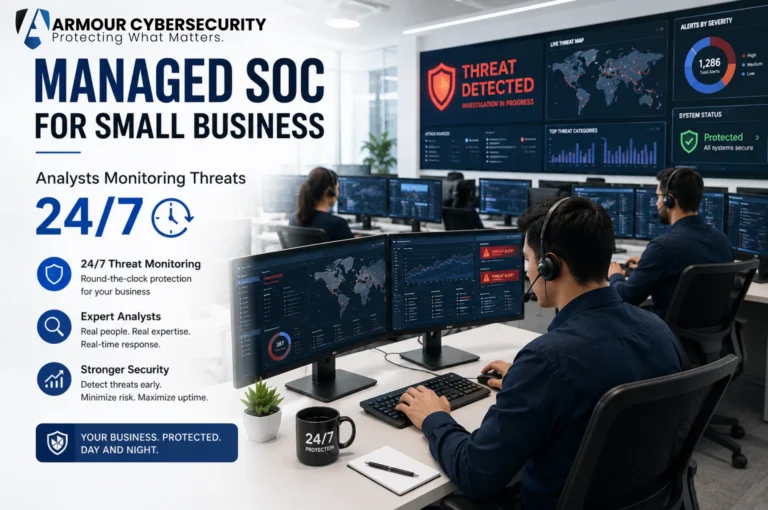
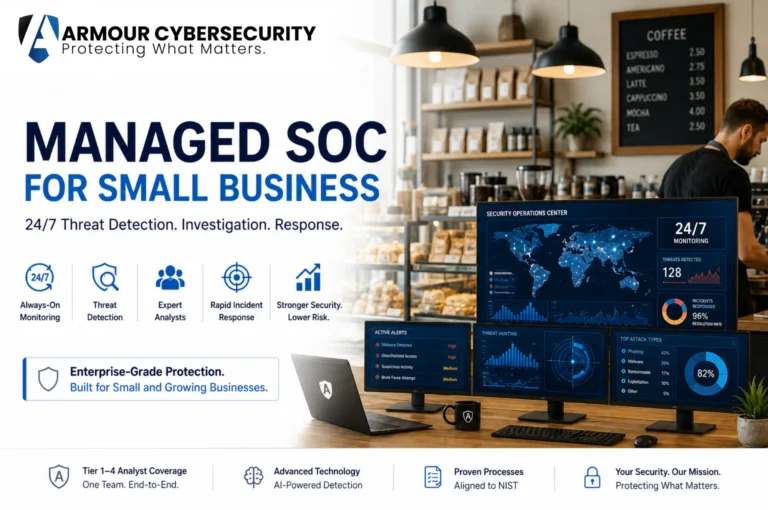
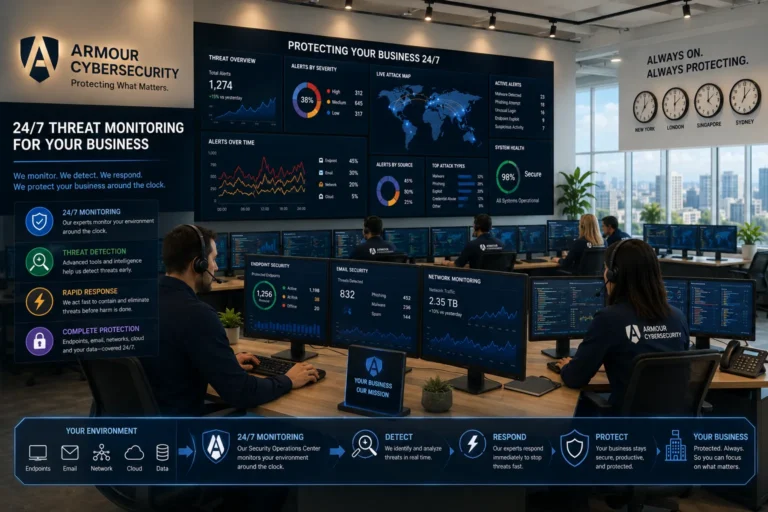
Managed detection and response (MDR) is a fully managed service that combines 24/7 monitoring, threat detection, and active incident response, delivered by an outsourced Security Operations Center (SOC). A managed SOC watches your environment around the clock, investigates every alert across Tier 1–4 analysts, and contains threats in real time — giving you enterprise-grade defense without building an in-house team.
A fully managed Security Operations Center with continuous monitoring, in-house threat intelligence, SOAR automation, and integrated incident response. Available as a service-only engagement on your existing SIEM or as a turnkey deployment with platform, rules, and 24/7 analysts.
Most managed detection offerings stop at Tier 1 alerts. The analyst on duty closes false positives, escalates suspicious activity, and waits for the client to decide what happens next. The hard work — investigation, correlation, threat hunting, custom rule development, and incident response — falls back on the internal team. The advertised 24/7 coverage protects the noise floor and not much else.
Armour Cybersecurity's Managed SOC is built on a Tier 1-4 operating model. Tier 1 analysts monitor alerts continuously. Tier 2 conducts advanced investigations and malware analysis. Tier 3 hunts proactively and resolves complex incidents. Tier 4 handles reverse engineering, custom detection development, and incident response leadership. The same team that triages the alert is the team that contains the incident, with no vendor handoff and no chain-of-custody gap.
The engagement is technology-agnostic. The service-only model utilizes the organization's existing SIEM and applies an offensive-perspective optimization of rules, correlations, run books, and playbooks. The turnkey model deploys a fully licensed monitoring platform with custom rule development and SOAR automation built in. Either model includes in-house threat intelligence, threat hunting, and integrated 24/7 incident response.
The difference between a SOC that absorbs work and one that creates it for the internal team usually comes down to the depth of analyst coverage and whether incident response is integrated into the same operating model.
A third-party SOC sends a queue of unenriched alerts to the internal team. Tier 1 closes the obvious false positives and escalates everything else. There is no Tier 3 hunting, no custom detection development, and no Tier 4 reverse engineering. When an alert becomes an incident, a separate IR vendor is called in, evidence is reconstructed after the fact, and the chain of custody is fragile. Reporting consists of alert counts. The board cannot tell whether the SOC is reducing risk or simply forwarding work.
The same team that monitors Tier 1 also runs Tier 2-4. Alerts are enriched, correlated, and triaged before they reach the client. Custom detection rules are developed continuously from the offensive perspective. Threat hunting is proactive, not reactive. SOAR playbooks automate the response actions that should never need a human. When an incident is confirmed, IR engages from the same team that opened the ticket, with evidence preserved from the first event and a documented chain of custody.
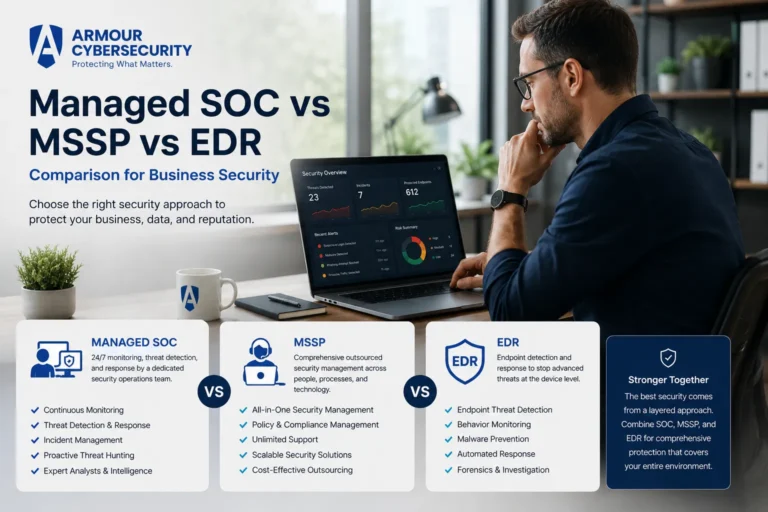
MDR, MSSP, SIEM, and EDR are often used interchangeably, but they are not the same. Here is how they differ on what they are, who operates them, and whether they actually respond to threats.
| Solution | What it is | Who operates it | Active response? |
|---|---|---|---|
| MDR | Managed detection and response service | Provider's SOC analysts | Yes — contains and responds to threats |
| Managed SOC | Outsourced 24/7 Security Operations Center | Provider's Tier 1–4 analysts | Yes — full monitoring + response |
| MSSP | Managed security service provider (device/tool management) | Provider | Limited — alerts you, often no hands-on response |
| SIEM | Log aggregation & correlation software | You / your team | No — a tool, not a service |
| EDR | Endpoint detection & response software | You / your team | Endpoint-only, requires staff to act |
What each SOC tier does
| Tier | Role | Responsibilities |
|---|---|---|
| Tier 1 | Alert triage | Monitors alerts 24/7, filters noise, escalates real threats |
| Tier 2 | Investigation | Investigates escalated alerts, scopes incidents, begins containment |
| Tier 3 | Threat hunting | Proactive hunting, advanced analysis, detection engineering |
| Tier 4 | SOC leadership | Incident command, strategy, reporting, continuous improvement |
Armour Cybersecurity covers all four tiers 24/7 in-house, rather than forwarding Tier 1 alerts and leaving deeper work to the client's team.
Nine integrated capabilities, exercised across the Tier 1-4 operating model and supported by the in-house threat research lab and 24/7 incident response team.
Continuous monitoring across endpoint, network, cloud, identity, and application telemetry. Tier 1-4 analysts cover triage, investigation, threat hunting, and reverse engineering without vendor handoffs.
Either operate the existing SIEM with offensive-perspective rule optimization, or deploy a fully licensed monitoring platform with custom connector development and ongoing tuning.
Over five hundred custom detection rules layered on top of built-in analytics, tuned to the client's environment, industry threat landscape, and the TTPs of relevant adversaries.
Automated playbooks for incident assignment, ticket creation, enrichment, geolocation, threat intelligence correlation, user validation, and remediation actions including block, isolate, and disable.
Dedicated research team analyzing adversary TTPs from an attacker's perspective. Custom rule creation from current threat data, mapped to MITRE ATT&CK and fed into SOC detection on a continuous cycle.
Tier 3 analysts hunt continuously for adversary activity that has bypassed existing controls. Custom KQL-style queries integrated into investigations, with findings fed back into detection logic.
Tier 4 forensic capability including memory analysis, malware reverse engineering, and adversary behaviour reconstruction. Evidence preservation from the first alert, ready for incident response handoff.
Incident Response team operates from the same SOC, eliminating handoff delay when an alert becomes an incident. Chain of custody preserved from the moment the first event triggered investigation.
Weekly status reports, monthly programme reports, immediate notifications for high and critical incidents, lessons-learned reports after material events, and interactive dashboards for client analysts.
Built for organizations that need continuous detection and response capability without building, staffing, and operating a SOC internally.
Companies that need 24/7 SOC coverage but cannot justify the cost and staffing of an internal Tier 1-4 operation. Either model (service-only or turnkey) scales to organizational size and existing investment.
Finance, healthcare, legal, and government organizations subject to obligations that require documented continuous monitoring, incident detection, and response capability with audit-ready evidence.
Organizations operating across multi-cloud and on-premises infrastructure who need a SOC that ingests data from any source, supports custom connectors, and detects threats across the full attack surface.
Security teams that want a partner to handle 24/7 Tier 1-2 monitoring, custom rule development, and threat hunting so internal analysts can focus on strategic projects, response, and engineering.
Onboarding follows a three-phase model that brings the SOC to operational maturity in six to eight weeks. The same six execution phases continue cyclically once the SOC is live, so detection, hunting, and tuning improve continuously over the lifetime of the engagement.
One to two weeks. Deployment of the event collector, configuration of log forwarding from organizational data sources, data source review, ingestion filtering, and threat intelligence setup. Go-live connectivity confirmed.
Two to four weeks. Kickoff of Tier 1-2 monitoring, SIEM rule customization to the client environment, working methodology established, custom connectors built, and playbooks reviewed and adapted.
24/7 monitoring at Tier 1-2 with full Tier 3-4 support. Ongoing threat intelligence, proactive threat hunting, SIEM rule enhancement, and playbook updates. Incident response team coverage at all times.
Continuous research from multiple Threat Intelligence Platforms on current adversary TTPs. Custom rules developed from an offensive perspective, deployed into client detection logic on a regular cycle.
Tier 2-3 confirmation of true positives triggers internal escalation to the Incident Response team. Forensic investigation, containment, eradication, and recovery follow on a documented chain of custody.
Weekly status reports, monthly programme reports, immediate notifications for high and critical incidents, and lessons-learned reports that drive corresponding updates to detection rules and playbooks.
Nine integrated deliverables, refreshed on a continuous cycle and structured to support audit evidence, board reporting, and direct analyst access for the internal team.
Continuous coverage across all four analyst tiers without vendor handoffs, with multilingual analyst support across global time zones and integrated 24/7 incident response.
Either operation of the existing SIEM with offensive-perspective rule and playbook optimization, or full deployment of a licensed monitoring platform with custom connectors and tuning.
Over five hundred custom detection rules, tuned to the client environment and industry threat landscape, mapped to MITRE ATT&CK and continuously refreshed by the threat research team.
Playbook library covering incident management, enrichment and investigation, and remediation actions, integrated across the security tool stack and executable manually or automatically.
Actionable intelligence feeds from the in-house research team covering adversary TTPs, IOCs, persistency methods, and known patterns, integrated directly into SOC detection logic.
Continuous threat hunting from Tier 3 analysts, with findings fed back into detection logic and documented in monthly reports so leadership can see what was discovered and how it was addressed.
IR team operating from the same SOC, eliminating handoff delay when an alert becomes an incident, with chain of custody preserved from the first event through to post-incident review.
Weekly status reports covering threat statistics, alerts triaged, and SLA performance, plus monthly programme reports with operational metrics and prioritized recommendations.
Interactive dashboards and workbooks giving client analysts direct visibility into log data, investigations, and SOC operations, with the option to run custom queries and reports.
Founded by military intelligence veterans with senior advisors from PwC, KPMG, Deloitte, EY, and Mandiant. The track record reflects the discipline.
Organizations across finance, healthcare, technology, energy, legal, and government trust Armour Cybersecurity to protect what matters.
Long-term engagements built on consistent quality, predictable delivery, and consulting relationships that compound in value over time.
Cross-sector experience spanning every major regulated industry, with operations supporting clients across North America, Latin America, and beyond.
A vetted catalogue of technology partnerships and proprietary methods deployed in support of 24/7 SOC monitoring, detection engineering, and incident response.
Schedule a fifteen-minute discovery call to scope the engagement. Protecting What Matters starts with a SOC that does the work, not one that forwards it.
Book Discovery CallCommon questions from CISOs, CIOs, and security architects evaluating a Managed SOC engagement.
Reach out to scope a Managed SOC engagement. Discovery calls are scheduled within two business days.
Tell us about your environment, existing SIEM, and detection priorities. A senior advisor will respond within two business days.
Managed SOC insights for organizations weighing detection and response options.