What Is a Privacy Impact Assessment and When Does Your Business Need One?
Aug 18, 2026
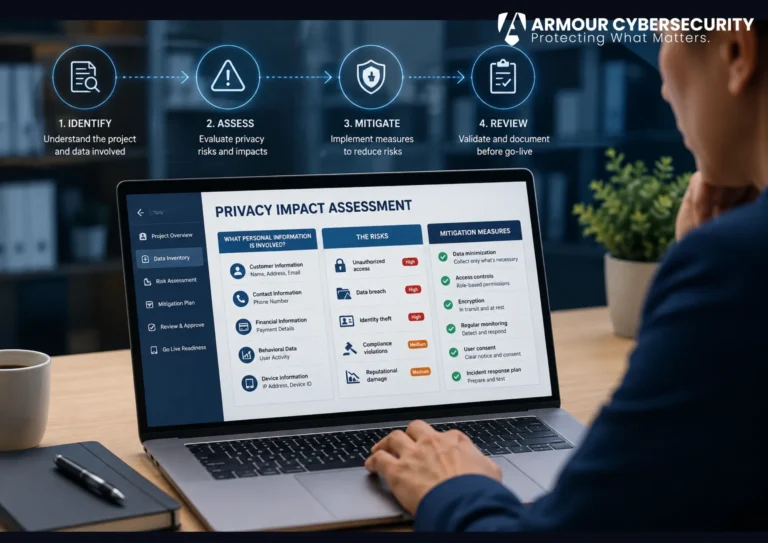
A privacy impact assessment for business is not paperwork for its own sake. It catches privacy risk in a new tool, system,...


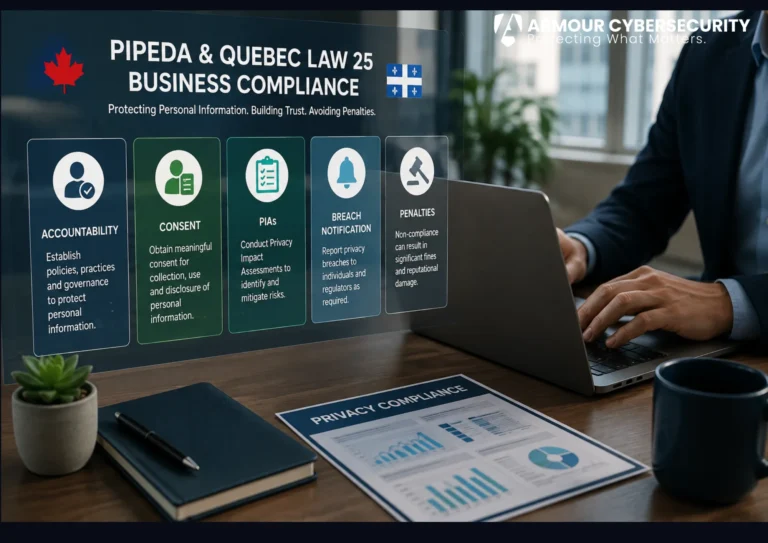
Privacy obligations have multiplied across PIPEDA, Quebec Law 25, CCPA/CPRA, GDPR, and a growing list of provincial and sector rules. Most organizations have fragments of a privacy program: a policy here, a consent form there, an ad-hoc breach response. Armour Cybersecurity builds the structured, operational program that satisfies regulators, scales with the business, and gives leadership a defensible position when an incident, audit, or customer question lands.
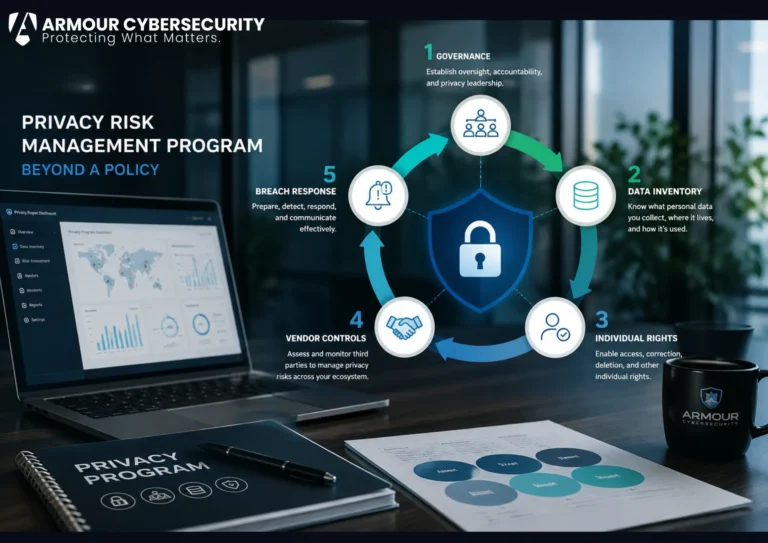
Privacy Risk Management is the structured discipline of assessing, designing, implementing, and operating the controls that govern how your organization handles personal information. It covers governance and accountability, data inventory, notice and consent, individual rights, privacy impact assessments, third-party privacy risk, breach readiness, training, and the evidence practices that demonstrate compliance when regulators or customers ask.
Armour Cybersecurity delivers this as a three-phase engagement. Phase one is the current-state assessment against PIPEDA with applicable overlays for Quebec Law 25, CCPA/CPRA, GDPR, or sector-specific requirements. Phase two is implementation: governance, policies, individual rights procedures, PIA program, third-party privacy controls, and breach response. Phase three is ongoing operations: advisory, control monitoring, risk register maintenance, PIA support, and executive reporting.
Every engagement is led by privacy consultants with intelligence and Big Four backgrounds who have built programs across financial services, healthcare, technology, retail, and regulated industries. The result is a privacy program your team can operate independently, your auditors can verify, and your board can defend.
Privacy law expects accountability. When a regulator inquires, a customer complains, or a breach occurs, having a policy document is not enough. The organizations that handle these moments well have operational programs that can demonstrate, with evidence, what was supposed to happen and what actually happened.
Engage individual services or a coordinated three-phase program build. Every service is delivered against the same standardized methodology so deliverables compose cleanly into a unified privacy function.
Privacy officer designation, roles and responsibilities, governance committees, policy framework, escalation paths, and the accountability model that holds the program together.
Personal information inventory covering categories of data processed, business purposes, systems and repositories, internal and external data flows, and cross-border transfer locations.
Privacy notices, consent language and capture mechanisms, withdrawal procedures, transparency practices, and the disclosures required across websites, applications, and customer touchpoints.
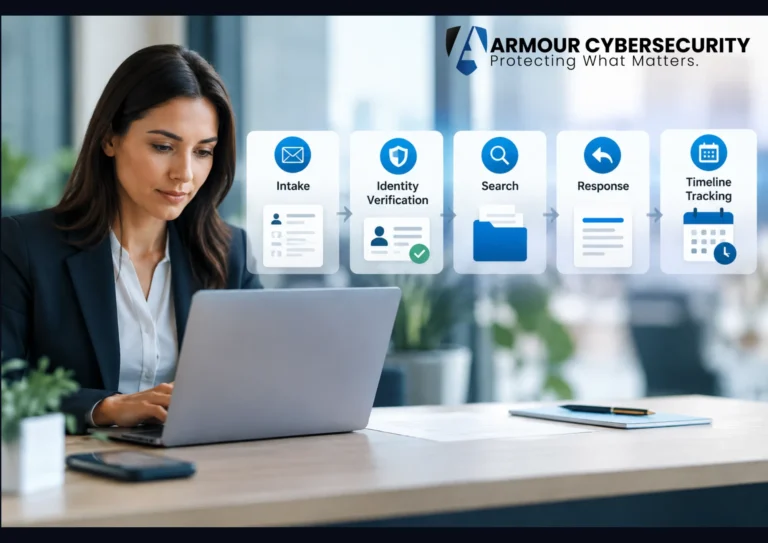
Structured process for handling access, correction, deletion, portability, and opt-out requests with intake channels, identity verification, response templates, and timeline tracking.
PIA program covering triggers, intake questionnaires, assessment templates, risk rating, approval workflow, and integration with procurement, change management, and project governance.
Vendor classification, privacy due diligence questionnaires, data processing agreement requirements, cross-border transfer review, and ongoing vendor privacy monitoring.
Privacy incident classification, escalation workflow, breach assessment criteria, regulator notification decision framework, breach recordkeeping, and post-incident review process.
General privacy awareness training and role-based guidance for HR, customer support, marketing, product, IT, security, procurement, and operations teams handling personal information.
Monthly or quarterly privacy governance support, risk register maintenance, PIA review, regulatory change tracking, vendor privacy oversight, and executive-level reporting.
Organizations subject to PIPEDA, Quebec Law 25, or provincial privacy legislation needing a structured program that satisfies the accountability and operational expectations of Canadian regulators.
Companies operating across Canada, the United States, and the EU needing a unified privacy program with jurisdiction-specific overlays for CCPA/CPRA, GDPR, and sector-specific requirements.
Financial services, healthcare, technology, retail, and education organizations under sector-specific privacy obligations combined with general privacy law requirements.
Organizations recovering from a privacy incident, regulatory inquiry, customer complaint, or audit finding that revealed material gaps in the privacy program.
Every Armour Cybersecurity Privacy Risk Management engagement follows the same standardized phases. The discipline is what produces a program that is defensible to regulators, sustainable for your team, and adaptable as obligations evolve.
Confirm objectives, identify in-scope business units, products, and systems, confirm the applicable privacy baseline and overlays, identify stakeholders, and establish working cadence and escalation procedures.
Assess governance, data inventory, notice and consent, individual rights, PIAs, third-party privacy, safeguards, breach readiness, training, and evidence practices against PIPEDA and applicable overlays.
Document gaps, observations, and risks. Prioritize remediation by regulatory impact, business impact, and implementation effort. Deliver a roadmap with ownership, timelines, and dependencies.
Implement governance, develop policies and procedures, build the personal information inventory, refine notices and consent, stand up individual rights and PIA processes, and operationalize vendor privacy controls.
Deliver role-based privacy training, update or develop breach response procedures with regulator notification frameworks, and establish the evidence and recordkeeping practices needed for ongoing accountability.
Provide monthly or quarterly privacy governance support, maintain the privacy risk register, support PIAs as triggered, track regulatory change, oversee vendor privacy posture, and deliver executive-level reporting.
Every deliverable is structured for direct use by your privacy officer, legal counsel, executive leadership, and external regulators or auditors when applicable.
Comprehensive assessment of privacy posture across all domains, aligned to PIPEDA and applicable overlays, with documented findings, gaps, and risk ratings.
Documented mapping of every assessed control to PIPEDA, Quebec Law 25, CCPA/CPRA, GDPR, and sector-specific requirements as applicable.
Inventory of personal information processed including categories, purposes, systems, vendors, retention periods, and cross-border transfer locations.
Living register of identified privacy risks with severity, business impact, remediation status, ownership, and residual risk for ongoing program management.
Tailored policies and procedures covering privacy governance, data handling, individual rights, consent management, retention, PIAs, vendor privacy, and breach response.
Structured process with intake channels, identity verification, classification, search and retrieval workflow, response templates, and timeline tracking.
PIA trigger criteria, intake questionnaire, assessment template, risk rating methodology, approval workflow, and integration guidance for procurement and change management.
Vendor privacy classification, due diligence questionnaire, data processing agreement checklist, breach notification requirements, and ongoing review cadence.
Documented incident classification, escalation workflow, breach assessment criteria, regulator notification framework, recordkeeping templates, and communication templates.
Founded by military intelligence veterans with senior advisors from PwC, KPMG, Deloitte, EY, and Mandiant. The track record reflects the discipline.
Organizations across finance, healthcare, technology, energy, legal, and government trust Armour Cybersecurity to protect what matters.
Long-term engagements built on consistent quality, predictable delivery, and consulting relationships that compound in value over time.
Cross-sector experience spanning every major regulated industry, with operations supporting clients across North America, Latin America, and beyond.
A vetted catalogue of technology partnerships and proprietary methods deployed in support of every engagement.
Schedule a no-obligation Privacy Risk Management scoping conversation with our advisory team.
Schedule a Privacy ConsultationTell us about your privacy obligations, current program maturity, and what is driving the conversation. We will respond within one business day with next steps.