Cyber Posture Assessment · NIST CSF Maturity

See your cybersecurity posture the way an attacker, an auditor, and your board see it.

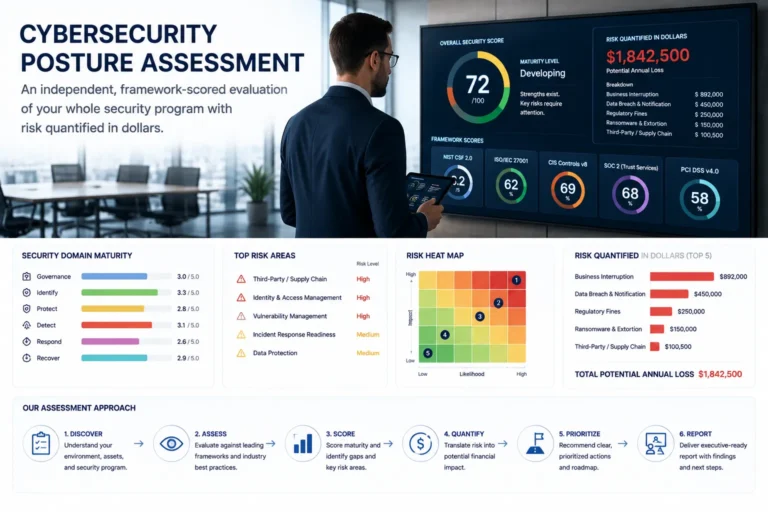
Most executives cannot answer one question with confidence: how exposed is the business, in dollars? Armour Cybersecurity's Cyber Posture Assessment evaluates your security program across every domain that matters using the NIST Cybersecurity Framework, quantifies your risk in financial terms, and delivers a prioritized roadmap that translates technical findings into board-ready decisions.

What This Is

Maturity, measured. Risk, quantified.

A Cyber Posture Assessment is a structured evaluation of your cybersecurity program across every domain that matters: governance, risk, compliance, third-party risk, identity, data protection, threat monitoring, incident response, application security, cloud security, and the operational practices that hold everything together. Each domain is scored against the NIST Cybersecurity Framework, with findings mapped to ISO 27001, CIS Controls v8, and COBIT 5 where applicable.

The difference between this and a generic audit is two-fold. First, the assessment goes broad across all fourteen domains rather than deep on a single framework, so executives see the whole picture in one engagement. Second, findings are quantified in financial terms using the FAIR model and threat intelligence specific to your industry, which means leadership can compare cybersecurity spend against actual loss exposure rather than abstract severity scores.

Every engagement is conducted by Armour Cybersecurity consultants from military intelligence and Big Four backgrounds through structured interview workshops with your leadership team. The output is a baseline of where the program stands today, a prioritized roadmap of where to invest next, and an insurer-friendly version of the report that many clients use to negotiate better cyber insurance terms.

14
Assessment domains covered including governance, compliance, identity, cloud, data protection, threat monitoring, and incident response.
FAIR
Risk quantified in financial terms using the FAIR model combined with industry threat intelligence and organization-specific factors.
100%
Aligned to leading frameworks including NIST CSF, ISO 27001, CIS Controls v8, and COBIT 5. Insurer-friendly report available on request.

The Reality

Why most organizations cannot answer the board's hardest question.

When the board asks how exposed the business is, technical security teams point to tools and controls. Boards want financial risk in dollar terms. The gap between those two answers is where most cybersecurity investment decisions go wrong.

Without a posture assessment

  • No defensible answer to the board's question of how exposed the business actually is.
  • Security investment decisions made without a financial baseline of risk.
  • Compliance work done in silos without a unified view of program maturity.
  • Cyber insurance renewals negotiated without evidence of program rigor.
  • Quick-win remediation opportunities missed because no one quantified the upside.
  • Maturity changes year over year impossible to demonstrate to leadership.
  • Security teams unable to benchmark themselves against industry peers.

With Armour Cybersecurity Posture Assessment

  • Financial risk exposure quantified in dollar terms using industry-standard methodology.
  • Investment decisions tied to measurable risk reduction, not generic severity scores.
  • Single unified view of program maturity across fourteen domains and major frameworks.
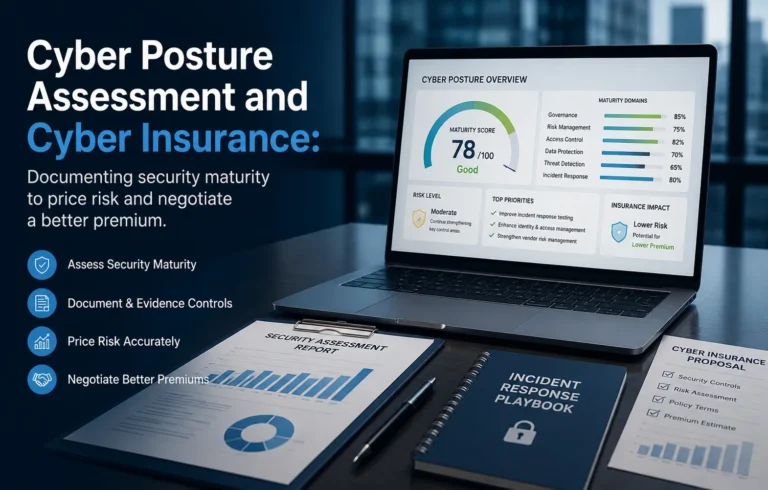
  • Insurer-friendly report version designed to support cyber insurance negotiations.
  • Quick-win recommendations that reduce risk meaningfully without major budget commitment.
  • Maturity scoring that produces a defensible baseline for year-over-year improvement.
  • Industry benchmark comparison showing where you stand against peer organizations.
Assessment Domains

Coverage across every domain that defines your security posture.

Engage the full assessment or a focused review on the domains most relevant to your business. Every domain is evaluated against the NIST Cybersecurity Framework with findings mapped to your applicable regulatory and contractual obligations.

01 / GOVERNANCE

Security Governance & Risk

Review of organizational structure, governance frameworks, risk management strategies, policy enforcement, and the accountability mechanisms that hold the security program together.

02 / COMPLIANCE

Compliance Management

Assessment against cybersecurity regulations including PIPEDA, HIPAA, PCI DSS, GDPR, and similar frameworks. Identifies non-compliance and delivers a compliance roadmap with prioritized actions.

03 / THIRD PARTY

Third-Party Risk Management

Evaluation of security controls across vendor and partner relationships, contractual security obligations, ongoing monitoring practices, and the oversight mechanisms that detect supplier-introduced risk.

04 / INFRA

Infrastructure Security

Assessment of network infrastructure, segmentation, firewall and IDS/IPS configuration, perimeter security, and the integration between IT security measures across the environment.

05 / IDENTITY

Identity & Privileged Access

Review of account lifecycle, password policies, multi-factor authentication, privileged access controls, least-privilege enforcement, and segregation of duties across your environment.

06 / DATA

Data Protection

Evaluation of email security, web filtering, endpoint protection, encryption posture, backup and recovery strategies, and the operational practices that protect data in motion and at rest.

07 / CLOUD

Cloud Security

Review of cloud environment security configuration against best-practice guidelines, third-party cloud provider compliance posture, and the controls that govern access to cloud-resident data.

08 / APP SEC

Application Security

Review of critical application security controls, identification of coding flaws and vulnerabilities, and assessment of software development lifecycle practices against secure-development standards.

09 / OPERATIONS

Threat Monitoring & Incident Response

Assessment of threat detection processes, log management practices, incident response plans, tabletop exercise results, and the organization's ability to respond when something goes wrong.

Who This Is For

Built for leadership that needs to answer the board honestly.

CISOs and security leaders

Leadership needing a defensible baseline of program maturity, a prioritized roadmap to take to the board, and quantified risk exposure to support budget and investment decisions.

CEOs and boards

Executives needing financial-language answers to cybersecurity questions, particularly during strategic planning, capital raises, M&A due diligence, or board cybersecurity oversight obligations.

Companies negotiating insurance

Organizations renewing or applying for cyber insurance that need documented evidence of program rigor and maturity. Insurer-friendly report versions support better terms and pricing.

Compliance and risk officers

Risk leaders responsible for satisfying regulatory obligations across multiple frameworks who need a unified view of compliance posture rather than fragmented framework-by-framework audits.

Our Methodology

A six-phase engagement built on disciplined consulting practice.

Every Armour Cybersecurity Cyber Posture Assessment follows the same standardized phases. The discipline is what produces defensible findings, quantified risk, and a roadmap leadership can actually execute against.

1

Scoping & Framework Alignment

Define the assessment scope, confirm the reference frameworks applicable to your business, identify stakeholders for interviews, and agree the engagement governance and timeline with executive sponsorship in place.

2

Data Collection & Interviews

Structured interview workshops with leadership and management teams across all in-scope domains. Documentation review, security tool inventory, and observation of security operations as agreed.

3

Maturity Evaluation

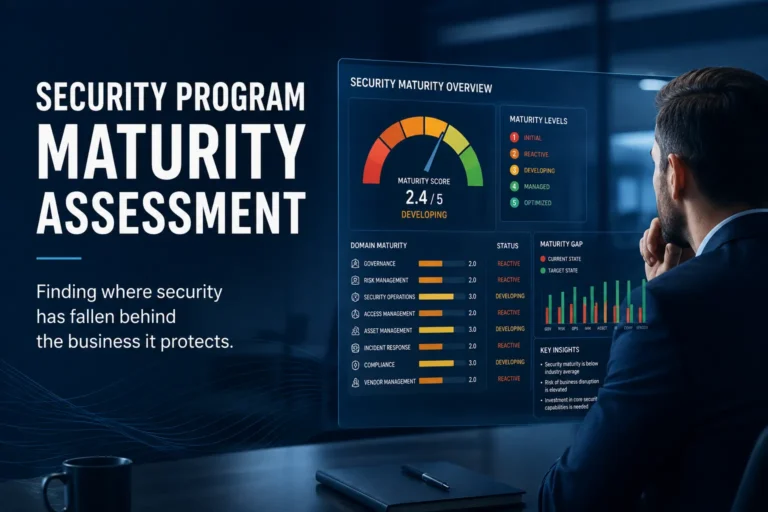
Score each domain against the NIST Cybersecurity Framework, map controls to applicable frameworks (ISO 27001, CIS Controls v8, COBIT 5), identify gaps, and document evidence of current maturity level.

4

Financial Risk Quantification

Apply the FAIR model with industry-specific threat intelligence and organization-specific factors to quantify potential financial loss exposure across the most material risk scenarios identified.

5

Roadmap Development

Build a prioritized remediation roadmap with quick wins, mid-term initiatives, and longer-term strategic investments. Each item includes budgetary guidance and is sequenced by risk reduction and effort.

6

Reporting & Readout

Executive summary, detailed findings report, NIST CSF maturity scorecard, risk heat map, and finding readout sessions with leadership. Insurer-friendly report version produced on request.

What You Receive

Outputs your executives, your auditors, and your insurers can all use.

Every deliverable is structured for direct use by your executive team, your board, your external auditors, and your cyber insurance carrier where applicable.

Comprehensive Assessment Report

Detailed report outlining the assessment methodology, findings across all fourteen domains, identified vulnerabilities, and full evidence trail for every documented gap.

Executive Summary

Board-ready narrative translating technical findings into business risk language for CEO, CFO, audit committee, and full executive consumption.

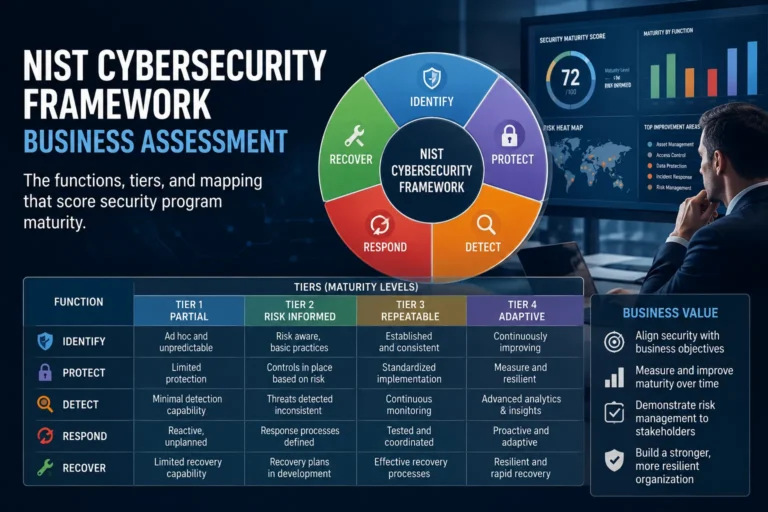
NIST CSF Maturity Scorecard

Visual maturity scoring across all NIST CSF function areas, designed for tracking progress over time and reporting to leadership in a recognized industry format.

Risk Heat Map

Visual heat map of identified risks plotted by likelihood and business impact, with severity ratings and prioritization guidance for leadership review.

Financial Risk Quantification

Dollar-denominated risk exposure analysis using the FAIR model, providing leadership with the financial baseline needed for defensible security investment decisions.

Prioritized Remediation Roadmap

Phased remediation plan with quick wins, mid-term initiatives, and strategic investments. Each item sequenced by risk reduction and effort, with budgetary guidance.

Quick Win Recommendations

Targeted recommendations that deliver meaningful risk reduction without major budget commitment, designed for immediate execution by your existing team.

Benchmark Comparison

Comparison of your maturity scoring against industry peers, providing context for board discussions and supporting positioning conversations with insurers and customers.

Insurer-Friendly Report

Optional version of the assessment report structured for direct use during cyber insurance underwriting, renewal, or claim conversations.

Why Armour Cybersecurity

The numbers behind the work.

Founded by military intelligence veterans with senior advisors from PwC, KPMG, Deloitte, EY, and Mandiant. The track record reflects the discipline.

260+

Clients Served

Organizations across finance, healthcare, technology, energy, legal, and government trust Armour Cybersecurity to protect what matters.

97%

Client Retention Rate

Long-term engagements built on consistent quality, predictable delivery, and consulting relationships that compound in value over time.

52+

Industries · Worldwide Reach

Cross-sector experience spanning every major regulated industry, with operations supporting clients across North America, Latin America, and beyond.

80+

Cybersecurity Technology Solutions

A vetted catalogue of technology partnerships and proprietary methods deployed in support of every engagement.

Ready to know your real cyber risk exposure in dollar terms?

Schedule a no-obligation Cyber Posture Assessment scoping conversation with our advisory team.

Schedule a Posture Assessment
Protecting What Matters.
Frequently Asked

Cyber Posture Assessment questions, answered directly.

How is this different from a penetration test?
A penetration test evaluates specific technical vulnerabilities by attempting to exploit them. A Cyber Posture Assessment evaluates the entire security program across governance, risk, compliance, technology, and operations. The two are complementary: penetration tests confirm whether specific technical controls hold up under attack, and posture assessments evaluate whether the broader program is mature enough to consistently produce strong technical controls in the first place.
How do you quantify risk in financial terms?
We use the FAIR model (Factor Analysis of Information Risk), an industry-standard methodology for cyber risk quantification, combined with threat intelligence data and organization-specific factors. The output is a defensible estimate of potential financial impact across the most material risk scenarios identified during the assessment. This allows leadership to compare cybersecurity spend against actual loss exposure rather than abstract severity scores.
What level of access do you need?
We need access to key stakeholders for interview workshops, documentation review, and observation of security operations. No invasive technical testing is performed during a posture assessment. The work is conducted primarily through structured interviews with leadership and management teams, supported by documentation review and security tool inventory.
How long does the assessment take?
Most engagements complete within four to six weeks. Scoping and stakeholder coordination take the first week, data collection and interviews take one to two weeks, analysis and maturity evaluation take one to two weeks, and roadmap development plus reporting take the final week. Larger or more distributed organizations may extend the timeline.
How often should this be repeated?
We recommend annual assessments with interim reviews after significant organizational changes such as M&A, major technology migrations, leadership changes, or material regulatory developments. The annual cadence creates a defensible year-over-year maturity record that boards, auditors, and insurers all value.
Can the results be shared with our insurer?
Yes. Many clients use our assessment to negotiate better cyber insurance terms. We produce an insurer-friendly version of the report on request that highlights the program rigor and control maturity insurers prioritize during underwriting. The same content also supports renewal negotiations and claim conversations.
Which frameworks do you align to?
Our assessment framework is aligned to leading industry standards including NIST Cybersecurity Framework, ISO 27001, CIS Controls v8, and COBIT 5. We discuss and agree the reference framework with you during scoping to ensure alignment with your specific industry, regulatory obligations, and customer requirements.
Get Started

Schedule your Cyber Posture Assessment scoping conversation.

Tell us about your organization and what is driving the conversation. We will respond within one business day with next steps.

Speak with our advisory team

Headquarters
77 Bloor St West, Suite 600
Toronto, ON

Request a consultation