By David Chernitzky, Co-Founder and CEO, Armour Cybersecurity | Serving organizations across Canada, the US, and beyond | Last updated August 18, 2026
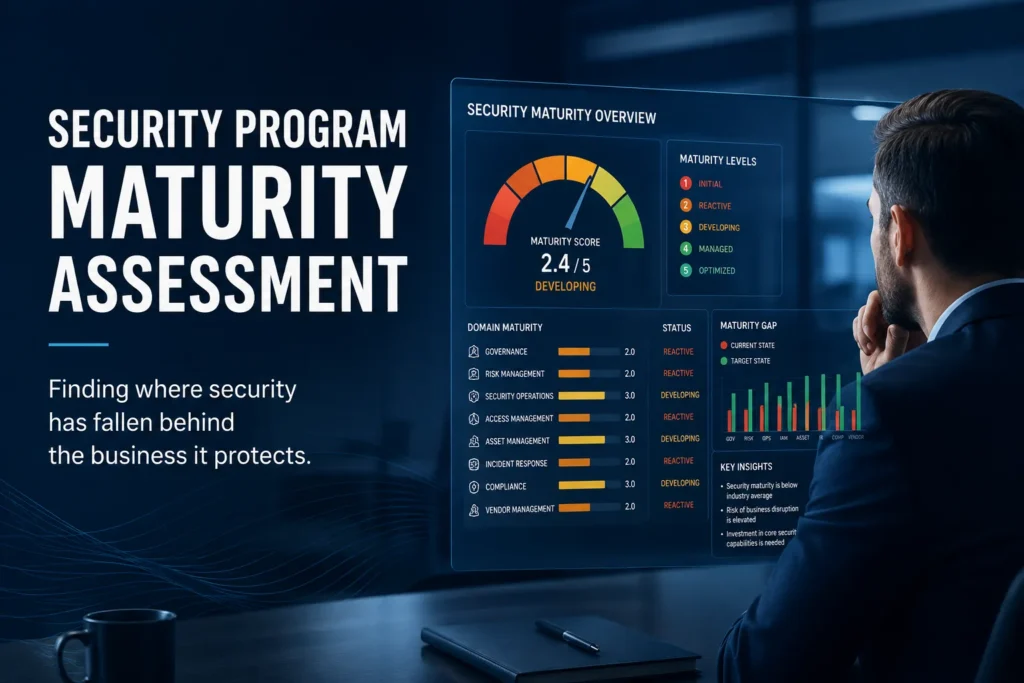
Quick answer: A security program maturity assessment exists because security programs fall behind the businesses they protect gradually and silently. Headcount grows, cloud platforms are added, customer data expands, and regulatory requirements change, while the security practices that worked at a smaller scale do not automatically scale with them. A cybersecurity posture assessment identifies where the gap has opened between your current security maturity and the risk exposure your current business creates, before that gap becomes a breach, a failed audit, or a lost deal.
Key Takeaways
- Business growth creates security risk in predictable ways: more employees mean more identity and access management complexity, more cloud services mean more configuration attack surface, more customer relationships mean more data handling obligations. Security programs that do not evolve with this growth leave compounding gaps.
- The most reliable signal that a security program has fallen behind is not a breach; it is the accumulation of smaller indicators: a compliance audit finding you did not expect, a customer security questionnaire you struggled to answer, an insurance renewal that required significant supplementary information.
- Security maturity is not self-evident. The team that runs the program is the least positioned to evaluate objectively whether it is adequate, because they live inside its assumptions. Independent assessment is the mechanism for getting an honest external view.
- Maturity scoring against the NIST Cybersecurity Framework provides a common language for discussing security program adequacy with executive leadership, the board, auditors, and insurers that internal metrics and tool lists do not provide.
- Quick wins identified in a posture assessment can reduce meaningful risk in weeks without large budget commitments. Many of the highest-impact improvements cost very little; they require process change and consistent enforcement more than significant technology investment.
Why Security Programs Fall Behind the Business
Security programs tend to be built for the organization as it exists at the time they are built. The identity and access management approach designed for fifty employees is often still running, largely unchanged, when the organization has grown to three hundred. The cloud security practices established when the organization used one cloud platform do not automatically extend to the five platforms added in the years since. The incident response plan written three years ago has not been updated to reflect the two acquisitions, the shift to remote work, or the new regulatory requirements that have materialized in the interim.
This is not negligence; it is organizational physics. Security teams are occupied managing current operations, responding to current threats, and addressing current compliance obligations. The systematic review that would identify how much the program has drifted from the business’s current risk profile requires dedicated time and an external reference frame that day-to-day operations do not provide. The result is a program that was adequate at some earlier point and has been maintained rather than evolved, leaving a widening gap between the risk the business actually faces and the capability the security program provides. Understanding that a cybersecurity posture assessment exists to measure exactly this drift is the first step to closing it.
The Warning Signs That the Gap Has Opened
The cybersecurity maturity gap rarely announces itself directly. It shows up as a set of smaller signals that are easy to explain away individually but form a clear pattern together.
Compliance findings you did not anticipate
When an external audit surfaces findings that the internal team did not identify, it indicates that the team’s view of the program’s adequacy differs from the auditor’s external standard. A single unexpected finding is a data point. A pattern of unexpected findings across successive audits is evidence that the program is not keeping pace with the compliance environment. The findings are symptoms; the underlying condition is a security program that has not evolved with the regulatory landscape that applies to the business.
Security questionnaire struggles
Enterprise customers, partners, and prospective clients increasingly send security questionnaires as part of procurement and onboarding processes. A security team that struggles to answer these questionnaires accurately and completely, or that provides answers the business cannot evidence with documentation, is signaling that the program does not match the maturity level the questionnaire assumes. Sales delays caused by inability to complete security questionnaires are a direct business cost that is easy to trace back to security program maturity, and they are the flip side of the gaps a vendor security questionnaire leaves when you are the one doing the assessing.
Insurance renewal friction
Cyber insurance underwriters ask increasingly detailed questions about security program maturity. An organization that answers these questions vaguely, that cannot demonstrate specific controls the underwriter expects, or that receives coverage limitations and higher premiums despite a clean loss history is receiving market feedback that its security program does not meet the current underwriting standard. This feedback is particularly useful because it is financially quantified: the premium difference between an organization that can demonstrate strong maturity and one that cannot is measurable and often significant, which is why cyber insurance advisory and posture work are so closely linked.
The team’s inability to answer the board’s question
When the board or audit committee asks “how exposed are we?”, the answer from a security program that has kept pace with the business is a financial range, a threat scenario analysis, and a maturity trajectory. The answer from a program that has not kept pace is typically a list of tools in place and controls maintained, which is not the same thing. A security team that cannot translate the program’s status into financial risk terms is missing the bridge between technical operations and governance language that a mature program provides.
What a Posture Assessment Finds in Programs That Have Fallen Behind
Organizations that commission a posture assessment after a period of growth without systematic security program evolution typically find the same categories of gap. Identity and access management has not scaled: privileged access is not consistently controlled, offboarding processes have gaps that leave former employees with residual access, and multi-factor authentication has been deployed inconsistently across systems. These are the exact issues a dedicated identity and privileged access management review surfaces. Data protection has not kept up with the volume and variety of data the business now handles: classification is informal, encryption is inconsistent, and backup and recovery arrangements have not been tested against the current data estate.
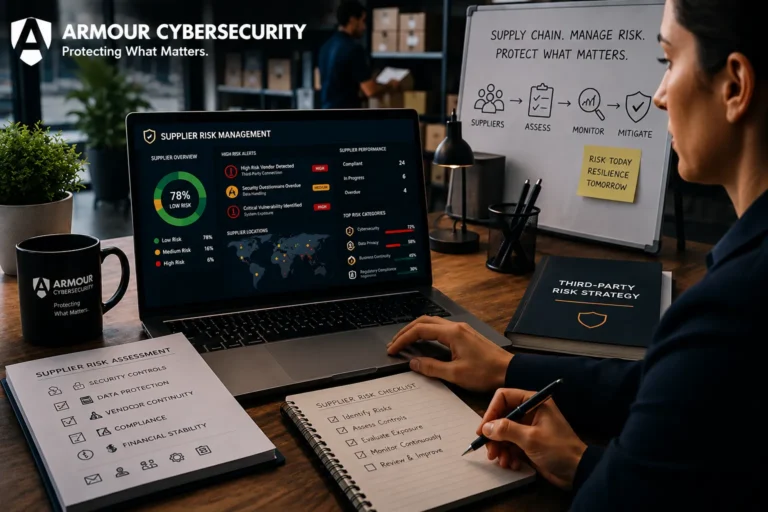
Third-party risk management has not expanded to cover the vendor relationships added during growth: the SaaS tools, managed service providers, and integration partners that now have access to systems or data have not been systematically reviewed, which is the whole purpose of a supplier risk management program. Incident response capability has not been updated: the plan was written for an earlier version of the organization and has not been tested against the current technology environment or the current regulatory notification obligations. And governance has not formalized: policies have not been reviewed since they were originally written, and the reporting and accountability mechanisms that connect security program status to executive and board oversight are informal or absent.
None of these gaps are unusual or surprising. They are the predictable result of growth without systematic evolution of the security program. What the posture assessment provides is a documented, independent account of exactly where the gaps are, how they rank by financial risk exposure, and what the prioritized sequence of remediation looks like. That documented account is the starting point for rebuilding the program to match the business it is meant to protect, which is exactly what a structured cyber posture assessment engagement is designed to produce.
What Closing the Gap Actually Looks Like
The remediation roadmap produced by a posture assessment sequences improvements by the combination of risk reduction impact and implementation effort. Quick wins are isolated for immediate execution: these are typically the highest-impact actions that require the least investment, often process improvements and configuration changes rather than new technology procurement. The quick win list from a typical posture assessment includes enforcing multi-factor authentication on all administrative and privileged accounts, implementing a formal offboarding process with access revocation verification, reviewing and updating the incident response plan, and establishing a third-party risk review process for the most critical vendor relationships.
Mid-term initiatives follow in the six-to-eighteen-month range, addressing the gaps that require more planning, budget, or organizational change: identity governance improvements, data classification and protection controls, cloud security configuration hardening, and detection and monitoring capability expansion. Strategic investments in the eighteen-month-to-three-year range address the architectural improvements that require the mid-term foundations to be in place first.
Frequently Asked Questions
How do we convince leadership to invest in a posture assessment if nothing has gone wrong?
The most effective framing is the forcing event that is already approaching. If a significant enterprise customer relationship is in the pipeline, an insurance renewal is coming, or the board has started asking governance questions that the team cannot answer fluently, each of these creates a concrete near-term need for the posture picture. The assessment is not a response to a crisis; it is preparation for a conversation that is coming regardless. The cost of the assessment is small relative to the cost of having that conversation without a documented, credible picture of where the program stands.
What if the assessment finds serious gaps we cannot immediately fix?
This is the normal outcome, not an alarming one. Most organizations that commission a posture assessment without prior systematic evaluation find meaningful gaps. The value of finding them through an assessment rather than through a breach, a failed audit, or a lost deal is that the assessment gives you time to address them in priority order with a documented plan. The prioritized roadmap tells you which gaps carry the most financial risk and should be addressed first. The quick win list gives you immediate actions that reduce risk without waiting for full remediation. Having found the gaps through assessment and responding with a documented plan is a governance position; having gaps surface through an incident is a crisis.
Can we run a posture assessment ourselves?
An internal team can conduct a structured self-assessment using the NIST CSF or another framework, and this is better than no assessment. The limitation is the same one that applies to all internal reviews: the team that runs the program is evaluating whether the program is adequate, without the external benchmarking that tells them what adequate looks like for an organization of their size and sector. Self-assessments tend to be generous in areas where the team has invested effort and blind to gaps they have not thought to look for. Independent assessment provides the external reference frame and the honest scoring that self-assessment cannot.
How do we select which frameworks to assess against?
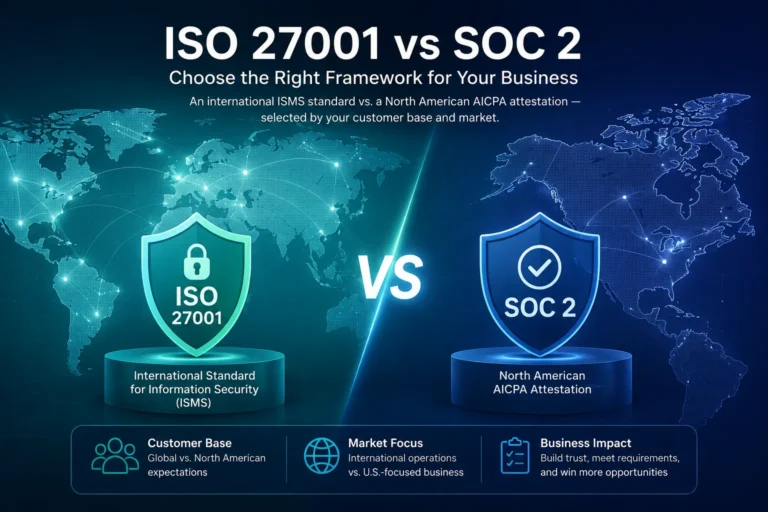
Framework selection depends on the organization’s regulatory profile, customer requirements, and strategic objectives. NIST CSF is the broadest and most widely recognized framework for general security program maturity assessment in North America, and it maps to most other frameworks, so it is a practical primary framework for most organizations. ISO 27001 is the relevant standard for organizations seeking certification or operating internationally. CIS Controls v8 provides more prescriptive guidance that is particularly useful for mid-market organizations building controls from the ground up. During the scoping conversation, the assessment team works through the regulatory and business context to confirm the right framework combination for the engagement.
What is a maturity score and how is it used?
A maturity score is a structured rating of how consistently and completely a security domain is implemented, ranging from initial or ad hoc practice at the low end to optimized, continuously improving capability at the high end. The NIST CSF uses implementation tiers that range from partial implementation to adaptive practice. Maturity scores are used in three ways: to provide a common vocabulary for communicating the program’s status to leadership, to create a baseline against which improvement is measured year over year, and to benchmark the program against industry peers at the same tier who provide a reference point for what the next maturity level looks like in practice.
The Bottom Line
Security programs do not fall behind the business all at once; they drift, quietly, while the team is busy keeping the current version running. The warning signs are rarely a breach. They are the unexpected audit finding, the security questionnaire you cannot answer cleanly, the insurance renewal that suddenly needs more from you, and the board question you can only answer with a list of tools. A cyber maturity evaluation through a structured cyber posture assessment turns that vague sense that you have outgrown your security program into a documented, ranked, and costed picture, with a roadmap that starts with quick wins you can act on in weeks. Finding the gap through an assessment is a governance position; finding it through an incident is a crisis.
About the author
David Chernitzky is Co-Founder and CEO of Armour Cybersecurity, a Toronto-based cybersecurity firm founded by military intelligence veterans and advised by senior leaders from PwC, KPMG, Deloitte, EY, and Mandiant. Armour serves more than 260 organizations across 52-plus industries, including finance, healthcare, technology, energy, legal, and government, with a 97 percent client retention rate.