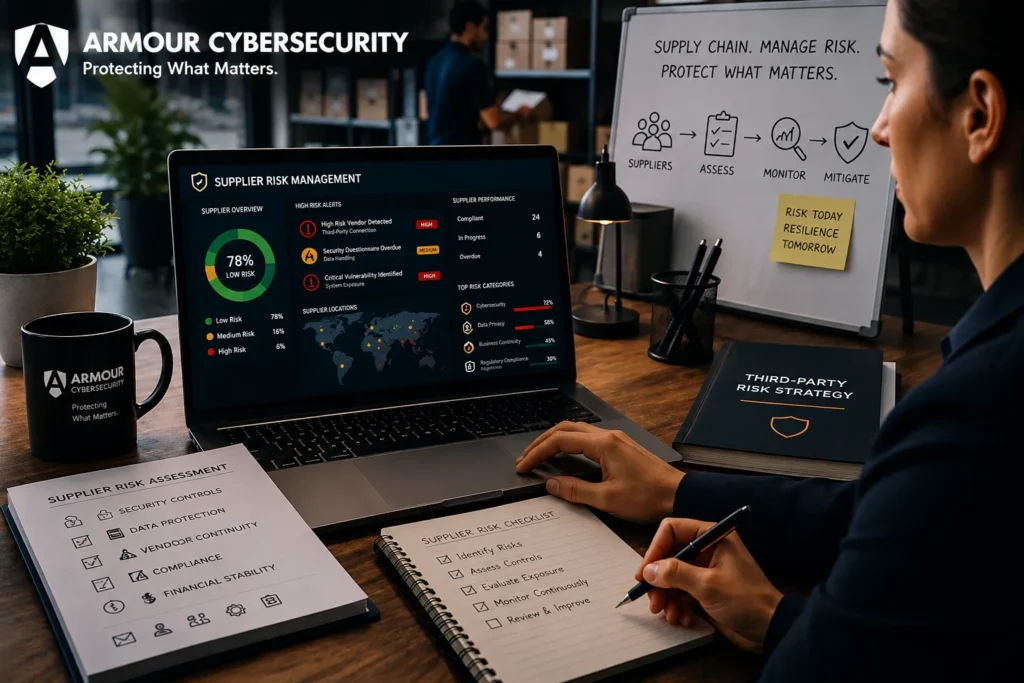
There is a category of security risk that most small and mid-sized businesses have not seriously addressed, not because they are unaware of it, but because it feels abstract and distant compared to the more immediate concerns of phishing, ransomware, and endpoint protection. That category is third-party risk: the exposure that comes not from attackers targeting your organisation directly, but from attackers who target the vendors, suppliers, and service providers who already have legitimate access to your systems.
The scale of this problem is significant. Industry data consistently places third-party and supply chain attacks as the origin point for a majority of serious data breaches. The reason is straightforward: attackers go where access is easiest. A well-defended organisation with mature security controls and a regular cybersecurity risk assessment process is a difficult target. That organisation’s payroll software provider, its managed IT support company, or its cloud backup platform may be a much easier one, and through that provider, the attacker gains access to every one of that provider’s clients simultaneously.
This is not a theoretical scenario. The pattern of large-scale supply chain attacks, where a single compromised vendor becomes the entry point for hundreds or thousands of downstream organisations, has repeated itself with regularity over the past several years. And the targets are not only enterprise companies. SMBs that use common business software, cloud platforms, and managed service providers are in exactly the same attack surface.
What Is Supplier Risk Management?
Supplier risk management is the practice of identifying, assessing, and managing the cybersecurity risks that arise from your organisation’s relationships with third parties. It covers the full population of vendors, suppliers, contractors, and service providers who have any form of access to your systems, data, or facilities, from major IT service providers to niche SaaS applications used by a single department.
The fundamental question it answers is: what can go wrong through this relationship, and what controls are in place to prevent or limit that outcome through an ongoing security risk assessment process? For each vendor relationship, this involves understanding what access the vendor has (systems, data, networks), what security controls the vendor has in place to protect that access, what your contractual rights are in the event of a security incident, and how you would know if the vendor’s systems were compromised and your data was affected.
For most SMBs, the honest answer to each of these questions is ‘we don’t know’, not because they are negligent, but because the practice of formally managing vendor security relationships is genuinely new to the mid-market, and the resources and frameworks available have historically been designed for enterprise-scale programmes. This is changing rapidly, as regulators, cyber insurers, and clients increasingly require evidence of supplier risk management as a condition of doing business.
Why Third-Party Risk Is Growing as a Security Priority
Several converging trends have elevated supplier risk management from a best practice to a near-necessity for SMBs.
The first is the expansion of the vendor ecosystem. The average mid-sized business today uses significantly more cloud-based software than it did five years ago. Each new SaaS application is a potential access point. Many of these applications have direct integrations with core business systems, connecting to email, calendar, customer data, or financial systems through OAuth grants and API keys that persist indefinitely. The attack surface from third-party software has grown at the same pace as software adoption.
The second is the maturation of supply chain attack techniques, making a comprehensive cyber risk assessment increasingly important for organisations that depend on third-party vendors. Attackers have learned that targeting a managed IT provider, a widely-used software platform, or a common business tool is more efficient than targeting individual organisations. The investment in compromising one supplier yields access to many clients. This efficiency has made supply chain attacks a preferred method for sophisticated criminal groups and state-sponsored actors alike.
The third is regulatory pressure. In Canada, PIPEDA and Bill C-26 establish accountability for the protection of personal information, including data held or accessed by third parties. In Quebec, Law 25 has introduced explicit third-party contractual requirements. In Chile, the new Ley 21.719 extends data protection obligations to encargados de tratamiento, the vendors and processors who handle data on behalf of the organisation. In Colombia and Peru, equivalent frameworks create similar obligations. Regulators are increasingly clear: ‘our vendor had poor security’ is not a defence, which is why strong governance risk and compliance practices are becoming a business requirement.
The fourth is cyber insurance. Insurers are incorporating supplier risk into underwriting questions with increasing specificity. Organisations that cannot demonstrate a structured approach to managing vendor security risk are facing coverage limitations or higher premiums as a direct consequence and may struggle with overall compliance readiness initiatives.
The Three Categories of Vendor Risk That Matter Most
Not all vendor relationships carry the same risk. Effective supplier risk management starts with categorising vendors by their risk profile, the combination of what they can access and what would happen if that access were compromised.
Tier 1: High-access, high-impact vendors
These are vendors with deep, persistent access to your core systems, your managed IT provider, your payroll platform, your primary cloud infrastructure provider, any vendor with administrative access to your network or key business systems. A compromise of any Tier 1 vendor is equivalent to a direct compromise of your environment. These relationships require the most rigorous assessment, the most specific contractual security requirements, and regular security reviews.
Tier 2: Moderate-access vendors
These are vendors who have access to specific systems or categories of data, your CRM platform, your accounting software, your HR system. A compromise creates meaningful exposure but is more bounded in scope than a Tier 1 incident. These relationships require documented security requirements and periodic review.
Tier 3: Low-access vendors
These are vendors with minimal or no access to sensitive systems or data, standard business software with no integration to core systems, generic services, and commodity tools. Basic security evaluation at onboarding is typically sufficient, with review triggered by material changes to the relationship.
The discipline of tiering is itself valuable, independent of the actions that follow. Most organisations that have never formally assessed their vendor relationships discover, in the process of categorisation, that several relationships they considered low-risk actually involve more access than they realised, a software tool that was originally a departmental experiment has been integrated with the CRM, or a contractor engagement that ended has left behind persistent system access.
Building a Supplier Risk Program That Scales for SMBs
A supplier risk programme does not need to be a compliance bureaucracy. For an SMB, a practical, effective programme has four components:
• Inventory: a complete and current list of all vendors with access to your systems, data, or facilities, including the nature and scope of that access.
• Tiering: a classification of each vendor by risk level, using criteria appropriate to your business context and risk appetite.
• Assessment: for Tier 1 and Tier 2 vendors, a documented evaluation of their security controls, either through a questionnaire, a review of their security certifications (SOC 2, ISO 27001), or direct engagement.
• Contractual requirements: standard security clauses in vendor contracts that establish minimum security requirements, breach notification obligations, and your rights to audit or terminate in response to a security failure.
The most common point of failure in SMB supplier risk programmes is the inventory step, not because it is technically difficult, but because the honest answer to ‘what vendors have access to our systems?’ often requires more investigation than expected. SaaS application sprawl, OAuth grants accumulated over years, and service provider relationships established before formal security processes were in place all contribute to an access landscape that is genuinely difficult to see without a structured effort to map it.
This is where a supplier risk assessment adds immediate value, not as a recurring bureaucratic process, but as a one-time mapping exercise that gives you the baseline visibility to start managing the risk systematically.
What Happens When a Vendor Is Breached?
Understanding your obligations and options in the event of a vendor security incident is part of effective supplier risk management and should be incorporated into broader incident response planning activities, and it is an area where many organisations have significant gaps.
From a regulatory perspective, if a vendor breach results in the exposure of personal data that your organisation is the data controller for, you likely have notification obligations, to the relevant regulator and potentially to the affected individuals. ‘The breach was at our vendor, not at us’ does not eliminate this obligation under most privacy frameworks.
From a contractual perspective, your ability to understand what happened, what data was affected, and what your vendor is doing about it depends entirely on the contractual terms you established before the incident. Without specific breach notification requirements, audit rights, and liability provisions in your vendor contracts, you may find yourself with limited information and limited recourse.
Reviewing your key vendor contracts through a security lens, not just a commercial one, is one of the highest-value activities an organisation can undertake as part of a supplier risk programme. Armour Cybersecurity includes contract review as a component of our supplier risk assessment, specifically examining breach notification timelines, security obligations, and audit rights.
To understand your current third-party risk exposure and begin building a practical supplier risk programme, visit armourcyber.io or contact the Armour Cybersecurity team.