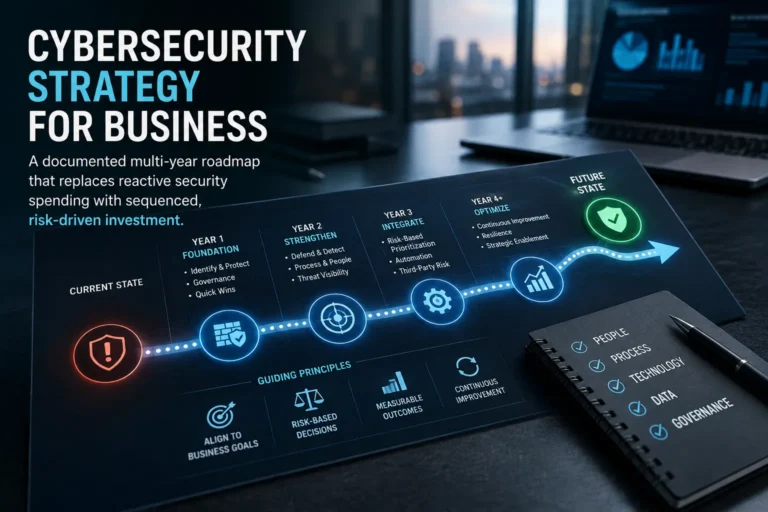
Turn cybersecurity from a reactive cost into a strategic business enabler.
A prioritized, multi-year cybersecurity strategy and roadmap that aligns every security investment with business objectives, risk appetite, and regulatory mandates. Built by military intelligence veterans and Big 4 advisors, delivered with the rigor that boards and audit committees expect.
A strategy that connects security to the business.
Most organizations spend on cybersecurity reactively. Tools get bought to chase the last incident, controls accumulate without a unifying architecture, and budgets are defended against finance rather than aligned with strategy. The result is coverage gaps, duplicated capability, and a security program that struggles to articulate its value to the board.
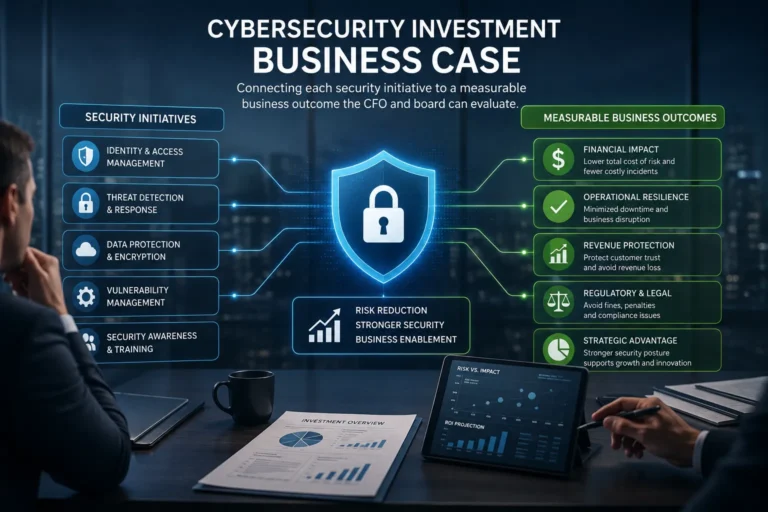
Armour Cybersecurity's Cyber Strategy & Roadmap Development service replaces reactive spending with a deliberate, multi-year plan. The engagement begins with a comprehensive assessment of the current posture, threat landscape, regulatory profile, and business context. It then defines a target-state architecture, a security maturity model, and a sequenced roadmap that maps every initiative to a risk reduction outcome, a business objective, and a measurable KPI.
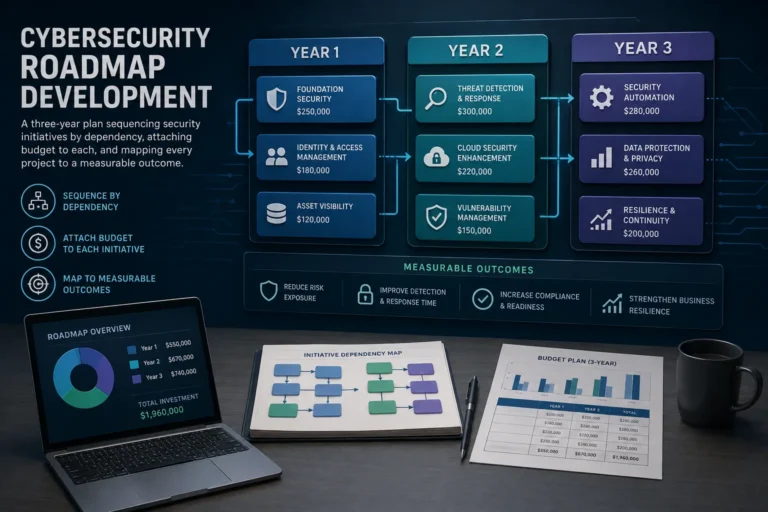
Each initiative carries its own budget projection, resource requirements, and dependencies, so leadership can make informed investment decisions and report progress with confidence. The deliverable is an execution-ready plan, not a strategy deck that sits on a shelf.
Reactive spending vs. strategic investment.
The difference between a cybersecurity program that protects the business and one that consumes budget without measurable return often comes down to whether a real strategy exists. Compare the two postures.
Tool sprawl, coverage gaps, and a budget that can't be defended.
Security investments are made in response to the last audit finding, the last vendor pitch, or the last incident. There is no target-state architecture, no maturity baseline, and no way to demonstrate that the program is moving forward. Compliance work is duplicated across frameworks. The board asks what the company is getting for its security spend and nobody has a clean answer. New initiatives stall because they cannot be sequenced against existing commitments.
A multi-year roadmap that every stakeholder can defend.
The engagement produces a documented current-state baseline, a target-state architecture, a maturity gap analysis, and a three-year sequenced roadmap with annual budget projections. Every initiative is tied to a business outcome, a risk reduction metric, and a framework control mapping. Quick wins are surfaced for execution in the first ninety days. The KPI framework feeds quarterly governance reporting after the engagement ends, so the strategy stays measurable.
What the engagement covers.
Nine domains assessed and integrated into a single strategic plan. Each domain is mapped to the selected framework, scored against the maturity model, and sequenced into the roadmap with budget and KPI attachment.
Security Governance & Operating Model
Review of policies, governance committees, reporting cadence, and the operating model that connects security leadership to executive and board oversight.
Risk Management & Appetite
Documentation of risk appetite, top enterprise cyber risks, treatment decisions, and the methodology used to escalate residual risk to leadership.
Target-State Security Architecture
Reference architecture defining the security capabilities required to support the business over the planning horizon, mapped to the selected framework.
Maturity Model & Gap Analysis
Tiered maturity assessment across each control domain, with current-state and target-state scoring and a documented gap that drives the roadmap.
Identity, Access & Zero Trust
Strategic direction for identity governance, privileged access, authentication modernization, and the zero trust architecture that supports them.
Security Operations & Detection
Roadmap for detection coverage, monitoring, incident response capability, and the operating model for the security operations function over the planning horizon.
Data Protection & Privacy
Strategy for data classification, encryption, loss prevention, and privacy program alignment with regulations including PIPEDA, GDPR, and sector-specific mandates.
Resilience & Third-Party Risk
Strategic direction for business continuity, incident response readiness, crisis communications, and the third-party risk program that protects the supply chain.
Compliance & Regulatory Alignment
Mapping of roadmap initiatives to the regulatory and certification objectives that matter most to the organization, including SOC 2, ISO 27001, HIPAA, and PCI DSS.
Who this engagement is for.
Built for leaders accountable for cybersecurity investment, board reporting, and the multi-year direction of the security program.
CISOs & Security Directors
Leaders who need a documented, defensible strategy to align their teams, defend their budgets, and report progress to executive and board stakeholders with confidence.
CIOs, CTOs & VPs of IT
Technology executives who own cybersecurity by default and need a partner to build the strategic plan that converts ad-hoc security spending into a measurable program.
CFOs & Audit Committees
Finance and oversight leaders who need cyber investment to be traceable, sequenced, and tied to business outcomes rather than reactive vendor procurement.
Growth-Stage & PE-Backed Companies
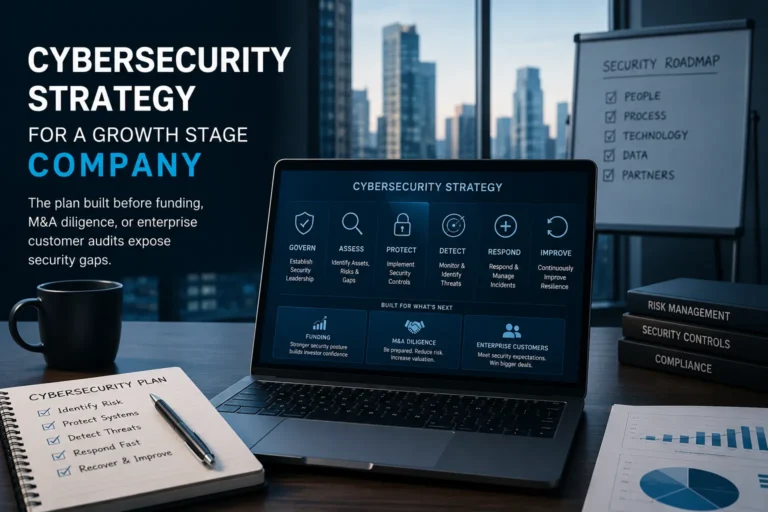
Organizations preparing for funding rounds, audits, M&A diligence, or rapid scale, where a formalized cybersecurity strategy becomes a precondition for the next phase.
A disciplined methodology across six phases.
Six to eight weeks, structured into three engagement phases and six execution stages. Informed by NIST CSF, ISO 27001, CIS Controls, COBIT 5, and MITRE ATT&CK, and delivered by a team with military intelligence and Big 4 consulting heritage.
Kickoff & Stakeholder Alignment
Scope confirmation, stakeholder map, access setup, and alignment on business objectives, risk appetite, and the regulatory landscape that will shape the strategy.
Discovery & Documentation Review
Structured interviews with executive, IT, and business stakeholders. Review of policies, architecture diagrams, audit reports, prior assessments, and incident history.
Current-State Assessment
Technical and governance analysis of the existing security program. Maturity scoring against the selected framework. Identification of gaps, redundancies, and quick wins.
Target-State & Strategy Formulation
Definition of the target-state architecture, the maturity model, and the strategic principles that will guide investment decisions over the planning horizon.
Roadmap, Budget & KPI Design
Construction of the three-year roadmap with quarterly execution phases. Each initiative receives a budget line, owner, dependency map, and measurable KPI.
Executive Delivery & Knowledge Transfer
Final report, board-ready executive summary presentation, and a knowledge transfer session that prepares internal teams to operate the strategy after engagement close.
What you walk away with.
Nine integrated deliverables that together form an execution-ready strategic plan. Every artifact is built to survive board review and feed quarterly governance after the engagement ends.
Current-State Security Assessment Report
Comprehensive baseline of the existing security posture across governance, architecture, operations, and compliance, scored against the selected framework.
Target-State Architecture Document
Reference architecture defining the capabilities, controls, and operating model required to support business objectives over the planning horizon.
Security Maturity Model & Gap Analysis
Tiered maturity scoring across every control domain, with current-state versus target-state visualization and the documented gap that drives the roadmap.
Three-Year Prioritized Roadmap
Sequenced roadmap with year-one initiative detail, year-two and year-three program sequencing, and quarterly execution phases aligned with business cadence.
Annual Budget Projection
Multi-year budget model that attaches capital, operating, and resource estimates to every initiative on the roadmap, ready for finance integration.
Quick Win Recommendations
Isolated playbook of high-impact, low-effort actions that can be executed within the first ninety days to demonstrate immediate program momentum.
KPI & Metrics Framework
Quantitative measurement framework that connects each initiative to a business outcome and feeds quarterly governance reporting after engagement close.
Executive Summary Presentation
Board-ready presentation that translates the strategy into the language of business risk, investment return, and competitive advantage for executive review.
Initiative Business Case Library
Modular business case template for each roadmap initiative, structured to support internal funding requests, vendor evaluations, and audit committee inquiries.
The numbers behind the work.
Founded by military intelligence veterans with senior advisors from PwC, KPMG, Deloitte, EY, and Mandiant. The track record reflects the discipline.
Clients Served
Organizations across finance, healthcare, technology, energy, legal, and government trust Armour Cybersecurity to protect what matters.
Client Retention Rate
Long-term engagements built on consistent quality, predictable delivery, and consulting relationships that compound in value over time.
Industries · Worldwide Reach
Cross-sector experience spanning every major regulated industry, with operations supporting clients across North America, Latin America, and beyond.
Cybersecurity Technology Solutions
A vetted catalogue of technology partnerships and proprietary methods deployed in support of multi-year cybersecurity strategy and roadmap execution.
Ready to align cybersecurity with the business plan?
Schedule a fifteen-minute discovery call to scope the engagement. Protecting What Matters starts with a strategy worth defending.
Book Discovery CallFrequently asked questions.
Common questions from CISOs, CIOs, and audit committees evaluating a strategy and roadmap engagement.
How is a cyber strategy and roadmap different from a risk assessment or gap analysis?
How long does a Cyber Strategy & Roadmap engagement take?
Which frameworks inform the strategy and roadmap?
What time horizon does the roadmap cover?
Who should be involved on the client side?
Does the engagement include implementation of the roadmap?
How does the roadmap connect to budget and board reporting?
Build the strategy that protects what matters.
Reach out to scope a Cyber Strategy & Roadmap engagement. Discovery calls are scheduled within two business days.
Talk to Armour Cybersecurity.
Toronto, ON, Canada
Request a discovery call.
Tell us about the organization and strategic priorities. A senior consultant will respond within two business days.