By David Chernitzky, Co-Founder and CEO, Armour Cybersecurity | Serving organizations across Canada, the US, and beyond | Last updated August 19, 2026
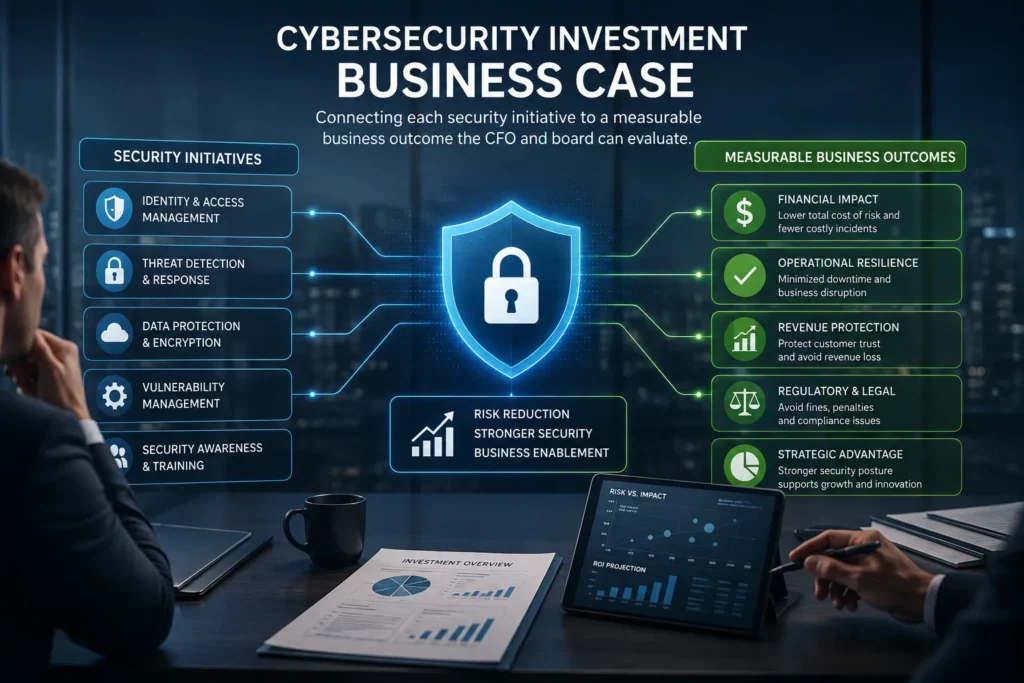
Quick answer: A cybersecurity investment business case connects each security initiative to a specific, measurable business outcome, so it is funded on merit rather than fear and defended with numbers rather than technical jargon the budget committee cannot evaluate. Every initiative serves one of four purposes: it reduces a quantified risk, enables a compliance or certification objective, protects a revenue-generating or operationally critical capability, or improves the efficiency of the security function itself. Naming which purpose an initiative serves, and attaching a measurable outcome to it, is what turns the security budget conversation from a negotiation into a business case the CFO and board can actually assess.
Key Takeaways
- Every cybersecurity initiative exists for one of four reasons: it reduces a specific risk, it enables a compliance or certification objective, it protects a revenue-generating or operationally critical business capability, or it improves the efficiency of the security function itself. The business case for each initiative should clearly state which of these it serves and with what measurable outcome.
- Risk reduction is the most common and most defensible basis for security investment. Quantifying the risk reduction, using financial terms such as expected loss reduction rather than maturity score improvement, gives finance and the board the language they need to evaluate the investment.
- Compliance investments are often under-rationalized. Organizations that connect compliance work to the specific regulatory obligations it satisfies, the revenue relationships it protects, or the audit findings it remediates have a stronger business case than those that cite compliance as a self-evident justification.
- The security budget conversation changes from adversarial to collaborative when finance can see a three-year roadmap with initiative-level business cases rather than an annual line-item request without strategic context.
- KPIs that measure business outcomes, not just security activity, are the mechanism through which investment effectiveness is demonstrated after the fact. Activity metrics tell you what the security team did. Outcome metrics tell you whether it made a difference.
Why Security Investments Fail to Get Funded
Security investment requests frequently fail in budget cycles not because the need is absent but because the business case is not built in the language the decision-makers use. A request that says “we need to implement privileged access management to improve our identity security posture against credential-based attacks” is asking a CFO to evaluate a technical assertion using technical criteria. Most CFOs cannot evaluate whether privileged access management is the right tool for the problem, whether the price is appropriate, or whether the problem it addresses is material enough to warrant the investment relative to other competing priorities.
The same request built as a business case reads differently: “Credential compromise is one of the most common initial access vectors in breaches year after year, and our current architecture provides no privileged access controls across our production systems. Implementing privileged access management for all production administrators reduces our expected annual loss from credential-based intrusion by an estimated $X, at a first-year implementation cost of $Y and an ongoing annual cost of $Z. The control also satisfies a specific requirement in our SOC 2 Type II audit scope.” The CFO can now evaluate proportionality, understand the risk context, and compare the investment against the alternatives.
The difference is not the underlying need, which is identical in both versions. The difference is that the second version supplies a threat frequency the decision-maker can sanity-check, an expected loss figure, a cost, and a compliance tie-in. Where a precise industry statistic genuinely strengthens the case, cite it with its source and year rather than a bare number, because a figure a board member can trace is persuasive and a figure they cannot is a liability the moment someone asks where it came from.
The Four Business Cases for Security Investment
Risk reduction
Risk reduction is the primary and most broadly applicable business case for security investment. The investment reduces the probability or impact of a specific threat scenario that would otherwise cause financial harm to the organization. The strength of a risk reduction business case depends on the quality of the risk quantification: a business case that can express the expected annual loss from the threat scenario being addressed, and the estimated reduction in that loss attributable to the investment, is substantially stronger than one that argues in qualitative terms.
Risk quantification for business cases does not require elaborate modeling. For many initiatives, a straightforward calculation works: the threat scenario, the probability of occurrence per year, the expected cost per occurrence, the estimated reduction in probability or impact attributable to the control, and the resulting expected loss reduction compared to the cost of the control. This structure gives the CFO and board a return-on-investment framing for a security control, the same language they apply to capital investment decisions in every other part of the business. A live security risk register that ranks exposures by likelihood and impact is what feeds this calculation, so the quantification traces back to a documented, maintained view of the organization’s actual risk rather than a number invented for the budget meeting.
Compliance enablement
Compliance investment protects the organization’s ability to operate in regulated markets, maintain certifications that customers require, and satisfy regulatory obligations that carry financial penalties for non-compliance. The business case for compliance investment is the cost of non-compliance: the regulatory fine, the lost contract, the failed audit, the certification withdrawal. Organizations that treat compliance as a self-evident justification for security investment miss the opportunity to quantify what non-compliance actually costs, which is typically much larger than the cost of the compliance program.
Compliance investment also frequently delivers security value beyond the compliance objective itself. An ISO 27001 implementation that satisfies a customer’s vendor security requirement also builds the control framework that reduces the organization’s broader attack surface. A SOC 2 program that satisfies a SaaS customer’s due diligence requirement also produces the audit evidence that supports the organization’s cyber insurance renewal and demonstrates the security posture that the board is responsible for overseeing. Connecting these compounding benefits to the compliance investment strengthens its business case beyond the direct cost-of-non-compliance calculation.
Business capability protection
Some security investments are justified not primarily as risk reduction or compliance but as protection for a specific revenue-generating or operationally critical business capability. The business case asks: what is the financial consequence if this capability is disrupted or destroyed by a security failure, and what does it cost to protect it to the standard that consequence warrants? This framing is particularly relevant for organizations whose core operations depend on technology availability, including SaaS businesses, financial services firms, healthcare providers, and manufacturers with connected production systems.
Business capability protection investment is often the most immediately compelling to business leaders outside the security function because it is expressed in terms of their own operational priorities. A CFO who is indifferent to abstract security posture improvements tends to be very interested in what would happen to quarterly revenue if the payment processing system were unavailable for three days. Building the security case for business continuity and resilience investment on the operational disruption scenario rather than the abstract threat vector changes the audience from a skeptical budget committee to engaged executive stakeholders with a stake in the outcome.
Operational efficiency
A smaller but meaningful category of security investment is justified by operational efficiency: the investment consolidates tools, reduces manual processes, improves analyst productivity, or eliminates operational overhead that currently consumes more resource than it is worth. Tool rationalization is a common example: an organization with twenty security tools many of which overlap in function can often achieve better detection coverage with fewer, better-integrated tools at lower total cost. The business case for rationalization is the avoided cost of the tools being eliminated plus the productivity improvement from the reduced operational overhead, net of the cost of the replacement capability.
Building the Business Case Library
A well-structured cyber strategy and roadmap engagement produces a business case library: a modular set of business cases for each roadmap initiative, each built to the same standard and each containing the four elements a decision-maker needs to evaluate the investment. The four elements are the problem the initiative addresses (the specific threat scenario, compliance gap, or capability vulnerability), the proposed solution (the initiative scope and approach), the expected outcome expressed in measurable terms (risk reduction in dollar figures, compliance objective satisfied, capability availability improved), and the cost-benefit summary (implementation cost, ongoing cost, and the financial value of the outcome).
The business case library serves multiple functions beyond the initial budget approval. When the annual budget cycle comes around, the roadmap initiative is supported by a documented business case rather than requiring reconstruction from memory. When a new CFO, board member, or audit committee chair asks why a specific investment was made, the business case provides the answer. When an incident occurs that was addressed by a roadmap initiative still awaiting funding, the business case demonstrates that the risk was identified and quantified before the incident, which is a governance record rather than a post-hoc justification. This is also where the business case library connects back to board cyber governance: the same initiative-level cases that justify spend to finance are the artifacts that let the board exercise real oversight of the security program rather than receiving status updates it cannot evaluate.
Frequently Asked Questions
How precise do the financial figures in a security business case need to be?
They need to be honest about uncertainty, not false precision. A business case that presents a single expected loss figure without acknowledging the range of assumptions underlying it is epistemically dishonest and vulnerable to challenge when those assumptions are questioned. A business case that presents a range of $800,000 to $2.4 million in expected annual loss, explains the assumptions driving the range, and acknowledges that the estimate is based on industry data rather than historical loss experience at this specific organization, is both more honest and more credible. Decision-makers generally understand that financial projections involve uncertainty. What they do not tolerate well is discovering that certainty was claimed where none existed.
What metrics should we use to measure security investment effectiveness?
Effectiveness metrics operate at two levels. Execution metrics track whether the initiative was delivered as planned: on time, on budget, and to scope. Outcome metrics track whether the delivered capability is producing the risk reduction, compliance, or operational result it was designed for. Outcome metrics for risk reduction might include mean time to detect an intrusion, percentage of critical assets with monitoring coverage, or the trend in security incidents by category. Outcome metrics for compliance might include audit finding trends, control testing pass rates, or regulatory submission timeliness. The key principle is that outcome metrics measure what happened in the business, not what the security team did.
How do we handle security investments that are hard to quantify?
Some security investments resist clean financial quantification. Governance improvements, policy programs, and cultural change initiatives do not produce easily modeled loss reductions. The approach for these investments is to be clear about what they enable rather than forcing an imprecise financial calculation: “This governance program creates the policy framework that our SOC 2 audit scope requires, enables the board governance reporting that satisfies our regulatory disclosure obligations, and provides the documented risk management process that our cyber insurance renewal requires.” These enabling outcomes are real and valuable even when they do not reduce to a single dollar figure.
How do we present security investment to a board that has no technical background?
Present risk, not technology. A board that does not understand endpoint detection and response as a technology concept understands very clearly that the organization’s top three threat scenarios could produce losses in the range of $2 million to $8 million, that the detection improvement being proposed reduces the probability of those scenarios reaching full impact by an estimated 40 percent, and that the investment costs $180,000 in year one and $90,000 per year thereafter. The technical solution is the mechanism; the risk and financial framing is the governance language. The executive summary presentation in a strategy and roadmap engagement is specifically designed to make this translation for board consumption.
Can a small organization afford to build proper business cases for security initiatives?
The investment in business case development scales with organizational size. A small organization with three to five security initiatives per year can build adequate business cases in a few hours per initiative using a structured template. The return on that investment is a security budget that is funded based on demonstrated business value rather than defended against skepticism, a CFO who understands what the security program is trying to achieve, and an audit trail of investment rationale that serves both governance and accountability purposes. The cost of not building business cases is security spending that cannot be defended, controlled, or measured. Where a full-time security leader is not available to own this, a virtual CISO can build and maintain the business case library and carry it into the board conversation.
The Bottom Line
A security investment that cannot be tied to a business outcome gets funded on fear and defended with jargon, which is why it is the first line cut when budgets tighten. The fix is to name, for every initiative, which of the four purposes it serves, reduce a quantified risk, enable a compliance objective, protect a critical business capability, or make the security function more efficient, and then attach a measurable outcome and a cost to it. Risk reduction expressed as expected loss, compliance expressed as the cost of non-compliance, capability protection expressed as the revenue at stake, efficiency expressed as avoided cost: these are the terms a CFO and a board already use for every other investment decision. Build each case to the same four-part standard, keep them in a library that survives a change of CFO or a surprise audit question, and the budget conversation stops being a negotiation. A structured cyber strategy and roadmap engagement produces that business case library as a standard deliverable, so every dollar of security spend carries a justification the business can evaluate.
About the author
David Chernitzky is Co-Founder and CEO of Armour Cybersecurity, a Toronto-based cybersecurity firm founded by military intelligence veterans and advised by senior leaders from PwC, KPMG, Deloitte, EY, and Mandiant. Armour serves more than 260 organizations across 52-plus industries, including finance, healthcare, technology, energy, legal, and government, with a 97 percent client retention rate.