How Cyber Simulation Exercises Satisfy Auditors and Insurance Carriers
Aug 7, 2026
SOC 2, ISO 27001, NIST CSF, and cyber insurance carriers all want proof of tested incident response. See what cyber simulation exercise...


Facilitated, scenario-based cyber tabletop exercises that pressure-test executive decision-making, incident response playbooks, communications discipline, and cross-functional coordination. Realistic scenarios, controlled environment, formal after-action report, and a prioritized roadmap of improvement opportunities.
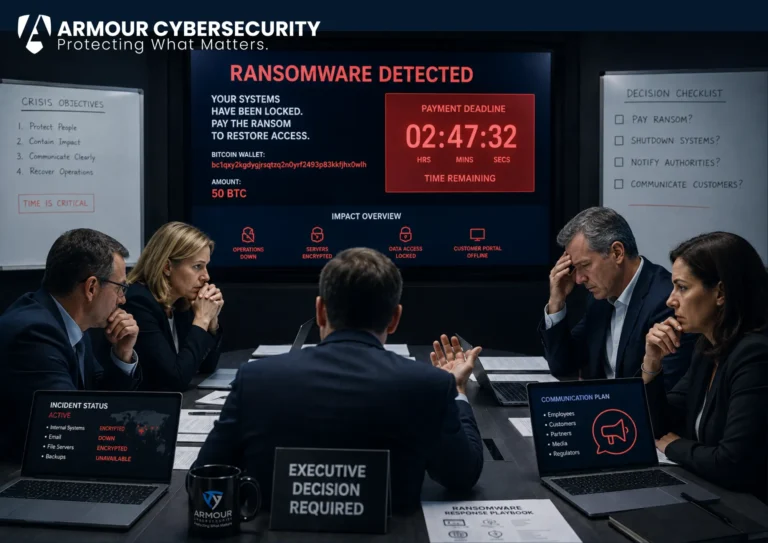
Every organization has an incident response plan. Few have ever exercised it under pressure. When a real ransomware event, business email compromise, or data exposure hits, decisions get made by people who have never made them together before, against a clock, with imperfect information, and with material legal, regulatory, and reputational consequences on every choice. The plan was written in a calm room; the response happens somewhere else.
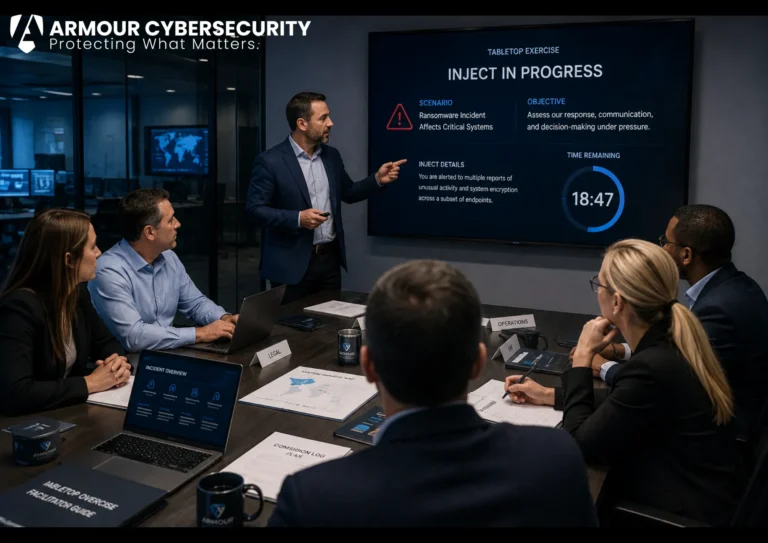
Armour Cybersecurity's Cyber Simulation Exercises close that gap. A senior facilitator walks the executive team, IT, legal and privacy, communications, and operations through a realistic scenario designed around the organization's actual threat profile and business model. Injects escalate the situation in real time. Participants make decisions, debate trade-offs, and surface the gaps between what the plan says and what would actually happen. The facilitator captures observations, the team builds shared muscle memory, and the after-action report turns the experience into a prioritized roadmap of action items.
Engagements include the formal independent security assessor's report typical of executive tabletops, suitable for board distribution, audit evidence, and cyber insurance underwriter review. Scenarios are technology-agnostic and tailored to the organization, drawing from a library that covers ransomware with exfiltration, business email compromise, cloud storage exposure, third-party breach, insider threat, and other patterns that match the threat landscape.
The difference between organizations that recover gracefully from a major cyber event and those that compound the crisis through poor decisions usually comes down to whether the response team has actually worked together under realistic pressure before.
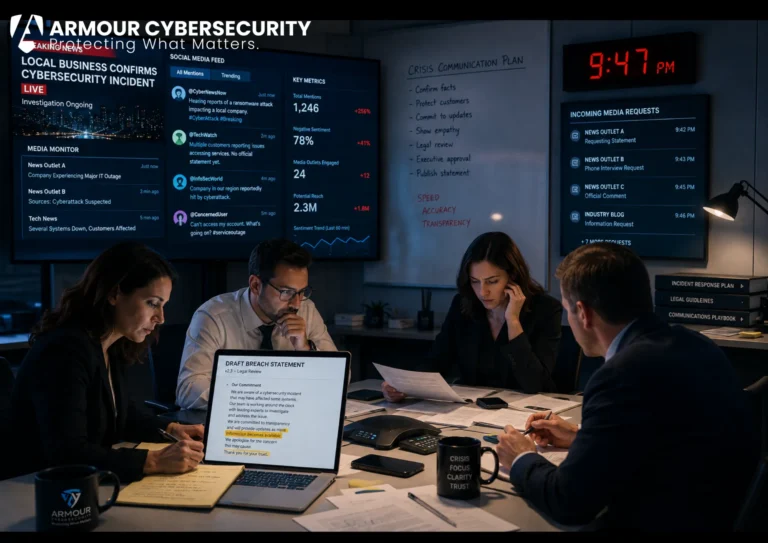
When the call comes in, the executive team is figuring out who has decision authority, what the insurance broker's after-hours number is, whether legal counsel has been retained, and what the communications team should say while leadership debates whether this is an "incident" or a "breach." Evidence handling improvises. Board notification thresholds are guessed at. The IR plan is twenty pages long and nobody can find the part that applies. The first hour is lost. Stakeholder trust erodes from the first public statement onward.
The exercise puts the right people in the room with a realistic scenario. Decision authority gets exercised, not theorized. Communications discipline is tested when the team is under pressure to say something. Escalation paths are walked, not just diagrammed. The facilitator captures every observation. The after-action report documents what worked, what surfaced, and what needs to be fixed before the real event arrives. Cyber insurance underwriters and auditors get evidence the organization actually exercises its response capability.
Nine response domains exercised across the scenario timeline. Each domain reflects a real failure mode observed in the cyber events organizations are most likely to face.
Validation that the IR plan can be located, understood, and executed under pressure. Tests the activation path, escalation triggers, and the moment when discretion becomes formal incident response.
Pressure-tests strategic decisions including business continuity priorities, ransom negotiation principles, board notification, regulatory disclosure, and operational shutdown decisions under time and information pressure.
Surfaces whether decision ownership is clear across executive leadership, legal/privacy, IT/security, communications, business continuity, and Board notification, or whether decisions get made collectively without clear accountability.
Tests the team's ability to communicate accurately under pressure: distinguishing "incident" from "breach," controlling internal messaging, drafting external statements, managing stakeholder questions, and avoiding speculation.
Tests the first-hour activation of cyber insurance carrier, breach counsel, external forensic responders, and PR support. Validates contact paths, contract readiness, and who initiates what call when.
Exercises operational fallback procedures: manual workarounds, fallback communications channels, prioritization of customer-facing services, and the decisions required when core systems are unavailable for extended periods.
Tests the tension between rapid containment and forensic evidence preservation. Validates that internal actions do not compromise chain of custody before external specialists arrive.
Surfaces obligations to partners, product providers, regulators, and contractual counterparties. Tests whether notification timelines and requirements can be determined under incident pressure.
Tests Board notification thresholds, executive update cadence, and the information executives need to brief governance bodies during a fast-moving event with material reputational and regulatory consequences.
Built for organizations that have invested in incident response capability and now need to validate that the people, the playbooks, and the relationships actually work together under pressure.
Boards and C-suite leaders accountable for cyber risk oversight who need to test executive decision-making, board escalation thresholds, and the governance posture they would actually demonstrate during a material event.
Finance, healthcare, legal, government, and other regulated organizations with documented IR obligations, where regulators, auditors, and cyber insurance carriers expect documented evidence of exercised response capability.
Companies in cyber insurance application or renewal cycles where carriers now expect documented evidence of tabletop exercises, IR plan testing, and exercised response capability as part of underwriting due diligence.
Organizations that have experienced a real incident and need to rehearse the lessons learned, validate updated playbooks, and build muscle memory across new processes before the next event puts them to the test.
The engagement runs four to six weeks across six structured phases. Two to three weeks of scenario design and preparation. A live half-day session. Two to three weeks of after-action analysis and report production.
Review of incident response plan, playbooks, prior incident reports, organizational structure, business model, and threat profile. Establishes the context against which the scenario will be designed.
Custom scenario crafted around the organization's industry, infrastructure, and stress points. Detailed inject library prepared with timed escalations, evidence artifacts, and the decision questions each inject will trigger.
Objectives confirmed (IR plan testing, communications validation, decision ownership, etc.), roles assigned to participants based on real-world counterparts, ground rules established for the live session.
Scenario presented, injects introduced on schedule, decisions made and debated, communications drafted under pressure. Facilitator captures observations across response, communications, coordination, and decision quality.
Immediate post-exercise debrief with all participants to capture initial takeaways, confirm observations, and surface lessons learned while the experience is fresh. Documented for inclusion in the after-action report.
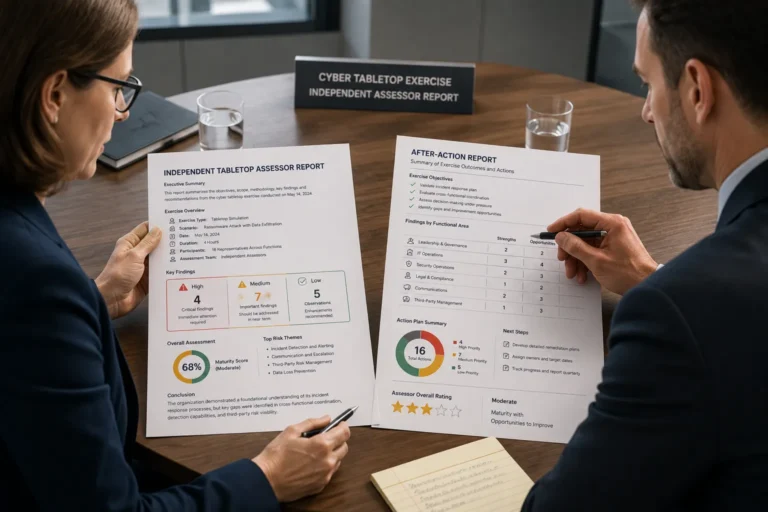
Formal after-action report covering key responses (what worked), key observations (what surfaced), and key opportunities of improvement (prioritized recommendations). Independent security assessor report suitable for board, audit, and insurer review.
Nine integrated deliverables that together turn a half-day exercise into a sustained improvement program. Every artifact is built to support board reporting, audit evidence, and direct action by internal teams.
Tailored scenario crafted around the organization's industry, infrastructure, and threat profile, with a timed inject library that escalates the situation and triggers specific decision points.
Formal independent assessor's report covering the exercise design, conduct, findings, and an external attestation suitable for board distribution, audit evidence, and cyber insurance underwriter review.
Three to four hour facilitated session covering one to three scenarios, with senior consultants leading the exercise, capturing observations, and managing the flow of injects against the engagement objectives.
Comprehensive after-action report documenting key responses, key observations, and key opportunities of improvement, with executive summary and detailed findings across each exercised response domain.
Prioritized roadmap of improvement opportunities with recommended owners, suggested timelines, and dependencies, designed for direct execution by internal teams after the exercise concludes.
Board-ready executive summary translating exercise outcomes into governance language, with strategic implications and the high-priority actions executives are being asked to sponsor.
Specific updates recommended to the IR plan based on observed gaps, including escalation triggers, decision authority, playbook content, and first-hour activation runbook improvements.
Recommended map of decision ownership across incident command, legal/privacy escalation, communications approval, insurer engagement, business continuity decisions, and board notification authority.
Recommended pre-approved communications templates and escalation guidance for internal staff, customers, partners, board notifications, media holding statements, website notices, and call center scripts.
Founded by military intelligence veterans with senior advisors from PwC, KPMG, Deloitte, EY, and Mandiant. The track record reflects the discipline.
Organizations across finance, healthcare, technology, energy, legal, and government trust Armour Cybersecurity to protect what matters.
Long-term engagements built on consistent quality, predictable delivery, and consulting relationships that compound in value over time.
Cross-sector experience spanning every major regulated industry, with operations supporting clients across North America, Latin America, and beyond.
A vetted catalogue of technology partnerships and proprietary methods deployed in support of scenario design, exercise facilitation, and post-exercise program development.
Schedule a fifteen-minute discovery call to scope a tabletop exercise. Protecting What Matters starts with knowing the team can execute under pressure.
Book Discovery CallCommon questions from CEOs, General Counsel, CISOs, and board members evaluating a Cyber Simulation Exercise engagement.
Reach out to scope a Cyber Simulation Exercise. Discovery calls are scheduled within two business days.
Tell us about your organization, the scenarios you want to test, and what success looks like. A senior advisor will respond within two business days.
Tabletop and simulation insights for teams that want to rehearse the incident before it happens.