Cyber Insurance Claim Documentation: What Carriers Need After a Breach
Aug 11, 2026
Carriers pay claims the evidence supports, and almost none of that evidence can be created after the fact. Here is what a...


Rapid breach response with 24-hour remote activation, senior responders, and an integrated lifecycle from triage through recovery. Available on retainer for organizations that want guaranteed response, or on emergency activation for organizations under active attack. Framework-agnostic methodology following industry-standard incident response lifecycles.
A breach is not a moment, it is a sequence. The first alert. The initial triage. The decision to contain or to observe. The escalation to legal, to leadership, to the insurance carrier. The forensic capture. The eradication. The recovery. The public communications. The post-incident review. Each step depends on the one before it, and each is easier to execute when the team running it has been through this before.
Armour Cybersecurity's Breach Response service is built around that sequence. The team activates within 24 hours of engagement, conducts incident identification and triage, applies short-term and long-term containment, leads investigation and forensic analysis, supports eradication and recovery, coordinates internal and external communications, and produces the documentation required for legal, regulatory, and insurance reporting. The same team that takes the first call is the team that delivers the final post-incident report.
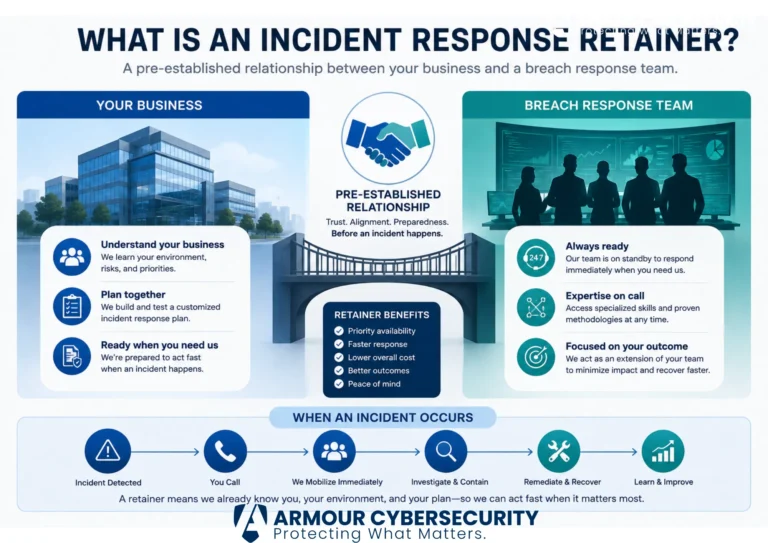
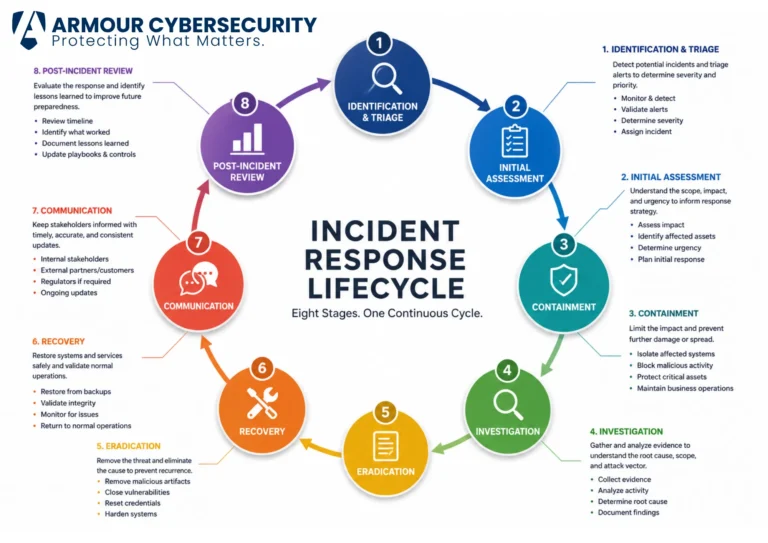
The service is available on two engagement models. Retainer clients receive a 24-hour remote response activation with pre-established onboarding so the team starts with context, not a blank page. Non-retainer organizations facing an active incident can engage emergency response. Both models follow the same eight-stage response lifecycle informed by leading industry standards.
The difference between organizations that contain a breach quickly and those that watch it spread is almost always whether the response team has done this before, has a defined lifecycle to follow, and starts with context rather than building it from scratch under pressure.
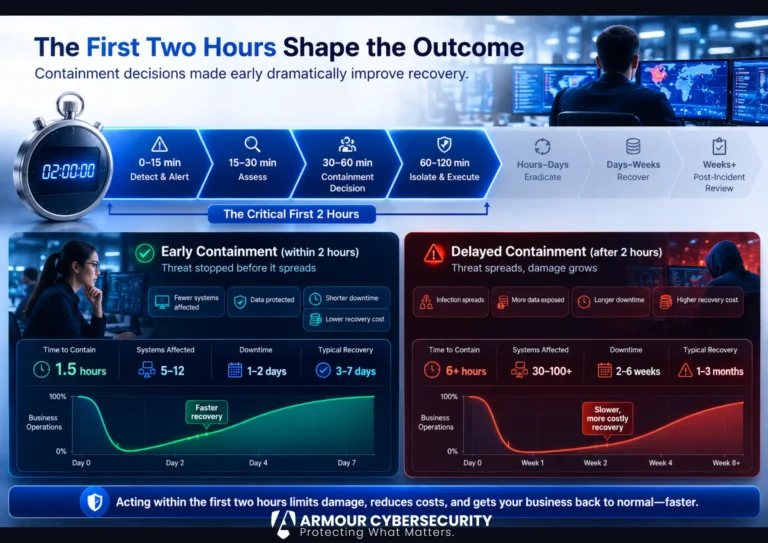
The alert fires at 11pm. The IT lead pages the CISO. The CISO calls the broker. The broker asks for the breach counsel name nobody has on file. Decisions get made before the team is fully convened. Evidence handling is improvised. Containment is delayed while leadership debates whether this is the moment to engage external responders. By the time the external team arrives, the attacker has had hours of unmonitored time and the response is now reconstructing what should have been captured live.
On retainer, the team is already onboarded: assets mapped, contacts exchanged, communication channels established. The 24-hour remote response activation begins immediately on the call. Containment is structured (short-term to limit spread, long-term to allow continued business operations). Investigation runs in parallel with eradication and recovery. Communications are coordinated. Documentation is captured live, not reconstructed later. The lifecycle from identification to lessons learned follows a discipline the team has executed before.
Nine integrated response capabilities aligned with industry-standard incident handling lifecycles. Each is exercised by the same senior team, with documentation captured live to support legal, regulatory, and insurance reporting requirements.
Review of alerts, logs, and notifications to confirm the incident. Verification of indicators of compromise. Classification by nature and severity to prioritize response and allocate resources.
Immediate actions to limit spread: isolating affected systems, blocking malicious IP addresses, disabling compromised accounts, and stopping ongoing lateral movement.
Sustainable measures to contain the threat while allowing continued business operations. Network segmentation, enhanced monitoring, and compensating controls applied at scale.
Forensic examination of affected systems to understand attack vectors, methods, and scope. Root cause analysis to identify exploited vulnerabilities and prevent recurrence.
Removing malicious software, closing exploited vulnerabilities, purging unauthorized access, and applying patches, updates, and configurations to prevent attacker re-entry.
Rebuilding and restoring affected systems with integrity verification. Increased post-recovery monitoring to detect lingering threats or additional compromise attempts.
Structured stakeholder updates for management, IT, and legal teams. Coordination of external notifications for customers, partners, regulators, and the public where applicable.
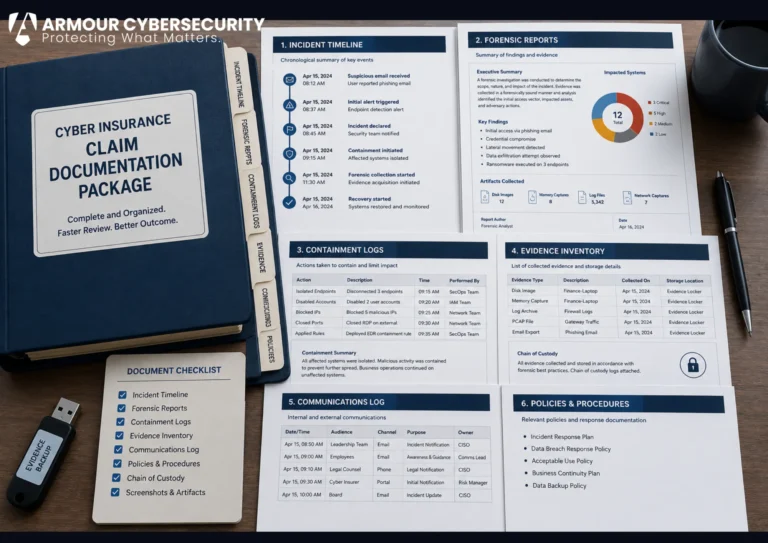
Comprehensive records of incident timeline, actions taken, decisions made, and communications, designed to support legal requirements, insurance claims, and regulatory submissions.
Structured post-incident review with stakeholders. Policy, procedure, and IR plan updates based on insights gained to improve preparedness for future incidents.
Built for organizations that need guaranteed response capability when an incident occurs, whether through a pre-established retainer or emergency activation under active attack.
Companies experiencing an active or suspected breach who need immediate senior responder support to contain, investigate, and recover. Emergency activation available outside of normal hours.
Organizations that prioritize predictable response capability with pre-established onboarding, 24-hour remote activation, and the option of physical presence on a best-effort basis.
Organizations whose cyber insurance carrier requires documented incident response capability or panel forensic relationships. Engagement evidence supports claims and renewal documentation.
Finance, healthcare, legal, government, and other regulated organizations with breach notification timelines that require coordinated technical, legal, and communications response from hour one.
The engagement follows a disciplined six-phase lifecycle informed by leading industry standards (NIST SP 800-61, NIST CSF, ISO 27035). Retainer clients begin from onboarded context. Emergency engagements begin from scratch but follow the same disciplined sequence.
Initial activation within agreed response time. Review of alerts, logs, and indicators of compromise. Classification of incident type and severity. Mobilization of the right specialist resources.
Short-term containment to stop the spread. Long-term containment with sustainable controls that allow continued business operations. Coordination with internal IT to maintain control of the environment.
Forensic examination of affected systems and data. Analysis of attack vectors, methods, and scope. Root cause identification. Evidence preservation to support legal, regulatory, and insurance reporting.
Removal of malicious software, closure of exploited vulnerabilities, application of patches and configurations. Rebuilding and restoration of affected systems with integrity verification and increased post-recovery monitoring.
Internal stakeholder updates. External notification coordination for customers, partners, regulators, and the public where applicable. Coordination with breach counsel, cyber insurance carrier, and PR support.
Final post-incident report covering timeline, actions, decisions, and recommendations. Post-incident review with stakeholders. Policy, procedure, and IR plan updates based on insights gained.
Nine integrated deliverables across the response lifecycle. Each artifact is structured to support audit evidence, legal and regulatory reporting, and the organization's continued operational recovery after the incident closes.
Confirmation of response activation with the assigned response lead, communication channel, and initial action plan, ready for immediate execution by the joint team.
Initial triage report documenting the incident type, severity, indicators of compromise, affected scope, and the response priorities allocated against them.
Documented short-term and long-term containment plan with execution log showing actions taken, systems isolated, accounts disabled, and the operational impact of each.
Real-time briefings during the incident to keep key stakeholders informed about the evolving situation, response actions, and potential business impact decisions.
In-depth forensic reports outlining analysis of affected systems, data, and logs. Documentation of how the incident occurred, the scope of compromise, and the tactics used by the attacker.
Recovery support documentation covering restoration steps, integrity verification, post-recovery monitoring guidance, and the system hardening applied to prevent re-entry.
Comprehensive post-incident report covering the incident, response actions, lessons learned, and recommendations for improvements to policies, procedures, and controls.
Documented lessons learned with specific recommended updates to incident response plans, security policies, and procedures to enhance preparedness for future incidents.
For retainer clients, customized playbooks and runbooks for specific incident types (ransomware, phishing, insider threat) developed during onboarding and refined after each engagement.
Founded by military intelligence veterans with senior advisors from PwC, KPMG, Deloitte, EY, and Mandiant. The track record reflects the discipline.
Organizations across finance, healthcare, technology, energy, legal, and government trust Armour Cybersecurity to protect what matters.
Long-term engagements built on consistent quality, predictable delivery, and consulting relationships that compound in value over time.
Cross-sector experience spanning every major regulated industry, with operations supporting clients across North America, Latin America, and beyond.
A vetted catalogue of technology partnerships and proprietary methods deployed in support of incident response, forensic investigation, and post-incident recovery.
Schedule a discovery call to scope a retainer, or contact us directly if you are facing an active incident. Protecting What Matters starts with knowing the team will answer.
Book Discovery CallCommon questions from CISOs, General Counsel, IT leaders, and risk owners evaluating a Breach Response engagement.
Reach out to scope a Breach Response retainer or engage emergency support. Discovery calls are scheduled within two business days. Active incidents are escalated immediately.
Tell us about your situation. If you are facing an active incident, indicate this in the form and our team will prioritize the response.
Breach response insights for teams that want the first hours of an incident to go right.