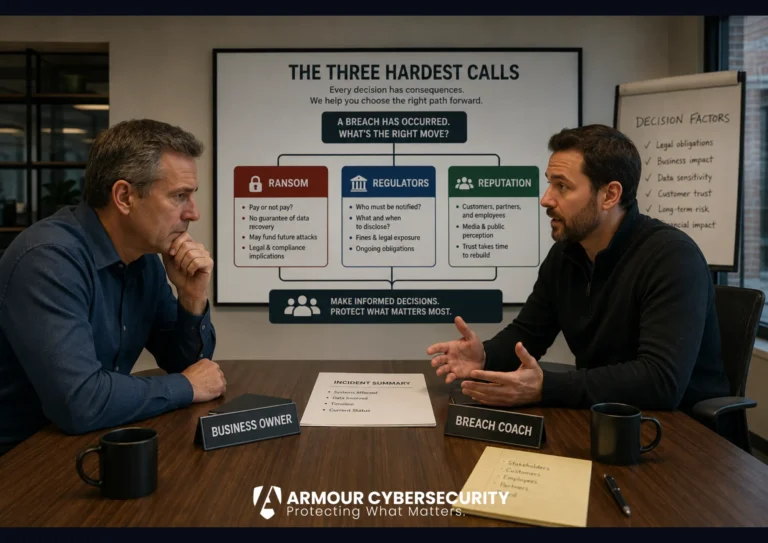
The senior voice in the room when the breach arrives.
A breach coach is the experienced advisor who quarterbacks the response: coordinating technical responders, breach counsel, cyber insurance carrier, communications, and executive decisions so the organization runs to a coherent strategy rather than as disconnected workstreams. Available on retainer for proactive engagement and on emergency activation when an incident is already in motion.
The advisor who has been here before. Many times.
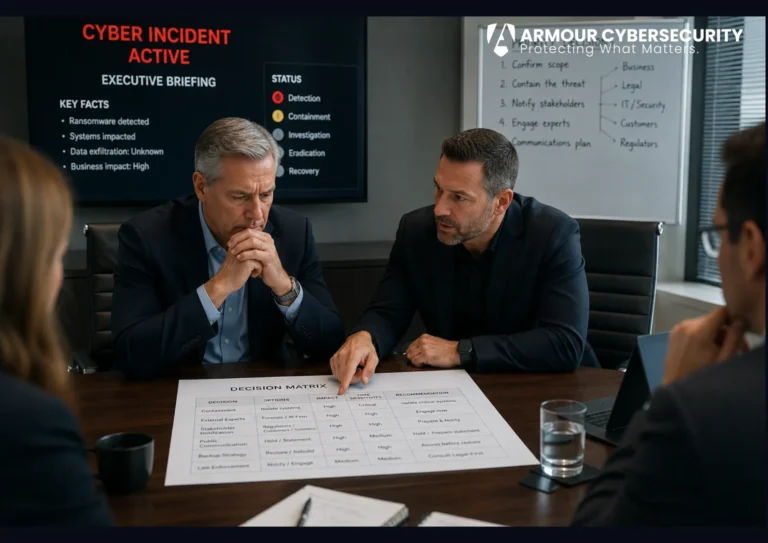
During a serious incident, an organization needs more than a technical response team. It needs someone who has run dozens of these before, who knows what decisions matter in the first hour versus the first day, who has working relationships with breach counsel and carriers, who can read the room when leadership is exhausted, and who can hold the response to a coherent strategy when every workstream wants to escalate at once.
That is what a breach coach does. Armour Cybersecurity's breach coach is a senior advisor with deep incident experience who attaches to the response and serves as the executive's strategic counterpart throughout. The coach is not the forensic lead, the legal counsel, or the communications team. The coach is the connective tissue that makes those workstreams pull in the same direction, the calm voice in the room when decisions get hard, and the advisor leadership can rely on for honest perspective when the answer to a question is uncomfortable.
The role is informed by years of running response engagements across regulated industries, working with major cyber insurance carriers, and coordinating with breach counsel from established firms. The breach coach is engaged on retainer for organizations that want the relationship in place before an incident, or on emergency activation when one is already in progress. Engagements are typically a few hours per day during an active incident, scaling with the complexity of the event.
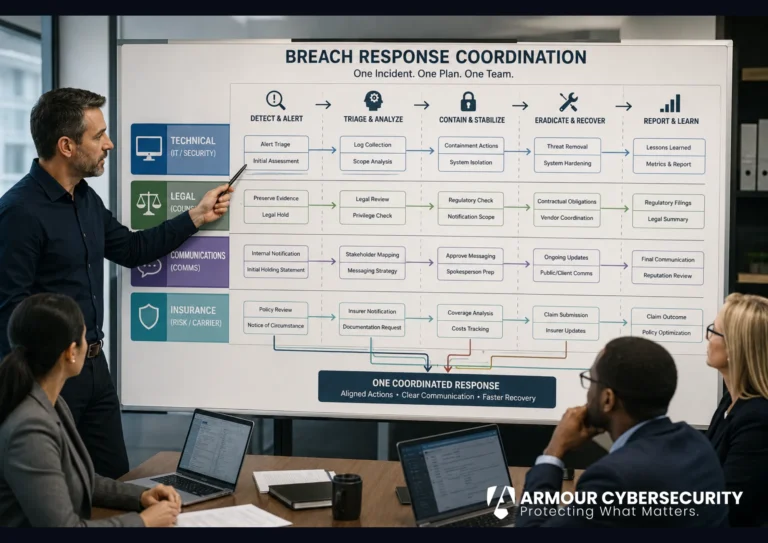
Five workstreams pulling in five directions vs. one coherent response.
The difference between organizations that emerge from a serious incident with reputation and trust intact, and those that compound the crisis through poor coordination, almost always comes down to whether anyone in the room had the experience to pull it all together.
A response that runs as five separate streams. None of them aligned.
The forensic team is reconstructing the attack. Breach counsel is preparing notification analysis. The communications team is drafting a holding statement. The CFO is on with the insurance carrier. The CEO is briefing the board. None of them are talking to each other. Decisions get made by whichever workstream surfaces them first. The technical response moves ahead of the legal strategy. The public statement contradicts the regulator notification. The board hears the technical story before they hear the strategic implications. The cumulative effect is worse than any single mistake.
A senior advisor who keeps the workstreams aligned and the executive informed.
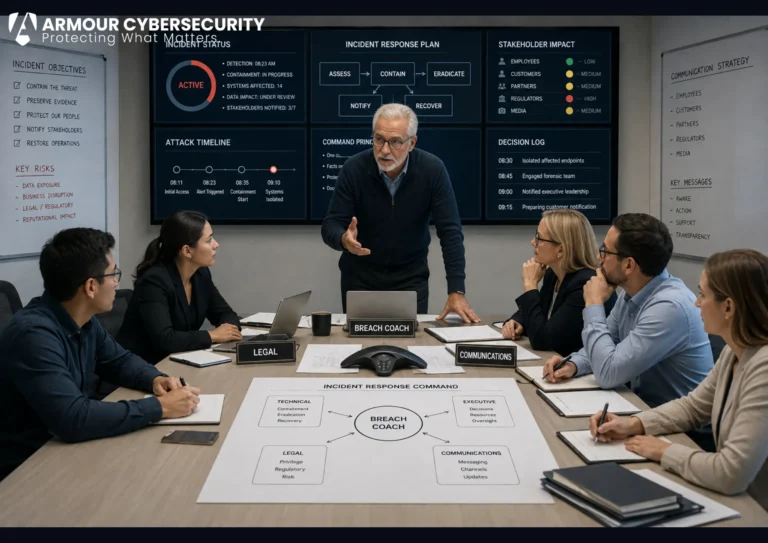
The breach coach sits above the workstreams and pulls them together. The forensic findings inform the legal strategy. The legal strategy informs the communications. The communications align with the carrier's expectations. The executive gets a single, coherent picture of where things stand and what decisions need to be made. The coach has the relationships, the experience, and the authority to hold the response to a strategy. The cumulative effect is that the organization emerges from the incident with its reputation intact and its stakeholders confident in how it was handled.
What a breach coach does.
Nine integrated responsibilities during a serious incident. The coach is not a workstream owner. The coach is the connective tissue that makes the workstreams pull in the same direction and the strategic counterpart to executive leadership.
Senior Incident Quarterback
Overall coordination of the response across technical, legal, communications, and executive workstreams. Ensures the response runs to a coherent strategy rather than as disconnected efforts.
Executive Decision Advisory
Strategic counsel to the CEO, CFO, General Counsel, and CISO during the incident. Helps leadership distinguish urgent from important, sequence decisions correctly, and avoid common first-incident missteps.
Breach Counsel Coordination
Direct working relationship with breach counsel (whether internal counsel, panel counsel from the insurance carrier, or external firm engaged for the incident). Translates technical findings into legal context and back.
Cyber Insurance Carrier Liaison
Coordination with the cyber insurance carrier from first notification through claim documentation. Ensures the carrier sees what they need to see when they need to see it, supporting claim and coverage outcomes.
Forensic & Technical Coordination
Coordination with the forensic team and internal technical responders. Translates technical findings into strategic context for leadership and makes sure the forensic work supports the legal and business priorities.
Communications Strategy Advisory
Strategic advisory on internal and external communications. Reviews messaging for technical accuracy and strategic risk. Coordinates with PR support, customer success, and government relations as needed.
Board & Stakeholder Briefings
Preparation of board updates, regulator briefings, and key customer or partner communications. Ensures the message to each audience is appropriate, accurate, and aligned with the broader strategy.
Strategic Response Plan
Translation of the immediate response into a strategic plan covering the next 24 hours, the next week, and the next month. Holds the response to the plan rather than to the urgency of the moment.
Post-Incident Strategic Debrief
Post-incident strategic review with executive leadership covering what was handled well, what could be improved, and the strategic capability investments that would strengthen future response.
Who this service serves.
Built for organizations whose incidents will involve more than a technical response. If the event has legal, regulatory, reputational, or board-level implications, a breach coach is the difference between a coordinated response and five workstreams running in parallel.
Boards & Executive Teams
CEOs, CFOs, General Counsel, and board members who need a senior advisor in the room during a serious incident, providing strategic counterpart and honest perspective when decisions get hard.
Regulated Industries & Financial Services
Organizations whose incidents will involve regulator notification, public disclosure, customer communications, and material reputational exposure where coordination across workstreams is critical.
Cyber Insurance Policyholders
Organizations whose cyber insurance carrier expects a coordinated response with breach counsel and forensic responders. The breach coach maintains the relationship and reporting cadence the carrier expects.
Organizations Under Active Incident
Companies facing a serious incident in progress that has expanded beyond technical response and now requires senior advisory across legal, communications, board, and carrier coordination.
How the breach coach operates.
Engagement runs across six structured phases during an incident. Retainer relationships begin from established context. Emergency engagements begin from scratch but follow the same disciplined sequence.
First-Hour Engagement
Initial engagement with executive leadership, breach counsel, and the incident response team. Rapid context-building. Identification of the immediate strategic decisions that need to be made in the first 24 hours.
Workstream Coordination
Establishment of coordination cadence across forensics, legal, communications, carrier, and executive workstreams. Daily standing sessions, escalation paths, and decision authority confirmed.
Strategic Plan Development
Translation of the incident into a strategic response plan covering the next 24 hours, the next week, and the next month. Plan agreed with executive leadership and shared with workstream leads.
Executive Advisory During Active Response
Ongoing advisory to executive leadership during the active response. Decision support, stakeholder briefing preparation, board update drafting, and strategic course correction when workstreams pull in different directions.
Communications & Board Coordination
Strategic review of internal communications, external statements, regulator notifications, customer communications, and board briefings. Ensures messaging is technically accurate, legally appropriate, and strategically aligned.
Post-Incident Strategic Debrief
Post-incident strategic review with executive leadership covering what was handled well, what could be improved, and the strategic capability investments that would strengthen future response.
What the organization walks away with.
Nine integrated deliverables from the breach coach engagement. The coach is not a technical responder, but the deliverables make sure the technical response, legal response, and communications response all pull in the same direction.
Senior Incident Quarterback Engagement
Senior advisor engaged from first call through post-incident debrief, attached to executive leadership and coordinating across workstreams for the duration of the response.
Strategic Response Plan
Documented strategic response plan covering the next 24 hours, the next week, and the next month, agreed with executive leadership and updated as the incident develops.
Executive Decision Briefings
Regular strategic briefings for executive leadership covering current status, pending decisions, options analysis, and recommended next steps in language tuned to the executive audience.
Breach Counsel Coordination Log
Documented coordination with breach counsel including translation of technical findings into legal context, coordination of legal hold decisions, and alignment of forensic work with notification analysis.
Carrier Liaison Documentation
Documentation of coordination with the cyber insurance carrier from first notification through claim submission, structured to support coverage outcomes and renewal documentation.
Communications Strategy Review
Strategic review of internal communications, external statements, regulator notifications, customer communications, and board briefings, with recommended revisions before each is released.
Board & Stakeholder Briefing Pack
Prepared briefing materials for board updates, regulator interactions, and key customer or partner communications, structured for executive presentation and tuned to each audience.
Daily Situation Reports
Daily situation reports during the active response covering current status, decisions made, decisions pending, and the strategic implications of each, distributed to executive leadership and key workstreams.
Post-Incident Strategic Report
Post-incident strategic report covering what was handled well, what could be improved, and the strategic capability investments that would strengthen future response.
The numbers behind the work.
Founded by military intelligence veterans with senior advisors from PwC, KPMG, Deloitte, EY, and Mandiant. The track record reflects the discipline.
Clients Served
Organizations across finance, healthcare, technology, energy, legal, and government trust Armour Cybersecurity to protect what matters.
Client Retention Rate
Long-term engagements built on consistent quality, predictable delivery, and consulting relationships that compound in value over time.
Industries · Worldwide Reach
Cross-sector experience spanning every major regulated industry, with operations supporting clients across North America, Latin America, and beyond.
Cybersecurity Technology Solutions
A vetted catalogue of technology partnerships and proprietary methods deployed in support of senior breach coach advisory, executive incident counsel, and post-incident strategic capability development.
Engage a senior advisor before the next incident demands one.
Schedule a discovery call to scope a retainer, or contact us directly if you are facing an active incident. Protecting What Matters starts with knowing the right voice is in the room.
Book Discovery CallFrequently asked questions.
Common questions from CEOs, General Counsel, board members, and CISOs evaluating a Breach Coach engagement.
How is a Breach Coach different from your Breach Response or Technical Forensics services?
Are you a lawyer? Do you provide legal advice?
Do you replace our breach counsel or work alongside them?
When should we engage a Breach Coach?
What does a Breach Coach engagement cost?
How does the Breach Coach work with our cyber insurance carrier?
What happens if you also provide our Breach Response or Forensics services?
Engage the senior advisor your response needs.
Reach out to scope a Breach Coach retainer or engage emergency advisory. Discovery calls are scheduled within two business days. Active incidents are escalated immediately.
Talk to Armour Cybersecurity.
Toronto, ON, Canada
Request a discovery call.
Tell us about your situation. If you are facing an active incident, indicate this in the form and our team will prioritize the response.