By David Chernitzky, CEO, Armour Cybersecurity · Serving organizations across North America · Last updated August 11, 2026
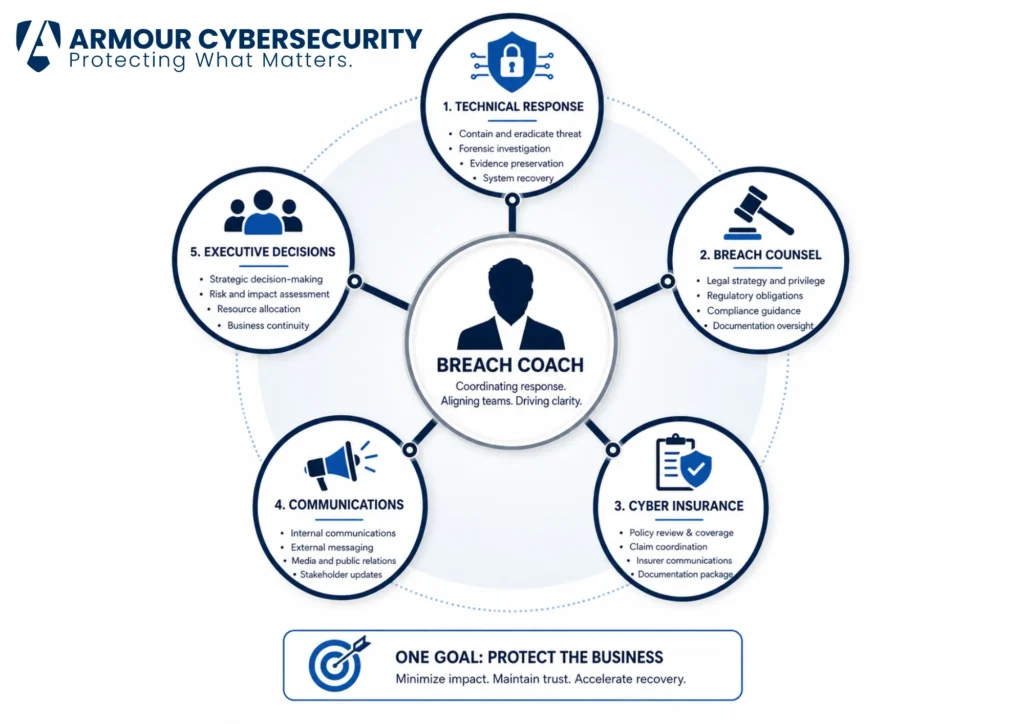
| Quick Answer A breach coach is a senior, experienced advisor who coordinates the response to a serious cyber incident across all the workstreams running at once: technical responders, breach counsel, the cyber insurance carrier, communications, and executive decision-making. The breach coach is not the forensic lead, the lawyer, or the PR firm. The coach is the connective tissue that keeps those experts pulling in the same direction while giving the CEO and leadership team a single, coherent strategic picture throughout the incident. |
Key Takeaways
- A serious cyber incident runs multiple workstreams at once, technical response, legal counsel, insurance coordination, communications, and executive decisions. Without coordination they run in parallel and frequently produce contradictory outcomes.
- The breach coach role is strategic, not technical. The coach coordinates and advises; the technical teams execute.
- Most CEOs and business owners have never managed a serious cyber incident before. A breach coach provides the experienced perspective that turns first-time crisis management into a structured, coherent response.
- Whether an organization comes through a serious incident with its reputation intact usually comes down to whether someone in the room had done this before.
- Breach coach relationships are most valuable when established before an incident through a retainer, but emergency engagement is available when an incident is already in progress.
Breach coach services for business exist to solve a problem most companies never see until they are in the middle of it: a serious cyber incident is not one crisis, it is five running at once. The incident response team is containing the attack, breach counsel is weighing notification, the insurer wants updates, communications is drafting statements, and the CEO has to brief the board without knowing what to say. Each lane needs an expert. What they collectively need is someone above the lanes keeping them coherent. That is the breach coach.
| By the NumbersCoordination is a cost lever. The global average breach cost $4.44M ($10.22M in the US); the distance between a contained incident and one that compounds is largely a coordination problem. Source: IBM Cost of a Data Breach Report 2025.A tested plan and a response team lower the bill. IBM 2025 consistently finds organizations with a practiced incident response capability incur materially lower breach costs; the coach is the senior coordination layer on top of that capability.Most leaders are first-timers. The typical CEO manages their first serious incident with no prior playbook, under pressure and with incomplete information, which is exactly the gap experienced coaching fills. |
What Problem Does a Breach Coach Solve?
When a serious cyber incident unfolds, multiple high-stakes workstreams activate at the same time. The technical response team is working to contain the attack and investigate its scope. Breach counsel is assessing regulatory notification obligations and managing legal privilege. The cyber insurance carrier is notified and expects regular updates. The communications team is drafting statements while the facts are still being established. The CFO is asking about financial exposure. The CEO needs to brief the board and does not yet know what to say.
Each of these workstreams needs expert handling, but they are not independent. The technical findings determine what counsel advises about notification. The notification strategy shapes what communications can say and when. The communications approach affects how the carrier views the claim. The board briefing needs to reflect the legal position, not just the technical facts. When these lanes run independently, with no one coordinating their outputs and sequencing their decisions, they produce inconsistent results and avoidable mistakes.
Across the 260+ organizations Armour serves in 52+ industries, the ones that come through a serious incident with their reputation intact almost always have one thing in common, and it is not the size of their security budget. It is that someone in the room had run an incident before and could keep the technical, legal, and communications tracks pointed the same way while the CEO still had ten unanswered questions. That person is the breach coach: a senior advisor who sits above the workstreams, understands how each operates, has working relationships with the specialists in each lane, and holds the whole response to a coherent strategy from hour one through the debrief.
What Does a Breach Coach Actually Do?
Quarterbacks the response
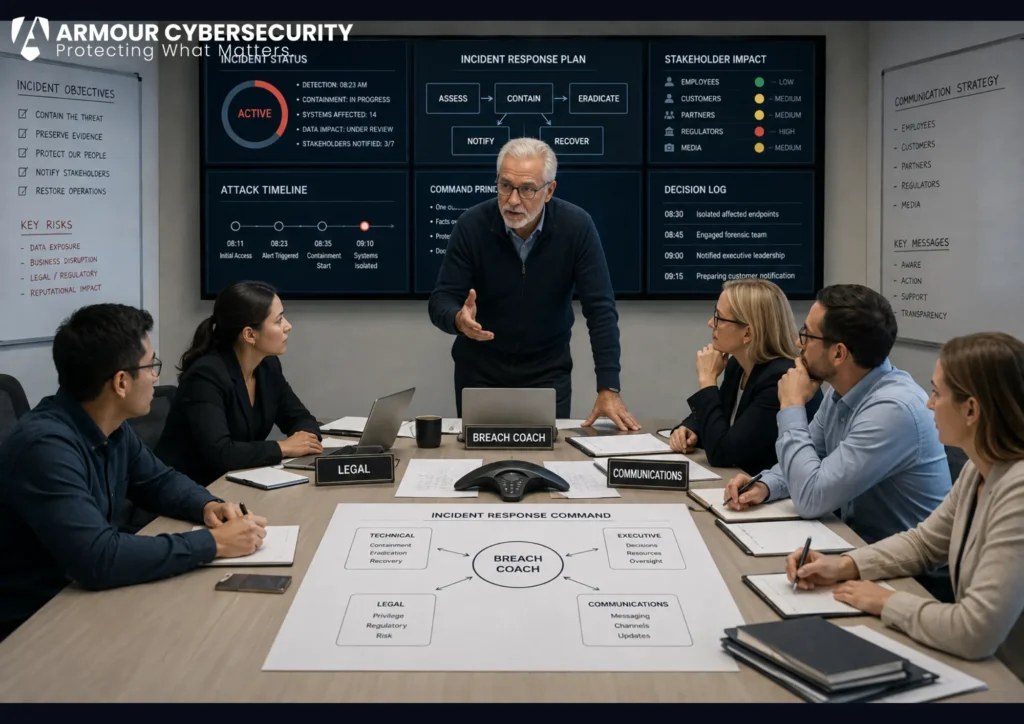
The coach’s primary function is coordination. In a serious incident, the CEO needs one trusted advisor who holds the full picture and can translate it into clear strategic guidance: synthesizing the outputs of the technical, legal, communications, and carrier workstreams into a coherent status picture and a clear set of decisions the leadership team needs to make, in the right sequence, with the right information at each step.
Advises executive decision-making
The decisions that matter most in a serious incident are not technical, they are business decisions: whether to accept operational disruption to stop a spreading attack, whether to engage a ransom negotiator, when to notify customers, how to brief the board, and what to say to regulators. These carry material legal, financial, and reputational consequences. A CEO making them for the first time, under pressure, with incomplete information, benefits enormously from a coach who has seen these decision points before and knows which choices tend to lead to better or worse outcomes.
Coordinates with breach counsel
The breach coach and breach counsel have complementary but distinct roles. Counsel provides legal advice, manages privilege over forensic communications, leads notification analysis, and represents the organization in regulatory and legal matters. The coach coordinates the technical workstream with the legal one: making sure the forensic investigation is structured to support counsel’s notification analysis, that technical findings are translated into legal context accurately, and that the sequence of response actions does not inadvertently create legal problems. The coach is not a lawyer and does not give legal advice; the value is in the translation and coordination.
Manages cyber insurance carrier engagement
Carrier engagement during an incident is more than notification. It involves regular status updates, coordination with carrier-panel forensic responders if engaged, structuring documentation to support the cyber insurance claim, and managing the relationship in a way that supports both the immediate claim and the long-term renewal. The breach coach runs this engagement so the carrier sees what they need, when they need it, in a format that supports the coverage outcome.
Guides communications strategy
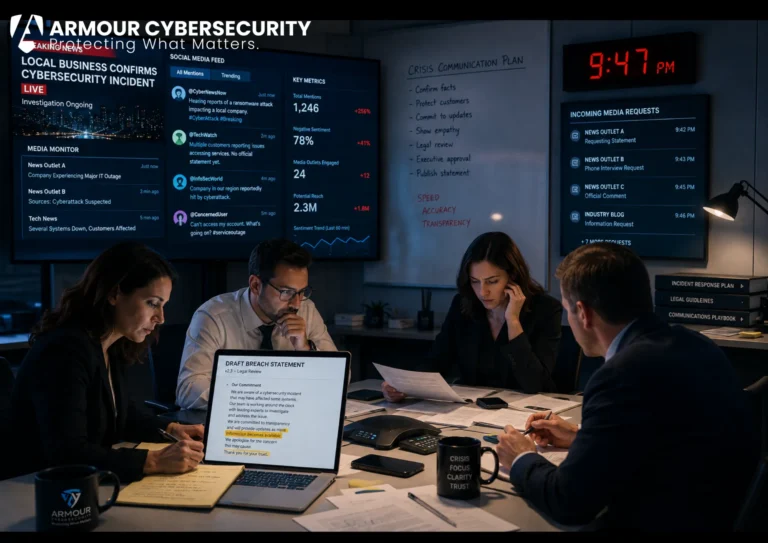
The communications decisions in a serious incident, when to say something, what to say, to whom, and through what channels, are among the highest-stakes choices in the response. The breach coach provides strategic review of all communications before release, checking technical accuracy, legal alignment, and strategic consistency. That review prevents the most common failures: statements made before facts are confirmed, messaging that contradicts the regulatory notification, and language that creates liability careful drafting would have avoided.
When Should a Breach Coach Be Engaged?
The ideal model is a retainer established before any incident. A coach onboarded with your risk profile, key stakeholders, technology environment, and industry context can activate immediately when an incident is detected, without the discovery phase emergency engagements require. The retainer also opens access to the coach between incidents, for IR plan review, tabletop exercise facilitation, or executive briefings on emerging threats.
Emergency engagement is available for organizations facing an active incident without a retainer in place. The coach can activate within hours, building context rapidly from the first call with executive leadership. The absence of a prior relationship makes the early engagement more demanding, but experienced strategic coordination starts adding value quickly once the coach has the initial context.
The threshold for engaging a breach coach is any incident that extends beyond a technical response into legal, regulatory, communications, or board-level consequences. For small and mid-market businesses without a large internal security or legal team, that threshold is often lower than for enterprises with in-house capability in each area. Armour Cybersecurity’s breach coach service is available on retainer and on an emergency basis.
Where the Breach Coach Fits in Armour’s Managed Services
The breach coach is one pillar of Armour’s managed cybersecurity services, working next to the incident response team it coordinates, the managed Security Operations Center whose telemetry feeds the picture, and the all-in-one Armour 360 program. The specialists do the work in each lane. The coach makes sure the lanes add up to one coherent response.
The Bottom Line
A serious incident is won or lost less on any single lane than on whether the lanes stay coordinated, and coordination is exactly what a first-time crisis lacks. If your business would be managing technical response, legal exposure, insurer demands, and board pressure at the same time with no one who has done it before, Armour’s breach coach service puts that experienced hand at the head of the table, on retainer before an incident or on an emergency basis during one.
Across the 260+ organizations Armour serves in 52+ industries, the ones that come through a serious incident with their reputation intact almost always have one thing in common, and it is not the size of their security budget. It is that someone in the room had run an incident before and could keep the technical, legal, and communications tracks pointed the same way while the CEO still had ten unanswered questions.
Frequently Asked Questions
What are breach coach services for business?
Breach coach services give a business a single senior advisor who coordinates a serious cyber incident end to end: synthesizing the technical, legal, insurance, and communications workstreams into one coherent picture, advising executive decision-making, and keeping the whole response on a consistent strategy from the first hour through the post-incident debrief. For small and mid-market organizations without a large in-house security or legal team, the coach supplies experience the business does not have internally, someone who has run incidents before and knows which decisions tend to lead to better or worse outcomes. The service is available as a pre-incident retainer or as emergency engagement during an active incident.
Is the breach coach the same as breach counsel?
No. Breach counsel is a lawyer specializing in cyber incident response who provides legal advice, manages privilege, leads notification analysis, and represents the organization in regulatory and legal matters. The breach coach is a cybersecurity advisor who coordinates the overall response across the technical, legal, communications, and carrier workstreams. The two roles are complementary, and most serious incidents benefit from both engaged at once. The breach coach can help identify and engage appropriate breach counsel if one is not already in place.
Does my business need a breach coach if we already have a cyber insurance carrier?
Cyber insurance carriers provide access to forensic responders, breach counsel, and communications support through their panel vendor network. What the carrier does not provide is the strategic coordination function: someone whose role is to coordinate all of those experts in the organization’s specific interest, advise executive leadership, and keep the response coherent. The breach coach fills that function and works in parallel with carrier-panel vendors, coordinating their outputs rather than replacing them.
How is a breach coach different from a vCISO?
A vCISO provides ongoing strategic security leadership: building the security program, managing risk, advising on compliance, and giving CISO-level guidance without the cost of a full-time hire. A breach coach is activated specifically during a serious incident to provide senior advisory and coordination for the duration of the response. The roles are complementary, and in some cases the vCISO and breach coach are the same person; in others they are distinct.
Can the breach coach engage with regulators on our behalf?
The breach coach can prepare briefing materials, coordinate the timing and content of regulator communications, and advise on the strategic approach. Formal regulatory communications and submissions are typically led by breach counsel, who provides legal representation and manages the legal dimensions of the interaction. The coach and counsel work together, with counsel leading the formal interaction and the coach ensuring the strategic and technical context is accurately reflected in what counsel presents.
How is a breach coach engagement structured and what does it cost?
A breach coach engagement is available two ways: a pre-incident retainer that onboards the coach with your environment and stakeholders so they can activate immediately when an incident is detected, and emergency engagement for an organization already facing an active incident. The retainer also opens access to the coach between incidents for IR plan review, tabletop facilitation, and executive briefings. Specific commercial terms are scoped during a discovery call based on your size, risk profile, and the engagement model that fits, so the structure matches your situation rather than a fixed package.
About the Author
David Chernitzky is the CEO and Co-Founder of Armour Cybersecurity, a Toronto-based firm that protects organizations across North America from advanced cyber threats. He brings more than 25 years of cybersecurity and military cyber intelligence experience, having served as an officer in an elite technology unit before co-founding Armour. Armour’s team of military-intelligence veterans and senior advisors serves 260+ clients across 52+ industries with a 97% client retention rate.