By David Chernitzky, CEO, Armour Cybersecurity · Serving organizations across North America · Last updated August 6, 2026
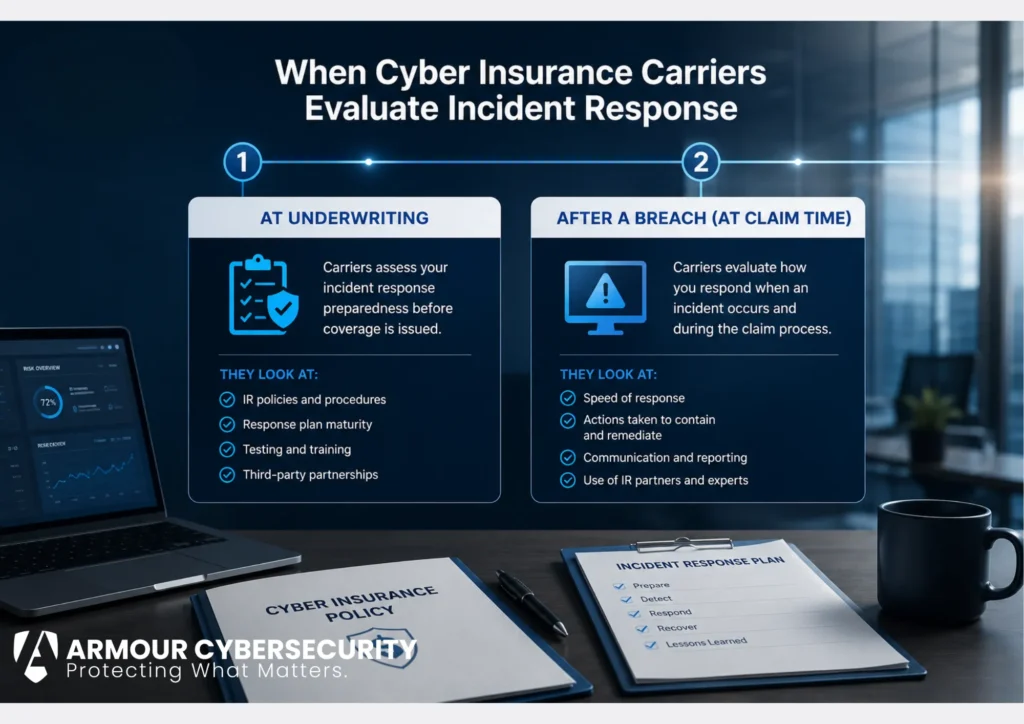
| Quick Answer Cyber insurance carriers evaluate your incident response capability at two points: during underwriting, to assess the risk they are taking on, and after a breach, to determine whether your response met the conditions of coverage. Gaps in your IR plan, playbooks, forensic readiness, and third-party relationships affect both outcomes. A breach readiness assessment closes those gaps and produces the evidence carriers expect to see. |
Key Takeaways
- Cyber insurance carriers have significantly tightened underwriting standards. What was acceptable evidence two years ago, a signed IR plan document, often does not satisfy current carrier requirements.
- Carriers examine specific control areas during underwriting: IR plan existence and testing, defined escalation paths, forensic log retention, and pre-established relationships with breach counsel and forensic responders.
- After a breach, carriers review whether the organization followed its documented response procedures. Responses that deviated significantly from documented plans raise coverage questions.
- A breach readiness assessment produces documentation that directly addresses carrier underwriting requirements and creates a defensible record of pre-incident preparedness.
- Organizations with documented, tested IR capability consistently receive better underwriting terms than those whose documentation is limited or outdated.
Cyber insurance incident response requirements now sit at the center of both underwriting and claims. Carriers have moved from questionnaire-based underwriting to evidence-based underwriting, and multi-factor authentication, endpoint detection and response, tested backups, and a documented, tested incident response plan are near-universal conditions of coverage across major carrier applications. The through line is simple: carriers want to see controls working, not just described, both before they issue a policy and after a breach when a claim is filed. That is also where a cyber insurance advisory relationship earns its keep, by aligning your controls and evidence with what underwriters actually score.
How Have Cyber Insurance Requirements Changed?
The cyber insurance market has changed substantially in the past several years, driven by escalating claim volumes, increasing ransomware severity, and the recognition that insured organizations varied enormously in their actual security posture. Carriers that previously accepted self-attestation on basic security controls now conduct structured underwriting reviews that examine specific capabilities and request documentation to support representations made in the application. Coalition’s cyber claims analysis found that the majority of claims involved organizations that had not fully deployed multi-factor authentication, and missing MFA and inadequate endpoint protection are now among the most common reasons applications are declined.
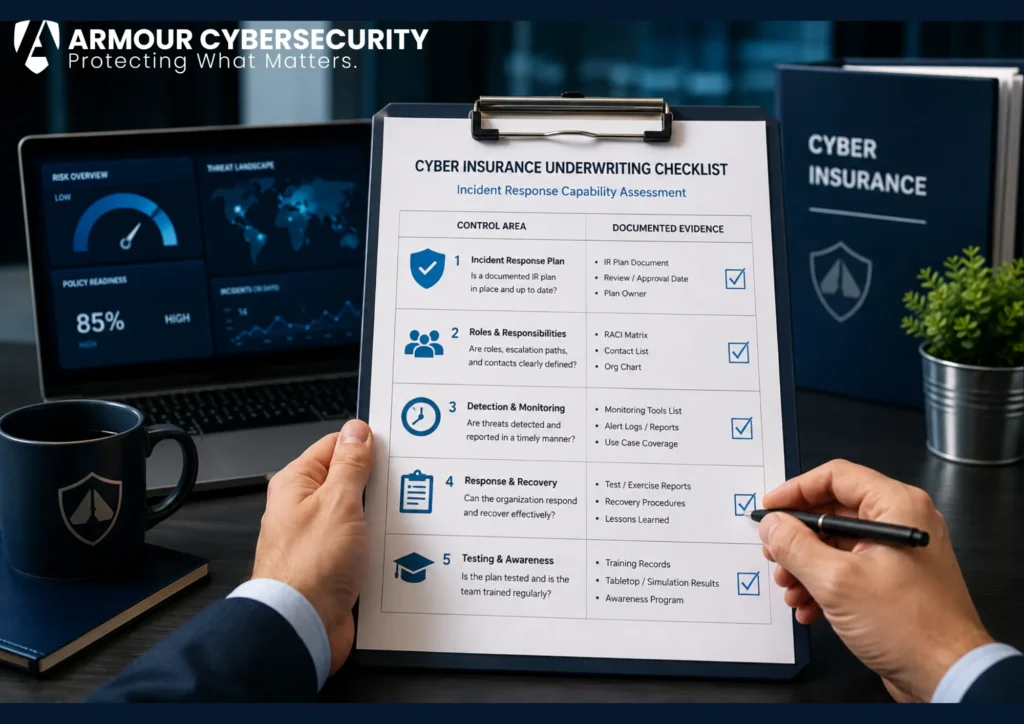
Incident response capability is now a standard component of cyber insurance underwriting. Carriers ask whether the organization has a documented incident response plan. They ask whether the plan has been tested in the past twelve months. They ask whether specific relationships are established: breach counsel on retainer, forensic response capability either internal or contracted, and a defined process for engaging the carrier at the time of an incident. They ask about log retention and whether the organization has the forensic evidence needed to support a claim investigation.
The shift is significant because it means that the quality and currency of your incident response capability directly affects both your insurability and the terms of the coverage you receive.
What Do Carriers Examine During Underwriting?
Incident response plan existence and currency
Carriers ask whether a documented incident response plan exists and when it was last reviewed or updated. A plan that has not been reviewed in more than two years raises questions about whether it reflects the current organizational structure, technology environment, and threat landscape. Plans that are demonstrably current, reviewed and updated within the past twelve months, and aligned with recognized frameworks such as NIST SP 800-61 support a stronger underwriting position.
IR plan testing evidence
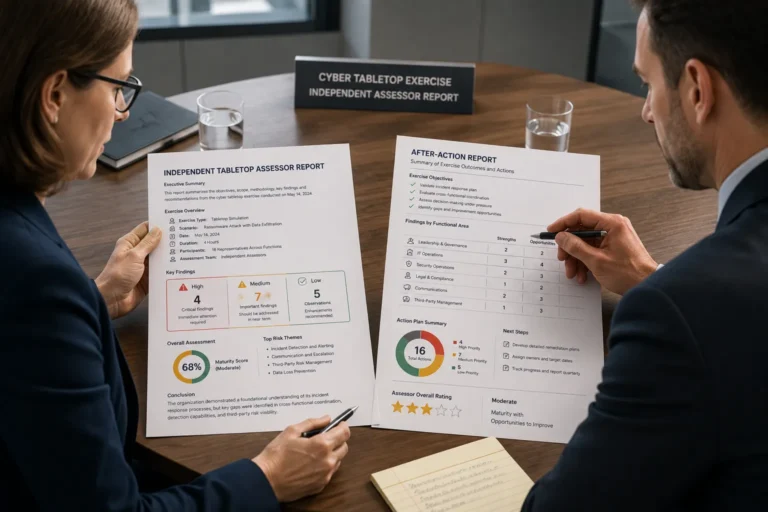
Existence of a plan is not sufficient. Carriers increasingly ask whether the plan has been tested, either through tabletop exercises or live incident simulations, and ask for evidence of that testing. Exercise reports, after-action reviews, and documented lessons-learned capture are the evidence types that satisfy this requirement. Organizations that can produce these documents demonstrate that their IR capability has been validated rather than simply written.
Defined escalation paths and decision authority
Carriers ask whether decision authority is clearly defined for key incident response decisions: who authorizes taking systems offline, who approves customer notification, who engages external legal counsel, who authorizes payment in a ransom scenario. Vague or undocumented authority structures are a red flag for carriers because they predict slow and disorganized response, which correlates with higher claim severity.
Pre-established third-party relationships
Carriers consistently ask whether breach counsel is retained, whether a forensic response provider is under contract, and whether the organization knows the specific process for engaging the carrier at the time of an incident. Organizations that have formalized these relationships before an event occurs demonstrate a level of preparedness that correlates with better response outcomes and faster claim resolution. Carriers that provide access to a panel of breach coaches and forensic responders through the policy itself still expect the insured to know how to engage those resources, not discover the process for the first time during an incident.
Forensic log retention and evidence capability
Forensic investigation of a breach requires log data that documents what happened, when it happened, which systems were affected, and what data was accessed or exfiltrated. Carriers ask about log retention periods, the types of logs maintained, and whether the organization has the forensic readiness to preserve and analyze evidence. Insufficient log retention is a recurring cause of claim complications because it makes it impossible to definitively establish breach scope, which affects the notification determination and the coverage analysis.
What Happens After a Breach When the Claim Is Filed?
When a covered incident occurs and a claim is filed, the carrier conducts a claim investigation that reviews the organization’s response against documented procedures. The investigation examines whether the organization followed its incident response plan, whether the carrier was notified within the required timeframe, whether breach counsel was engaged and whether their guidance was followed, and whether the response costs and decisions were reasonable given the nature of the incident. Carriers increasingly deny or reduce claims when a post-incident forensic review finds that the controls the policyholder attested to were not actually in place at the time of the incident.
Deviations from documented response procedures, decisions that were inconsistent with the plan, and costs incurred without following the engagement procedures specified in the policy can all create friction in the claims process. This is why the alignment between the documented IR plan and the actual response that occurs matters for coverage purposes, not just for response quality.
Organizations whose documented IR plan reflects what they actually do, whose third-party relationships are pre-established and their engagement procedures are followed, and whose forensic evidence supports the breach scope determination, experience faster and more complete claim resolution than those whose documentation and response diverge significantly.
How Does a Breach Readiness Assessment Support Insurance Outcomes?
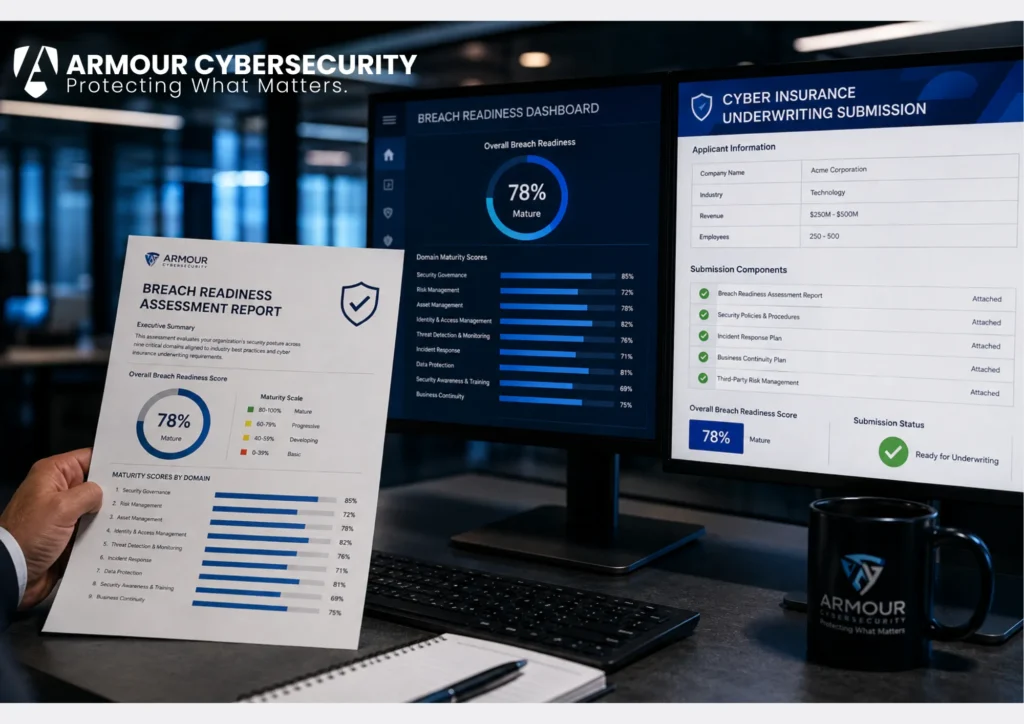
A breach readiness assessment addresses the specific capability areas that cyber insurance carriers examine, both during underwriting and after a breach.
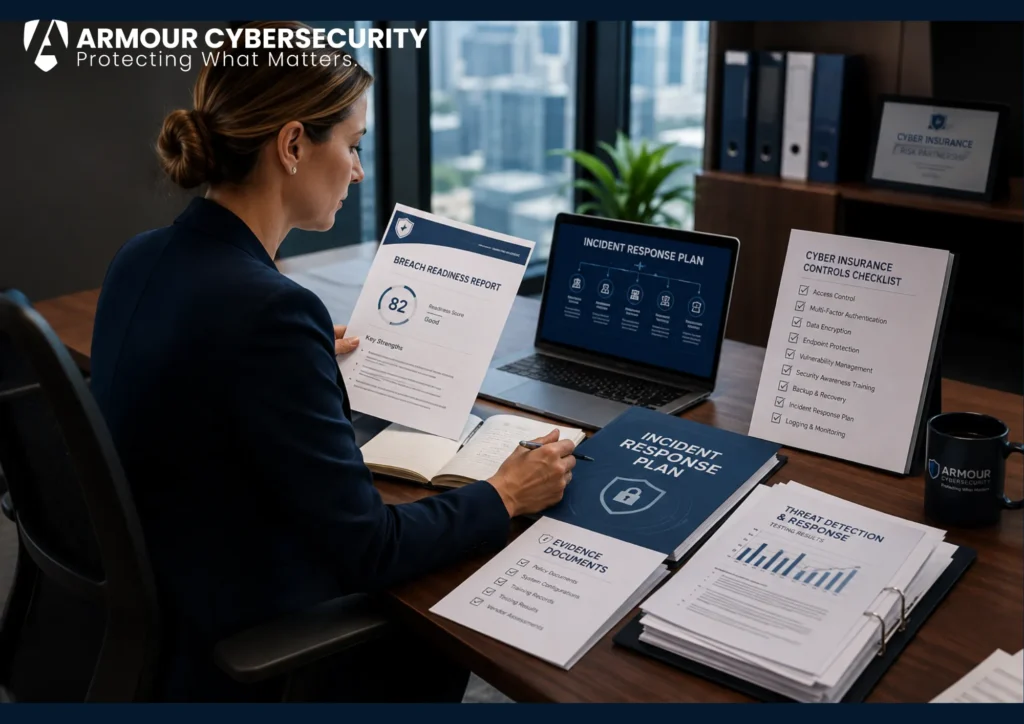
The assessment produces a Breach Readiness Assessment Report that documents current-state capability across nine domains with maturity scoring and evidence from document review and stakeholder workshops. This report is structured for direct submission alongside underwriting questionnaires and demonstrates that the organization has conducted an independent review of its IR capability rather than relying solely on internal self-assessment.
The remediation roadmap that follows the assessment addresses the gaps that carriers flag most frequently: plan currency, testing evidence, decision authority documentation, third-party relationship formalization, and forensic readiness. Organizations that complete the assessment and execute the remediation roadmap are in a demonstrably stronger position at underwriting and in a better position to satisfy the claims investigation requirements when an incident occurs.
Armour Cybersecurity’s Breach Readiness Assessment is structured to produce evidence that satisfies underwriter expectations across major carrier frameworks. The methodology draws from NIST SP 800-61, NIST CSF, ISO 27035, CIS Controls v8, and the control expectations published by major cyber insurance carriers, and it maps cleanly onto the recognized frameworks underwriters ask about.
Where Cyber Insurance Readiness Fits in Armour’s Managed Services
Insurance readiness rarely works alone. It is one pillar of Armour’s managed cybersecurity services, operating alongside a managed Security Operations Center for the centralized logging carriers want to see, cyber threat intelligence to anticipate the scenarios your policy covers, vCISO leadership to own decision authority, cyber awareness training to reduce the human error behind most claims, and the all-in-one Armour 360 managed program. Coverage terms follow when these pieces are already documented and working.
The Bottom Line
Cyber insurance no longer rewards organizations that can describe their controls. It rewards those that can prove them. A breach readiness assessment produces the documented, tested, independently reviewed evidence that carriers score at underwriting and scrutinize at claim time, which means the same work that improves your response also protects your coverage. Close the gaps now, while the record you build is an asset at renewal rather than a liability in a claim dispute.
Across the 260+ organizations Armour protects in 52+ industries, the incident response evidence carriers now ask for at underwriting, a tested plan, documented decision authority, and named third-party relationships, is exactly the evidence most organizations cannot produce on the day the questionnaire arrives.
Frequently Asked Questions
What are cyber insurance incident response requirements?
Cyber insurance incident response requirements are the specific IR capabilities carriers expect an insured organization to have in place, verified with evidence rather than attestation. At underwriting, carriers look for a documented incident response plan reviewed within the past twelve months, evidence that the plan has been tested, defined decision authority and escalation paths, pre-established breach counsel and forensic relationships, and adequate log retention. After a breach, they check that the organization actually followed those procedures. A breach readiness assessment produces documentation that maps directly to these requirements.
Can a cyber insurance carrier deny a claim based on IR plan gaps?
Carriers can and do contest claims on the basis that the organization’s response did not follow documented procedures, that the carrier was not notified within the required timeframe, or that costs were incurred without following the engagement procedures specified in the policy. While outright denial based solely on IR plan gaps is uncommon, claim complications, reduced payments, and disputed costs are more common in organizations whose documentation and response are not aligned. Maintaining a current, tested IR plan that the organization actually follows reduces this risk significantly.
Do cyber insurance carriers share their specific IR requirements publicly?
Major carriers publish their minimum security control requirements as part of the underwriting process. Some have released public guidance on security posture expectations. The specific questions vary by carrier and policy type, but the core areas, IR plan existence and testing, escalation authority, third-party relationships, and forensic capability, appear consistently across carriers. The Armour Cybersecurity breach readiness assessment methodology is calibrated against the control expectations of major carriers to ensure the evidence it produces is directly applicable to the underwriting process.
How often should the IR plan be reviewed to satisfy carrier requirements?
Most carriers expect the IR plan to be reviewed and updated at least annually. The review should be documented with a revision date and evidence of what was changed. Major organizational changes, such as acquisitions, technology platform changes, or significant personnel changes in roles with IR authority, should trigger an interim review rather than waiting for the annual cycle. Carriers that ask about plan currency are looking for evidence that the plan reflects the current organization, not just evidence that a plan exists.
What is a breach coach and does my policy cover one?
A breach coach is a lawyer specializing in cyber incident response who advises on regulatory obligations, privilege considerations, notification decisions, and the legal dimensions of the response. Most cyber insurance policies provide access to a panel of breach coaches as part of the coverage. The specific engagement process, which firm to call, how to engage them in a way that preserves privilege, and what information to provide in the first call, should be documented in the IR plan before an incident occurs. Discovering these details for the first time during an incident delays legal guidance at the moment it is most needed.
Will completing a breach readiness assessment reduce our cyber insurance premium?
Premium impact depends on the carrier and the underwriting review. Some carriers offer explicit credits for documented IR capability testing and third-party assessment evidence. Others factor it into the overall risk assessment without a specific line item reduction. In both cases, demonstrating documented, tested IR capability typically produces better underwriting terms than the alternative: higher retentions, sublimits on specific coverage areas, or additional conditions attached to coverage. The assessment investment is generally favorable relative to the cost of suboptimal coverage terms over a multi-year policy period.
About the Author
David Chernitzky is the CEO and Co-Founder of Armour Cybersecurity, a Toronto-based firm that protects organizations across North America from advanced cyber threats. He brings more than 25 years of cybersecurity and military cyber intelligence experience, having served as an officer in an elite technology unit before co-founding Armour. Armour’s team of military-intelligence veterans and senior advisors serves 260+ clients across 52+ industries with a 97% client retention rate.