What Cyber Disclosure Obligations Mean for Your Board Right Now
Aug 13, 2026
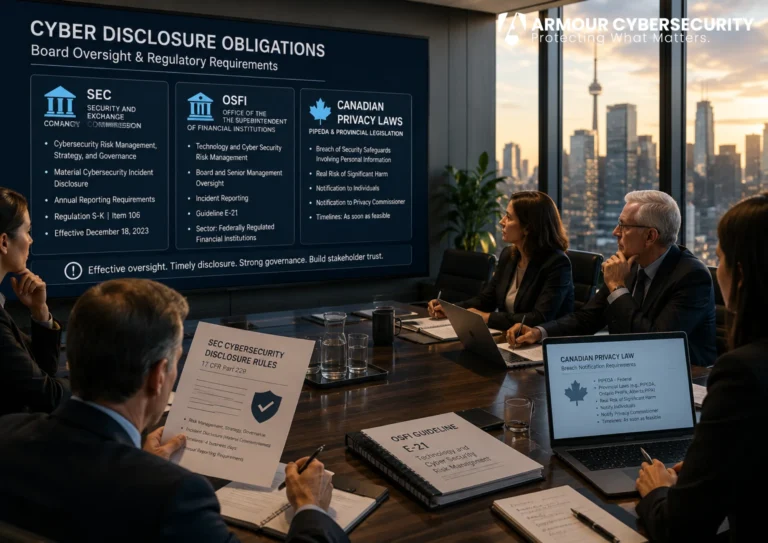
SEC disclosure rules, OSFI B-13, and Canadian privacy law now put cyber disclosure and breach-notification decisions at the board level. This guide...


Independent cybersecurity advisory for boards of directors, audit committees, and risk committees. Quarterly briefings, financial risk dashboards, and executive counsel that turn technical complexity into the governance signal directors need to oversee cyber as an enterprise risk.
Cybersecurity has become a top enterprise risk, but most boards still rely on a single internal source for their view of it: the CISO. That arrangement leaves directors without independent challenge, without external benchmarking, and without the financial framing they apply to every other risk category they oversee.
Armour Cybersecurity's Board Advisory service operates one level above the security function. The advisor reports to the board, the audit committee, or the risk committee, providing independent assurance, structured quarterly briefings, and a cyber risk dashboard that quantifies exposure in financial terms. The work is governance-grade, not technical-grade, and is built to satisfy the oversight standard regulators and shareholders increasingly expect.
The engagement complements rather than replaces internal security leadership. The CISO continues to run the program. The Board Advisor frames the questions directors should be asking, translates posture into business impact, and ensures the board can demonstrate active, informed oversight of cyber risk to regulators, auditors, and shareholders.
Cyber has moved from an IT topic to a board-level fiduciary concern. The difference between a board that can demonstrate active oversight and one that cannot often comes down to whether independent counsel sits beside the CISO.
Cyber briefings are prepared and delivered by the same function that owns the program. Directors lack the technical depth to challenge the narrative and lack the financial framing to compare cyber risk against the rest of the enterprise portfolio. Regulators, auditors, and shareholders are raising expectations for board-level cyber oversight, but the materials in front of the board often fall short of that bar.
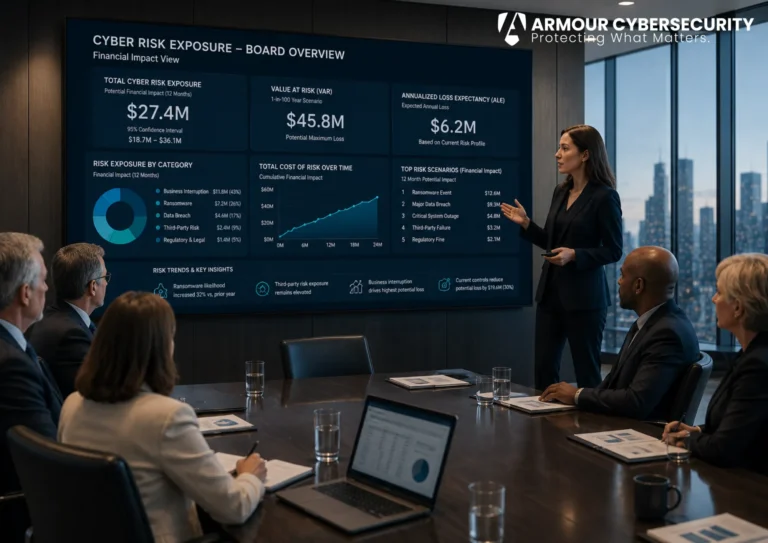
The Board Advisor delivers a quarterly briefing pack, a financial cyber risk dashboard, and direct dialogue with the board, audit committee, or risk committee. Risk is quantified in dollar terms. Regulatory developments are flagged before they become disclosure problems. Directors get the questions they should be asking and the benchmarks against which to evaluate management's answers. The board can demonstrate active, informed oversight on the record.
Nine board-level domains, integrated into the quarterly briefing cadence and reflected in the cyber risk dashboard. Every domain is framed for governance, not for technical execution.
Review of how cyber risk flows into the board, the committee structure, charters, and reporting lines that govern oversight. Recommendations on cadence, escalation triggers, and decision rights.
Cyber exposure expressed in dollar ranges using FAIR-aligned methodology, so the board can compare cyber against every other risk on the enterprise risk register.
Tracking of upcoming obligations including SEC cyber disclosure, OSFI guidance, PIPEDA, GDPR, HIPAA, PCI DSS, and sector-specific mandates, with readiness implications for the board.
Independent evaluation of the organization's ability to detect, contain, and recover from material cyber events, plus the disclosure and crisis communications playbook the board should approve.
Oversight of the third-party risk program, concentration risk in critical vendors, and the contractual and monitoring controls the board should expect management to maintain.
Independent review of the multi-year cybersecurity strategy, budget alignment with risk appetite, and validation that security investment is delivering measurable risk reduction.
Board-level perspective on operational resilience, ransomware recovery posture, crisis decision rights, and the continuity arrangements that protect the enterprise during major events.
Structured education sessions and facilitated tabletop exercises that prepare directors to govern cyber confidently and to navigate a real incident under pressure.
Advisory on materiality assessment, public disclosure language, and the stakeholder communications posture the board should approve before an incident requires them.
Built for governance bodies and senior leadership accountable for cyber oversight, regulatory posture, and enterprise risk reporting.
Boards seeking an independent voice on cyber risk, structured quarterly briefings, and the governance materials needed to demonstrate active oversight to regulators and shareholders.
Committees responsible for cyber oversight who need independent assurance, financial risk framing, and the discipline to challenge management on posture and investment decisions.
CEOs, CFOs, and General Counsel who own enterprise risk and need a trusted cybersecurity advisor to brief executive committees and prepare leadership for board-level conversations.
Organizations subject to SEC cyber disclosure, OSFI guidance, or sector-specific oversight where active board engagement on cyber is a regulatory expectation, not optional.
A two to three week initial assessment establishes the baseline. Quarterly briefings thereafter follow the same standardized phases, so the board sees consistent materials, consistent risk framing, and consistent benchmarks every quarter.
Two to three week onboarding. Review of charters, prior board materials, audit findings, and the current cyber risk picture. Establishes the baseline against which quarterly progress is reported.
Cyber exposure translated into financial terms using FAIR-aligned methodology. The dashboard is built once, then refreshed each quarter as the risk picture evolves and new threats emerge.
Construction of the board briefing deck, regulatory scorecard update, third-party risk summary, and the specific recommendations the advisor will bring to directors that quarter.
Live briefing of the board, audit committee, or risk committee. Independent dialogue with directors, framing of the governance questions, and closed-session time when the agenda requires it.
Ad-hoc support for material incidents, regulatory developments, M&A diligence, and director questions that cannot wait for the next quarterly cycle. The advisor remains accessible on retainer.
Once per year, a comprehensive review of the cyber strategy, risk appetite alignment, and the maturity trajectory. Sets the agenda and priorities for the following year of board-level oversight.
Nine integrated deliverables, refreshed on the quarterly cycle and built to survive regulator and auditor scrutiny. Every artifact is designed for governance consumption.
Concise, board-ready briefing pack delivered each quarter, covering posture, risk trajectory, regulatory developments, and the specific decisions the board is being asked to make.
Living dashboard that quantifies cyber exposure in financial terms, tracks key risk indicators quarter over quarter, and feeds the enterprise risk register on a consistent basis.
Independent annual review of the multi-year cybersecurity strategy, risk appetite alignment, investment effectiveness, and the maturity trajectory of the program.
Scorecard tracking the organization's posture against applicable regulatory obligations, refreshed each quarter so the board can see compliance status at a glance.
Independent evaluation of the organization's ability to detect, contain, recover from, and disclose material cyber events, refreshed annually and after every tabletop or real event.
Board-level view of the third-party risk program, concentration in critical vendors, and the contractual and monitoring controls protecting the organization from supply chain exposure.
Forward-looking briefing on upcoming regulatory changes relevant to the organization, with readiness implications, expected timelines, and the actions the board should expect from management.
Structured director education sessions and facilitated tabletop exercises that prepare the board to govern cyber confidently and to make decisions under incident pressure.
Confidential memo to the board chair or committee chair each quarter, capturing the advisor's independent observations, concerns, and recommendations outside the formal briefing.
Founded by military intelligence veterans with senior advisors from PwC, KPMG, Deloitte, EY, and Mandiant. The track record reflects the discipline.
Organizations across finance, healthcare, technology, energy, legal, and government trust Armour Cybersecurity to protect what matters.
Long-term engagements built on consistent quality, predictable delivery, and consulting relationships that compound in value over time.
Cross-sector experience spanning every major regulated industry, with operations supporting clients across North America, Latin America, and beyond.
A vetted catalogue of technology partnerships and proprietary methods deployed in support of board-level cyber oversight and governance reporting.
Schedule a fifteen-minute discovery call to scope a Board Advisory engagement. Protecting What Matters starts at the board table.
Book Discovery CallCommon questions from board chairs, audit committee chairs, and executive sponsors evaluating a Board Advisory engagement.
Reach out to scope a Board Advisory engagement. Discovery calls are scheduled within two business days.
Tell us about your governance structure and what you need from independent counsel. A senior advisor will respond within two business days.
Board-level cyber governance insights for directors who own the oversight question.