Identity & Privileged Access Management

Lock down every identity and eliminate the privileged account risk attackers target first.

The majority of breaches start with credential abuse or privileged account misuse. Armour Cybersecurity designs and implements zero trust identity architecture that covers users, administrators, contractors, and service accounts. We deploy MFA and SSO where they matter, stand up PAM tooling that brings privileged access under control, and operationalize quarterly access governance so the program holds up between assessments.

What This Is

Identity, made the foundation of security instead of the gap.

Identity and Access Management (IAM) is the layer that decides who can do what across your environment. Privileged Access Management (PAM) is the discipline of controlling, monitoring, and auditing the small group of accounts that can do anything. Most organizations have parts of both, but few have an architecture that ties them together into a defensible whole. The result is shared admin credentials, missing MFA, contractor access that never gets revoked, and access reviews that happen years apart.

Armour Cybersecurity delivers the full lifecycle. We assess your current identity posture against zero trust principles, design the target architecture covering users, admins, service accounts, and external identities, implement PAM tooling that brings privileged accounts into a vault with session recording and audit trails, configure MFA and SSO across the applications that matter, and stand up the quarterly access review process that keeps the program healthy.

Every engagement is delivered against NIST SP 800-63, ISO 27001, and industry best practices, with administrator and identity-owner training included so your team can operate the program independently after the build.

4
Engagement phases from identity discovery and gap analysis through governance and access review operationalization.
6
Standardized methodology phases covering assessment, design, tooling, governance, training, and validation.
100%
Framework-aligned. Every program built against NIST SP 800-63, ISO 27001, CIS Controls, and zero trust architecture principles.

The Reality

Where identity gaps become the easiest path into the business.

The vast majority of breaches start with stolen, shared, or over-privileged credentials. The gaps that enable this are well known. Most organizations have not closed them because identity work cuts across IT, security, HR, procurement, and every application owner at once.

Without an IAM/PAM program

  • No central visibility into who has privileged access across the environment.
  • Shared administrator credentials passed between team members in chat, email, or spreadsheets.
  • Multi-factor authentication missing or inconsistently enforced on admin accounts.
  • Contractor and vendor access provisioned for projects and never revoked at the end.
  • Service and machine accounts running with permanent privileges no one audits.
  • Access reviews happening annually if at all, with rubber-stamp approvals.
  • Inactive and terminated user accounts left active because deprovisioning is manual.

With Armour Cybersecurity IAM/PAM

  • Documented inventory of privileged accounts with risk classification and ownership.
  • Privileged credentials vaulted, rotated, and session-recorded with audit trails.
  • Multi-factor authentication enforced across users, admins, and contractor access.
  • Time-bound contractor and vendor access that expires automatically at project end.
  • Service and machine accounts inventoried, rotated, and continuously audited.
  • Quarterly access reviews with documented certification and remediation workflows.
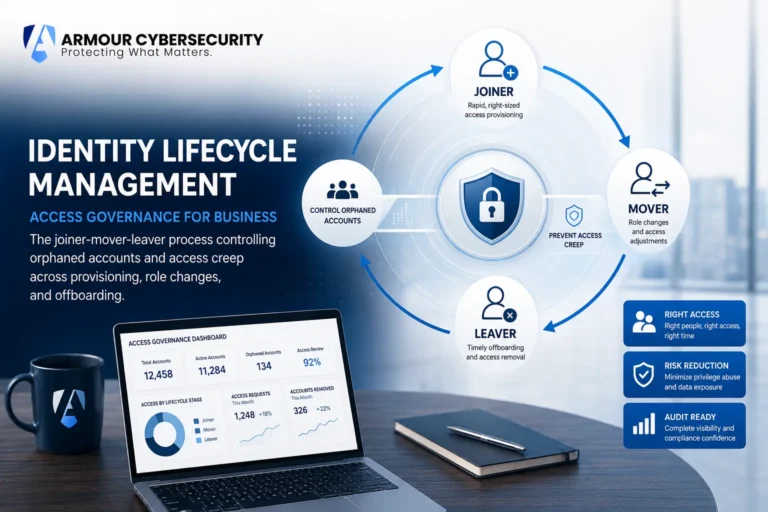
  • Automated provisioning and deprovisioning tied to HR events for joiners, movers, and leavers.
Our IAM/PAM Services

End-to-end coverage of the identity and privileged access lifecycle.

Engage individual services or a coordinated full-program build. Every service is delivered against the same standardized methodology so deliverables compose cleanly into a unified identity function.

01 / ASSESSMENT

Identity Posture Assessment

Structured assessment of current identity architecture, privileged account inventory, MFA coverage, SSO posture, and access governance practices against zero trust principles and industry frameworks.

02 / ARCHITECTURE

Zero Trust Identity Architecture

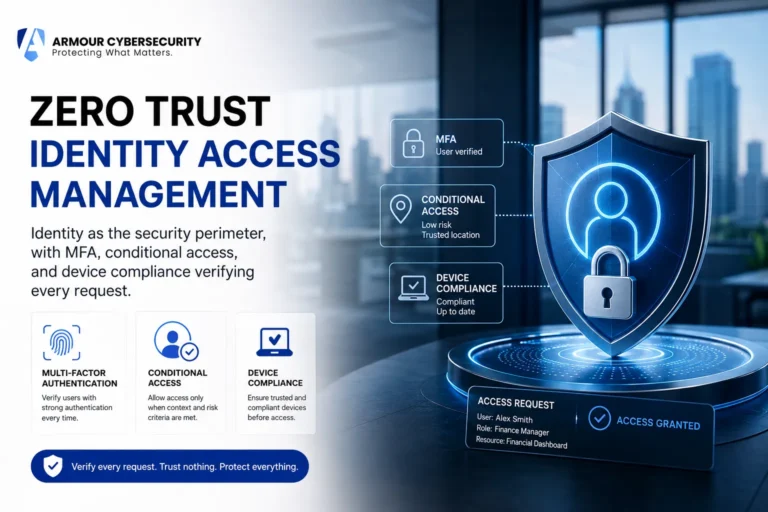
Target identity architecture design covering users, administrators, service accounts, contractors, and external identities. Aligned to zero trust principles and tailored to your directory infrastructure.

03 / PAM

PAM Implementation

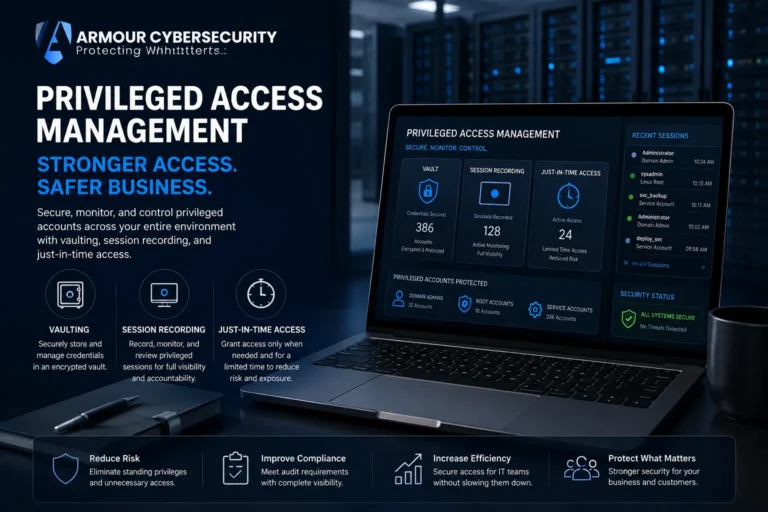
Privileged Access Management tooling deployed for administrator accounts. Password vaulting, session recording, just-in-time access, and audit logging configured to your environment and operational workflows.

04 / MFA

Multi-Factor Authentication

MFA deployment across agreed platforms covering users, administrators, and external identities. Configured with risk-based policies that balance security with user experience.

05 / SSO

Single Sign-On Configuration

SSO configured across agreed applications to reduce credential sprawl, improve user experience, and create a single auditable authentication point for security operations.

06 / DIRECTORY

Directory Modernization

Modernization of identity directory infrastructure where appropriate, including cloud identity provider integration, hybrid identity design, and consolidation of legacy directory sources.

07 / GOVERNANCE

Access Governance & Reviews

Quarterly access review process design with role-based access control framework, certification workflows, exception handling, and the cadence that keeps the program healthy between engagements.

08 / LIFECYCLE

Joiner-Mover-Leaver Workflows

Automated provisioning and deprovisioning workflows tied to HR events. Role-based assignment, timely revocation, and the documentation trail auditors expect for every access change.

09 / TRAINING

Administrator & Owner Training

Hands-on training for identity administrators, application owners, and access reviewers covering platform operations, access certification, and the day-to-day workflows that keep the program effective.

Who This Is For

Built for organizations where identity is the front line of defense.

Companies modernizing identity

Organizations consolidating legacy directories, moving to cloud identity providers, or building zero trust architecture for the first time. We deliver the design, tooling, and governance to make the modernization stick.

Compliance-driven implementations

Companies pursuing SOC 2, ISO 27001, HIPAA, PCI DSS, or CMMC certification where IAM controls and privileged access governance are explicit, audited control requirements.

Post-incident programs

Organizations recovering from credential compromise, ransomware, or insider incident that revealed how much was missing from identity controls. We build the program that should have been in place.

Mid-market and enterprise

Organizations with hundreds to thousands of identities, multiple directories, complex application portfolios, and contractor or vendor ecosystems that need structured identity governance.

Our Methodology

A six-phase engagement built on disciplined consulting practice.

Every Armour Cybersecurity IAM/PAM engagement follows the same standardized phases. The discipline is what turns identity from a scattered set of controls into a coherent program your team can operate independently.

1

Identity Discovery & Gap Analysis

Document the current identity architecture, privileged account inventory, MFA coverage, SSO posture, and access governance practices. Identify gaps against zero trust principles and framework requirements.

2

Architecture Design

Target zero trust identity architecture documented across users, administrators, service accounts, contractors, and external identities. Integration approach defined for existing directory infrastructure.

3

Tool Selection & PAM Implementation

PAM platform selected and deployed for privileged accounts including password vaulting, session recording, just-in-time access, and audit logging. MFA platforms configured across agreed scope.

4

Access Provisioning & SSO

SSO configured across agreed applications, automated provisioning and deprovisioning workflows tied to HR events, and role-based access control framework documented for ongoing operation.

5

Governance & Access Reviews

Quarterly access review process designed and operationalized, certification workflows configured, exception handling documented, and the cadence established for ongoing program health.

6

Training & Validation

Administrator and identity-owner training delivered, runbooks documented for ongoing operations, post-implementation validation conducted, and handoff package prepared for independent program operation.

What You Receive

Outputs your administrators, auditors, and identity owners can all use.

Every deliverable is structured for direct use by your identity team, your application owners, and your external auditors during certification engagements.

IAM/PAM Architecture Design

Documented zero trust identity architecture covering users, administrators, service accounts, contractors, and external identities, integrated with your directory infrastructure.

Privileged Account Inventory

Complete inventory of privileged accounts across the environment with risk classification, ownership, vaulting status, and remediation priority.

Access Governance Policy

Role-based access control framework documented with policies, procedures, decision rights, and exception handling for ongoing governance operation.

Tool Configuration Documentation

PAM platform setup and tuning documentation covering vault configuration, session recording, just-in-time access policies, and audit log integration.

MFA & SSO Configuration Guide

Documented MFA and SSO deployment covering user scope, application coverage, risk-based policies, and the configuration baselines for ongoing operation.

Quarterly Access Review Template

Standardized access certification process template with reviewer assignments, certification workflows, exception handling, and reporting outputs for ongoing reviews.

Joiner-Mover-Leaver Workflows

Documented automated provisioning and deprovisioning workflows tied to HR events, including role-based assignment logic and audit trail requirements.

Administrator & User Training Materials

Training documentation covering platform administration, access certification workflows, exception handling, and the day-to-day operations of the program.

Compliance Mapping

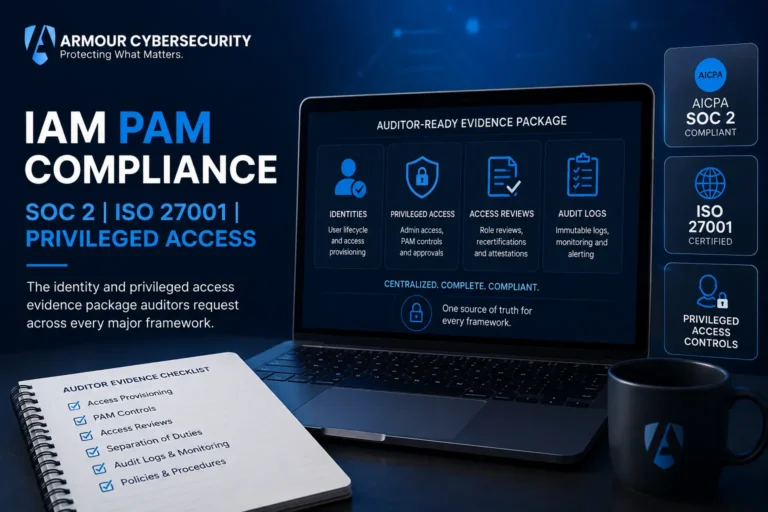
Documented mapping of IAM/PAM controls to NIST SP 800-63, ISO 27001, SOC 2, HIPAA, PCI DSS, CMMC, and CIS Controls for direct use during audits.

Why Armour Cybersecurity

The numbers behind the work.

Founded by military intelligence veterans with senior advisors from PwC, KPMG, Deloitte, EY, and Mandiant. The track record reflects the discipline.

260+

Clients Served

Organizations across finance, healthcare, technology, energy, legal, and government trust Armour Cybersecurity to protect what matters.

97%

Client Retention Rate

Long-term engagements built on consistent quality, predictable delivery, and consulting relationships that compound in value over time.

52+

Industries · Worldwide Reach

Cross-sector experience spanning every major regulated industry, with operations supporting clients across North America, Latin America, and beyond.

80+

Cybersecurity Technology Solutions

A vetted catalogue of technology partnerships and proprietary methods deployed in support of every engagement.

Ready to bring privileged access under control?

Schedule a no-obligation IAM/PAM scoping conversation with our identity team.

Schedule an IAM/PAM Assessment
Protecting What Matters.
Frequently Asked

IAM/PAM questions, answered directly.

What is the difference between IAM and PAM?
Identity and Access Management (IAM) is the broad discipline of managing who can do what across your environment. It covers user accounts, application access, authentication, and provisioning. Privileged Access Management (PAM) is the narrower discipline focused on the small group of accounts that can do anything: administrators, root accounts, service accounts with broad rights, and break-glass credentials. Most engagements cover both because the architecture and tooling integrate tightly.
Which directory and PAM platforms do you support?
We have implementation experience across the major identity providers and PAM platforms used in mid-market and enterprise environments. Platform selection is part of the engagement: we evaluate options against your environment, integration requirements, operational maturity, and budget during the architecture design phase and recommend the best fit. Existing platform investments are accommodated where they make sense.
How long does a typical IAM/PAM engagement take?
Most engagements complete within twelve weeks. Assessment and design take three weeks, tool implementation takes five weeks, and governance setup plus training take the final four weeks. Larger environments with complex directory consolidation, extensive application SSO scope, or large privileged account inventories extend the timeline; smaller engagements complete faster.
Will this disrupt our users during deployment?
Disruption is minimal when deployments are run properly. PAM tooling is initially deployed in parallel with existing access methods, then privileged accounts are migrated gradually. MFA and SSO rollouts are phased by user group with clear communication and support windows. The architecture design phase specifically identifies disruption risk and plans rollout sequencing to minimize it.
Do we still need our existing IT team to run identity?
Yes. Identity and access management is an ongoing operational function, not a one-time project. Our engagement delivers the architecture, tooling, processes, and training so your existing IT team can operate the program effectively. Many clients use the engagement as a structured way to mature internal identity capability and reduce dependency on external consultants over time.
Will this satisfy our compliance requirements?
Yes. IAM and PAM controls are explicit, heavily-audited control areas in SOC 2, ISO 27001, HIPAA, PCI DSS, CMMC, and NIST CSF. Our deliverables (architecture documentation, access governance policy, quarterly review templates, PAM configuration evidence) are formatted for direct use during the formal audit engagement and mapped to applicable framework requirements.
What happens if we already have some IAM/PAM tools in place?
Many engagements start from partial deployments rather than greenfield. We assess what is already in place, identify gaps and configuration issues, and integrate existing investments into the target architecture rather than ripping and replacing. The goal is a coherent program, not a particular toolset. Where existing tools cannot scale to the target architecture, we recommend phased migration.
Get Started

Schedule your IAM/PAM scoping conversation.

Tell us about your identity environment and what is driving the conversation. We will respond within one business day with next steps.

Speak with our identity team

Headquarters
77 Bloor St West, Suite 600
Toronto, ON

Request a consultation