Cyber Awareness Training for Regulated Industries: What PIPEDA, SOC 2, and ISO 27001 Actually Require
Aug 4, 2026
Compliance is a floor, not a ceiling. Here is what PIPEDA, SOC 2, ISO 27001, and NIST CSF actually require of a...


A fully managed cyber awareness training program with role-based modules, simulated phishing, real-time risk scoring, and audit-ready compliance evidence for PIPEDA, SOC 2, ISO 27001, and NIST CSF. Built to shift culture, not check a box.
The overwhelming majority of breaches start with a phishing email. Employees remain the primary attack vector for organized criminal groups, nation-state actors, and opportunistic threat actors targeting organizations of every size. Annual compliance training does not change that reality, because retention fades within weeks and the threat landscape does not pause between sessions.
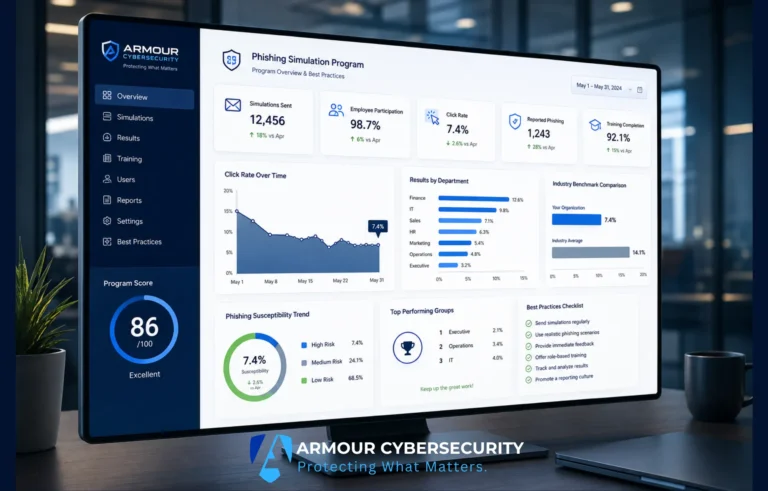
Armour Cybersecurity delivers a fully managed Cyber Awareness Training program that transforms the workforce into a proactive line of defense. Role-based curricula are designed for executives, finance, HR, IT, and general staff. Simulated phishing runs on a rolling monthly schedule. Risk scoring tracks behavioural change at the user and organizational level. Repeat-clickers receive automated micro-training. Quarterly executive reports translate the activity into board-ready evidence of program effectiveness.
Every component is mapped to applicable regulatory frameworks from day one. Audit evidence is generated automatically. The program is operated by certified specialists with IDF Intelligence Corps and Big 4 consulting backgrounds, so the experience is delivered with the discipline boards and auditors expect.
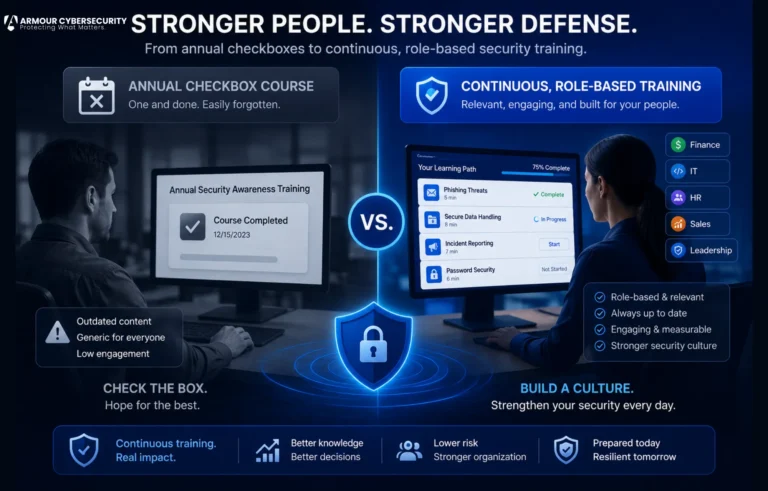
The difference between organizations whose employees report phishing and organizations whose employees click it is rarely intelligence or intent. It is whether the security program treats human risk as a continuous engineering problem or as a once-a-year compliance task.
The organization runs a single annual security course to satisfy compliance. Click rates on real phishing remain unchanged. Repeat-clickers are never identified. There is no role-based content, no simulated phishing, no risk score, and no way for the board to evaluate whether human risk is improving or worsening. Auditors ask for evidence and the response is a completion spreadsheet that nobody trusts.
Role-based modules are delivered on a rolling schedule. Simulated phishing runs monthly with teachable-moment redirects. Repeat-clickers receive automated micro-training and escalated reinforcement. Risk scoring tracks behavioural change at the user, team, and organizational level. Compliance evidence is generated automatically. Quarterly reports document risk reduction in language the board can act on.
Nine integrated components, delivered as a managed service so the internal team can focus on outcomes instead of operating the platform.
Content tailored to executives, finance, HR, IT, and general staff. Right message, right audience, right scenario, mapped to the specific risks each role actually faces.
Monthly simulated attacks with templates customized to the industry, threat landscape, and seasonal scenarios. Realistic enough to teach, safe enough to deploy at scale.
Targeted exercises against high-risk roles including executives, finance, and IT administrators, with vishing scenarios to test the human response to voice-based social engineering.
Real-time landing pages and micro-training automatically delivered to employees who click simulated threats, converting the failure into an immediate learning opportunity.
Interactive e-learning covering phishing, password hygiene, social engineering, removable media, remote working security, BEC, ransomware, and incident reporting.
Live behavioural analytics showing organizational and per-user risk scores, trend lines over time, and identification of repeat-clickers and high-risk cohorts requiring intervention.
Automated enrolment of new hires, role-change reassignment, and leavers management through the organization's HR or HRIS system, on a two business day SLA.
Monthly awareness newsletters, security tip communications, and up to two annual live or virtual security awareness webinars to reinforce key behaviours.
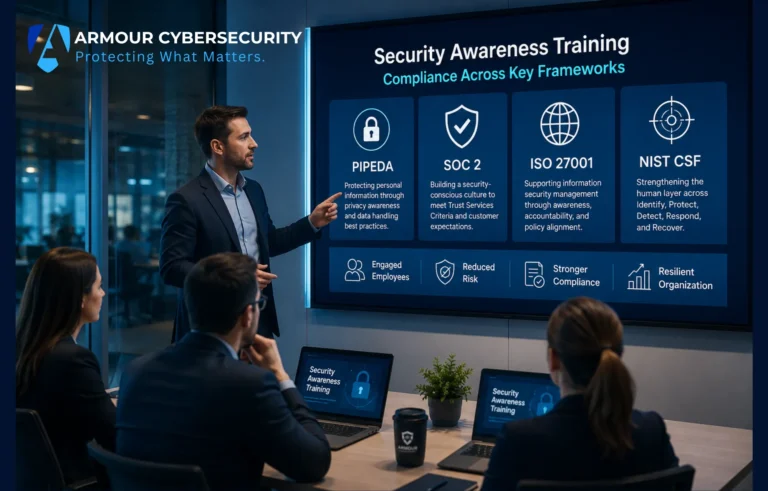
Automatically generated evidence packages mapped to PIPEDA, SOC 2, ISO 27001, and NIST CSF, structured for auditor review and ready before year-end audits begin.
Built for organizations that need to demonstrate measurable progress on human risk, satisfy auditors, and protect themselves from the breach vectors that target employees first.
Organizations between twenty-five and several thousand employees that need a managed program with predictable cost, measurable outcomes, and audit evidence without building an internal awareness team.
Finance, healthcare, legal, and government organizations subject to PIPEDA, SOC 2, ISO 27001, HIPAA, PCI DSS, or sector-specific obligations that require documented, continuous security awareness programs.
Companies preparing for SOC 2, ISO 27001, or other certifications where evidence of an active, measurable awareness program is a hard requirement rather than a nice-to-have.
Security leaders who need to demonstrate measurable risk reduction in their awareness program, isolate repeat-offender cohorts, and report quarterly outcomes to executives and the board.
The program follows a structured engagement model that establishes the baseline, customizes content, launches at scale, measures behavioural change, and feeds the next quarter of improvements.
Surveys, dark-web exposure checks, and stakeholder interviews establish the current security culture and identify the highest-risk cohorts. A baseline phishing simulation captures the starting click rate.
Curricula and phishing templates are customized to the industry, threat landscape, compliance obligations, and brand. Content is ready for deployment within five business days of kickoff.
Modules are deployed via the existing LMS or the managed cloud platform. Simulated attacks run on a rolling schedule so employees stay sharp year-round rather than peaking once a year.
Click-through rates, completion stats, and risk scores are tracked monthly. Repeat-clickers receive targeted micro-training automatically. High-risk cohorts receive escalated interventions.
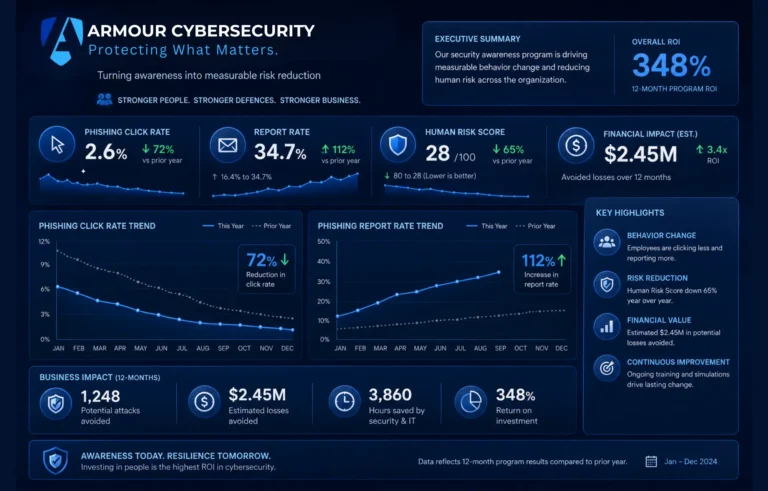
Quarterly executive reports translate operational metrics into board-ready risk reduction outcomes. Monthly programme reports document SLA performance and detailed campaign results.
An annual program review aligns the curriculum, simulation strategy, and risk scoring with the evolving threat landscape and organizational changes. The next year's program is refined accordingly.
Nine integrated deliverables built to satisfy auditors, equip security leadership, and demonstrate measurable behavioural change quarter over quarter.
Monthly simulated phishing campaigns with industry benchmarking, trend analysis, and per-team and per-user click and report metrics.
Over two hundred training modules covering core security hygiene, role-specific scenarios, and emerging threats, refreshed quarterly to reflect current adversary behaviour.
Audit-ready evidence packages mapped to PIPEDA, SOC 2, ISO 27001, and NIST CSF, generated automatically and structured for direct auditor review.
Live dashboard showing organizational and per-user risk scores, trend lines, repeat-clicker identification, and the high-risk cohorts requiring targeted intervention.
Automated micro-training delivered to employees who click simulated threats, with escalated reinforcement for repeat-clickers built into the platform.
Branded monthly newsletters and security tip communications that maintain awareness between formal training cycles and reinforce key behaviours.
Up to two annual live or virtual security awareness webinars covering current threat trends, organizational context, and behavioural reinforcement.
Automated new-employee enrolment, role-change reassignment, and leaver management through the organization's HR or HRIS system, on a two business day SLA.
Executive summaries with risk reduction KPIs, ROI metrics, and the residual high-risk cohorts that warrant additional intervention, delivered each quarter.
Founded by military intelligence veterans with senior advisors from PwC, KPMG, Deloitte, EY, and Mandiant. The track record reflects the discipline.
Organizations across finance, healthcare, technology, energy, legal, and government trust Armour Cybersecurity to protect what matters.
Long-term engagements built on consistent quality, predictable delivery, and consulting relationships that compound in value over time.
Cross-sector experience spanning every major regulated industry, with operations supporting clients across North America, Latin America, and beyond.
A vetted catalogue of technology partnerships and proprietary methods deployed in support of managed cyber awareness training and human-risk reduction programs.
Schedule a fifteen-minute discovery call to scope the program. Protecting What Matters starts with the people who answer the email.
Book Discovery CallCommon questions from CISOs, HR leaders, and compliance owners evaluating a managed awareness program.
Reach out to scope a Cyber Awareness Training engagement. Discovery calls are scheduled within two business days.
Tell us about the organization, employee headcount, and compliance objectives. A senior advisor will respond within two business days.
Security awareness insights for organizations building a stronger human firewall.