Quick answer: Continuous security awareness training replaces the once-a-year compliance course with an ongoing, role-based program: monthly simulated phishing, teachable-moment micro-training at the point of failure, automated escalation for repeat-clickers, and continuous risk scoring. It works because it matches how people actually learn and forget, and because it produces measurable behavioural change instead of a completion certificate.
Key Takeaways
- Most organizations do not have an awareness problem. They have an awareness program design problem: one course, once a year, for everyone.
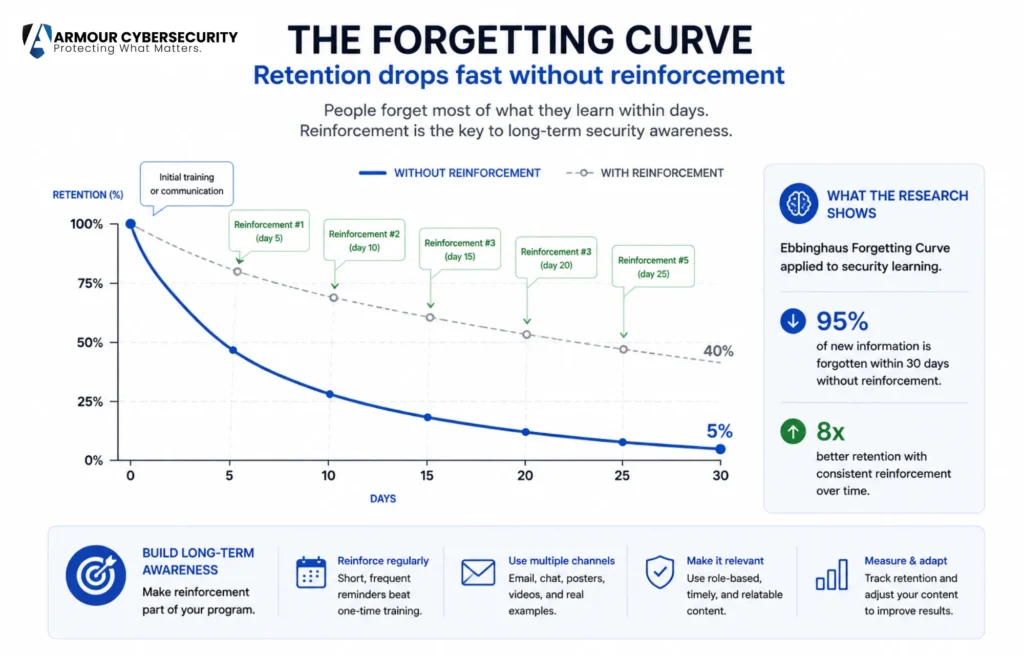
- Annual training was built to satisfy an auditor, not to change behaviour, and retention fades within weeks.
- Continuous programs work because they are role-based, reinforced monthly, and measured, not because they add more training.
- Repeat-clickers, a small cohort carrying outsized risk, only get identified and helped in a continuous, data-driven program.
- Continuous programs also produce the audit-ready evidence that SOC 2, ISO 27001, and PIPEDA increasingly expect.
Most organizations do not have a security awareness problem. They have a security awareness program design problem. The distinction matters, because the wrong diagnosis leads to the wrong fix, and the wrong fix is precisely what most compliance calendars recommend: one course, once a year, for every employee regardless of role.
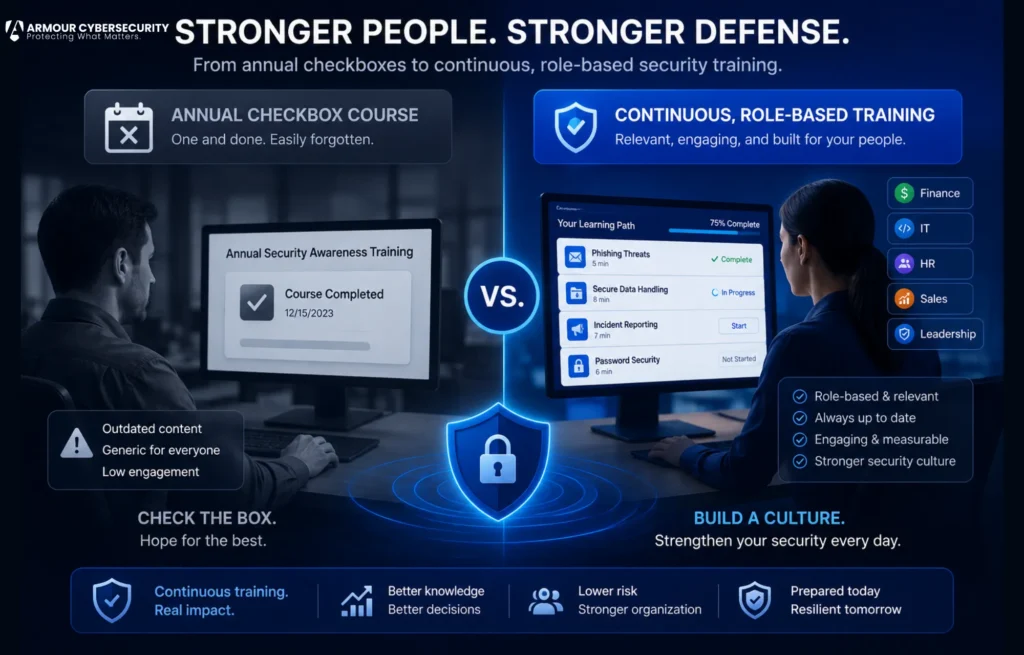
That model was never built to change behaviour. It was built to satisfy an auditor. And it does, for exactly as long as it takes the completion certificate to be filed.
The Research Is Clear: Retention Fades Fast
Studies on security awareness retention consistently find that without reinforcement, employees lose more than half of what they learned within a month. By the time the next annual course arrives, the previous year’s content has largely vanished from working memory. In the interim, threat actors have launched hundreds of thousands of phishing campaigns, refined their social engineering techniques, and identified new pretexts that no annual course could have anticipated.
The problem is not that employees are careless or inattentive. It is that human memory does not preserve low-frequency, high-volume information dumps. Training designed for auditors is optimized for completion rates, not behavioural change.
60% of confirmed breaches involve a human element such as phishing, credential theft, or social engineering (Verizon 2025 DBIR).
~30 days the window in which phishing click-rates typically drift back toward baseline after a one-time training event, absent reinforcement.
74% of organizations that experienced a breach in the past year had completed their annual security training.
What Fails, and Why
One-size-fits-all content
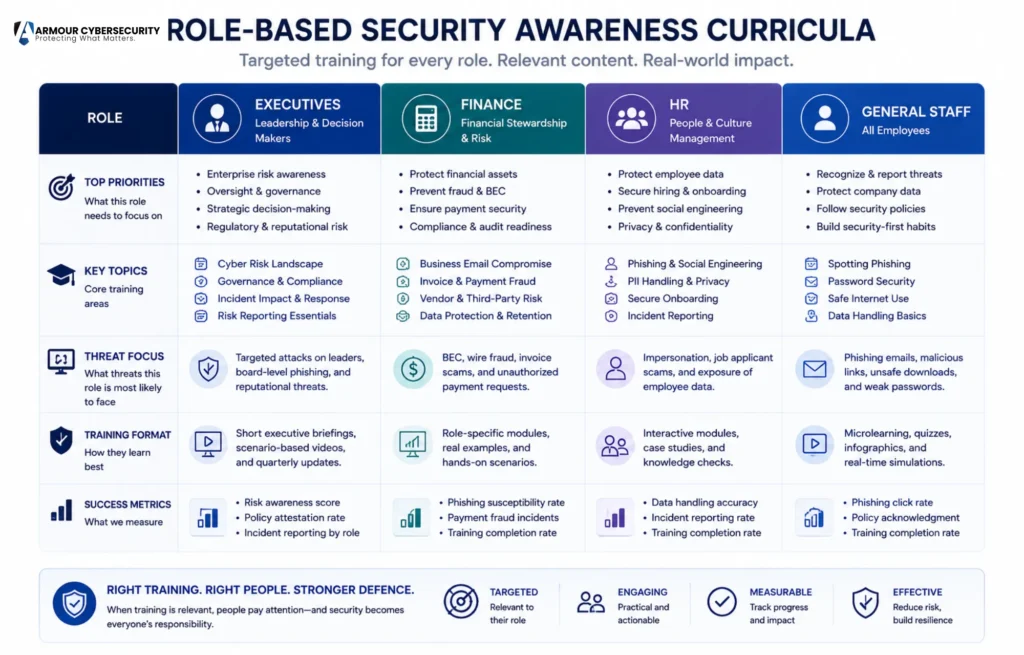
An executive facing spear-phishing and business email compromise has fundamentally different risk exposure than a warehouse operative or a junior HR analyst. Annual training that delivers identical content to every employee ignores this reality. The executive skips through slides they consider irrelevant. The HR analyst, who handles sensitive personal data daily, receives no training on the specific pretexts used to target people in their role. Neither is better prepared.
No measurement of behavioural change
Completion rates tell you nothing about risk reduction. A 100 percent course completion rate is consistent with a click rate on real phishing emails that has not moved in three years. Without simulated phishing data, risk scoring, and trend analysis over time, the organization has no visibility into whether its investment is working. The board cannot evaluate it. The CISO cannot defend it. The auditor accepts it because they have no alternative metric to request.
No reinforcement between cycles
Threat actors do not pause between your annual training windows. Business email compromise pretexts evolve with current events. Seasonal phishing campaigns exploit tax season, health benefits enrolment, and payroll updates. Employees who are never exposed to simulated versions of these threats have no frame of reference when the real ones arrive, which is why layered phishing prevention depends on people as much as filters.
No consequence for repeat-clickers
In most annual programs, an employee who clicks every simulated phish receives the same training as an employee with a perfect track record. Repeat-clickers, typically a small cohort responsible for a disproportionate share of risk, are never identified, never escalated, and never given targeted intervention. They remain invisible until an incident forces a post-mortem.
What a Continuous Program Looks Like
The alternative is not more training. It is smarter, continuous training designed around how human learning actually works, and it is the operational engine behind a genuine security awareness culture.
Role-based curricula
Content is segmented by the actual risk profile of each role. Executives receive targeted spear-phishing and BEC scenarios. Finance teams train on invoice fraud and wire transfer pretexts. HR teams focus on identity theft and benefits manipulation. General staff receive core hygiene training: phishing recognition, password behaviour, secure remote work. Every employee gets content relevant to the threats they actually face.
Monthly simulated phishing
Simulated campaigns run on a rolling monthly schedule, not as a one-time baseline. Templates are customized to the industry, seasonal threat calendar, and current adversary behaviour informed by threat intelligence. Those who click receive immediate teachable-moment micro-training at the point of failure, when attention is highest and the lesson is most likely to stick.
Automated escalation for repeat-clickers
Employees who click multiple simulated phishing attempts are automatically flagged and placed into an escalated reinforcement track. Managers are notified. Targeted micro-training is assigned. The cycle continues until behavioural improvement is confirmed in the data.
Continuous risk scoring
Risk scores are calculated at the user, team, and organizational level on a rolling basis. Trend lines show whether the program is working. Quarterly executive reports translate the data into board-ready evidence: not a completion spreadsheet, but a documented record of measurable behavioural change over time.
Across the 260+ organizations Armour protects in 52+ industries, the programs that actually move phishing click-rates are the continuous, role-based ones. The annual-course clients look compliant on paper and behave no differently under a real lure.
The Compliance Question
Regulators and auditors increasingly expect more than completion records. PIPEDA, SOC 2, ISO 27001, and NIST CSF all contain provisions that are difficult to satisfy with a once-a-year course: continuous control effectiveness, documented risk reduction, and evidence of program improvement over time, the same standard behind broader compliance readiness.
A managed continuous program generates this evidence automatically. Phishing simulation results, risk score trend data, completion records segmented by role, and the escalation history for repeat-clickers are all available in structured audit-ready packages, built throughout the year, not assembled at the last minute before an audit window opens.
Organizations preparing for SOC 2 Type II certification, ISO 27001 audits, or regulatory reviews under PIPEDA find that a continuous awareness program does not just satisfy the evidence requirement. It tells a materially better story about the organization’s approach to human risk.
The Decision
Annual training is not free. It costs employee time, license fees, and administrative overhead. The question is not whether to invest in security awareness. It is whether to invest in a program designed to change behaviour or in one designed to generate a completion certificate.
For organizations that have experienced a breach, are preparing for a compliance audit, or have a board that expects quantified evidence of risk reduction, the decision is clear. A continuous, role-based, measurement-driven awareness program is not a premium option. It is the minimum viable approach to human-risk management in 2026.
Awareness training rarely works alone. It is one pillar of Armour’s managed cybersecurity services, operating alongside a managed Security Operations Center for detection, cyber threat intelligence on live adversary behaviour, vulnerability management for the technical layer, vCISO leadership for governance, and the all-in-one Armour 360 managed program.
The Bottom Line
A completion certificate proves an employee sat through a course. It does not prove they will hesitate before clicking a well-crafted invoice lure eight months later. Continuous, role-based, measured training is what closes that gap, and it produces the audit evidence as a by-product. Armour’s managed cyber awareness training shifts behaviour and generates audit-ready evidence on a continuous basis. Schedule a fifteen-minute discovery call to scope a program for your organization.
Frequently Asked Questions
What is continuous security awareness training?
A: It is an ongoing program that replaces the once-a-year compliance course with role-based content, monthly simulated phishing, immediate micro-training when someone clicks, automated escalation for repeat-clickers, and continuous risk scoring. Instead of a single annual event, employees are reinforced throughout the year in a way that matches how people actually learn and forget.
Why isn’t annual security awareness training enough?
A: Because retention fades fast. Research consistently shows employees forget more than half of what they learned within about a month without reinforcement. Annual training is optimized for completion rates, not behavioural change, so a 100 percent completion rate can coexist with a real-world phishing click rate that has not improved in years. Attackers, meanwhile, refine their techniques continuously between your training windows.
What is role-based security awareness training?
A: It segments training by the actual risk profile of each role. Executives train on spear-phishing and business email compromise, finance teams on invoice and wire-transfer fraud, HR on identity theft and benefits manipulation, and general staff on core hygiene. Everyone receives content relevant to the threats they actually face, rather than identical slides for the whole company.
How does phishing simulation work in a continuous program?
A: Simulated phishing campaigns run on a rolling monthly schedule, with templates customized to the industry, the seasonal threat calendar, and current attacker behaviour. Employees who click receive immediate teachable-moment micro-training at the point of failure. Results feed risk scoring and trend analysis, and repeat-clickers are automatically escalated into a reinforcement track until the data shows improvement.
Does continuous awareness training help with SOC 2, ISO 27001, and PIPEDA compliance?
A: Yes. These frameworks increasingly expect evidence of continuous control effectiveness and documented risk reduction, which a once-a-year course cannot easily provide. A managed continuous program produces simulation results, risk-score trends, role-segmented completion records, and escalation history as structured, audit-ready evidence built throughout the year rather than assembled before an audit.
About the Author
David Chernitzky is the CEO and Co-Founder of Armour Cybersecurity, a Toronto-based firm that protects organizations across North America from advanced cyber threats. He brings more than 25 years of cybersecurity and military cyber intelligence experience, having served as an officer in an elite technology unit before co-founding Armour. Armour’s team of military-intelligence veterans and senior advisors serves 260+ clients across 52+ industries with a 97% client retention rate.