Quick answer: A quarterly vulnerability scan tells you where your environment stood on the day the scan ran. By the time anyone acts on the report, new vulnerabilities have been published, new assets have appeared on your network, and the findings you were not going to fix anyway are three months older. Continuous vulnerability management replaces the point-in-time snapshot with an ongoing program that tracks your real attack surface in real time.
Key Takeaways
- New CVEs are published daily. A quarterly scan misses everything disclosed between scan dates.
- Environments change constantly. New devices, cloud workloads, and applications appear between scans without security review.
- Most scan findings are never remediated. Without a tracking and verification process, the report is the end of the process rather than the beginning.
- Attackers move faster than quarterly cycles. A critical vulnerability disclosed on a Tuesday can be weaponized and exploited at scale within days.
- Auditors, enterprise customers, and cyber insurance carriers increasingly distinguish between point-in-time scans and continuous programs when evaluating security posture.
What Is the Gap Between a Quarterly Scan and Continuous Management?
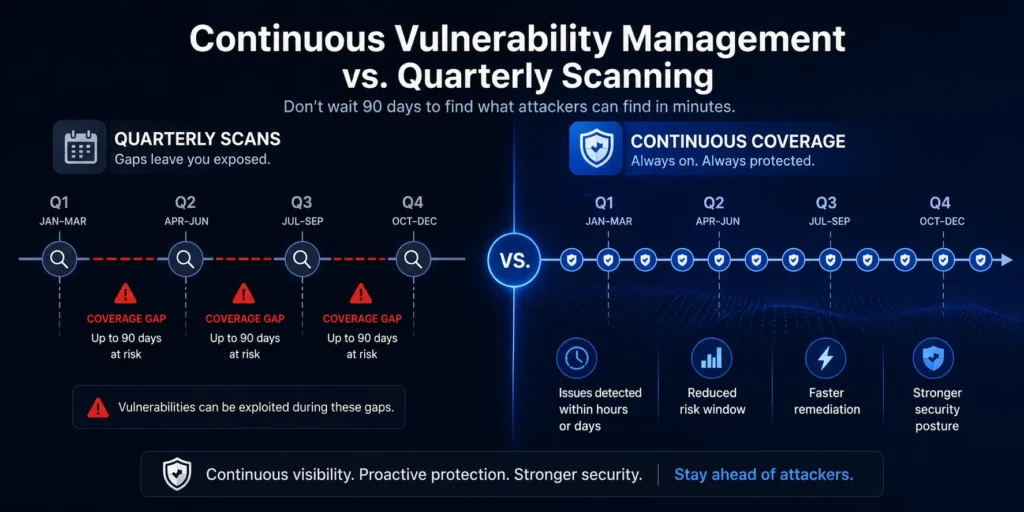
Most organizations that believe they are actually managing vulnerabilities are actually running scans. The scan completes, the report is delivered, a few findings are remediated, and the next scan is scheduled for three months later. In the interval between those two scans, the environment is largely unmonitored from a vulnerability perspective.
That interval is where risk accumulates. Security researchers and vendors publish new CVE disclosures continuously throughout the year. A software vendor issues a critical patch for a widely deployed product, and within days exploit code is circulating in threat actor communities. An organization whose last scan ran six weeks ago has no visibility into whether that newly disclosed vulnerability exists on its systems.
The gap is not hypothetical. Verizon’s 2025 Data Breach Investigations Report found that exploitation of known vulnerabilities surged as an initial access route into breaches, and consistently shows that a large share of breaches exploit vulnerabilities for which patches were already available at the time of the attack. The patches existed. The organizations were not applying them systematically. Quarterly scanning with no remediation tracking is the process that produces that outcome.
How Fast Do Vulnerabilities Get Exploited After Disclosure?
The window between a vulnerability being publicly disclosed and it being actively exploited in the wild has narrowed significantly over the past several years. High-profile vulnerabilities in widely used software are now routinely weaponized within days of disclosure. The assumption that your organization has weeks or months to respond to a critical CVE is not supported by current threat intelligence.
This speed asymmetry favors attackers running continuous scanning against organizations running quarterly programs. An attacker’s automated tools identify every internet-facing system running vulnerable software within hours of a new exploit being published. An organization that scans quarterly will not know it is exposed for up to 90 days after that window opened. Regular penetration testing confirms which of those exposures are actually reachable from outside.
For SMBs without dedicated security staff monitoring threat intelligence feeds, the quarterly cadence is not a risk management decision. It is an absence of one. The business is not consciously accepting a 90-day exposure window. It simply has no visibility into what is happening to its attack surface between scans, which is exactly the visibility a managed SOC and a continuous program provide together.
What Changes in Your Environment Between Quarterly Scans?
One of the most significant problems with point-in-time scanning is that it only captures the environment as it existed at the moment the scan ran. Modern business environments are not static.
New assets appear without security review
Cloud platforms make it straightforward for any team member with appropriate permissions to spin up a new server, database, or application environment. Remote work has expanded the device population connected to business systems. Software-as-a-service applications are adopted by individual departments without IT involvement. Each of these adds to the organization’s attack surface, and none of them appear in a scan that ran before they existed.
A continuous asset discovery process identifies new assets promptly, before they operate for months outside any security oversight. In many organizations, the asset inventory produced by a first-pass discovery scan includes systems the IT team was not aware of.
Software and configurations drift over time
Systems that were fully patched at the time of the last scan receive new software, configuration changes, and application updates in the weeks and months that follow. Each of those changes can introduce new vulnerabilities. A server that was clean in January may have three new critical findings by March, none of which appear in any report the organization has seen.
New CVEs affect software already in your environment
Every piece of software your organization uses today will have new vulnerabilities disclosed against it. The CVE database grows by thousands of entries per year. A quarterly scan captures CVEs known at the time the scan ran. Everything disclosed in the 90 days between scans is invisible until the next cycle. A continuous program incorporates new CVE disclosures on an ongoing basis, so emerging vulnerabilities in your environment are identified and prioritized as they are published rather than at the next scheduled scan date.
What Happens to Findings That Are Not Tracked?
The second major failure mode of the quarterly scan model is what happens to the report after it is delivered. In most organizations, the answer is that critical findings get some attention and everything else accumulates.
Without a structured remediation tracking process, findings have no owner, no target date, and no verification step. A finding marked as remediated based on someone’s assertion that it was fixed may or may not have actually been addressed. A finding deferred because it seemed lower priority may remain open indefinitely. The medium and low findings from the first quarterly scan may still be open at the third quarterly scan, at which point the report has simply grown longer.
Continuous vulnerability management replaces the report-and-forget cycle with tracked remediation. Every finding has an assigned owner, a target remediation date based on its severity, and a verification requirement: the item is not closed until a follow-up scan confirms the vulnerability is no longer present. Open items are aged and escalated when they exceed target timelines. Leadership has real-time visibility into what has been fixed and what has not, rather than learning about overdue remediation during an audit.
In our work across 260+ client environments, the systems that cause incidents are rarely the ones flagged in the last quarterly scan. They are the ones that changed, or were added, in the weeks after it ran.
How Do Auditors and Cyber Insurance Carriers View the Difference?
The answer to this question has shifted significantly over the past few years and continues to move in one direction. Both audiences are becoming more sophisticated in how they evaluate vulnerability management, and both are increasingly distinguishing between organizations with point-in-time scan programs and those with continuous managed programs.
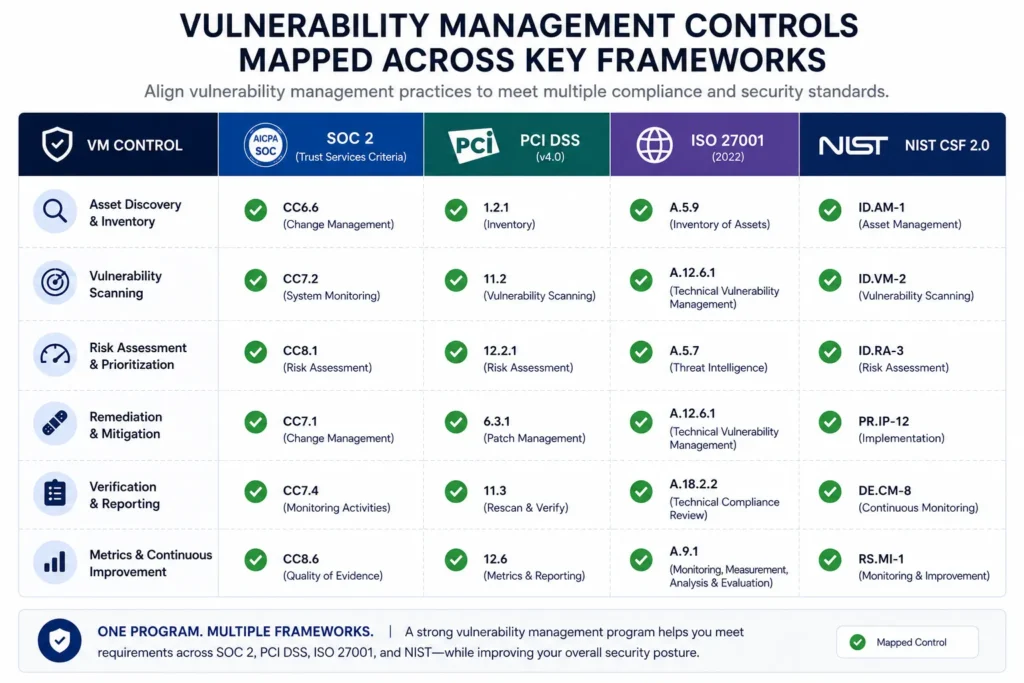
Auditors testing against SOC 2, ISO 27001, PCI DSS, and NIST CSF ask for evidence of an ongoing vulnerability management program. They request asset inventories, scan reports, prioritized remediation worklists, and evidence of closure. A quarterly scan report is technically responsive to these requests, but an auditor who sees that the same findings appear across multiple periods with no remediation progress will flag the program as deficient.
Cyber insurance carriers have become more direct. Underwriting questionnaires now commonly ask about scan frequency, asset coverage, and remediation cadence. Carriers that previously accepted an annual scan as evidence of vulnerability management are now asking specifically whether the program is continuous. Premium pricing and coverage availability are increasingly tied to the answers.
Armour Cybersecurity’s vulnerability management program produces monthly and quarterly reports structured to satisfy both audiences. Every deliverable is designed to provide the evidence that auditors request and that carriers require, produced as a standard output of the program rather than assembled retroactively under deadline pressure.
The Bottom Line
A quarterly scan answers a question no attacker asks: where were you 90 days ago? Continuous vulnerability management answers the one that matters: where are you exposed right now? For any small business facing an audit, an insurance renewal, or an enterprise customer’s security review, that shift from snapshot to ongoing evidence is fast becoming the baseline. Armour’s managed vulnerability management delivers it as a standard, reportable output.
Frequently Asked Questions
How is a continuous vulnerability management program different from running more frequent scans?
A: Frequency of scanning is one element of a continuous program, but not the defining characteristic. What separates continuous management from more frequent scans is the program around the scanning: continuous asset discovery that captures new systems as they appear, risk-based prioritization that sequences remediation by genuine business risk, tracked remediation with verified closure, and recurring executive reporting. More frequent scans without those elements still produce reports that may or may not be acted on.
What does a risk-based prioritization approach look like in practice?
A: A risk-based approach starts with the CVSS score as a baseline, then layers in additional context to sequence remediation. Is exploit code publicly available for this CVE? Is the affected system internet-facing or internal only? How critical is that system to business operations? Are there compensating controls in place that reduce the practical risk? The output is a prioritized worklist where the most dangerous combination of severity, exploitability, and asset criticality comes first, regardless of whether the raw CVSS score is the highest on the list.
Can a small business afford continuous vulnerability management?
A: The more relevant question is whether a small business can afford not to have it. A single breach that exploits an unpatched known vulnerability costs far more in remediation, legal fees, notification costs, and business disruption than a managed vulnerability program. Armour Cybersecurity structures programs for organizations of various sizes, with scope and cadence tailored to match the risk profile and budget of each engagement.
How does remediation verification work?
A: After a finding is remediated, a follow-up scan of the affected system confirms that the vulnerability is no longer present. Until that confirmation is received, the finding remains open in the remediation tracker. This prevents the common failure mode where a fix was applied incorrectly or incompletely, the ticket was closed, and the vulnerability remained exploitable for months.
Does continuous vulnerability management cover cloud environments?
A: Yes. A well-structured program covers cloud workloads alongside on-premises systems. Cloud environments introduce specific vulnerability classes, including misconfigured storage buckets, overly permissive identity and access management policies, and unpatched cloud-hosted operating systems, that require dedicated scanning profiles. Continuous asset discovery is particularly valuable in cloud environments where new resources are created frequently and can exist entirely outside security oversight if not captured promptly.
About the Author
David Chernitzky is the CEO and Co-Founder of Armour Cybersecurity, a Toronto-based firm that protects organizations across North America from advanced cyber threats. He brings more than 25 years of cybersecurity and military cyber intelligence experience, having served as an officer in an elite technology unit before co-founding Armour. Armour’s team of military-intelligence veterans and senior advisors serves 260+ clients across 52+ industries with a 97% client retention rate.