Quick answer: 24/7 threat monitoring for small businesses means security analysts watch your endpoints, email, and network around the clock, detect suspicious activity the moment it appears, and take defined response actions before it becomes a breach. For small businesses without a dedicated security team, it is the capability that most often determines whether an incident is contained or catastrophic.
Key Takeaways
- Most cyberattacks happen outside business hours, when no one is watching internal systems.
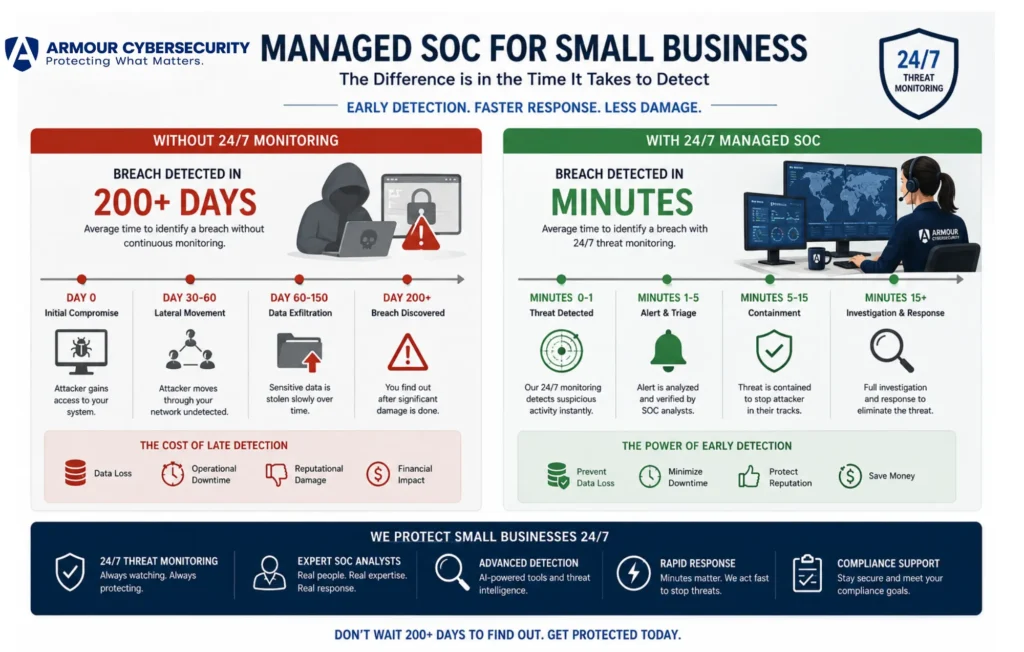
- Without continuous monitoring, the average time to detect a breach is over 200 days.
- 24/7 monitoring reduces detection time from months to minutes, which directly reduces breach cost.
- Monitoring alone is not enough. Response capability determines whether a threat is stopped or just observed.
- Armour 360 includes 24/7 monitoring and response by dedicated analysts at every service tier. Small business cybersecurity starts with knowing what is happening in your environment around the clock.
Why Small Businesses Need Continuous Security Monitoring
Most small businesses operate during business hours. Their security, such as it is, operates on the same schedule. An IT person who checks in on systems during the day, reviews alerts when time allows, and goes home at 6 p.m. is the standard model for SMB security operations.
Attackers do not follow that schedule. Automated scanning tools probe networks 24 hours a day looking for vulnerabilities. Ransomware deployments are timed for nights and weekends, when no one is present to intervene. Phishing campaigns run continuously. The gap between when a threat enters a network and when someone notices it is where attackers do their most damaging work.
IBM research consistently shows the average time to identify a breach is over 200 days. In that window, attackers have had months to move through the environment, access sensitive data, establish persistence, and prepare for the visible phase of the attack. By the time the ransom note appears or the data theft is noticed, the actual compromise happened long ago.
What Happens During 24/7 Threat Monitoring?
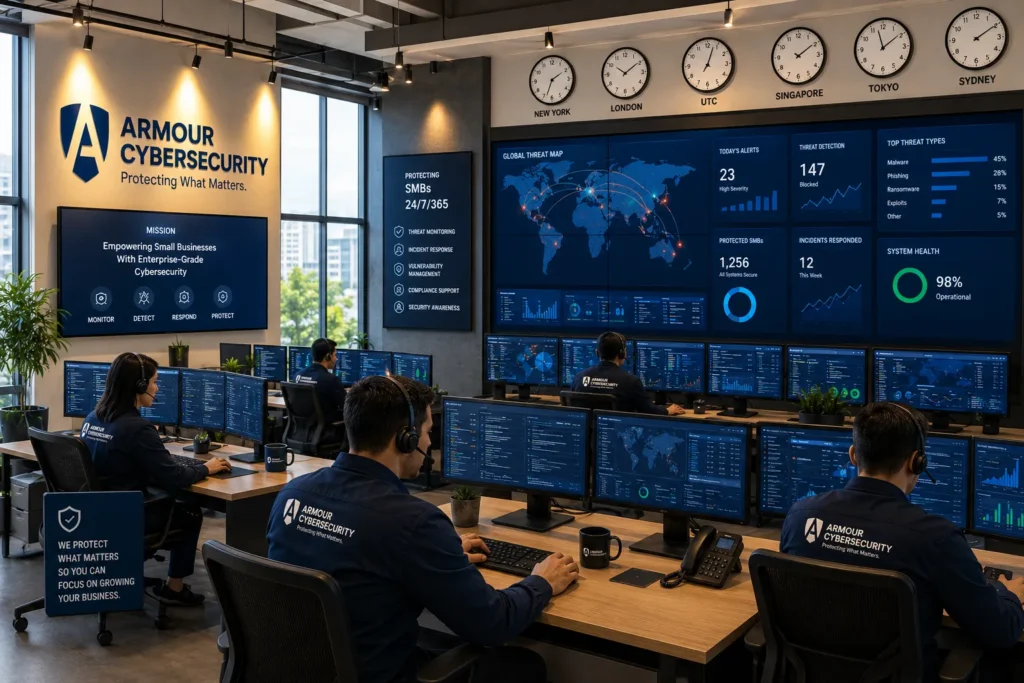
Continuous monitoring is not a dashboard that sits open on a screen. It is an active process run by analysts using specialized tools to detect, investigate, and respond to threats across your environment.
Signal collection across every layer
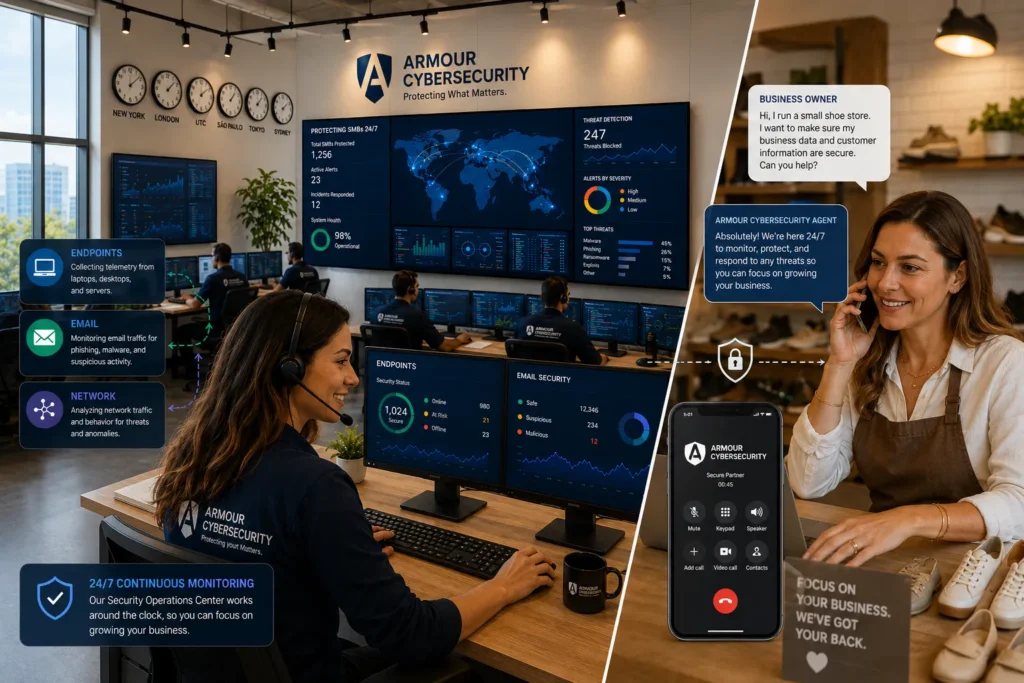
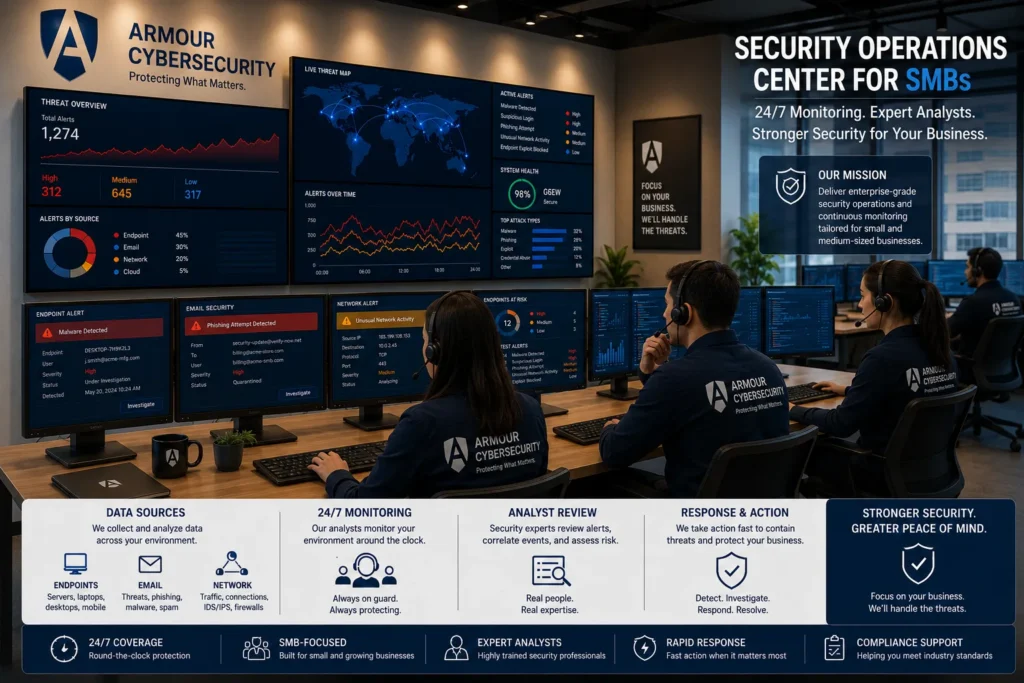
Monitoring begins with collecting security signals from every part of your environment. Endpoint detection software reports what is happening on each device. Email security logs track phishing attempts and suspicious links. Network monitoring captures traffic patterns and looks for anomalies. Authentication logs flag unusual login activity. In a well-structured managed cybersecurity program, these signals feed into a unified view rather than sitting in separate dashboards that no one has time to correlate.
Automated detection and analyst review
Detection tools apply rules and machine learning models to identify behavior that deviates from normal patterns. A device communicating with a known malicious server. An email account logging in from a country it has never been accessed from. A process spawning child processes in a pattern consistent with ransomware staging. These anomalies trigger alerts, which analysts review and investigate.
The analyst review step is where the difference between genuine monitoring and security theater becomes clear. A system generating alerts with no one to triage them provides a false sense of security. Managed monitoring means trained analysts are reviewing those alerts around the clock, distinguishing real threats from false positives, and escalating or responding based on what they find.
Response within agreed parameters
Detection without response is incomplete. When a genuine threat is confirmed, analysts take response actions: isolating a compromised endpoint from the network, blocking a malicious IP address, suspending a compromised account, or initiating an incident response procedure. In a managed service, these actions happen within agreed parameters so threats are contained quickly without requiring the client to approve every decision in real time.
Response actions that require higher-impact decisions, such as taking a business-critical server offline, are escalated to the client’s designated contact for authorization. The goal is containment speed balanced against operational awareness.
What Is a Managed SOC for Small Business?
A Security Operations Center, or SOC, is the team and facility where monitoring and response happen. For large enterprises, this is an internal team. For SMBs, it is typically provided as a managed service by a cybersecurity firm.
A managed SOC provides the same capability: analysts with specialized tools, established playbooks for responding to common incident types, and the institutional knowledge that comes from handling threats across many clients and environments. The advantage for an SMB is access to that capability without the cost of building and staffing an internal team, which runs to several million dollars annually before technology costs.
Armour 360 includes 24/7 monitoring and response as a standard component at every service tier. Analysts monitor endpoint, email, and network signals in a coordinated program, respond to confirmed threats within agreed parameters, and escalate to the client’s team only when business decisions are required. Monthly threat reports and quarterly reviews translate monitoring activity into business language for leadership consumption.
How Does 24/7 Monitoring Reduce the Cost of a Breach?
Breach cost research consistently identifies time to detection as the primary driver of total breach cost. The faster a threat is identified and contained, the less damage it does and the less expensive it is to remediate. The relationship is not linear: threats contained in minutes cost significantly less than threats discovered weeks later, because the attacker has had less time to expand access, steal data, and cause operational damage.
For small businesses, this matters for an additional reason. An SMB that discovers a breach months after it occurred faces retroactive notification obligations, regulatory scrutiny, and the reputational damage of informing clients that their data was exposed for an extended period. An SMB whose managed security team detects and contains the same threat in hours faces a manageable incident response, not an existential event.
What Should a Security Operations Center Cover for an SMB?
Effective monitoring for a small business needs to cover the surfaces that attackers actually use. The most common attack paths into SMBs are endpoints (laptops, desktops, servers), email, and network connections. Monitoring that covers only one of these leaves significant gaps.
A phishing email that delivers a malicious attachment needs email monitoring to catch the delivery, endpoint monitoring to catch the execution, and network monitoring to catch the outbound communication the malware initiates after running. Without all three, the attack is visible at only one point, and by the time that signal appears, damage may already be done.
Armour 360 coordinates endpoint, email, and network monitoring signals into a unified program. With SMB cybersecurity services built into a single coordinated platform, analysts get the complete picture needed to detect threats that span multiple surfaces, which is how most sophisticated attacks operate.
Can My IT Team Handle Monitoring Instead?
In most SMBs, the honest answer is no. Continuous monitoring requires around-the-clock availability, specialized detection tools, analyst expertise to distinguish real threats from false positives, and established response procedures for each threat type. IT generalists managing a 50-person company’s infrastructure and support requests are not in a position to deliver that alongside their existing responsibilities.
The more practical question is what monitoring coverage exists right now. If the answer is that alerts go into a system that gets checked when someone has time, the business has a significant detection gap. Closing that gap does not require hiring a security team. It requires engaging a managed security provider who already operates the infrastructure and employs the analysts needed to deliver continuous monitoring at a cost designed for businesses that are not enterprises.
The gap between when a threat enters your network and when someone notices it is where attackers do their most damaging work. Armour 360 closes that gap with 24/7 monitoring and response by dedicated analysts, so threats are caught in minutes, not months.
Get 24/7 Protection with Armour 360
Contact the Armour Cybersecurity team at armourcyber.io/armour-360 to learn how 24/7 monitoring works for your business.
Frequently Asked Questions
What does 24/7 threat monitoring mean in practice?
It means security analysts and automated detection tools are watching your endpoints, email, and network around the clock. When suspicious activity is detected, analysts investigate, confirm the threat, and take response actions within agreed parameters, rather than waiting for someone at your business to notice something is wrong.
How quickly does 24/7 monitoring detect a threat?
Detection speed depends on the type of threat and the monitoring coverage in place. With a well-configured managed security program, anomalous behavior that indicates an attack in progress can be detected in minutes. This contrasts with the industry average of over 200 days to identify a breach in organizations without continuous monitoring.
Does 24/7 monitoring mean someone is always looking at my systems specifically?
Monitoring operates through a combination of automated detection tools and human analyst review. Automated tools process security signals continuously and flag anomalies. Analysts review flagged activity, investigate confirmed threats, and respond. The result is continuous coverage without the cost of a dedicated analyst watching a single organization’s systems around the clock.
What happens when a threat is detected outside business hours?
In a managed security program, analysts operate on shifts that cover nights, weekends, and holidays. When a threat is confirmed outside your business hours, analysts take containment actions within agreed parameters, document the activity, and contact your designated emergency point of contact if the situation requires a decision from your team. You receive a full incident report regardless of when the event occurred.
Is 24/7 monitoring the same as having a firewall?
No. A firewall controls what traffic can enter and leave your network based on rules, but it does not detect what happens inside the network after traffic passes through it. 24/7 monitoring watches behavior across endpoints, email, and the network itself, detecting threats that have already passed perimeter controls and are operating inside your environment.
About David Chernitzky
David Chernitzky brings over 25 years of deep cybersecurity and military cyber intelligence experience, with a career rooted in strategic risk management and protecting critical systems against advanced threats. As CEO and Co-Founder of Armour Cybersecurity, he combines strategic vision with hands-on expertise to deliver practical, high-impact cyber defense solutions.