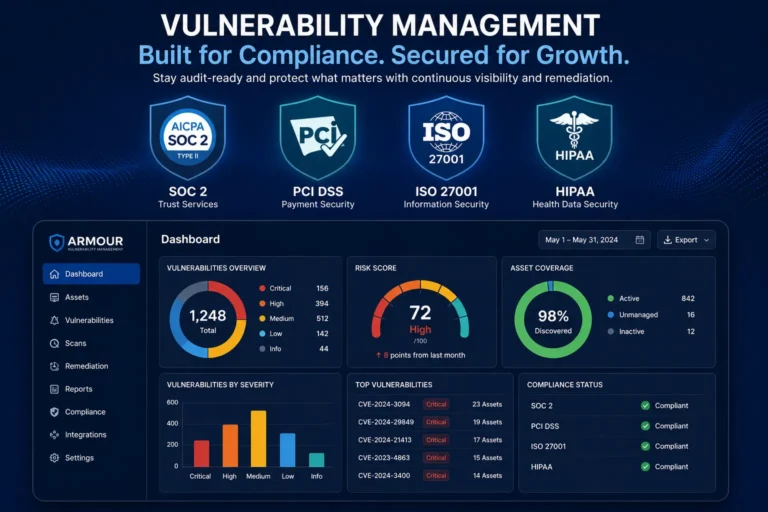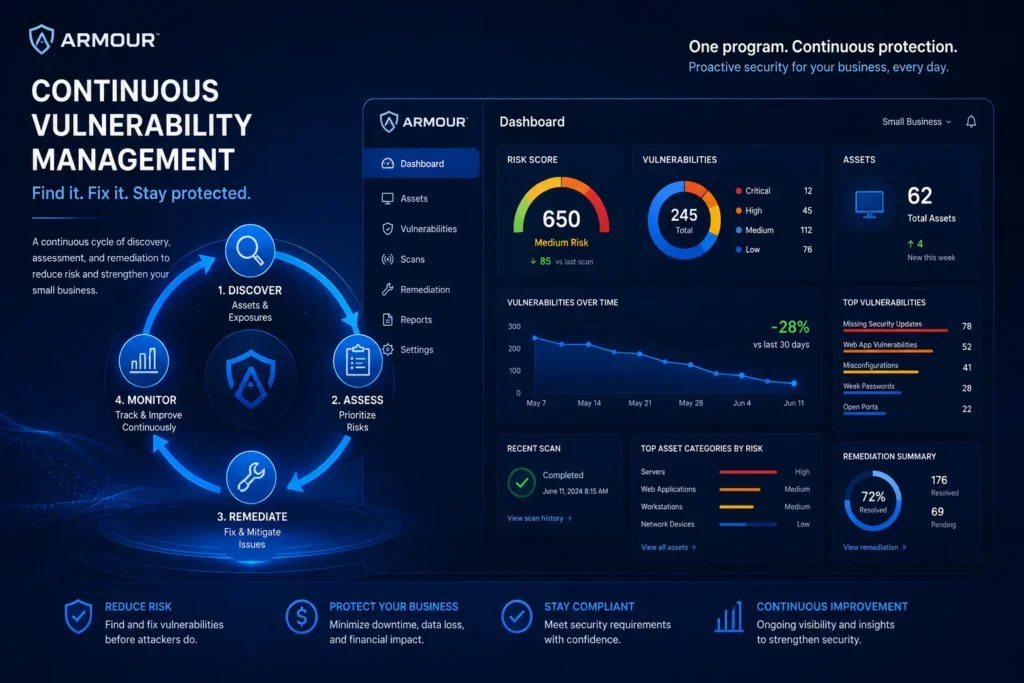
Quick answer: Vulnerability management is the continuous process of discovering, assessing, prioritizing, and remediating security weaknesses across your business systems before attackers find and exploit them. A one-time scan is not vulnerability management. A managed program that runs on an ongoing cadence, tracks fixes to confirmed closure, and reports progress to leadership is.
Key Takeaways
- Every connected system in your business has vulnerabilities. New ones are published daily. A program that only looks once gives you a snapshot that is out of date the moment the scan ends.
- Vulnerability management is not the same as a vulnerability scan. The scan finds weaknesses; the program ensures they get fixed and stays current as the environment changes.
- Most breaches exploit known vulnerabilities, not zero-day attacks. The fixes exist. The problem is that organizations do not apply them systematically.
- A continuous program covers asset discovery, recurring scanning, risk-based prioritization, remediation tracking, and verified closure, on a defined cadence.
- For SMBs with compliance obligations or cyber insurance requirements, a documented vulnerability management program is increasingly mandatory, not optional.
What Is a Vulnerability?
A vulnerability is a weakness in a system, application, or configuration that an attacker can exploit to gain unauthorized access, escalate privileges, steal data, or disrupt operations. Vulnerabilities exist in operating systems, business applications, network devices, cloud services, and the configurations that govern how those systems interact.
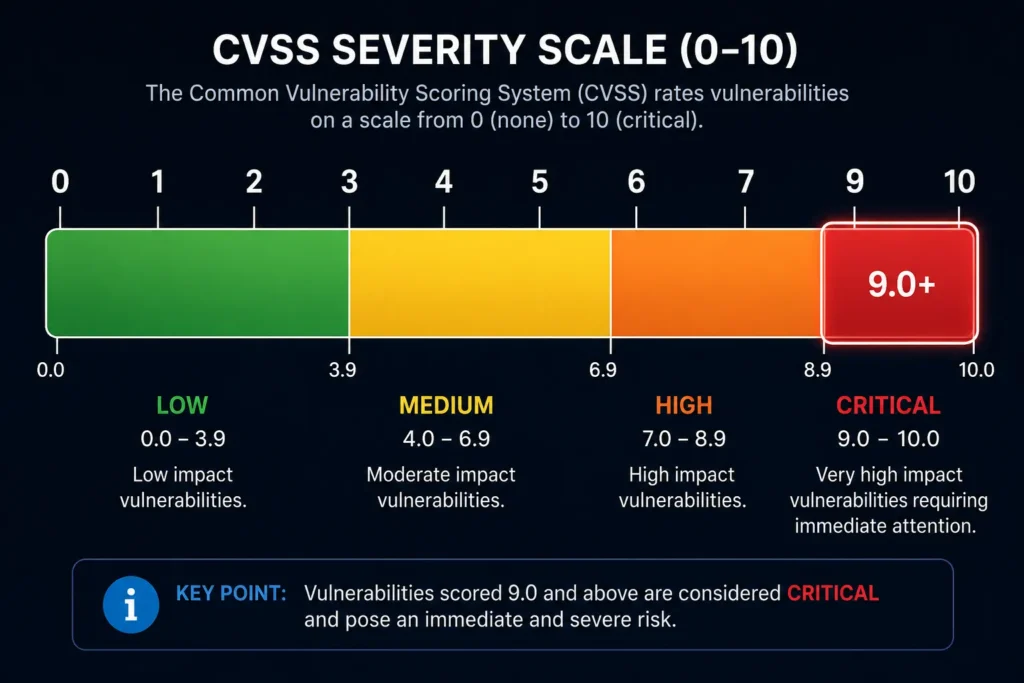
The Common Vulnerabilities and Exposures database, known as CVE, publishes thousands of new vulnerabilities every year. Each one is assessed using the Common Vulnerability Scoring System, or CVSS, which rates severity from zero to ten based on how easy the vulnerability is to exploit and what an attacker can do with it. Critical vulnerabilities, those rated 9.0 and above, typically have public exploit code available and represent an immediate risk to any unpatched system.
The practical implication for a business owner is straightforward: the software your organization uses today has known weaknesses, and new ones are discovered constantly. Some of those weaknesses are actively being targeted by attackers right now. The only way to know which ones affect your environment and which are most urgent to address is a structured vulnerability management program.
What Is the Difference Between Vulnerability Management and a Vulnerability Scan?
This distinction matters more than most business owners realize, because the two are often conflated in conversations about cybersecurity.
A vulnerability scan is a technical activity. A scanner connects to your systems, probes for known weaknesses, and produces a report listing what it found. That report is a point-in-time snapshot. The moment the scan ends, new vulnerabilities are being published, new assets are being added to your network, and the environment is drifting away from what the report reflects.
Vulnerability management is the broader discipline that uses scanning as one input. A managed program continuously discovers what assets exist across your environment, runs recurring scans on a defined schedule, prioritizes findings by actual business risk rather than raw severity score, tracks remediation through to confirmed closure with follow-up scans, and reports outcomes to leadership on a defined cadence. The deliverable is not a report. It is a sustained, measurable reduction in attack surface over time.
Most SMBs that think they have vulnerability management actually have periodic scans. The scans produce findings. The findings sit in a PDF. Three months later, the same process repeats, often finding the same issues because nothing was fixed. A genuine vulnerability management program breaks that cycle.
Why Do Most Breaches Exploit Known Vulnerabilities?
One of the most consistent findings in annual breach investigation reports is that the majority of successful attacks exploit vulnerabilities that already had patches available at the time of the breach. Verizon’s 2025 Data Breach Investigations Report found that exploitation of known vulnerabilities surged as an initial access route into breaches, rising sharply year over year to rival phishing as a leading entry point. This is not primarily a technology problem. The patches exist. The problem is that organizations, particularly smaller ones without dedicated security resources, do not have a systematic process for applying them.
Attackers are patient and methodical. They scan the internet continuously for systems running software with known vulnerabilities. When they find one, they apply the exploit. The process is largely automated. An SMB running an unpatched server with a critical CVE is not being specifically targeted by a sophisticated adversary. It is being swept up in an automated campaign that targets every exposed system meeting that profile. Regular penetration testing validates which of those known weaknesses are actually reachable and exploitable in your specific environment.
This is why vulnerability management has such a high return on investment for small businesses. The attacks it prevents are not exotic. They are the common, high-volume attacks that exploit predictable weaknesses in poorly maintained environments. Closing those vulnerabilities systematically removes the business from a large proportion of the threat landscape it currently occupies.
What Does a Vulnerability Management Program Actually Include?
A well-structured vulnerability management program covers five core capabilities, and works best alongside a broader cybersecurity posture assessment that sets the baseline.
Continuous asset discovery
You cannot manage vulnerabilities in systems you do not know exist. Continuous asset discovery identifies every device, server, workstation, cloud workload, and network appliance in your environment, including assets added by other teams without formal security review. New assets surface quickly rather than remaining outside the program for months.
Recurring authenticated and unauthenticated scanning
Scans run on a defined schedule appropriate to each environment. Authenticated scans, where the scanner logs into systems with valid credentials, produce deeper findings than unauthenticated scans. High-priority systems are scanned more frequently than lower-risk assets. OT environments with operational constraints are scanned using non-invasive techniques that avoid disruption.
Risk-based prioritization
A large environment can produce thousands of findings from a single scan. The prioritization step translates that list into a sequenced worklist based on genuine business risk: CVSS score combined with whether exploit code is publicly available, how critical the affected system is to operations, and whether the vulnerability is internet-facing or internal. The team works the right issues first rather than the loudest.
Remediation tracking and verified closure
Every finding is tracked from identification through to confirmed remediation with a follow-up scan. Items are not closed based on a ticket being marked done. They are closed when a subsequent scan confirms the vulnerability is no longer present. Open items are aged and ownership is assigned so accountability is visible and slippage is escalated.
Executive reporting
Monthly operational reports cover scan coverage, new findings, remediation velocity, and open item aging. Quarterly executive reports translate those metrics into governance language: risk posture trends, comparison to prior periods, and strategic recommendations. Both are structured for board distribution, audit submission, and cyber insurance carrier requirements.
Across the 260+ organizations Armour protects in 52+ industries, first-pass scans almost always surface at least one critical, exploitable vulnerability the business did not know it had.
Why Is Continuous Vulnerability Management Better Than Quarterly Scans?
The quarterly scan model creates a predictable gap. The scan runs in March. The report goes out. A handful of critical findings get patched. The medium and low findings are deferred. New systems are stood up in April, May, and June. New CVEs are published throughout that period. By the time the next scan runs in June, the environment has drifted significantly from what was measured in March, and there is no tracking of what actually got fixed.
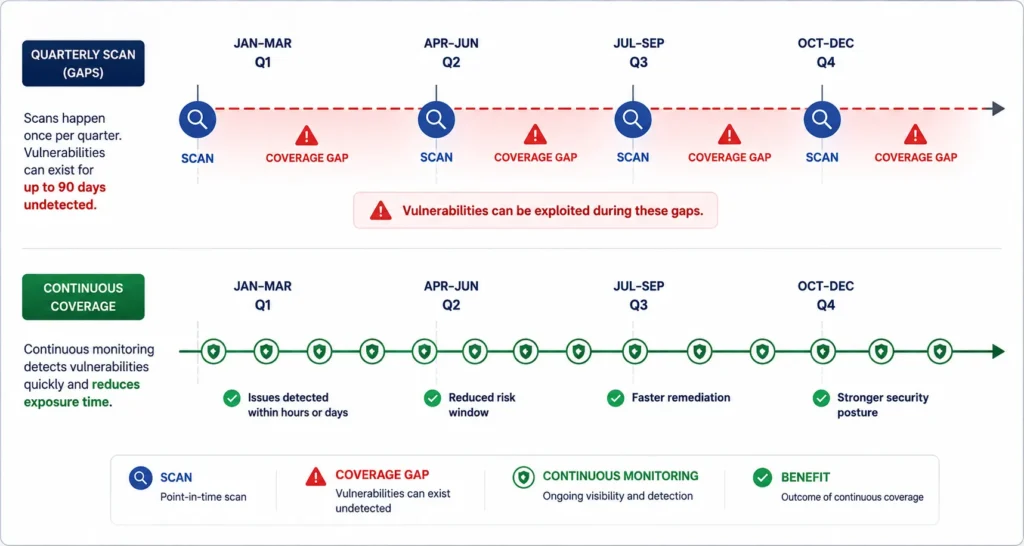
Continuous vulnerability management eliminates that drift. Asset discovery runs constantly, so new systems are captured immediately. Scans run on a weekly or monthly cadence depending on asset priority. Remediation is tracked in real time, not assembled from memory before the next audit. It also feeds the wider detection picture, giving a managed SOC the context to prioritize alerts on systems you already know are exposed. The organization knows its current vulnerability posture at any given time, not its posture as of the last scan date.
For regulated businesses, cyber insurance policyholders, and organizations responding to enterprise customer security requirements, this distinction increasingly matters in practical terms. Auditors and carriers ask for evidence of an ongoing program, not a dated PDF. It is the same evidence-based discipline behind an honest SMB cyber posture check: prove your current state, do not assume it.
The Bottom Line
A one-time scan tells you where you stood on one day. Vulnerability management tells you where you stand today, and shrinks your attack surface month over month. For any small business facing compliance, insurance, or enterprise-customer scrutiny, that ongoing evidence is quickly becoming the baseline expectation. Armour’s managed vulnerability management delivers that program, with reporting structured to satisfy auditors and carriers out of the box.
Frequently Asked Questions
What is the difference between vulnerability management and patch management?
A: Patch management is the process of applying software updates and security patches to keep systems current. Vulnerability management is broader: it identifies all weaknesses in the environment, including misconfigurations, weak credentials, unnecessary services, and network exposure issues that patches do not address. Patch management is one input to vulnerability remediation; vulnerability management is the program that identifies what needs to be patched and verifies that it was.
How often should vulnerabilities be scanned in a small business environment?
A: At minimum, monthly comprehensive scans across all in-scope assets. High-priority systems, those that are internet-facing, hold sensitive data, or are critical to operations, should be scanned weekly. Scans should also be triggered by significant CVE disclosures affecting software in your environment and by major changes such as new systems being deployed.
What happens if a critical vulnerability is found?
A: Critical findings, those rated 9.0 or above on the CVSS scale with active exploit code available, require immediate escalation and rapid remediation. A well-run program has defined response timelines for each severity tier: critical findings typically require acknowledgment within 24 hours and remediation within a defined short window, often 7 to 14 days depending on the organization’s risk tolerance and compensating controls in place.
Can vulnerability management help with cyber insurance requirements?
A: Yes. Cyber insurance carriers increasingly require documented evidence of continuous vulnerability management as part of underwriting and renewal. They look for asset coverage, scan frequency, remediation cadence, and evidence that critical findings are addressed promptly. The monthly and quarterly reports produced by a managed program provide exactly this documentation.
Do I need vulnerability management if I already have antivirus software?
A: Yes. Antivirus detects and blocks known malware. Vulnerability management identifies the weaknesses in your systems that malware and attackers exploit. They address different parts of the threat landscape and are complementary, not interchangeable. A system can run current antivirus and still be fully exploitable via an unpatched application vulnerability the antivirus has no mechanism to detect or block.
About the Author
David Chernitzky is the CEO and Co-Founder of Armour Cybersecurity, a Toronto-based firm that protects organizations across North America from advanced cyber threats. He brings more than 25 years of cybersecurity and military cyber intelligence experience, having served as an officer in an elite technology unit before co-founding Armour. Armour’s team of military-intelligence veterans and senior advisors serves 260+ clients across 52+ industries with a 97% client retention rate.