Quick answer: You prevent phishing with layers, not a single fix: email filtering to block what it can, multi-factor authentication so a stolen password is not enough, ongoing training so people recognise the lures that get through, and a simple verification habit for anything involving money or credentials. No single layer is perfect, which is exactly why you need several.
Key Takeaways
- Modern phishing is not obvious. It is well-written, personalised, and often free of the links and typos people were taught to spot.
- Speed is the danger: Verizon’s 2025 DBIR found the median time for a user to fall for a phishing email is under 60 seconds.
- Phishing-driven breaches are expensive, IBM puts them at around $4.91 million on average in 2025.
- No single defence stops phishing. Layer email security, MFA, training, and out-of-band verification.
- Plan for the click: fast reporting and rapid response limit the damage when someone inevitably slips.
Why Phishing Still Works
The advice most people absorbed years ago, watch for bad spelling, hover over links, ignore the obvious scam, no longer matches the threat. Today’s phishing is written to pass every one of those tests: clean grammar, a familiar tone, a real invoice number, a request that fits your normal workflow. Attackers research their targets and time their messages to land during real business moments, when a payment is due or an executive is travelling.
That is why phishing remains the entry point for so many breaches. It does not attack your firewall; it attacks a busy person’s judgement in a moment of routine. Building genuine resilience against it is the goal of a security awareness culture, where careful behaviour becomes instinct rather than a rule.
The Anatomy of a Modern Attack
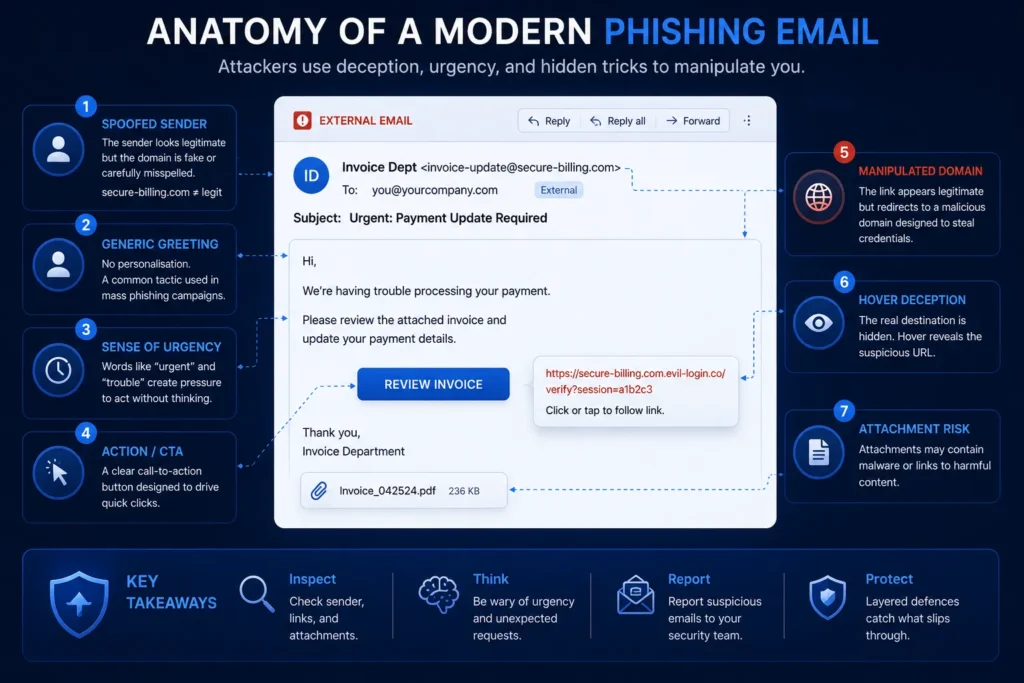
Most successful phishing shares a pattern: it impersonates someone trusted, creates urgency, and asks for something specific, a login, a payment, a change of banking details. The most costly version is business email compromise, where an attacker impersonates a vendor or executive to redirect a real payment. There is often no malware at all, just words designed to move money, which is why traditional antivirus never sees it.
The Layered Defence
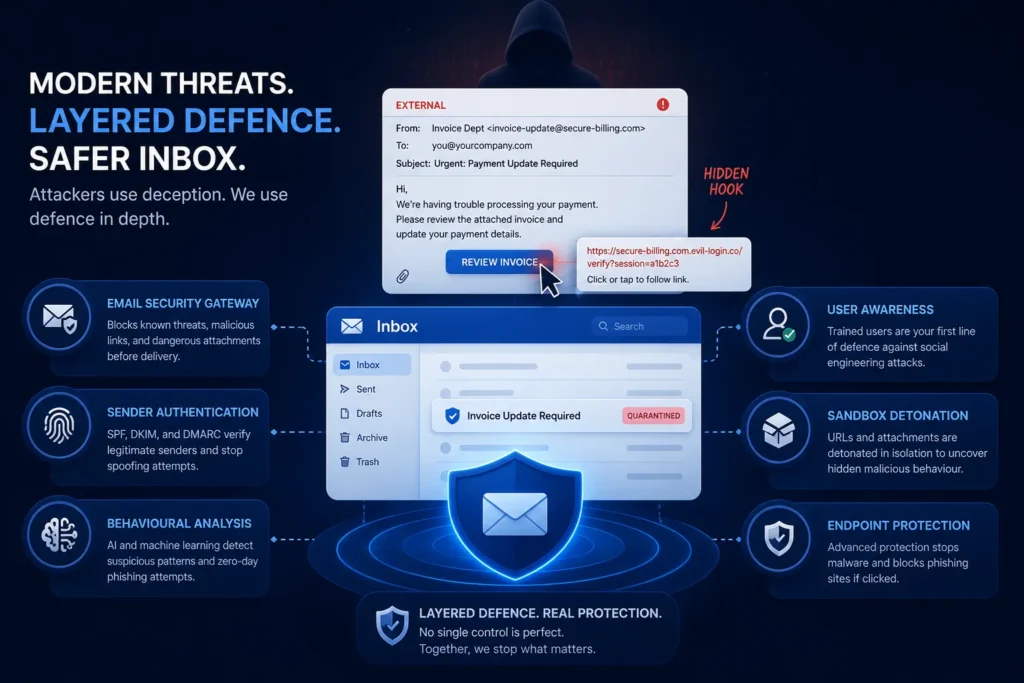
Because no single control is perfect, prevention is about stacking defences so a failure at one layer is caught by the next:
- Email security. Filtering blocks the high-volume, known-bad messages before they reach an inbox, shrinking what your people ever have to judge.
- Multi-factor authentication. If a password is phished, MFA means it is not enough on its own. Backed by strong identity and access management, it neutralises most credential theft.
- Ongoing training and simulations. Regular, realistic security awareness training teaches people to recognise the lures that slip past filters, and to report them.
- Out-of-band verification. A simple rule, confirm any payment or banking change by phone using a known number, stops the most expensive attacks cold.
Armour protects 260+ organizations across 52+ industries, and the businesses that weather phishing best are the ones whose people report fast, backed by a 97% client retention rate.
Plan for the Click
Assume that eventually, someone clicks. What happens next decides the damage. Fast, blame-free reporting lets your team act while the attacker is still moving. Endpoint detection and response can contain a compromised device in minutes, and a clear path to incident response turns a potential breach into a contained event. A reported click handled in minutes is a non-event; an unreported one can run for weeks.
The Bottom Line
You will never make your people immune to phishing, and you do not need to. You need layers that catch what slips through, an MFA safety net under stolen passwords, a workforce that reports fast, and a verification habit on anything that moves money. Stack those, and the modern phishing email, however convincing, runs out of ways to win.
Frequently Asked Questions
How can I prevent phishing at my business?
A: Use layers, not one fix: email filtering to block known-bad messages, multi-factor authentication so a stolen password is not enough, ongoing training and phishing simulations so people recognise what slips through, and an out-of-band verification rule for any payment or credential change. Then plan for the click with fast reporting and response.
Why do people still fall for phishing?
A: Because modern phishing is well-written, personalised, and timed to fit normal workflows, nothing like the obvious scams people were trained to spot. Verizon’s 2025 DBIR found the median time to fall for a phishing email is under a minute, so it exploits routine and speed, not carelessness.
Does multi-factor authentication stop phishing?
A: MFA does not stop the phishing email, but it stops much of the damage. If a password is phished, MFA means the attacker still cannot log in without the second factor. It is one of the highest-value, lowest-cost defences you can deploy, though it works best alongside training and email security.
What should employees do if they clicked a phishing link?
A: Report it immediately, without fear of blame. Speed is everything: fast reporting lets the security team contain a compromised device and reset credentials before the attacker acts. A click reported in minutes is usually a non-event; one hidden out of embarrassment can become a full breach.
About the Author
David Chernitzky is the CEO and Co-Founder of Armour Cybersecurity, a Toronto-based firm that protects organizations across North America from advanced cyber threats. He brings more than 25 years of cybersecurity and military cyber intelligence experience, having served as an officer in an elite technology unit before co-founding Armour. Armour’s team of military-intelligence veterans and senior advisors serves 260+ clients across 52+ industries with a 97% client retention rate.