| Quick AnswerA cyber tabletop exercise is a facilitated, scenario-based session that puts your leadership team through a realistic breach scenario in a controlled environment, no systems touched, no operations disrupted. It tests whether your incident response plan works in practice, whether decision authority is clear, and whether your team can communicate and coordinate under pressure. Most organizations discover gaps they did not know existed. The time to find those gaps is before a real incident. |
Key Takeaways
- Tabletop exercises test the human and decision-making layer of your incident response capability, the layer that technical security controls cannot validate.
- The most common findings in tabletop exercises are not technical gaps. They are in decision authority, communications approval, and third-party activation procedures that nobody has tested under pressure.
- A tabletop exercise produces formal after-action documentation that satisfies cyber insurance underwriter and auditor expectations for evidenced IR plan testing.
- Participants should include the actual decision-makers: CEO or COO, CFO, general counsel, communications lead, and the CISO or IT director. Exercises populated by delegates miss the point.
- The value of a tabletop compounds over time. Organizations that exercise annually build muscle memory and identify improvement opportunities before they become incident failures.
A cyber tabletop exercise for a business is how you find out whether your incident response plan survives contact with a real decision, before a real breach forces the test. It is not a technical exercise. It targets the layer that technical controls cannot reach: the people who have to decide, communicate, and coordinate under pressure. That layer matters more than most teams assume. The human element is involved in roughly 60 percent of breaches in Verizon’s 2025 Data Breach Investigations Report, and a tabletop is the most direct way to rehearse it. The output is a documented, independent incident response readout that shows exactly where the gaps are.
| By the NumbersThe human element is involved in roughly 60% of breaches. A tabletop tests exactly that layer, which technical controls cannot validate. Source: Verizon 2025 Data Breach Investigations Report.Faster containment lowers breach cost. The global average breach cost $4.44M ($10.22M in the US), and rehearsed teams contain faster. Source: IBM Cost of a Data Breach Report 2025.Carriers accept tabletop and after-action documentation as evidence of IR plan testing, which underwriting increasingly requires. Source: 2025 to 2026 carrier underwriting guidance. |
What Is a Cyber Tabletop Exercise?
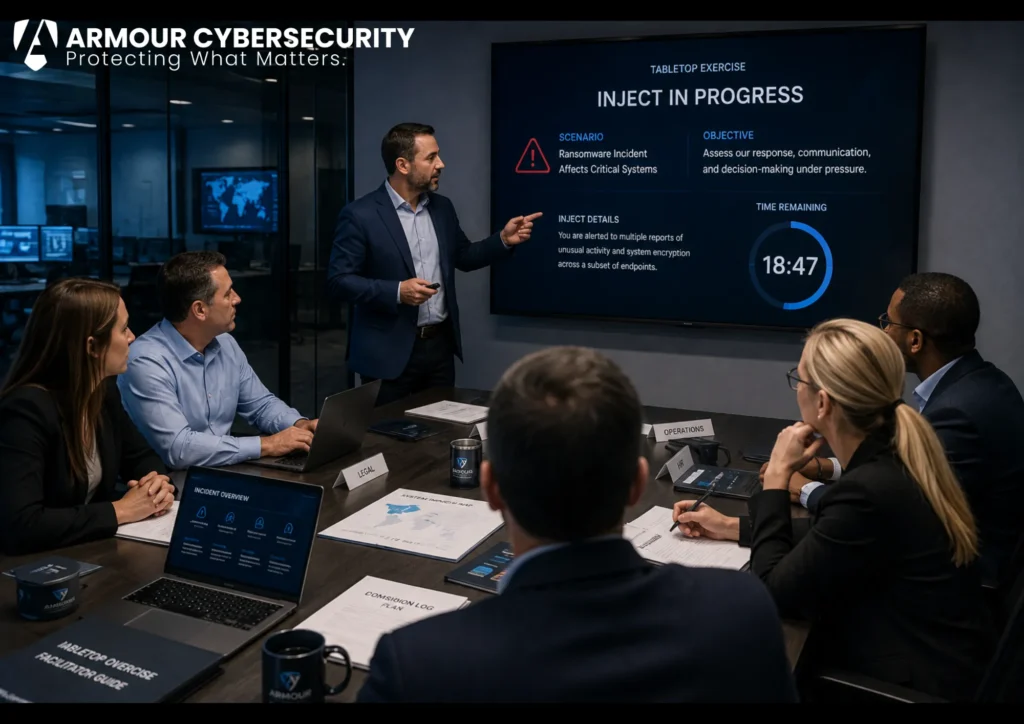
A cyber tabletop exercise is a structured, facilitated discussion that walks a cross-functional team through a realistic cyber incident scenario. Unlike a penetration test, which probes technical systems, or a full simulation, which involves live systems and real alerts, a tabletop is a scenario-based conversation. Participants sit together, or connect virtually, and work through a developing incident as the facilitator introduces new information and decision points in real time. A tabletop is also distinct from a breach readiness assessment: the assessment diagnoses whether the underlying capability exists, and the tabletop pressure-tests it under a live scenario.
The scenario is designed around the organization’s actual threat profile, industry, and business model. A ransomware scenario for a law firm looks different from a ransomware scenario for a financial services company, because the systems involved, the regulatory obligations triggered, and the client notification requirements differ. A well-designed tabletop scenario makes these differences concrete, so the team is making decisions about their actual organization, not a generic placeholder.
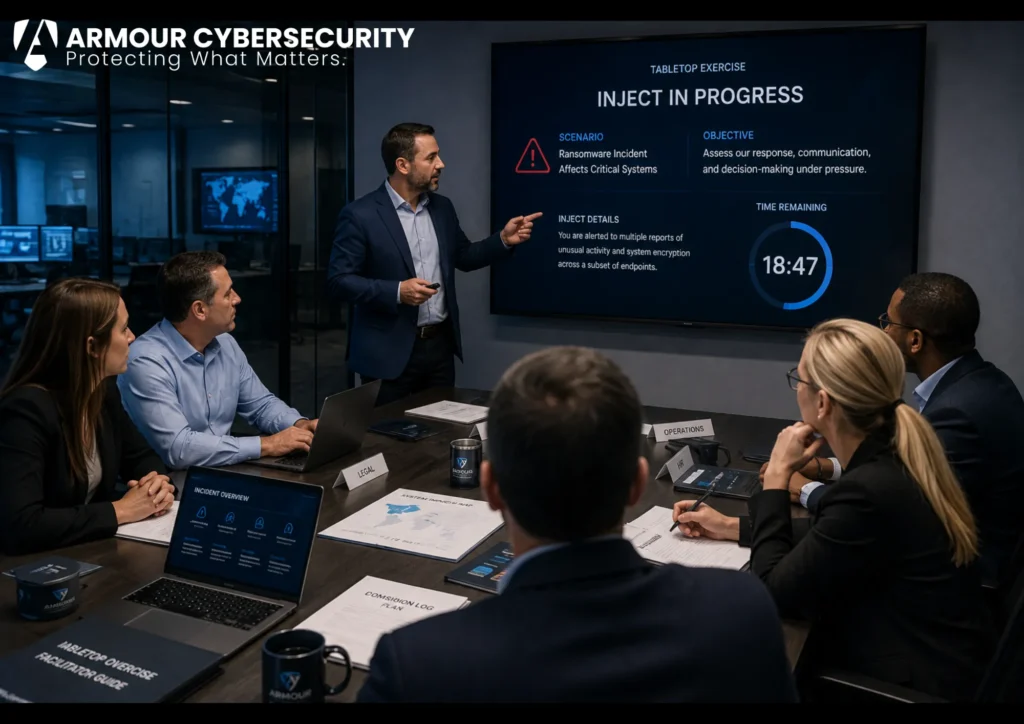
Injects, structured updates that introduce new information and escalate the situation, drive the session forward. An inject might reveal that the ransomware has reached backup systems, changing the recovery calculus. Another might introduce a journalist inquiry that forces a communications decision before the facts are confirmed. Another might reveal that a regulatory notification deadline is approaching. Each inject tests a different dimension of the response capability.
What Does a Tabletop Exercise Actually Test?
The domains a tabletop exercise tests are the ones that most commonly fail during real incidents, not because organizations lack the technical capability but because the human coordination and decision-making layer has never been pressure-tested.
Incident response plan activation
The first thing a tabletop tests is whether the IR plan can be located, understood, and activated under pressure. Plans that live in a shared drive nobody has navigated in two years, written in language that presupposes technical knowledge the executive team does not have, or structured around a notification tree with outdated contacts, fail at the first moment they are needed. The tabletop exposes this before a real incident does.
Executive decision-making
Strategic decisions in a breach response require executive authority: whether to shut down business-critical systems to stop lateral movement, whether to pay a ransom demand, whether to notify customers before the scope is confirmed, when to brief the board, and what to tell regulators. These decisions have material legal, financial, and reputational consequences. A tabletop puts executives through the actual decision logic under time pressure, surfacing the cases where authority is unclear, where disagreement emerges, or where the decision framework simply does not exist.
Decision authority and role clarity
Incident response requires that specific people have clear authority to take specific actions without waiting for committee consensus. When a forensic responder needs authorization to access a compromised system at 2am, who provides it? When the communications team needs approval for a customer-facing statement, whose signature is required? When the insurance carrier needs to be engaged, who makes that call? Tabletops consistently surface authority gaps between what the plan documents and what the real organization would actually do.
Crisis communications
Communications decisions in a breach are among the highest-stakes choices an organization makes. Saying too little destroys trust. Saying too much creates legal exposure. Saying the wrong thing makes future corrections appear like cover-ups. A tabletop exercises the communications decisions directly: when does a preliminary internal notification go out, what does the first external statement say, who approves it, and how does the team manage the gap between what it knows and what it can responsibly say? These decisions are significantly harder to make well for the first time during a real event.
Third-party activation
Most organizations plan to engage breach counsel, their cyber insurance carrier, and an external forensic response team in the event of a material incident. The tabletop tests whether these relationships are actually ready to activate: whether the engagement procedures are documented, whether the right contacts are known, and whether the team knows which call to make first and what information to provide. First-time activation of a breach counsel relationship under crisis conditions is measurably slower and less effective than activating a pre-established relationship through a documented procedure.
Who Should Participate in a Tabletop Exercise?
The value of a tabletop exercise depends entirely on who is in the room. An exercise populated by middle management and IT staff while executives observe from a distance does not test executive decision-making. An exercise where the CEO’s delegate attends instead of the CEO does not validate whether the CEO would actually make the decisions the plan assigns to them.
An executive tabletop should include the CEO or COO, CFO, general counsel or privacy lead, CISO or IT director, communications lead, head of operations or business continuity, and a board observer where appropriate. These are the actual decision-makers for the categories of decisions a breach response requires. Supporting participants from IT security, legal, and operations complete the picture.
The facilitator’s role is to ensure the exercise tests these participants as they would actually function: making decisions with imperfect information, under time pressure, with competing priorities and genuine uncertainty about consequences. A session that allows too much deliberation, too many asides, or too much hypothetical discussion fails to create the conditions that reveal real capability gaps.
What Does the Exercise Produce?
A well-structured tabletop exercise produces documentation that serves multiple purposes simultaneously. The after-action report documents key responses (what worked), key observations (gaps and friction points surfaced during the exercise), and key improvement opportunities (a prioritized action roadmap for addressing the gaps). This report is written by an independent assessor, making it suitable for board distribution, audit evidence for compliance auditors, and cyber insurance underwriter review.
The improvement roadmap distinguishes between quick wins, updating contact details, clarifying decision authority in the plan, drafting pre-approved communications templates, and longer-term initiatives like playbook development or IR plan rebuilds. Many organizations execute the roadmap internally. Others engage Armour Cybersecurity for follow-on work to develop the artifacts the exercise identified as missing.
Armour Cybersecurity’s cyber simulation exercises are facilitated by senior consultants with military intelligence and Big 4 advisory backgrounds. Scenarios are custom-designed around the organization’s actual threat profile and industry. The formal independent security assessor report produced after each exercise is structured to satisfy the documentation expectations of major cyber insurance carriers and compliance auditors.
Where Tabletop Exercises Fit in Armour’s Managed Services
A tabletop exercise rarely works alone. It is one pillar of Armour’s managed cybersecurity services, operating alongside a managed Security Operations Center that detects the incident a tabletop rehearses, cyber threat intelligence that shapes realistic scenarios, vCISO leadership to own the decision authority the exercise stress-tests, cyber awareness training to reduce the human error that starts most incidents, and the all-in-one Armour 360 managed program. The exercise reveals the gaps. The program is how you close them.
The Bottom Line
A cyber incident is the worst possible time to discover that your decision authority is unclear, your communications approval path is undefined, or your breach counsel relationship exists only in principle. A cyber tabletop exercise moves that discovery to a conference room, where the cost of a wrong answer is a note in an after-action report rather than a headline. If your leadership team has never made these decisions together under pressure, a cyber tabletop exercise is the fastest way to find out how they will, while it still counts as practice.
| Across the 260+ organizations Armour runs exercises for in 52+ industries, the gaps a tabletop surfaces are rarely technical. They are unclear decision authority and third-party relationships that have never been activated under pressure. |
Frequently Asked Questions
What is a cyber tabletop exercise for a business?
A cyber tabletop exercise for a business is a facilitated, scenario-based session that walks the leadership team through a realistic breach without touching live systems. A facilitator introduces a developing incident through timed injects, and participants make the real decisions a breach would require: when to isolate systems, whether to pay a ransom, when to notify customers and regulators, and who has the authority to decide. It tests the human and coordination layer of incident response that technical controls cannot validate, and it produces an independent after-action report documenting what worked and where the gaps are.
How long does a tabletop exercise take?
The live tabletop session typically runs three to four hours, covering one to three scenarios with timed injects that escalate the situation. Total engagement including scenario design, preparation, and after-action reporting runs four to six weeks. Two to three weeks of design and preparation precede the live session. Two to three weeks of analysis and report production follow it. The live session is a half-day commitment for participants; the value is delivered through the preparation and the after-action work that surrounds it.
Can a tabletop exercise be conducted remotely?
Yes. Remote tabletop exercises conducted via video conference are effective and widely used, particularly for organizations with distributed leadership teams. The facilitator manages the scenario and injects through the session, and participants engage through the same channels they would use in a real incident. Some organizations prefer in-person exercises for the first engagement, finding that the physical presence adds to the sense of urgency and the quality of cross-functional interaction. Both formats produce comparable outcomes when well-facilitated.
How often should a business run a tabletop exercise?
Most organizations benefit from an annual tabletop exercise as a minimum. Annual exercises allow the team to validate IR plan updates made since the previous exercise, test new participants who have joined the response team, and stay current with the evolving threat landscape. Organizations that have experienced a real incident, implemented significant technology changes, or significantly changed their business model should exercise more frequently to validate that the response capability reflects the current organization.
Is a tabletop exercise the same as a fire drill?
The analogy is useful. A fire drill builds the muscle memory for a physical evacuation. A cyber tabletop builds the decision-making and coordination muscle memory for a cyber incident response. Both are rehearsals for a high-stakes event in a controlled environment where the cost of mistakes is learning rather than consequence. The difference is that a cyber tabletop involves strategic and legal decisions under uncertainty, not just procedural steps, which is why the quality of the facilitator and the scenario design matters significantly.
What happens if the exercise reveals significant gaps?
Finding significant gaps is the point of the exercise. An organization that runs a tabletop and discovers that decision authority is unclear, that breach counsel has not been retained, or that the IR plan does not reflect the current organization has learned something that was always true but previously invisible. The after-action report documents these gaps as prioritized improvement opportunities with suggested owners and timelines. Many organizations find that the exercise accelerates IR program improvements that had been deprioritized because nobody had directly experienced the consequences of the gaps.
About the Author
David Chernitzky is the CEO and Co-Founder of Armour Cybersecurity, a Toronto-based firm that protects organizations across North America from advanced cyber threats. He brings more than 25 years of cybersecurity and military cyber intelligence experience, having served as an officer in an elite technology unit before co-founding Armour. Armour’s team of military-intelligence veterans and senior advisors serves 260+ clients across 52+ industries with a 97% client retention rate.