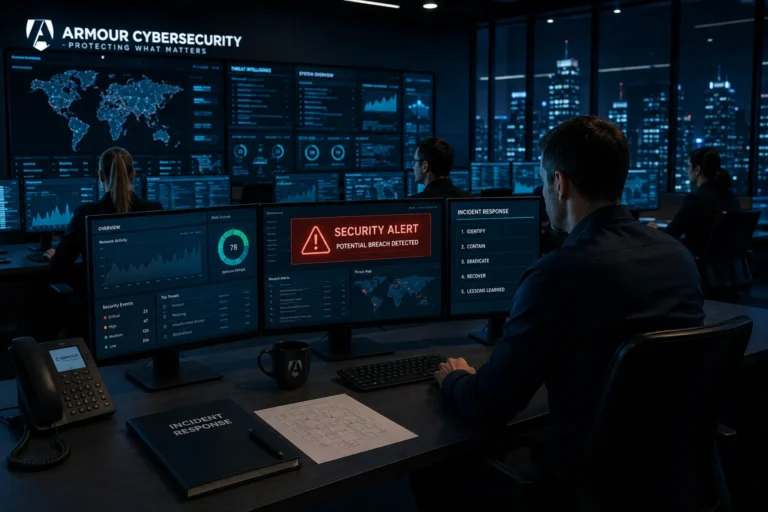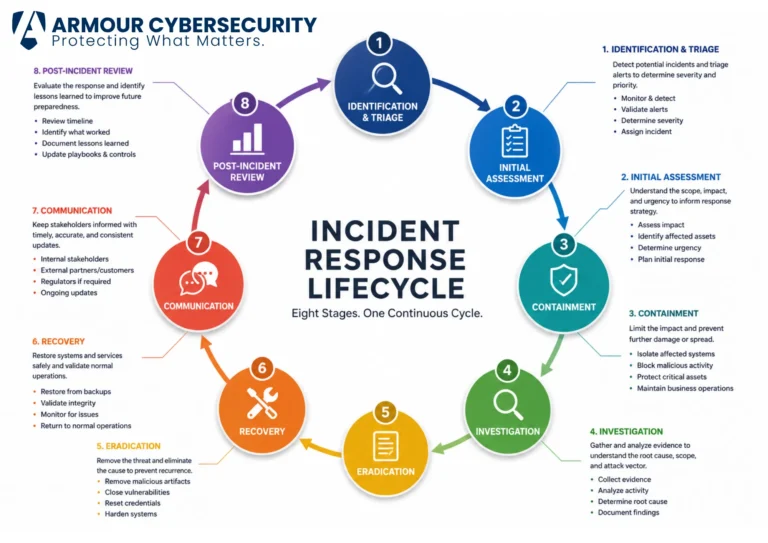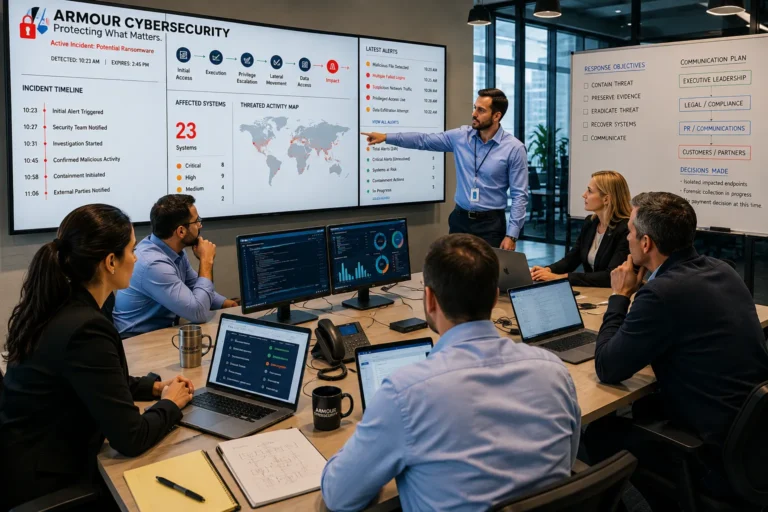
When an organization experiences a significant cybersecurity incident, the pressure to restore operations as quickly as possible can create a dangerous tension with the requirement to understand exactly what happened through structured incident response services . Organizations that prioritize recovery over investigation can restore from compromised backups, miss residual attacker access that persists through the recovery, and lack the evidentiary record needed to satisfy regulatory notification requirements, support insurance claims, and respond to legal proceedings.
Technical forensics services provide the structured, methodologically rigorous investigation capability that turns the raw evidence of an incident into a defensible, documented account of what occurred. This article explains what technical forensics covers, why methodology matters, and how Armour Cybersecurity approaches post-incident investigation.
What Technical Forensics Is, and Is Not
Technical forensics is the application of scientific methods to the collection, preservation, analysis, and presentation of digital evidence. The defining characteristic of forensic investigation, as opposed to incident response analysis, is defensibility: the methods used must be capable of withstanding scrutiny in regulatory proceedings, litigation, and insurance claim review.
This means that technical forensics is not simply a matter of reviewing logs and reconstructing events. It requires documented chain of custody for evidence, validated collection methods that can be demonstrated not to have altered the evidence, analysis techniques that meet accepted evidentiary standards, and reporting that clearly distinguishes findings from inferences and inferences from speculation.
Organizations that conduct informal post-incident analysis and then find themselves in regulatory proceedings or litigation often discover that their internally conducted investigation cannot be presented as evidence because the methodology does not meet the standards required. Armour Cybersecurity’s technical forensics practice is designed from the ground up to produce findings that hold up.
Core Technical Forensics Capabilities
Disk and Memory Forensics
Disk forensics involves the acquisition and analysis of storage media, workstations, servers, storage systems, to identify evidence of attacker activity: malware installations, modified files, attacker tools, deleted data, and access logs. Memory forensics captures and analyzes the volatile memory of running systems, which contains evidence that is not present on disk: running processes, network connections, encryption keys, and attacker code that executes in memory to avoid leaving disk-based artifacts.
Memory forensics is particularly valuable for investigating fileless malware and living-off-the-land attacks that use legitimate system tools to avoid detection. Evidence that would be invisible to disk-based investigation is frequently available in memory captures taken during or shortly after an incident.
Log Analysis and Timeline Reconstruction
Log analysis is the process of collecting, correlating, and analyzing log data from across the environment to reconstruct the attacker’s timeline: when they first gained access, what they did, where they moved, what data they accessed, and when they executed the final stage of their attack. Effective timeline reconstruction requires logs from multiple sources — endpoint security tools, network infrastructure, identity and access management systems, application logs — and the analytical capability to correlate them into a coherent narrative.
The quality of log analysis is directly dependent on the quality of the logging infrastructure. Organizations that discover during an investigation that critical log sources were not being collected, that retention periods were too short to capture the full incident timeline, or that log integrity was not protected have significantly less visibility into what occurred. Armour Cybersecurity can help organizations improve their forensic readiness through incident response planning before an incident to ensure that investigations are not limited by logging gaps.
Malware Analysis
When malware is discovered during an incident, understanding its capabilities, behavior, and indicators of compromise is essential for effective remediation. Malware analysis determines what the malware was designed to do, what it actually did in your environment, what command-and-control infrastructure it used, and what indicators can be used to identify other systems that may be infected. Armour Cybersecurity conducts both static analysis (examining malware code and structure without executing it) and dynamic analysis (executing malware in a controlled sandbox environment to observe its behavior).
Network Forensics
Network forensics analyzes network traffic captures and network infrastructure logs supported by ongoing managed security services to understand attacker communication patterns, data exfiltration activity, and lateral movement through the environment. For incidents involving data exfiltration, the most common driver of regulatory notification obligations and insurance claims, network forensics is frequently the primary source of evidence about what data left the environment, when, and to where.
Cloud Forensics
As organizations move infrastructure and data to cloud environments, the forensic challenge evolves: cloud providers offer different evidence sources, retention periods, and collection mechanisms than on-premises infrastructure, and the tools and techniques for cloud forensics are distinct from traditional endpoint forensics. Armour Cybersecurity’s technical forensics practice covers major cloud platforms, AWS, Azure, Microsoft 365, Google Cloud, and can investigate incidents that span hybrid environments.
Mobile Device Forensics
Mobile devices are increasingly involved in enterprise security incidents, whether as vectors of initial compromise, repositories of sensitive data, or evidence sources for insider threat investigations. Mobile forensics covers both iOS and Android platforms and can recover deleted data, reconstruct application activity, and preserve evidence in a manner that meets evidentiary standards.
The Forensic Investigation Process
Evidence Identification and Preservation
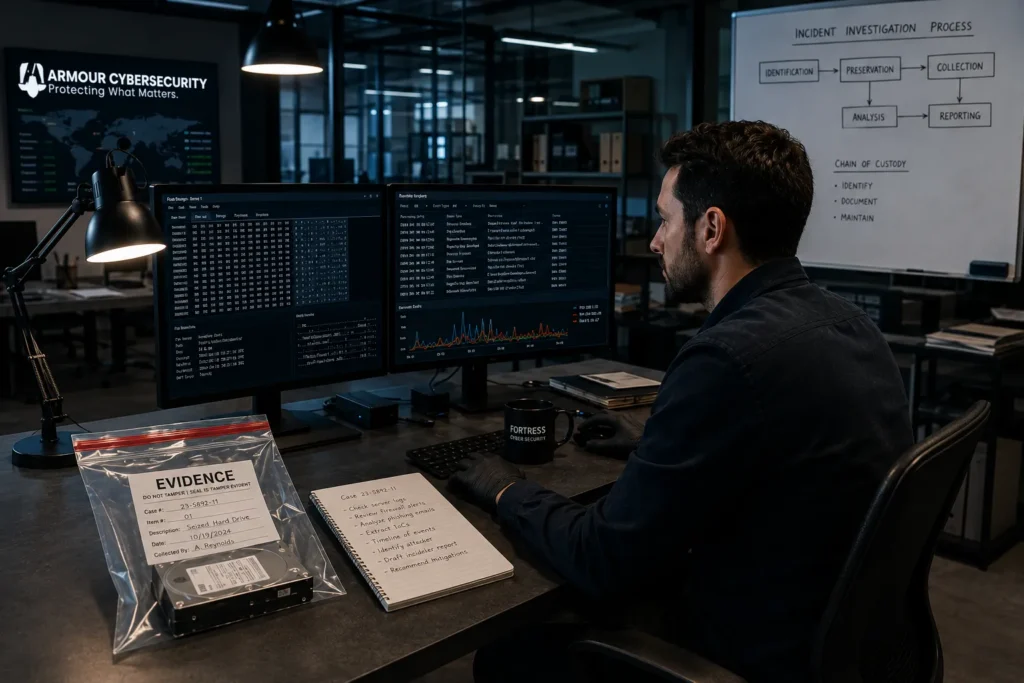
The first priority in any forensic investigation is preserving the evidence before it can be altered, overwritten, or lost. This requires identifying all relevant evidence sources, not just the systems most obviously involved in the incident, but the log sources, backup systems, and adjacent systems that may contain corroborating evidence, and taking forensically sound copies before any remediation activity disturbs the original state.
Analysis and Correlation
The analysis phase applies forensic techniques to the collected evidence to reconstruct events, identify attacker activity, and develop an understanding of the incident scope. Armour Cybersecurity analysts use industry-standard forensic tools and documented methodologies, and maintain detailed notes of every analytical step taken, documentation that becomes part of the evidentiary record if the investigation becomes the subject of legal or regulatory review.
Findings Documentation and Reporting
The forensic report documents findings in a manner that distinguishes clearly between what was observed in the evidence, what analytical conclusions are supported by the evidence, and where uncertainty exists. For regulatory and legal purposes, the report must identify the methodology used, the evidence sources examined, the chain of custody maintained, and the basis for each finding. Armour Cybersecurity produces reports structured for both technical and non-technical audiences, with technical detail in appendices and executive findings in language accessible to legal counsel and leadership.
Technical Forensics and Regulatory Obligations
Regulatory breach notification requirements in most jurisdictions require organizations to determine whether personal data was accessed or exfiltrated, and to report within defined timeframes when it was. The forensic investigation is the mechanism for making that determination. An investigation that cannot answer the question, because of logging gaps, evidence destruction during remediation, or inadequate methodology, puts the organization in the position of notifying regulators under uncertainty, which triggers different obligations and creates different risks than a notification supported by a clear forensic finding and broader soc compliance requirements
Armour Cybersecurity coordinates technical forensics with breach coach services to ensure that investigation findings are available to legal counsel in the timeframe needed to support notification decisions.