By David Chernitzky, Co-Founder and CEO, Armour Cybersecurity | Serving organizations across Canada, the US, and beyond | Last updated August 18, 2026
Quick answer: A compliance readiness audit is a structured pre-assessment of your environment against the framework you are pursuing, conducted before the formal audit begins. It identifies the control gaps, evidence deficiencies, and documentation problems that your formal assessor would otherwise find during fieldwork. Organizations that complete a readiness audit walk into their formal engagement knowing exactly where they stand. Those that do not typically discover their gaps mid-audit, which turns a certification process into an extended remediation project.
Key Takeaways
- Formal audits are not diagnostic exercises. Assessors are there to confirm whether controls meet the standard, not to help you fix them. Gaps discovered during fieldwork become findings in the report, which delays certification and creates remediation obligations that push timelines into the next quarter or year.
- The most common causes of audit findings are not missing technology; they are incomplete documentation, untested controls, evidence that does not match the standard the framework requires, and scope surprises that emerge when the assessor discovers systems or data flows the organization did not include in the original scope.
- A compliance readiness audit evaluates controls the way the formal assessor will: through walkthroughs, evidence review, and testing. The difference is that the readiness assessor’s job is to find problems so you can fix them, not to produce the certification report.
- Organizations that invest in readiness consistently achieve shorter formal audit timelines, fewer findings, and more predictable certification dates, which directly protects commercial commitments to enterprise customers who are waiting on certification before proceeding with contracts.
- Readiness audits are particularly valuable for first-time certifications, where there is no prior audit history to indicate what controls were adequate and where gaps developed since the last cycle.
Why Formal Audits Fail Without Preparation
The formal compliance audit, whether for SOC 2, ISO 27001, HIPAA, PCI DSS, or another framework, is a confirmation exercise. The assessor reviews the controls you have implemented, tests them against the framework requirements, and issues a report reflecting what they found. The auditor’s job is not to help you build your program; it is to evaluate whether the program you have meets the standard. If it does not, the report says so, with findings that must be remediated before certification can be issued or before the next audit cycle begins.
Organizations that approach formal audits without prior preparation frequently experience the same sequence of events. The pre-engagement scoping call reveals systems and data flows that were not considered in the original scope definition. Fieldwork begins and the assessor requests evidence for controls that the organization believed were in place but cannot demonstrate. Documentation reviews surface policies that were written for a different version of the organization and have not been updated. Control testing reveals that processes described in policies are not actually being followed in practice. Each of these discoveries is a finding or a qualification, and each one extends the timeline and adds remediation obligations. This is why serious compliance audit preparation begins well before the assessor arrives, not in the fieldwork window.
What a Compliance Readiness Audit Actually Does
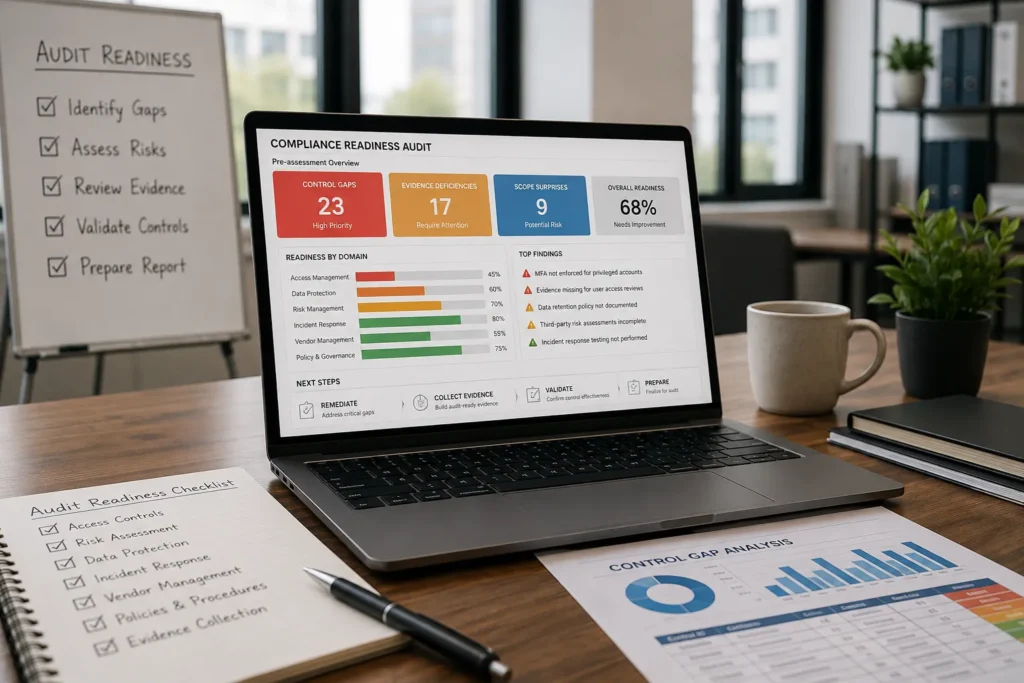
A readiness audit replicates the formal assessor’s process, with one critical difference: the readiness assessor’s role is to find problems so you can fix them before the formal engagement, not to produce the certification report. The readiness team approaches the engagement the way the formal auditor will, which means the same control evaluation criteria, the same evidence standards, and the same scope definition discipline. The output is a gap analysis that tells the organization exactly where it stands and what it needs to do before the formal audit. Done well, this pre-audit compliance assessment converts the formal engagement from a discovery exercise into a confirmation.
Scope confirmation
Scope surprises are one of the most common sources of audit disruption. An organization defines its scope based on its understanding of which systems, data flows, and business processes are in scope for the framework, and the formal auditor expands it because the organization missed something. A readiness audit conducts a thorough scope analysis before the formal engagement, confirming which systems, environments, third-party services, and data flows are in scope and ensuring that the scope definition is consistent with how the formal auditor will interpret the framework’s scope requirements. Scope that is confirmed before the formal audit does not expand mid-engagement.
Control-by-control assessment
The readiness audit assesses every control in the applicable framework against the organization’s actual implementation. Controls that are fully implemented and can be evidenced are confirmed. Controls that are partially implemented are documented with the specific gap between the current state and the framework requirement. Controls that are missing are identified and prioritized by the severity of the finding they would generate in the formal audit. An independent cyber posture assessment is a useful way to establish that current-state control picture objectively, and it becomes the foundation of the remediation roadmap that follows.
Evidence validation
Many controls fail not because the organization lacks the relevant practice but because the evidence does not meet the standard the framework requires. A security awareness training requirement might be met by a training program that employees complete, but if the completion records are not retained in a format that the auditor can review, the control cannot be evidenced. An access review requirement might be satisfied by quarterly reviews that the IT team conducts, but if the reviews are not documented with a record of who participated, what was reviewed, and what actions were taken, the evidence does not hold. The readiness audit identifies these evidence gaps so they can be closed before the formal engagement begins.
Documentation review
Framework compliance requires that the controls in place be documented in policies and procedures that describe how they work, who is responsible for them, and how they are maintained. Policies that are out of date, that do not reflect current practice, or that are missing entire sections required by the framework create findings that are easy to prevent and expensive to remediate under audit timeline pressure. These are the same cybersecurity policy gaps that surface in any framework audit, and the readiness audit reviews all relevant documentation and identifies the gaps, inconsistencies, and updates needed before the formal assessor reviews them.
What the Readiness Audit Produces
The output of a readiness audit is structured for direct use in the remediation process and in the formal audit engagement. The framework gap analysis documents every control with its current state, the target state required by the framework, the severity of the gap, and the remediation effort estimate. The remediation roadmap sequences the remediation work by severity and timeline relative to the formal audit date, identifying which gaps must be closed before the formal engagement and which can be addressed in the post-audit remediation cycle. The evidence package organizes existing evidence by control, identifying where evidence exists and meets the standard, where it exists but needs supplementation, and where it is missing entirely.
Mock audit findings, written in the format and language the formal assessor uses, allow the remediation team to track closure against the same structure that will appear in the formal report if gaps are not addressed. The audit coordination plan defines the schedule, evidence delivery process, interview roster, and finding response procedure for the formal engagement, so the fieldwork period is managed rather than improvised. Armour Cybersecurity structures compliance readiness engagements across SOC 2, ISO 27001, HIPAA, PCI DSS, and other frameworks so that each of these outputs is ready before the formal auditor arrives.
The Business Cost of Skipping Readiness
The commercial consequence of a delayed or qualified audit is concrete. Enterprise customers waiting on a SOC 2 report or ISO 27001 certificate before proceeding with a contract do not wait indefinitely. Deals that were expected to close in Q1 slip to Q3 because the certification timeline kept moving. The internal cost of an extended audit cycle, the staff time consumed by extended fieldwork, the consultant hours required for mid-audit remediation, and the management attention diverted from the business during an uncontrolled audit, consistently exceeds the cost of a readiness engagement by a significant multiple. The readiness audit is not an added cost; it is a substitution of planned preparation for unplanned remediation.
Frequently Asked Questions
How long before our formal audit should we start a readiness engagement?
The optimal timing depends on the current state of the program and the framework being pursued. For organizations with a reasonably mature security program pursuing a familiar framework, starting the readiness engagement eight to twelve weeks before the formal audit provides enough time to complete the gap analysis, execute the highest-priority remediation, and confirm closure before fieldwork begins. For first-time certifications or organizations with significant known gaps, starting four to six months before the formal audit target gives sufficient runway for more substantial remediation. Starting less than six weeks before the formal audit limits what can be realistically closed before fieldwork begins and is generally not recommended unless the gap profile is already known and well-understood.
What is the difference between a readiness audit and a gap analysis?
A gap analysis measures the distance between current controls and a framework standard, typically through document review and interviews. A readiness audit goes further: it includes control testing and evidence validation conducted the way the formal assessor will test and validate them. The distinction matters because a gap analysis may confirm that a control is in place while the readiness audit reveals that the evidence for that control does not meet the standard the framework requires. Organizations that conduct only a gap analysis sometimes receive audit findings on controls they believed were implemented and documented, because the gap analysis did not validate the evidence to the standard the formal auditor applies.
Can the same firm do both the readiness audit and the formal audit?
This is where a common misconception needs correcting. The AICPA independence rule that governs SOC 2 does not, by itself, prohibit the same CPA firm from performing a readiness assessment and the formal audit; many firms do both. What it prohibits is a firm auditing its own work: if the firm designs, implements, or operates the controls, or takes on management responsibility for them, it can no longer issue an independent SOC 2 report on those controls. A readiness assessment that only evaluates and identifies gaps does not cross that line, but readiness work that extends into remediation and control implementation does, which is why organizations that need hands-on remediation typically keep that advisory work separate from the CPA firm that issues the attestation. ISO 27001 is stricter on this point: accreditation rules require the certification body to be independent of the organization and prohibit it from also providing the consultancy that builds the management system it certifies. The cleanest arrangement, regardless of framework, is to keep whoever builds or remediates the control environment separate from whoever issues the formal certification.
What if we receive findings in the formal audit despite completing a readiness engagement?
Findings after a readiness engagement typically occur in one of three situations: the formal auditor applies a stricter interpretation of a control requirement than the readiness team anticipated, new systems or processes were introduced between the readiness engagement and the formal audit, or remediation of identified gaps was incomplete before fieldwork began. In any of these cases, the finding is handled through the standard response and remediation process. The readiness engagement reduces the probability of findings and ensures that any findings that do occur are in areas where the gap was known and accepted rather than areas that should have been identified and remediated in advance.
Do we need a readiness audit for every annual audit cycle or just the first time?
First-time certifications benefit most from a full readiness engagement because there is no prior audit history and the gap profile is unknown. Recurring annual cycles benefit from a lighter-touch readiness review that focuses on changes since the last audit: new systems in scope, controls that were noted as observations in the prior report, and evidence gaps identified during the prior fieldwork. Many organizations use a continuous compliance monitoring approach between annual audits to maintain audit readiness year-round, supplemented by a targeted pre-audit review in the weeks before fieldwork begins. This approach turns the annual audit into a genuinely predictable confirmation rather than a recurring fire drill.
The Bottom Line
A formal audit confirms whether your controls meet a standard; it does not help you get there. That is the whole reason a compliance readiness audit exists: to find the scope surprises, evidence gaps, and stale documentation before the assessor does, while there is still time to fix them without the report reflecting them. Organizations that treat readiness as an optional expense end up paying for it anyway, in slipped certification dates, qualified reports, and enterprise deals that stall waiting on a clean report. Run the readiness audit the way the formal auditor will run the real one, close the gaps it surfaces, and the formal engagement becomes a confirmation rather than a discovery. A structured compliance readiness program across SOC 2, ISO 27001, HIPAA, and PCI DSS is what makes that the normal outcome rather than the lucky one.
About the author
David Chernitzky is Co-Founder and CEO of Armour Cybersecurity, a Toronto-based cybersecurity firm founded by military intelligence veterans and advised by senior leaders from PwC, KPMG, Deloitte, EY, and Mandiant. Armour serves more than 260 organizations across 52-plus industries, including finance, healthcare, technology, energy, legal, and government, with a 97 percent client retention rate.