By David Chernitzky, Co-Founder and CEO, Armour Cybersecurity | Serving organizations across Canada, the US, and beyond | Last updated August 17, 2026
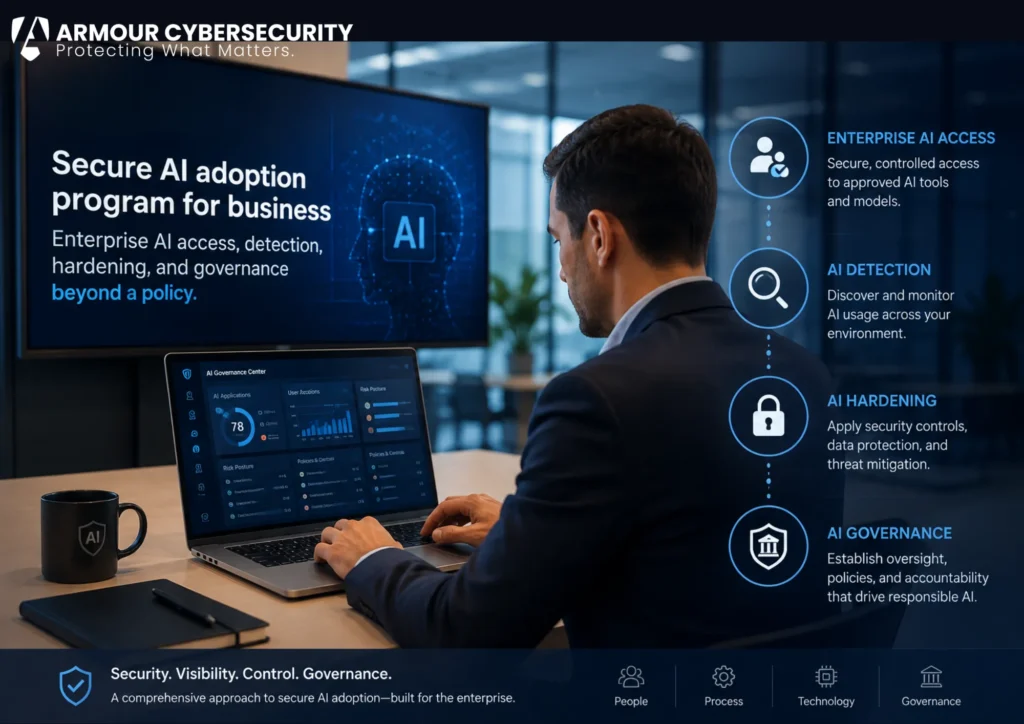
Quick answer: A secure AI adoption program for business is what a policy document cannot be: a governed enterprise AI access layer that replaces personal accounts, technical detection and enforcement that verifies compliance, hardened platform deployments that do not rely on employee self-governance, and a structured governance committee with the operational authority to manage AI risk as the landscape evolves. When organizations recognize that AI usage has outpaced their controls, the typical first response is to publish a policy that states what employees may and may not do with AI. That is a necessary starting point. It is not a program. The gap between having a policy and having a program is where the real AI risk lives.
Key Takeaways
- A policy defines the rules. A program builds the infrastructure that makes the rules enforceable, provides employees with a sanctioned alternative to the personal accounts the rules prohibit, and creates the governance and monitoring function that keeps the rules current as the AI landscape changes. Most organizations that respond to AI risk with a policy alone have addressed the documentation requirement without closing the operational risk.
- The most significant limitation of a policy-only approach is that it relies entirely on employee behavior change without providing the technical controls or sanctioned alternatives that make that change realistic. Employees who need AI to do their jobs will continue to use it through personal accounts if no enterprise alternative is available, regardless of what the policy says.
- AI usage detection and enforcement is the technical layer that makes a policy operational. Without visibility into which AI tools employees are actually using and which data categories are being submitted to them, the organization cannot verify compliance, cannot detect violations, and cannot demonstrate to auditors or regulators that the policy is followed rather than merely published.
- Productivity assistant hardening is a distinct program component that a policy cannot substitute for. A policy can restrict what employees do with an AI productivity assistant. It cannot verify that the assistant’s permissions are properly scoped, that oversharing in the underlying document repositories has been addressed, or that the assistant plugins and connectors have been reviewed for security. Those are technical program deliverables.
- Regulators assessing AI governance do not accept policy documents as evidence of a managed program. They assess whether the governance structure is operational, whether controls are implemented and monitored, and whether the organization can demonstrate accountability for AI-related decisions. A policy with no operational infrastructure behind it does not satisfy these expectations.
What a Policy Alone Can and Cannot Do
A well-written AI acceptable use policy establishes the organization’s rules for AI use: which tools are approved, which use cases require review before proceeding, which uses are prohibited, and what data categories may or may not be submitted to AI tools. These rules are necessary. They create the documented standard against which employee behavior can be measured and against which the organization can hold people accountable when violations occur. They provide a framework for evaluating new AI use case requests. And they give the organization something to point to when customers, auditors, or regulators ask what AI governance is in place.
What a policy cannot do is enforce itself. A policy that prohibits submitting customer personal data to public AI platforms does not prevent an employee from opening a browser tab, logging into a personal account, and doing exactly that. The employee may not have read the policy. They may have read it and not recognized the data they are working with as personal data in the policy’s terms. They may understand the policy and choose to work around it because the enterprise alternative is unavailable, inconvenient, or slower than the personal account they have been using for months. In all three cases, the policy violation occurs, the data leaves the organization through an unsanctioned channel, and the organization has no visibility into it because the policy created no monitoring capability.
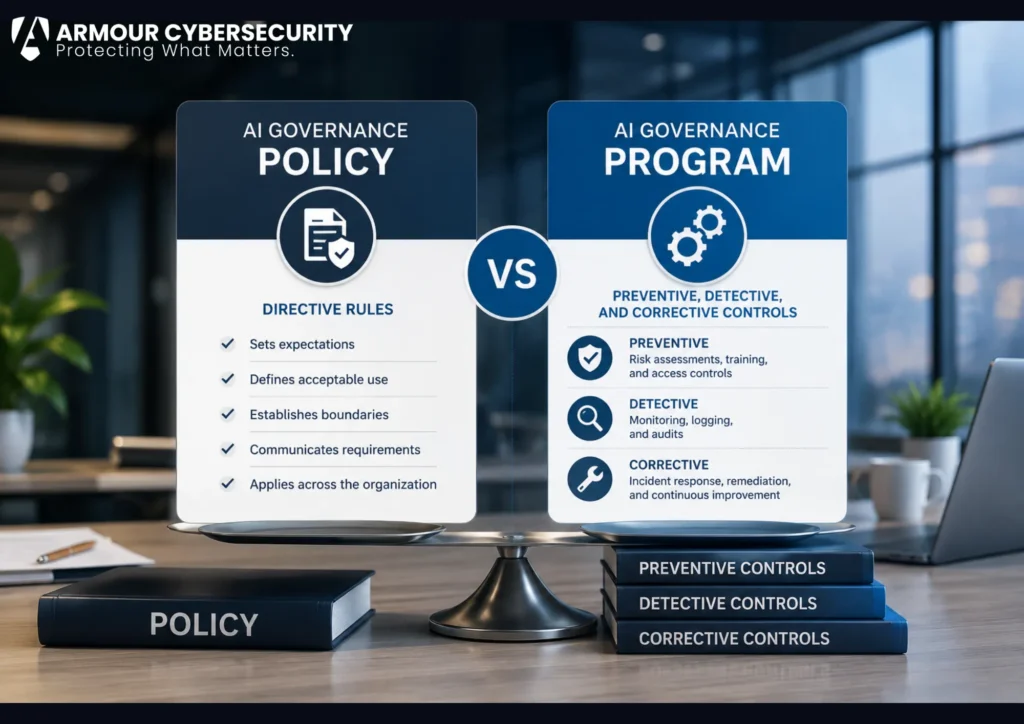
This is not a failure of policy writing. It is a structural limitation of policy as a control mechanism. Policies are directive controls: they direct behavior. The most resilient security programs combine directive controls with preventive controls (technical measures that make violations difficult), detective controls (monitoring that surfaces violations when they occur), and corrective controls (processes that respond to violations and close the gaps they reveal). A Secure AI Adoption Program delivers all four. A policy document delivers only the first.
What a Secure AI Adoption Program Delivers That a Policy Cannot
A sanctioned enterprise AI access layer
The most important deliverable of a Secure AI Adoption Program is one that a policy cannot replicate: a deployed corporate AI access layer that gives employees a sanctioned, monitored, enterprise-grade alternative to the personal accounts the policy prohibits. This is the preventive control that changes the risk equation, and it is the heart of enterprise AI adoption security. When employees have a fast, capable, enterprise AI environment available to them, the personal account alternative loses its primary advantage. The productivity benefit that drove shadow AI adoption is now available through a channel the organization controls, can monitor, and can apply data handling protections to.
Deploying this access layer requires architecture design, identity provider integration, access group configuration, foundation model selection, data handling agreement review with the AI platform provider, and rollout coordination across the organization. None of this is addressable through a policy document. It is an infrastructure project that produces the enterprise alternative that makes the policy meaningful rather than aspirational.
AI usage detection and enforcement
AI usage detection is the technical monitoring capability that tells the organization which AI tools are actually being used, by whom, at what frequency, and with what data categories being submitted. Without it, the organization is flying blind: the policy says what is permitted, but the organization has no mechanism to verify that the policy is followed or to detect when it is not. Detection coverage spans managed endpoints (monitoring installed applications and browser extensions), browsers (monitoring web traffic to known AI platform domains), and network channels (monitoring outbound traffic patterns associated with AI API calls).
Enforcement converts detection from observation into action. Sanctioned tool usage is logged and allowed. Unapproved tool access triggers alerts and, depending on the risk tier of the tool and the data involved, may be blocked at the network or browser level. Sensitive data category submissions to non-approved AI platforms trigger immediate alerts to the security team, work many organizations run through a managed SOC. The enforcement configuration is calibrated to the risk tier of each tool: blanket blocking of all AI access is counterproductive when the goal is governed adoption rather than prohibition, but targeted enforcement against the highest-risk unauthorized platforms and data categories is both appropriate and technically achievable.
Productivity assistant hardening
Organizations deploying AI productivity assistants face a distinct risk that policy governance cannot address: the assistant’s access to organizational data is determined by the permissions and integrations configured during deployment, not by the rules the policy states employees must follow. An assistant with access to all shared document repositories will surface content from those repositories regardless of whether the policy restricts certain data categories, because the restriction exists at the policy layer while the access exists at the technical layer. Productivity assistant hardening is the technical program component that aligns the two.
Hardening covers identity and access review of the accounts and roles with assistant-related privileges, permission hygiene across the collaboration and document repositories the assistant has access to, validation that the assistant respects role-based access boundaries rather than surfacing content that users could not access directly, review of the data protection controls applied to the assistant environment, and evaluation of assistant plugins, connectors, and agentic features for security implications. Each of these is a technical assessment and configuration activity. A policy document can state that assistants should be configured securely; a program can verify and implement that configuration.
Secure AI-assisted development lifecycle
For organizations whose developers use AI coding tools, the risk is not limited to data handling: it extends to the security of the code that AI generates and the processes by which that code reaches production. AI-generated code can introduce vulnerabilities, embed insecure patterns, reference deprecated or vulnerable dependencies, and include secrets or credentials that should not appear in code at all. A policy that requires developers to review AI-generated code before committing it creates a directive without the structural controls that make the directive enforceable.
A secure AI-assisted SDLC establishes the structural controls: access separation that prevents AI development users from holding direct production deployment privileges, repository and branch protection that enforces review requirements before code can merge, integrated security scanning that automatically evaluates AI-generated code for vulnerability patterns and secret exposure, and a maker-checker model that requires a reviewer other than the code author to approve changes before production deployment. These are development infrastructure configurations, not policy statements. They are delivered by a program, not described in a document.
An operational governance committee
An AI Governance Committee described in a policy is a documented intention. An AI Governance Committee stood up with defined membership, operating cadence, decision rights, use case intake process, and tool registry is an operational governance function. The difference matters because the committee is the mechanism through which the organization manages AI risk as the landscape evolves: evaluating new use case requests, reviewing policy exceptions, monitoring the AI usage exception log, updating the approved tool registry, and reporting to leadership on the state of AI governance. A committee that exists only in a policy document cannot perform any of these functions.
Standing up an effective AI Governance Committee requires identifying the right stakeholders across IT, security, legal, privacy, business leadership, and development; defining the operating model including meeting cadence and decision timelines; establishing the use case intake and approval process with tooling that makes submissions and responses trackable; and running the committee through its first governance cycles until it reaches operational maturity. This is a program standup activity that an experienced AI governance advisory team, often led by a virtual CISO, can accelerate significantly compared to an organization attempting to design and launch the committee independently while also managing the business demands that created the AI risk exposure in the first place.
What Regulators and Auditors Actually Assess
Organizations that have responded to regulatory AI guidance by publishing a policy often discover in their next audit or regulatory review that a policy document is not what assessors are looking for. OSFI’s guidelines for federally regulated financial institutions require documented governance and board and senior management accountability under B-13 (Technology and Cyber Risk Management), and assessment of third-party AI providers under B-10 (Third-Party Risk Management). Quebec Law 25 requires process controls around automated decision-making that involve personal information. The EU AI Act imposes operational requirements on organizations deploying AI systems in regulated domains. The NIST AI Risk Management Framework, increasingly referenced by regulators and auditors as a benchmark, is organized around four operational functions: Govern, Map, Measure, and Manage. All four require operational infrastructure, not just a policy that describes the intention to govern, map, measure, and manage. This is why an effective AI risk management program is folded into the organization’s broader governance, risk and compliance function rather than left as a standalone document.
When a regulator or auditor asks how the organization governs AI use, the answers they are looking for are: who owns AI governance decisions and what is their authority; what process exists for evaluating and approving AI use cases; how does the organization monitor compliance with its AI policies; what happens when a policy violation is detected; and how does the governance function adapt as new AI tools and capabilities emerge. A policy document answers none of these questions operationally. A structured Secure AI Adoption Program answers all of them with running processes, technical controls, and documented evidence, and it feeds the board cyber governance reporting leadership is accountable for.
Armour Cybersecurity’s Secure AI Adoption Program delivers the governance structure, enterprise access layer, detection and enforcement controls, and platform hardening that moves an organization from a policy on a shared drive to a program that regulators can assess and that actually manages the risk. The program is structured across two phases, from governance standup and enterprise AI access through detection, enforcement, and platform hardening.
Frequently Asked Questions
If we already have an AI policy, do we still need a full program?
Yes, for most organizations. A policy is the right starting point and should not be discarded. But for any organization with meaningful AI adoption, sensitive data, regulatory obligations, or a deployed productivity assistant, the policy alone is leaving material risk unaddressed. The program components that the policy cannot replace, specifically the enterprise AI access layer, the usage detection and enforcement, and the platform hardening, are what close the gap between the risk the policy identifies and the risk the organization actually manages. The practical question is not whether to have a policy but whether the policy is backed by the operational infrastructure that makes it meaningful.
How long does it take to go from a policy to a running program?
The timeline depends on the organization’s size, existing cloud infrastructure, and identity stack maturity. The Secure AI Adoption Program is structured as a two-phase engagement, and most mid-market organizations move from kickoff to an operational program within a few months. Phase 1, which covers governance standup, enterprise AI access deployment, and secure SDLC for AI-generated code, is typically the longer phase because it involves infrastructure deployment alongside governance design. Phase 2, which layers detection and enforcement, productivity assistant hardening, and supporting data protection controls, builds on the Phase 1 foundation and moves faster. Organizations that already have a mature identity stack, an existing enterprise cloud platform, and some governance documentation in place typically move faster than those starting from scratch.
What is the difference between an AI governance program and a vCISO engagement that covers AI?
A vCISO engagement covers the full security program, with AI governance as one component among many. The Secure AI Adoption Program is specifically scoped to deliver the governance structure, technical controls, and operational infrastructure for AI adoption in full. For organizations that need comprehensive security program leadership, the vCISO engagement is the right vehicle with the AI program as a prioritized workstream. For organizations that already have a functioning security program and need to address AI adoption specifically, the dedicated AI program delivers depth in that domain that a generalist vCISO engagement would not provide within its scope.
Can our IT team implement this program without outside support?
The components of a Secure AI Adoption Program span security, privacy, legal, cloud architecture, identity management, development operations, and governance design. Few internal IT teams have deep expertise across all of these disciplines simultaneously, and most are managing existing operational responsibilities that compete for the time a program standup requires. External advisory support accelerates the program by bringing the framework, the methodology, and the cross-disciplinary expertise that would otherwise need to be assembled from scratch. Organizations that attempt to build the program internally without outside support typically find that the governance components move slowly due to internal politics, the technical components are deprioritized behind operational demands, and the program takes significantly longer to reach operational maturity than an externally supported engagement. The question is not whether the internal team is capable but whether the program gets built at the speed the risk requires.
How does the program handle AI tools that employees are already using?
The program begins with an AI use case discovery exercise that maps current AI usage across the organization, including tools that employees have adopted informally. Each identified tool and use case is evaluated against the governance framework: approved tools are registered in the tool registry with appropriate data handling conditions; restricted tools require use case review before continued use in specific applications; prohibited tools are addressed through the enforcement controls deployed in Phase 2 of the program. The discovery exercise typically surfaces more AI usage than leadership expected and provides the factual foundation for designing a governance framework that addresses real usage rather than theoretical risk. Employees who have been using personal AI accounts are transitioned to the enterprise access layer that the program deploys, giving them a sanctioned alternative that preserves the productivity benefit while bringing usage under organizational control.
The Bottom Line
A policy tells your organization what to do about AI. A secure AI adoption program for business makes it actually happen, with an enterprise access layer that displaces personal accounts, detection and enforcement that verifies compliance, platform hardening that closes the technical gaps a policy cannot reach, and a governance committee that keeps pace with the risk. The distance between a document on a shared drive and an operational program is exactly the distance between identifying AI risk and managing it. A governed AI adoption program closes it. Start with a use case discovery, then build the access, detection, and governance layers in sequence.
About the author
David Chernitzky is Co-Founder and CEO of Armour Cybersecurity, a Toronto-based cybersecurity firm founded by military intelligence veterans and advised by senior leaders from PwC, KPMG, Deloitte, EY, and Mandiant. Armour serves more than 260 organizations across 52-plus industries, including finance, healthcare, technology, energy, legal, and government, with a 97 percent client retention rate.