By David Chernitzky, Co-Founder and CEO, Armour Cybersecurity | Serving organizations across Canada, the US, and beyond | Last updated August 18, 2026
Quick answer: A cybersecurity posture assessment is a structured, independent evaluation of your organization’s entire security program, scored against a recognized framework such as the NIST Cybersecurity Framework, and translated into financial risk terms using a quantification model. It tells you where your program stands today across every domain that matters, how that compares to industry peers, what the gaps are and which ones carry the most financial risk, and what to do first to reduce that risk measurably.
Key Takeaways
- A cyber posture assessment is broader than a penetration test or a compliance audit. It evaluates all fourteen security domains, including governance, identity, cloud, data protection, threat monitoring, and incident response, in a single engagement rather than one domain at a time.
- Findings are scored against the NIST Cybersecurity Framework and mapped to ISO 27001, CIS Controls v8, and COBIT 2019 where applicable, giving leadership a unified view of maturity across every framework that might be relevant to regulators, customers, or auditors.
- Risk is quantified in financial terms using the FAIR model. This is what allows the board to compare cybersecurity risk against other enterprise risks and evaluate whether security investment is proportionate to the actual loss exposure.
- The assessment produces a prioritized remediation roadmap with quick wins, mid-term initiatives, and strategic investments, each sequenced by risk reduction impact and effort so the security team knows exactly where to start.
- An insurer-friendly version of the report can be used to negotiate better cyber insurance terms, making the assessment directly relevant to the annual insurance renewal cycle.
What a Cyber Posture Assessment Is
A cyber posture assessment is an independent, structured evaluation of how well your organization’s security program is protecting the business. It is a whole-of-program security program assessment: consultants review your governance, policies, technology controls, and operational practices across every security domain, interview your leadership and management teams, and score what they find against a recognized maturity model tied to an industry framework. The output is a documented, defensible picture of where your security program stands today: what is working, what is missing, what is most urgently needed, and what the financial consequences of the current gaps are.
The “posture” framing is deliberate. Posture describes the overall stance of the organization toward security threats, not just the configuration of any individual tool or the status of any specific compliance checklist. An organization can have strong endpoint protection and weak identity governance. It can be SOC 2 compliant and have no functioning incident response capability. A posture assessment sees the whole picture simultaneously rather than one domain at a time, which is the only way to identify the relationships between gaps and prioritize remediation in the order that produces the most risk reduction.
How a Posture Assessment Differs from Other Security Reviews
Versus a penetration test
A penetration test is a technical exercise in which a team of security professionals attempts to exploit vulnerabilities in your systems to determine whether specific controls hold up against real attack techniques. It goes deep on the technical attack surface. A posture assessment goes broad across the entire security program: governance, risk management, compliance, identity, data protection, cloud security, application security, threat monitoring, and incident response. The two are complementary. A penetration test confirms whether specific technical controls are effective. A posture assessment evaluates whether the program that produces those controls is mature enough to build on and sustain them.
Versus a compliance audit
A compliance audit evaluates whether the organization meets the requirements of a specific regulatory framework or certification standard. It answers a pass/fail question: are the required controls in place? A posture assessment asks a different question: how mature is the security program across all the domains that matter, and what is the actual financial risk exposure given the current state? A posture assessment covers compliance posture as one of fourteen domains, maps findings to applicable frameworks, and identifies compliance gaps alongside the operational, technical, and governance gaps that a compliance audit would not reach.
Versus an internal security review
Internal security reviews are valuable for operational purposes. They are typically conducted by the team that owns the program being reviewed, which creates a structural limitation: the same people who built and run the program are assessing whether it is adequate. An independent posture assessment brings external benchmarking that internal reviews cannot provide: how does this organization’s maturity compare to peers of similar size and sector, how does the risk exposure compare to industry loss data, and what are organizations at the next maturity level doing differently? These comparisons require an external reference frame that only an independent assessor can provide.
What the Assessment Actually Covers
A comprehensive posture assessment evaluates fourteen security domains. Security governance and risk management covers the organizational structure, policies, governance frameworks, risk management methodology, and accountability mechanisms that hold the security program together, and it maps directly to a formal governance, risk and compliance function. Compliance management evaluates posture against applicable regulations including PIPEDA, HIPAA, PCI DSS, GDPR, and sector-specific requirements. Third-party risk management evaluates vendor and partner security controls, contractual obligations, and ongoing monitoring practices, the same discipline covered in depth by a dedicated supplier risk management program.
Infrastructure security covers network architecture, segmentation, firewall and intrusion detection configuration, and perimeter security. Identity and privileged access reviews account lifecycle management, multi-factor authentication, privileged access controls, and least-privilege enforcement, the core of identity and privileged access management. Data protection evaluates email security, endpoint protection, encryption, backup and recovery, and the operational practices protecting data in motion and at rest. Cloud security reviews the configuration of cloud environments against best-practice guidelines and the controls governing cloud-resident data access.
Application security evaluates the security of critical applications and the development practices that produce them. Threat monitoring and incident response assesses detection capability, log management, incident response plans, and the organization’s tested ability to respond when something goes wrong. Each domain is scored on a maturity scale tied to the NIST Cybersecurity Framework, producing a cybersecurity maturity assessment with findings mapped to ISO 27001, CIS Controls v8, and COBIT 2019 where applicable.
What the Assessment Produces
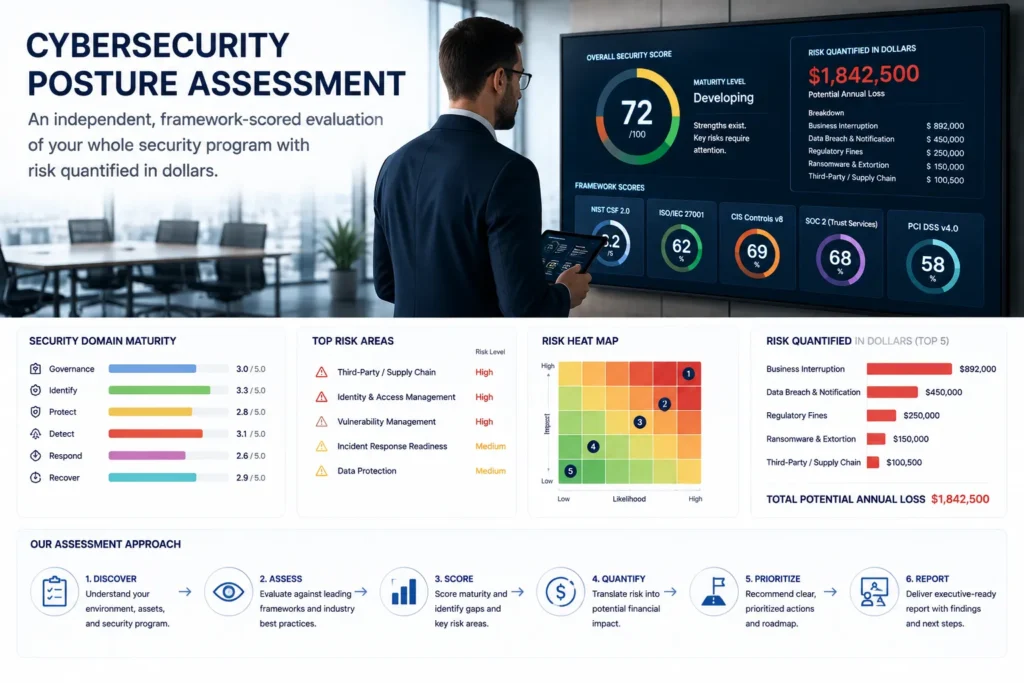
The assessment delivers a set of outputs structured for different audiences. The detailed findings report documents the assessment methodology, findings across all domains, identified vulnerabilities, and the evidence trail supporting every gap. The executive summary translates technical findings into business risk language for the CEO, CFO, audit committee, and board. The NIST CSF maturity scorecard provides a visual maturity score across all framework functions designed for leadership reporting and year-over-year tracking.
The financial risk quantification output, produced using the FAIR model combined with industry-specific threat intelligence and organization-specific factors, gives leadership the dollar-denominated risk exposure estimate they need to compare security investment against actual loss exposure. The prioritized remediation roadmap sequences improvements by risk reduction impact and effort, isolating quick wins for immediate execution. The benchmark comparison shows where the organization’s maturity sits relative to industry peers. And the insurer-friendly report version, produced on request, is structured for direct use in cyber insurance advisory work, underwriting, and renewal conversations.
Armour Cybersecurity’s Cyber Posture Assessment is conducted by consultants from military intelligence and Big Four backgrounds through structured interview workshops with your leadership team, with no invasive technical testing required.
Frequently Asked Questions
How long does a cyber posture assessment take?
Most engagements complete within four to six weeks. The first week covers scoping and stakeholder coordination. Data collection and structured interviews with leadership and management teams take one to two weeks. Analysis and maturity evaluation take one to two weeks. Roadmap development and reporting take the final week. Larger or more distributed organizations may extend the timeline. The engagement requires no invasive technical testing, which means the timeline is driven by stakeholder availability for interviews and documentation review rather than by technical scanning schedules.
What level of access does the assessment team need?
The assessment is conducted primarily through structured interviews with leadership and management teams, supported by documentation review and security tool inventory. The assessment team needs access to key stakeholders across all in-scope domains, access to security policies, architecture documentation, audit history, and prior assessment reports, and observation of security operations as agreed. No invasive technical testing is performed. The engagement does not require administrative access to systems or networks beyond what is needed for documentation review and observation.
How often should we repeat a posture assessment?
Annual assessments create the most value because they produce a year-over-year maturity record that boards, auditors, and insurers all find credible. An organization that can show three consecutive annual assessments with documented maturity improvement has a governance record that is qualitatively more defensible than one that conducted a single assessment. Between annual assessments, interim reviews are warranted after significant organizational changes including M&A activity, major technology migrations, leadership changes, and material regulatory developments that affect the compliance posture.
Can we use the assessment results with our cyber insurance carrier?
Yes, and many organizations do. The insurer-friendly report version is structured to highlight the program rigor and control maturity that underwriters prioritize during underwriting and renewal. Organizations that present documented evidence of security program maturity, a prioritized remediation roadmap demonstrating commitment to improvement, and a quantified financial risk picture can negotiate from a stronger position than those whose only evidence of security posture is a list of tools they have deployed. The assessment often pays for itself in insurance premium savings within the first renewal cycle.
What is the difference between a posture assessment and a gap analysis?
A gap analysis measures the distance between the organization’s current controls and the requirements of a specific framework or certification standard. It answers: where are we relative to the target? A posture assessment goes further: it scores the current state of the whole program across all domains, quantifies the financial risk associated with the gaps, benchmarks the findings against industry peers, and produces a prioritized roadmap for improvement. The gap analysis is an input to the posture assessment rather than a substitute for it.
The Bottom Line
A cybersecurity posture assessment answers the question a board actually asks: how good is our security program, really, and what is the risk in dollars if we do nothing? It is broader than a penetration test and deeper than a compliance audit, scoring every domain from governance to incident response against a recognized framework, quantifying the exposure with a model leadership can compare to other business risks, and handing the security team a prioritized roadmap that says exactly where to start. Done annually, it becomes the maturity record that boards, auditors, and insurers trust. A structured Cyber Posture Assessment gives you that picture in four to six weeks, through interviews rather than invasive testing.
About the author
David Chernitzky is Co-Founder and CEO of Armour Cybersecurity, a Toronto-based cybersecurity firm founded by military intelligence veterans and advised by senior leaders from PwC, KPMG, Deloitte, EY, and Mandiant. Armour serves more than 260 organizations across 52-plus industries, including finance, healthcare, technology, energy, legal, and government, with a 97 percent client retention rate.