By David Chernitzky, Co-Founder and CEO, Armour Cybersecurity | Serving organizations across Canada, the US, and beyond | Last updated August 18, 2026
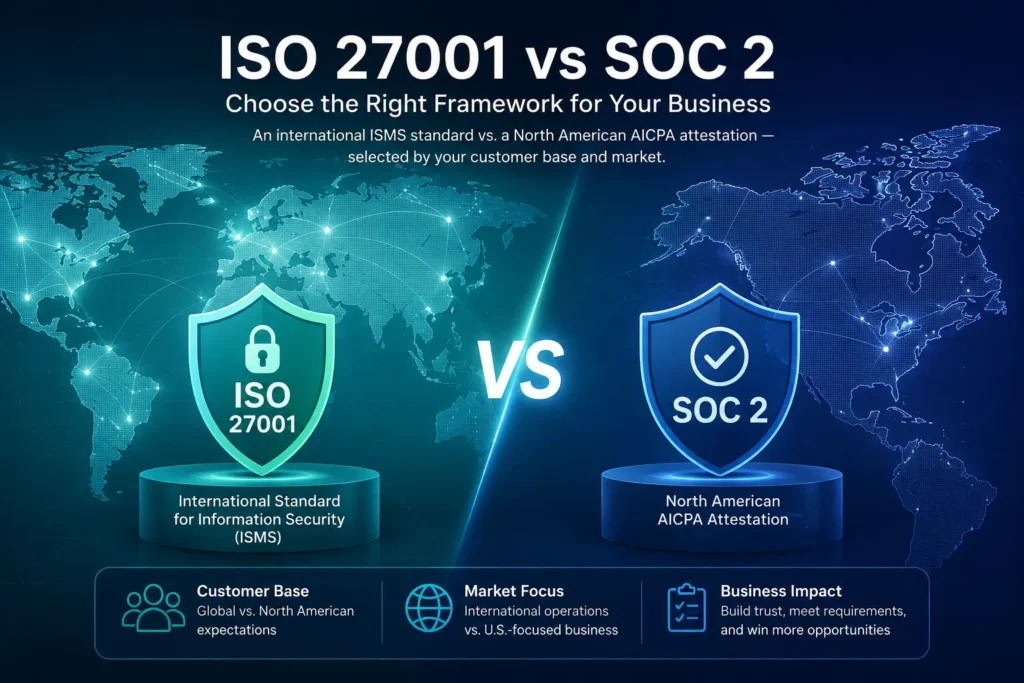
Quick answer: For a business weighing ISO 27001 vs SOC 2, the right choice comes down to your customer base and market. ISO 27001 is an international standard for information security management systems with global recognition, particularly strong in Europe, Asia Pacific, and government markets. SOC 2 is a North American attestation framework developed by the AICPA, dominant in US enterprise B2B technology markets. Organizations selling to US enterprise technology buyers typically need SOC 2. Organizations selling globally or into regulated industries in Europe, the Middle East, or Asia Pacific typically need ISO 27001. Many organizations that operate in both markets need both.
Key Takeaways
- The most reliable way to determine which certification your business needs is to ask your target customers what they require. If enterprise procurement teams are asking for SOC 2, pursue SOC 2. If they are asking for ISO 27001, pursue ISO 27001. If they are asking for both, the certifications share enough control overlap that pursuing them together is more efficient than sequentially.
- ISO 27001 is a standard: your information security management system either conforms to the standard or it does not, and an accredited certification body certifies that it does. SOC 2 is an attestation: a CPA firm attests that your controls met the Trust Services Criteria during the observation period. These are structurally different, with different renewal cycles, different assessor qualifications, and different outputs.
- ISO 27001 certification is valid for three years with annual surveillance audits. SOC 2 reports are typically renewed annually, with each report covering the prior twelve-month observation period. The ongoing cost of maintaining ISO 27001 and SOC 2 simultaneously is meaningful, which is why multi-framework control mapping that allows a single set of evidence to satisfy both is valuable.
- ISO 27001 requires a formal information security management system with defined scope, documented risk treatment, and a Statement of Applicability. SOC 2 requires controls that meet the Trust Services Criteria in the context of the service being provided. ISO 27001 is more prescriptive in its governance requirements; SOC 2 is more focused on the specific controls protecting the service.
- First-time certification typically takes six to twelve months for ISO 27001 and eight to eighteen months for SOC 2 Type II, depending on the organization’s starting point. Both timelines are significantly shortened by completing a readiness assessment before beginning the formal certification process.
What ISO 27001 Actually Is
ISO 27001 is published by the International Organization for Standardization and specifies requirements for establishing, implementing, maintaining, and continually improving an information security management system. An ISMS is the set of policies, procedures, controls, and management processes through which an organization manages its information security risks. ISO 27001 certification means that an accredited certification body has audited the organization’s ISMS and found that it conforms to the standard’s requirements.
The standard requires the organization to define the scope of the ISMS, conduct a formal risk assessment and risk treatment process, produce a Statement of Applicability documenting which of the standard’s 93 controls in Annex A are applicable and which have been implemented, and establish a management review and continuous improvement process. The certification body conducts a two-stage audit: a Stage 1 documentation review that confirms the ISMS documentation meets the standard’s requirements, and a Stage 2 implementation audit that confirms the controls are implemented and operating as documented. Certification is valid for three years, with surveillance audits conducted at twelve and twenty-four months to confirm ongoing conformance.
What SOC 2 Actually Is
SOC 2 is developed by the American Institute of Certified Public Accountants and uses the Trust Services Criteria as its evaluation framework. It is not a standard in the ISO sense; it is an audit and attestation framework. A SOC 2 report is an attestation by a licensed CPA firm that the service organization’s controls met the Trust Services Criteria during the observation period. The report is addressed to user entities, the customers who rely on the service organization’s controls, and gives them an independent assessment of the service organization’s security posture.
SOC 2 reports are renewed annually by convention, with each new report covering the most recent observation period, typically twelve months for a renewal. Unlike ISO 27001, which issues a certificate that is valid for three years, the SOC 2 attestation covers a specific period and the report is dated accordingly. Enterprise customers typically ask for the most recent report and note its observation period. A report that is more than twelve months old is generally considered stale and does not satisfy most enterprise procurement requirements.
The Key Differences That Drive the Decision
The core ISO 27001 SOC 2 difference is structural: one certifies a management system against a standard, the other attests to controls against criteria. That difference shows up in four practical places.
Geographic and customer market recognition
ISO 27001 is recognized globally and is the dominant security certification requirement in European enterprise markets, Middle East and Africa public sector markets, and Asian markets. Organizations whose enterprise customers are primarily in the United States and Canada, particularly in the software-as-a-service sector, encounter SOC 2 requirements far more frequently than ISO 27001. Organizations selling globally, particularly into regulated industries in Europe alongside North American markets, encounter both. The simplest decision input is a survey of your existing and target customers: what are they asking for?
What the assessor evaluates
ISO 27001 certification evaluates whether the ISMS is properly structured, documented, and operating, with controls selected and implemented based on a risk treatment process that the organization has conducted. The emphasis is on the management system: is there a systematic, documented process for identifying and treating information security risks? SOC 2 evaluates whether the specific controls protecting the service you provide to customers meet the Trust Services Criteria. The emphasis is on the controls themselves and their operating effectiveness over the observation period. An organization with ISO 27001 and a well-documented ISMS is well-positioned for SOC 2, but the two assessments ask slightly different questions.
The Statement of Applicability
ISO 27001 requires a Statement of Applicability, a document that lists all 93 controls in Annex A, states whether each is applicable to the organization, and where applicable describes how it is implemented and justifies any excluded controls. The SOA is a significant governance document that makes the organization’s control selection transparent to auditors, customers, and regulators. SOC 2 does not have an equivalent document; the system description in the SOC 2 report describes the controls in place for the specific service being assessed, and the auditor evaluates those controls against the Trust Services Criteria without a formal applicability statement.
Ongoing maintenance requirements
ISO 27001 requires the organization to maintain the ISMS as an ongoing management system, with documented risk assessments, risk treatment decisions, management reviews, internal audits, and continuous improvement processes. These requirements create ongoing operational overhead beyond the annual surveillance audit. SOC 2 requires that controls operate consistently throughout the observation period, which creates ongoing evidence collection and process discipline requirements, but does not prescribe the same management system overhead as ISO 27001. Organizations that have both certifications find that the ISO 27001 management system provides a strong foundation for the SOC 2 evidence requirements.
Pursuing Both: Where the Overlap Works in Your Favor
The control overlap between ISO 27001 and SOC 2 is substantial. The access control, risk management, incident management, asset management, and operations security controls required by both frameworks are largely the same in substance, even if the documentation requirements differ. An organization that pursues both certifications through a multi-framework readiness engagement can build a single set of policies, procedures, and evidence that satisfies both frameworks simultaneously, rather than building two parallel programs that maintain separate documentation and evidence trails.
Multi-framework control mapping identifies which controls satisfy both the ISO 27001 Annex A requirements and the SOC 2 Trust Services Criteria, allowing the organization to collect evidence once and apply it to both audit frameworks. This ISO 27001 vs SOC 2 comparison rarely ends in a pure either-or for organizations that sell into multiple markets: the more useful question is sequencing. Armour Cybersecurity’s compliance readiness engagements include multi-framework mapping for organizations pursuing multiple certifications, reducing the total cost and timeline compared to sequential single-framework approaches.
Frequently Asked Questions
Can we get ISO 27001 certified if we are a small company?
Yes. ISO 27001 scales to organizations of any size, and the standard explicitly accommodates smaller organizations in how it expects the ISMS to be structured. A small organization does not need a dedicated ISMS team or a large documentation library; it needs a proportionate management system that is appropriate for the scale and complexity of its information security risks. The scope of the ISMS can be defined to focus on the systems and processes most relevant to the organization’s risk profile, and the control selection in the Statement of Applicability can reflect the controls that are genuinely applicable to the organization rather than all 93 controls in Annex A.
Which certification is faster to achieve?
ISO 27001 is generally faster to achieve for organizations with a relatively mature security program because the certification process does not require an extended observation period. The Stage 1 and Stage 2 audits can be completed within a few months once the ISMS documentation is in order. SOC 2 Type II requires an observation period, most often six months for a first report though three months is the practical floor, after the controls are confirmed to be operating, which means the earliest a Type II report can be issued is roughly that period plus the fieldwork and reporting time. For organizations that need a quick certification for an immediate customer requirement, ISO 27001 may be faster than SOC 2 Type II. SOC 2 Type I, which is a point-in-time assessment, can be completed quickly but is less universally accepted than Type II. A compliance readiness audit before either engagement is the most reliable way to compress the overall timeline.
What happens during the annual ISO 27001 surveillance audit?
ISO 27001 surveillance audits are conducted at twelve and twenty-four months after initial certification to confirm ongoing conformance with the standard. The surveillance audit is narrower in scope than the initial certification audit: the certification body reviews a subset of the ISMS documentation, tests a sample of controls, and confirms that the management review, internal audit, and continuous improvement processes are functioning. The surveillance audit reviews any non-conformities identified in the prior audit to confirm they have been addressed. At the end of the three-year certification cycle, a recertification audit is conducted that is more comprehensive than a surveillance audit and effectively restarts the three-year cycle.
Do our customers get to see the full SOC 2 report?
SOC 2 reports are confidential documents addressed to user entities, the customers of the service organization. The standard practice is to share the report under a non-disclosure agreement or with a confidentiality restriction, to prevent the detailed control descriptions in the report from being publicly disclosed. Many organizations share the executive summary or the auditor’s opinion section with prospects, and share the full report under NDA with customers who have executed the agreement. Some customers require access to the full report as a condition of the relationship. ISO 27001 certificates, by contrast, are public documents that can be shared freely, though the audit report itself is confidential.
What is CMMC and how does it relate to ISO 27001 and SOC 2?
The Cybersecurity Maturity Model Certification is a US Department of Defense requirement for contractors and subcontractors in the defense industrial base, distinct from both ISO 27001 and SOC 2 in its purpose, assessment methodology, and the market it applies to. Under the current CMMC model, Level 1 covers basic cyber hygiene and is met through an annual self-assessment. Level 2 aligns to the 110 controls in NIST SP 800-171 and, depending on the contract and the sensitivity of the information involved, is met through either a self-assessment or a third-party assessment by a Certified Third-Party Assessment Organization (C3PAO). Level 3 adds a subset of requirements from NIST SP 800-172 and involves a government-led assessment by the Defense Industrial Base Cybersecurity Assessment Center. The program is being phased into Department of Defense contracts under a final rule that took effect in late 2025, and the specific assessment requirements and rollout timing have continued to change, so contractors should confirm the current requirement for their contract rather than rely on a fixed rule of thumb. Organizations in the defense supply chain need CMMC regardless of whether they hold ISO 27001 or SOC 2. Because CMMC is built on the NIST control families, the overlap with the NIST Cybersecurity Framework and NIST 800-171 is significant, which is why multi-framework readiness engagements that cover CMMC alongside other frameworks are efficient.
The Bottom Line
ISO 27001 and SOC 2 are not competitors so much as two answers to the same underlying question, proving to customers that your security is real, aimed at two different markets. ISO 27001 certifies a management system and travels well internationally; SOC 2 attests to controls and is the North American enterprise default. The decision is driven far more by who your customers are than by any inherent superiority of one over the other, and for organizations selling into both markets the practical question is sequencing rather than choosing. Because the control sets overlap heavily, the efficient path when you need both is a single multi-framework program rather than two parallel ones. A structured compliance readiness engagement maps the controls once and gets you to whichever certification your customers require, without building the same evidence twice.
About the author
David Chernitzky is Co-Founder and CEO of Armour Cybersecurity, a Toronto-based cybersecurity firm founded by military intelligence veterans and advised by senior leaders from PwC, KPMG, Deloitte, EY, and Mandiant. Armour serves more than 260 organizations across 52-plus industries, including finance, healthcare, technology, energy, legal, and government, with a 97 percent client retention rate.