By David Chernitzky, Co-Founder and CEO, Armour Cybersecurity | Serving organizations across Canada, the US, and beyond | Last updated August 18, 2026
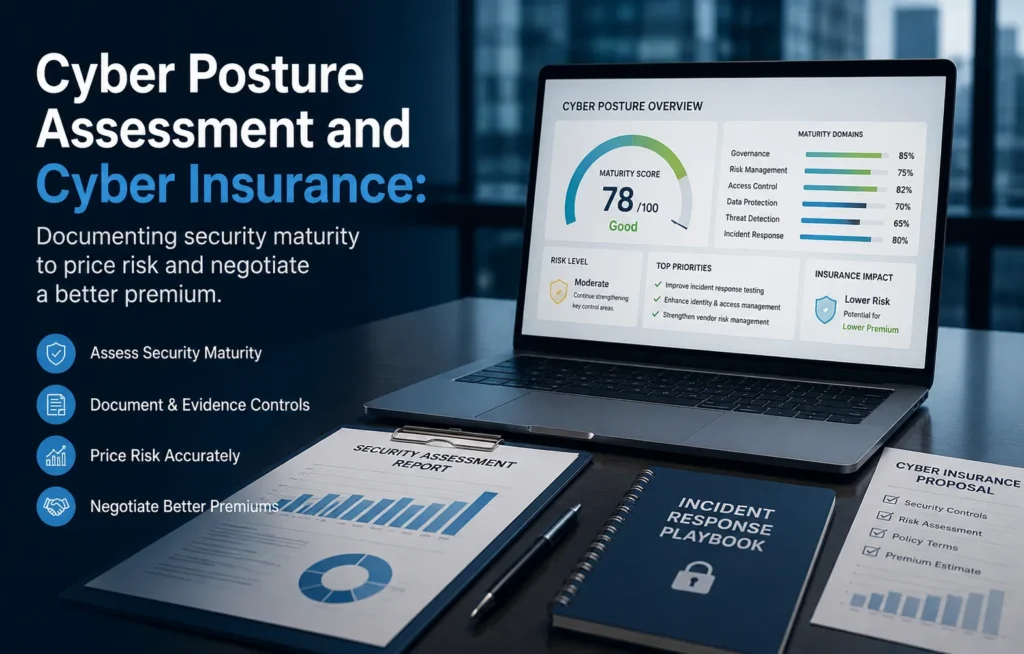
Quick answer: A cyber posture assessment can directly support a lower cyber insurance premium, because underwriters price risk based on the security program they can see and verify. An organization that presents documented evidence of security maturity, a quantified risk picture, and a prioritized remediation roadmap is demonstrably lower risk than one whose evidence of security posture is a list of tools deployed. A cyber posture assessment produces exactly the documentation that supports better underwriting outcomes, and many organizations recover the cost of the assessment within the first renewal cycle.
Key Takeaways
- Cyber insurance underwriting is an information problem. Underwriters cannot directly observe your security program; they infer its quality from the evidence you provide. The quality and structure of that evidence has a direct effect on the terms you are offered.
- The controls underwriters weight most heavily in their risk assessment include multi-factor authentication on remote access and email, privileged access management, endpoint detection and response, offline or immutable backups, and incident response planning. A posture assessment documents your status on all of these.
- An insurer-friendly report version of the posture assessment is structured to present program rigor in the format underwriters use during evaluation, making the evidence easier for the underwriting team to assess and reducing the friction in the renewal process.
- Organizations that can demonstrate year-over-year maturity improvement through consecutive annual assessments have the strongest negotiating position because they can show that the risk is trending downward, not just that it is currently at a certain level.
- The financial risk quantification component of the posture assessment, expressed using the FAIR model, helps you evaluate whether your current coverage limits are proportionate to your actual exposure, which is a separate and equally important benefit from the insurance negotiation.
How Cyber Insurance Underwriting Actually Works
Cyber insurance underwriting is the process through which an insurer evaluates the risk of covering your organization against cyber losses and sets the premium, coverage terms, sublimits, and exclusions accordingly. The underwriter’s goal is to estimate the probability and potential magnitude of a claim from your organization and price the coverage so that the premium reflects that risk. Because underwriters cannot directly inspect your security program, they rely on the information you provide through the application and supplementary questionnaires to form their view of your risk profile. This is the same information problem that our cyber insurance advisory work is built to solve from the buyer’s side.
The quality of the underwriting decision is therefore limited by the quality of the information provided. An organization that submits a detailed application with documented evidence of specific controls, an independent maturity assessment, and a quantified risk picture gives the underwriter the information needed to price the risk accurately. An organization that submits a generic application with minimal detail and no supporting documentation is priced based on the underwriter’s assumptions about organizations in its sector with its profile, which typically reflects a conservative estimate that produces unfavorable terms.
What Underwriters Are Looking For
Cyber insurance underwriters have become significantly more sophisticated in their security requirements over the past several years, driven by the growth in claims frequency and severity. The controls they weight most heavily reflect the most common attack vectors and the highest-impact loss scenarios they have experienced across their book of business, and they map closely to the cyber insurance underwriting requirements an application asks you to evidence.
Multi-factor authentication
MFA on remote access and email is the single control most consistently cited by underwriters as a determining factor in their risk assessment. Its absence is often a hard decline or a significant coverage limitation in the current market. Its presence, documented in the application and evidenced in the posture assessment, removes a major risk flag. Organizations that have deployed MFA broadly across critical systems demonstrate a fundamental level of access security hygiene that underwriters can credit.
Privileged access management
Privileged access, the administrative credentials used to manage systems and infrastructure, is the target of the majority of ransomware and data theft attacks because compromise of privileged accounts allows attackers to move freely through the environment and access any system or data they choose. Underwriters increasingly ask specifically about privileged access management, session monitoring, and just-in-time access controls. A posture assessment that documents the current state of identity and privileged access management, and a remediation roadmap that shows a credible path to improvement if gaps exist, is more useful to the underwriter than a generic assertion that privileged access is managed.
Endpoint detection and response
Endpoint detection and response capability, the ability to detect malicious activity on endpoints in near real time and respond to contain it before it spreads, has become a standard underwriting expectation. Underwriters ask about coverage, management, and alert response processes. A posture assessment that documents EDR deployment coverage, the monitoring and response capability behind it, and any gaps in the current deployment provides evidence that is more specific and credible than a checkbox on an application form.
Offline or immutable backups
Ransomware recovery capability depends on the existence of backups that the attacker cannot reach and encrypt along with the primary data. Offline or immutable backups, air-gapped from the production environment, are the control that determines whether a ransomware event results in a manageable recovery or an existential crisis. Underwriters ask specifically about backup architecture, testing frequency, and recovery time objectives. Documenting this in a posture assessment, with evidence of tested recovery procedures, is a significant positive signal in the underwriting evaluation.
Incident response planning
An organization with a documented, tested incident response plan can contain and recover from a cyber event faster than one that is improvising its response under crisis conditions. Faster containment means lower total loss, which is directly relevant to the underwriter’s claim exposure assessment. Underwriters increasingly ask whether incident response plans exist, whether they have been tested through tabletop exercises or actual incidents, and whether legal counsel and breach coach services are pre-arranged. A posture assessment that evaluates incident response readiness and documents the current state, gaps, and improvement roadmap provides specific evidence rather than a general claim of preparedness.
How the Insurer-Friendly Report Works
The insurer-friendly report version of the posture assessment is a cyber insurance security assessment structured specifically for use in the underwriting conversation. It organizes the assessment findings around the control categories underwriters evaluate, presents the maturity scoring in a format consistent with how underwriters think about risk tiers, and highlights the specific controls and practices that are strongest in the program alongside the remediation commitments for gaps. The report demonstrates that the organization has invested in an independent, rigorous evaluation of its security program, which itself signals a governance posture that underwriters view favorably.
Many organizations share the insurer-friendly report with their insurance broker before the renewal application is submitted, allowing the broker to advise on how to present the organization’s security posture most effectively and to identify whether any gaps should be addressed before renewal to improve the outcome. The combination of a professional independent assessment, a documented remediation roadmap, and a broker who can contextualize the findings for the underwriting team is the strongest possible position for a renewal negotiation.
Organizations that have conducted consecutive annual posture assessments and can demonstrate year-over-year maturity improvement have the strongest negotiating position of all. The trajectory matters as much as the current state: an organization at maturity tier two that is demonstrably moving toward tier three, with documented evidence of the improvements made in the past twelve months, is a better risk than one at tier three with no evidence of active program management. This is the security-program-insurance-discount effect that compounds when a security program maturity assessment is repeated on an annual cadence. Armour Cybersecurity produces the insurer-friendly report version on request as part of the Cyber Posture Assessment engagement.
Using the Financial Risk Quantification to Evaluate Coverage
A separate and equally important use of the posture assessment output is evaluating whether your current insurance coverage is proportionate to your actual risk exposure. Organizations that set their coverage limits based on revenue multiples or broker recommendations without a quantified risk picture may be significantly over- or under-insured for their specific threat profile. The FAIR-based financial risk quantification in the posture assessment provides the exposure estimate that informs an evidence-based coverage decision.
An organization that knows its probable maximum loss from a ransomware event is in the range of three to nine million dollars can evaluate whether its two-million-dollar ransomware sublimit is adequate. An organization that knows its expected annual loss from all cyber scenarios combined is in the range of several hundred thousand to a few million dollars can evaluate whether its coverage limit is proportionate relative to the premium being paid for the excess coverage. These are governance decisions that the financial risk quantification enables; without it, the coverage structure is set based on intuition rather than analysis. Understanding what a cybersecurity posture assessment produces makes clear why the quantification output is as useful for coverage decisions as it is for the premium negotiation.
Frequently Asked Questions
Will sharing the assessment report with our insurer hurt our renewal if it shows gaps?
It depends on how the gaps are presented and whether a remediation plan accompanies them. An assessment report that identifies gaps without a remediation roadmap tells the underwriter that the organization knows about its problems and is not addressing them. An assessment report that identifies gaps alongside a prioritized remediation roadmap and evidence of active execution on the quick wins tells the underwriter that the organization has done the work to understand its risk and is managing it systematically. The second presentation is significantly stronger than the first. Your broker can advise on which components of the assessment to include and how to frame them for the underwriting conversation.
How much can a posture assessment actually save on premiums?
The savings depend on the current premium, the organization’s current documented security posture, and the market conditions at renewal. Organizations that were previously unable to provide meaningful evidence of program maturity and can now present a comprehensive independent assessment with a quantified risk picture and a remediation roadmap typically see meaningful premium reductions, often in the range of ten to thirty percent and in some cases more, though the outcome always depends on the specific program and market. Coverage improvements, including higher limits, lower deductibles, and the removal of exclusions that applied when specific controls could not be evidenced, provide additional value that is harder to express as a single number. The assessment typically costs a small fraction of the annual premium and pays for itself within the first renewal cycle for most organizations.
What if our insurer does not accept third-party assessments?
Most insurers do accept and value independent security assessments, particularly from recognized firms with documented methodologies. The insurer-friendly report format is designed to align with the documentation styles that underwriters find useful. If a specific insurer requires a proprietary questionnaire rather than accepting an independent assessment, the posture assessment findings still provide the factual foundation that makes answering those questionnaires accurately and completely much easier. The team that completed the assessment has a clear, documented view of the program’s status across every domain the questionnaire is likely to cover.
Should we fix gaps before the assessment or after?
The purpose of the assessment is to find the gaps, so fixing gaps before the assessment on the assumption that a higher score will help the insurance renewal misses the point. The assessment is most valuable when it reflects the actual current state of the program, gaps and all, because that is what produces an accurate roadmap and a credible risk quantification. Gaps that are fixed before the assessment do not appear in the findings, which means the remediation roadmap does not address them and the financial risk quantification does not account for the improvement. Fix gaps after the assessment, in the priority order the roadmap recommends, and document the improvements as evidence for the subsequent renewal.
How does the annual assessment cadence benefit the insurance relationship over time?
Annual assessments create a documented maturity trajectory that is qualitatively more valuable to underwriters than a single point-in-time assessment. An organization that presents three consecutive annual assessments demonstrating consistent maturity improvement, with each report showing that the prior year’s quick wins and roadmap initiatives were executed, has built an evidence base that demonstrates systematic, accountable security program management. This evidence base is the foundation of a long-term relationship with insurers and brokers in which the organization is recognized as a well-managed risk rather than an unknown quantity reassessed from scratch at each renewal.
The Bottom Line
Cyber insurance underwriters cannot see your security program; they can only see what you show them, and they price the risk accordingly. A cyber posture assessment turns a vague application into documented evidence of maturity, a quantified risk picture, and a remediation roadmap, which is exactly what lets an underwriter credit your controls rather than assume the worst. Present it well, ideally with your broker and ideally showing year-over-year improvement, and it becomes one of the most direct levers you have on your premium and your coverage terms. A structured Cyber Posture Assessment produces that evidence, and for most organizations it pays for itself within the first renewal cycle.
About the author
David Chernitzky is Co-Founder and CEO of Armour Cybersecurity, a Toronto-based cybersecurity firm founded by military intelligence veterans and advised by senior leaders from PwC, KPMG, Deloitte, EY, and Mandiant. Armour serves more than 260 organizations across 52-plus industries, including finance, healthcare, technology, energy, legal, and government, with a 97 percent client retention rate.