By David Chernitzky, CEO & Co-Founder, Armour Cybersecurity · Toronto-based, serving organizations across North America · Last updated July 28, 2026
Quick answer: The case for 24/7 threat monitoring for business starts with a simple fact: most companies watch their environment during business hours and leave it unattended the rest of the time. Attackers know this. Ransomware is commonly deployed on a Friday night. Data theft happens at 3 a.m. A business without continuous monitoring is not just accepting more risk. It is accepting more undetected risk, which is meaningfully worse.
Key Takeaways
- Without continuous monitoring, the average breach goes undetected for around 200 days, and the cost of a breach grows directly with how long it runs.
- Most serious attacks are timed on purpose for nights, weekends, and holidays, when monitoring is weakest.
- The gap between detecting a threat in minutes versus days is usually the gap between a contained incident and a catastrophic one.
- 24/7 monitoring does not require an in-house team. A managed SOC delivers continuous coverage for a fraction of the cost of building it yourself.
- For businesses with compliance obligations or cyber insurance, continuous monitoring is increasingly a requirement, not a nice-to-have.
When Do Most Serious Attacks Happen?
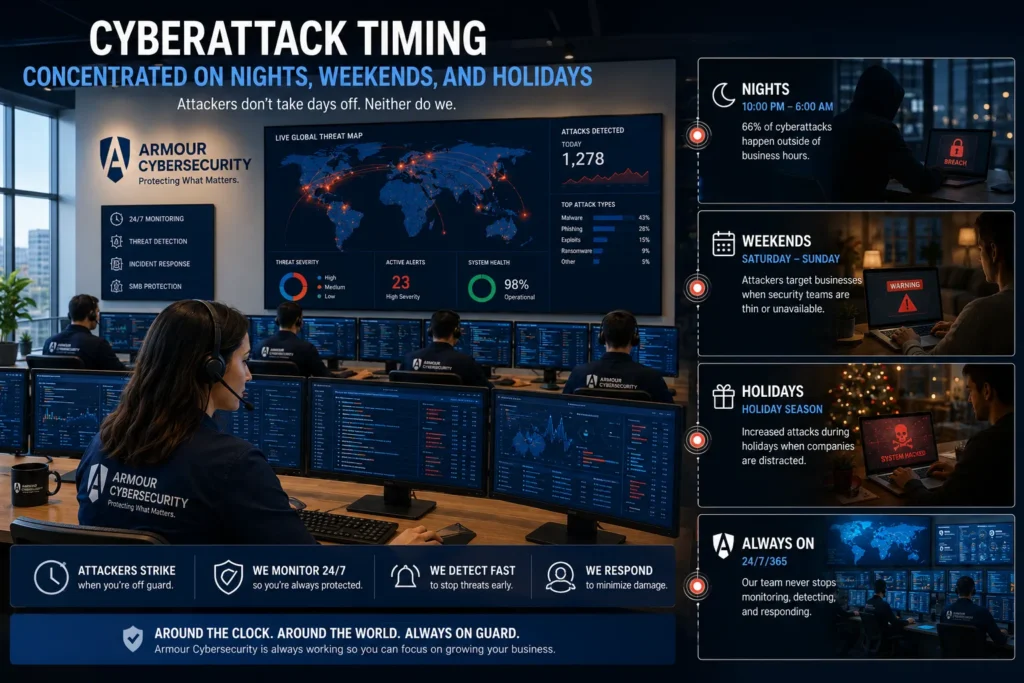
The timing of cyberattacks is not random. Attackers make deliberate choices about when to run the most damaging phases of an intrusion, and those choices consistently favor the windows when monitoring is weakest.
Ransomware deployment, the phase that encrypts files and makes the damage visible, is disproportionately timed for Friday evenings, Saturday nights, and holidays. The logic is simple. An attacker who has gained access has usually been inside for days or weeks before triggering encryption. When they finally pull the trigger, they want the most time possible to run before anyone responds. A deployment that starts at 11 p.m. on a Friday has until Monday morning in a business with no weekend coverage.
Data exfiltration follows the same pattern. Large volumes of data leaving a network at 3 a.m. are unlikely to prompt a phone call to anyone who can act. By the time the business opens, the exfiltration is done and the evidence sits on an attacker’s server.
This is not speculation. Incident response teams consistently report that the most damaging breaches are the ones discovered Monday morning, once the weekend’s activity becomes visible. The organizations that contain these attacks fastest are the ones with 24/7 monitoring that caught the threat before the weekend was over. Understanding how small businesses get hacked makes the pattern even clearer.
What Does Undetected Dwell Time Actually Cost?
Dwell time is the stretch between when an attacker first gains access and when they are detected. IBM’s Cost of a Data Breach research gives the most comprehensive read on how dwell time and breach cost move together.
The pattern is consistent: organizations that identify and contain a breach in under 200 days save roughly $1 million on average compared to those that take longer. The global average breach cost now exceeds $4 million. For organizations with fewer than 500 employees, the figure still runs above $3 million once investigation, legal, notification, regulatory, and business-disruption costs are added up.
For most SMBs, a breach of that size is an existential financial event. The business does not always recover. And the main driver of that cost is not how sophisticated the attack was. It is how long the attacker operated undetected.
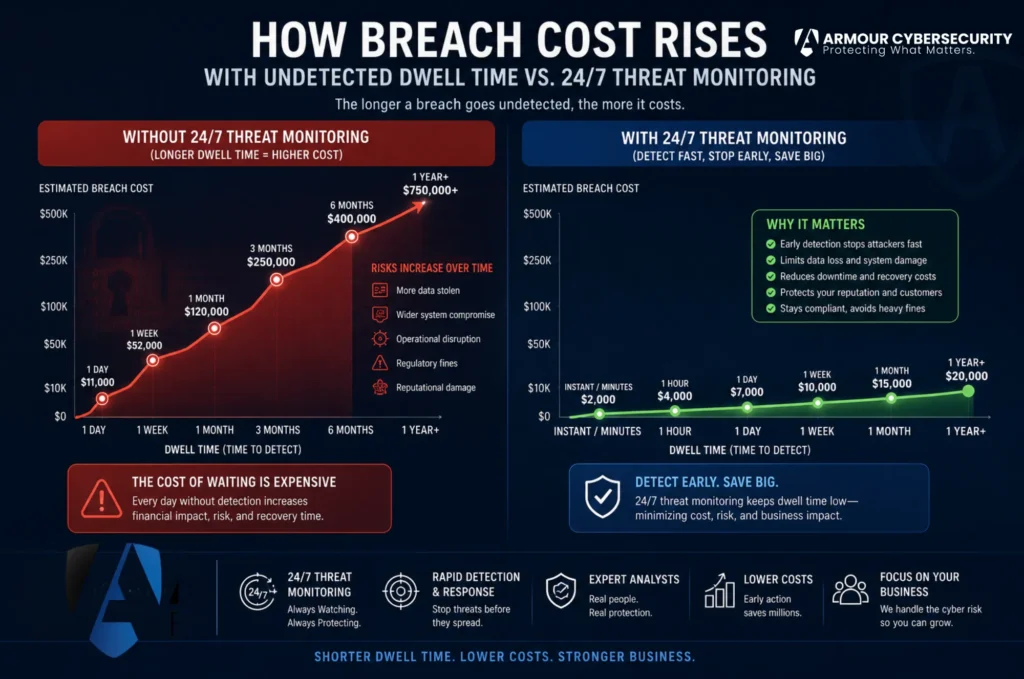
24/7 monitoring changes that one variable directly. An attacker detected in minutes has had minutes to cause damage. An attacker detected in 90 days has had 90 days. What that means for recovery cost, data exposure, and business continuity is not subtle.
What Is the Real Cost of Skipping 24/7 Threat Monitoring for Business?
Owners weighing a security investment naturally compare the cost of the service against its price. The sharper comparison is the cost of the service against the cost of the breach it prevents. But there is a middle category too: the operational and reputational costs that pile up even before a major incident, purely from the gap in coverage.
Threats that run longer than they should
Without 24/7 monitoring, threats that get a foothold during off-hours keep running until someone notices. A compromised email account used for business email compromise fraud over a weekend creates losses that cannot be reversed once the money moves. A malware implant that establishes persistence Friday evening has two days to move laterally before anyone looks Monday morning.
Compliance gaps and audit findings
SOC 2, ISO 27001, PCI DSS, and HIPAA all include requirements for continuous security monitoring. An organization that can only show business-hours monitoring is likely to pick up audit findings against those requirements. Findings like that affect certification status, customer confidence, and eligibility for enterprise contracts. A compliance readiness assessment is often where those gaps first surface.
Cyber insurance exposure
Cyber insurance carriers are getting specific about monitoring. Policies covering business interruption, ransomware, and data breach response often carry exclusions or sublimits for incidents that happened because monitoring controls were absent or inadequate. A claim from an attack that ran undetected over a weekend, in an environment with no 24/7 monitoring, can face real scrutiny during the claims process. This is worth raising early with your broker or a cyber insurance advisor.
Enterprise customer requirements
Large enterprise buyers assess a supplier’s security posture before they sign. Security questionnaires increasingly ask, in so many words, about continuous monitoring and incident response capability. A business that cannot demonstrate 24/7 coverage is at a disadvantage against competitors that can.
What Would It Cost to Build This In-House?
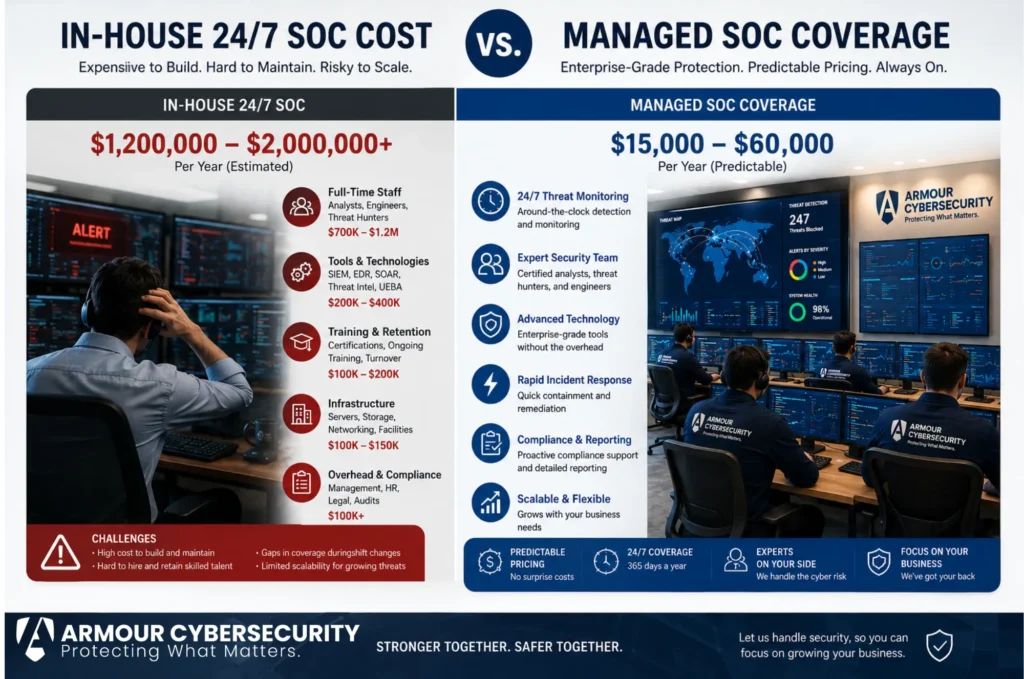
Building genuine 24/7 Tier 1-4 SOC coverage internally takes staffing most SMBs cannot justify. Round-the-clock operation needs a minimum of four to five analysts to cover shifts without anyone working unsustainable hours. Senior analysts at Tier 3 and 4 command compensation of $150,000 to $250,000 or more in major markets. Add Tier 1 and 2 analysts, management, technology infrastructure, threat intelligence subscriptions, and SOAR licensing, and the annual cost of a genuine internal SOC for a mid-market organization runs past $2 million before overhead.
A managed SOC delivers equivalent coverage for a fraction of that, because the provider spreads the fixed costs of staffing, technology, and expertise across many clients. For any organization that does not treat security operations as a core competency, the business case for a managed SOC is lopsided in its favor.
What Should a Business Expect From a Managed SOC?
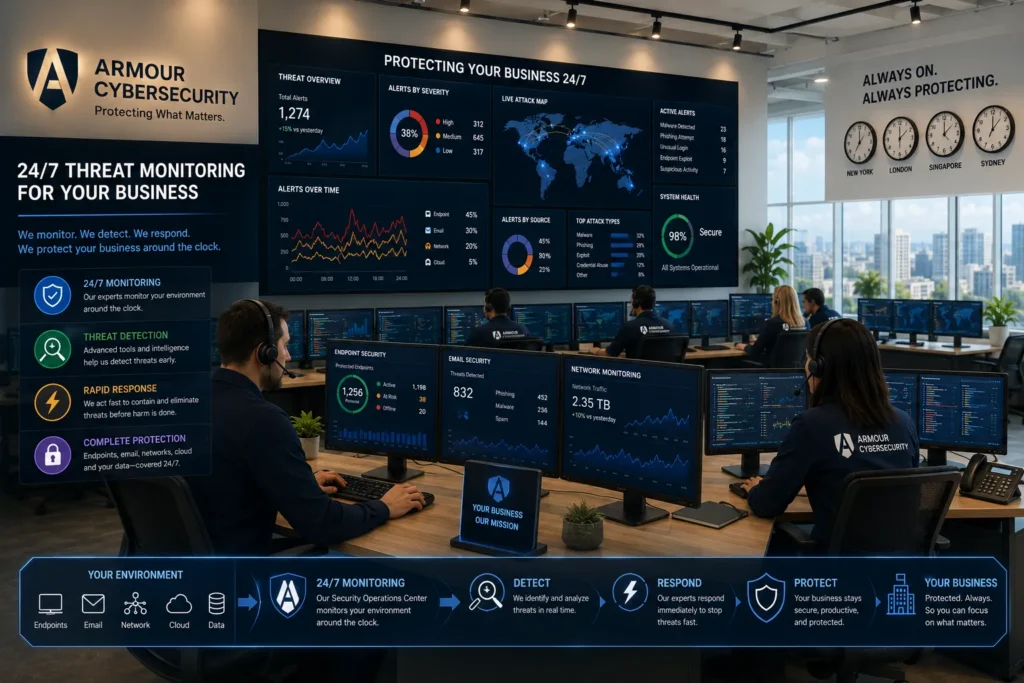
Not every managed SOC offering delivers the same depth. The questions that matter when you evaluate a provider: are all four analyst tiers covered in-house without vendor handoffs, is incident response integrated into the same team or handled separately, is threat hunting proactive rather than reactive, and what reporting comes out for compliance and the board? For the fuller picture of the operation itself, our breakdown of what a modern SOC does walks through it.
Armour’s managed SOC is built on a Tier 1-4 operating model with 24/7/365 analyst coverage, in-house threat intelligence, SOAR automation, proactive threat hunting, and an integrated incident response team that engages from the same SOC when an alert becomes an incident. It is available as a service-only model on your existing SIEM or as a turnkey deployment with a fully licensed monitoring platform.
Frequently Asked Questions
How does mean time to detect (MTTD) affect a business financially?
Mean time to detect is the average time between when an attacker first gains access and when the organization identifies the compromise. IBM breach cost research shows that every day of undetected dwell time adds to the total breach cost through additional data accessed, additional systems compromised, and additional cleanup required. Organizations with MTTD under 200 days save an average of $1 million or more compared to those that take longer. A managed SOC with 24/7 monitoring reduces MTTD from the industry average of over 200 days to minutes for most alert categories.
What is mean time to respond (MTTR) and why does it matter?
Mean time to respond is the time between when a threat is detected and when it is contained. Even after detection, every minute of uncontained activity represents additional potential damage. An attacker who is detected but not contained can continue lateral movement, escalate privileges, and exfiltrate data. A managed SOC with integrated incident response and SOAR automation reduces MTTR from hours or days to minutes for most containment actions.
Does 24/7 monitoring mean someone is actively watching my systems at all times?
Yes. A Tier 1-4 managed SOC operates on analyst shifts that provide human coverage around the clock, every day of the year. Automated detection tools process security signals continuously, and human analysts review, investigate, and respond to confirmed threats at any hour. The combination of automation and human judgment is what distinguishes a genuine managed SOC from an alerting service that sends notifications to an inbox no one checks at 3 a.m.
Can 24/7 monitoring prevent every attack?
No security control prevents every attack. The goal of 24/7 monitoring is to detect threats early enough and respond quickly enough to contain damage before it becomes catastrophic. An attacker detected minutes after gaining access causes far less damage than one operating undetected for weeks. Continuous monitoring combined with rapid response capability reduces both the probability that an attack succeeds at scale and the cost of the incidents that do occur.
How does a managed SOC satisfy cyber insurance requirements for continuous monitoring?
Cyber insurance carriers that require continuous monitoring typically look for evidence that the organization has a documented process for detecting and responding to threats around the clock, that alerts are reviewed by qualified personnel on a 24/7 basis, and that incidents trigger a defined response procedure. A managed SOC engagement produces weekly and monthly reports that document monitoring coverage, alert activity, incident response actions, and SLA performance, providing the evidence carriers request during underwriting and claims processes.
The Bottom Line
Going without 24/7 monitoring is not a decision to accept a little more risk. It is a decision to leave the most dangerous hours of the week unwatched, when the most damaging attacks are deliberately timed to land. The fix does not require building a team of your own. Armour’s Managed SOC provides continuous Tier 1-4 coverage and integrated response for a fraction of the internal cost. Protecting what matters means watching for it at 3 a.m., not just at 3 p.m.
About the author
David Chernitzky is the CEO and Co-Founder of Armour Cybersecurity, a Toronto-based firm that protects organizations across North America from advanced cyber threats. He brings more than 25 years of cybersecurity and military cyber intelligence experience, having served as an officer in an elite technology unit before co-founding Armour. Armour’s team of military-intelligence veterans and senior advisors serves 260+ clients across 52+ industries with a 97% client retention rate.