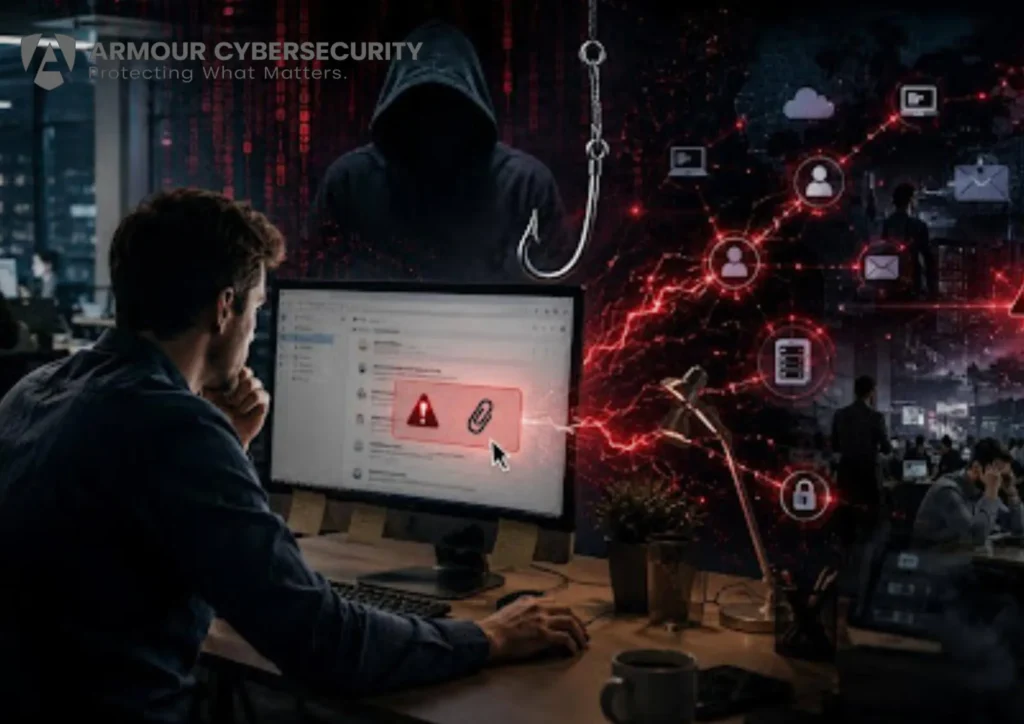
It doesn’t take a sophisticated hacker to bring down a small business. It takes one tired employee, one reused password, one convincing text message on a Tuesday afternoon. The data is unambiguous: people, not code, are the leading cause of data breaches and small businesses are paying for it.
62% of breaches involve the human element (Verizon DBIR 2026) | 26% are caused directly by human error (IBM 2025) | 8/80% of employees are behind 80% of incidents (Verizon DBIR 2025) |
| THE SHORT ANSWER People are still the single biggest factor in data breaches. Verizon’s 2026 Data Breach Investigations Report found the human element involved in 62% of breaches through error, social engineering, and misuse. IBM’s 2025 Cost of a Data Breach Report attributes 26% of breaches directly to human error. No firewall, antivirus, or AI tool has changed that fundamental fact: your team is both your first line of defence and your biggest attack surface. |
The Numbers Don’t Lie: People Are Still the Top Cause of Breaches
Every year, security vendors promise a new tool that will finally solve the human problem. Every year, the data says otherwise. Verizon’s 2026 DBIR built from more than 22,000 confirmed breaches across 145 countries found the human element present in 62% of breaches. IBM’s independent research, based on 600 breached organizations, found human error was the direct root cause in 26% of cases, on par with malicious attacks and IT failures combined.
These aren’t fringe numbers from a niche survey. They’re the two most cited datasets in the industry, built from real, confirmed incidents not self reported surveys or marketing estimates.
You can patch a server in an afternoon. You can’t patch a distracted employee on a Tuesday.
Technology has gotten better at stopping automated attacks. Firewalls block more traffic, endpoint detection and response catches more malware, spam filters catch more junk. But every one of those systems has the same failure mode: a human with legitimate access, clicking, typing, or approving something they shouldn’t. That’s the door attackers are walking through.
The Three Ways Humans Open the Door
“Human element” isn’t one behaviour it’s three, and each one needs a different fix:
1. Error misdelivered emails, misconfigured cloud storage buckets, lost laptops, sensitive files sent to the wrong recipient. No malicious intent required just a moment of inattention. IBM found this category directly responsible for 26% of all breaches studied.
2. Social engineering phishing, pretexting, impersonation attacks built entirely around manipulating a person’s trust rather than exploiting a technical flaw. Verizon’s 2026 data shows mobile based scams, SMS and voice phishing, now succeed 40% more often than email phishing. Employees have learned to be suspicious of their inbox. Attackers simply moved to the phone in their pocket.
3. Misuse employees using systems or data in ways that create risk, including a fast growing new habit: shadow AI, the exact exposure a disciplined AI security program is built to govern. Verizon found employee use of AI tools tripled to 45% in 2026, with 67% accessing AI services through personal, non corporate accounts on work devices often pasting in client data, contracts, or source code. IBM found this behaviour adds an average of USD $670,000 to the cost of a breach.
Why This Hits Small Businesses Hardest
Large enterprises have layers: dedicated security teams, redundant controls, budget to absorb a mistake before it becomes a breach. Small businesses usually have one IT person wearing five hats which means a single human error travels further and faster before anyone catches it.
88% of SMB breaches involved ransomware, vs. 39% at large organizations (Verizon DBIR 2025) | $4.8M average cost of a phishing initiated breach, the most common initial vector (IBM 2025) | 95 days how long stolen credentials sat unused before half of all ransomware attacks (DBIR 2026) |
That last figure is the one that should worry SMB owners most. Among ransomware victims, 73% showed evidence of a prior infostealer or credential compromise and in half of those cases, the credentials were stolen up to 95 days before the ransomware hit — a monthslong blind spot that managed detection and response exists to close. One employee logging into a work account from an infected personal device can quietly hand attackers a key that doesn’t get used for three months. By the time the ransom note appears, nobody remembers the moment it started.
Why Awareness Training Alone Isn’t the Full Answer
It’s tempting to conclude that if people cause most breaches, the fix is simply “train people harder.” The data complicates that. Verizon’s research shows phishing simulation click rates plateau over time some percentage of any workforce will click, no matter how much training they’ve had. Human attention is not a variable you can drive to zero.
What training reliably does move is reporting. After awareness training, employee reporting of suspicious messages increased roughly fourfold. That’s the real lever: you can’t eliminate the click, but you can shrink the time between the click and someone raising a hand.
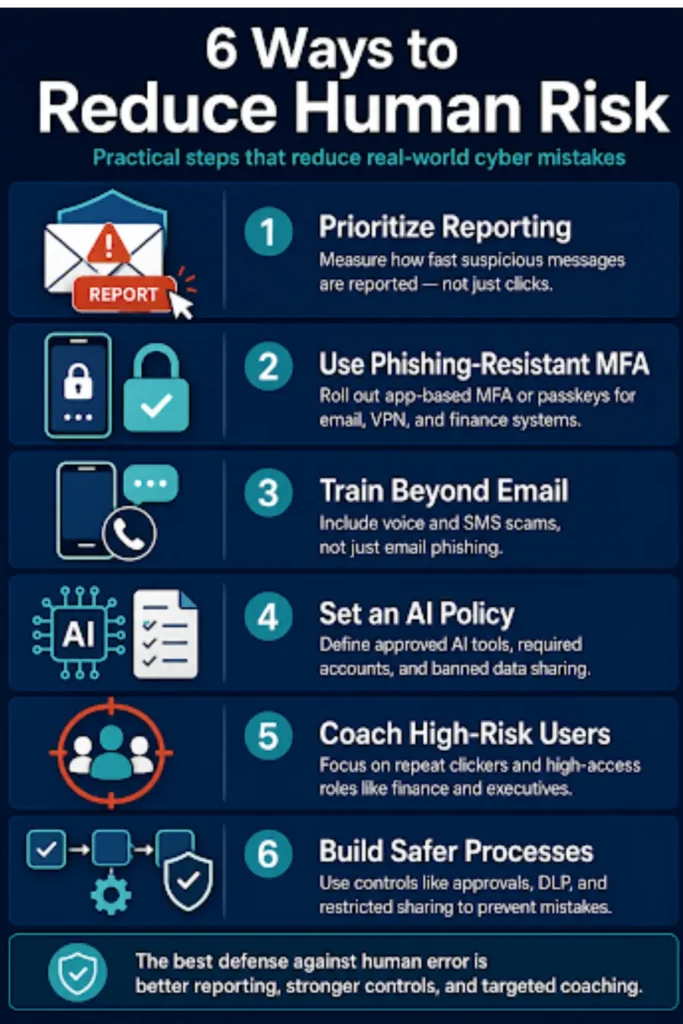
Six Ways to Reduce Human Risk (Not Just Talk About It)
1 Optimize for reporting, not perfection
Stop measuring success by click rate alone. Track how quickly employees report suspicious messages that’s the metric tied to faster containment, and training measurably improves it.
2 Deploy phishing resistant MFA everywhere
MFA remains the gold standard for account protection, but weak forms are being bypassed prompt bombing appeared in 14% of incidents in Verizon’s data. Move to app based or passkey authentication as part of stronger identity and access management, starting with email, VPNs, and financial systems.
3 Train for voice and SMS, not just email
With mobile based scams outperforming email by 40%, awareness programs stuck on “spot the phishing email” are training for yesterday’s attack. Add simulations for text and voice pretexting.
4 Put an AI usage policy in writing this quarter
Your team is already using AI tools; the only question is whether it’s governed. Define approved tools, require corporate accounts, and specify what data can never be pasted into a public model.
5 Focus coaching on your highest risk people
Verizon’s data shows 8% of employees account for 80% of security incidents. Blanket annual training misses this entirely. Identify repeat clickers and high access roles (finance, executives, admins) for targeted, role specific coaching.
6 Build processes that don’t depend on someone remembering
Where possible, replace “employee has to remember the rule” with a control that enforces it automatically approval workflows for wire transfers, data loss prevention tools, locked down sharing permissions, the kind of controls Managed Security Services keep running around the clock. The best defence against human error is removing the opportunity for it.
The Bottom Line
Every dollar spent on the newest detection tool is well spent but it’s spent defending against the smaller half of the problem. The larger half walks into your business every morning, badges in, and means well. That’s not a reason for blame; it’s a reason to design your security program around how people actually behave, not how you wish they would. The businesses managing this risk well aren’t the ones with zero mistakes. They’re the ones who catch the mistake fast, because they built a culture and a system that expects it.