The word “compliance” has an unfortunate reputation in business circles. It is associated, not unfairly, with bureaucratic exercises that consume resources, produce documentation no one reads, and result in a certificate filed away until the next renewal cycle. In cybersecurity, that reputation is particularly dangerous, because the gap between genuine security and compliance for its own sake is real. Organizations that chase the certificate instead of the underlying controls it represents are not actually reducing risk.
At the same time, dismissing compliance frameworks entirely misses their genuine value. A well-implemented framework forces an organization to examine its controls systematically, find gaps it would otherwise overlook, and maintain a level of discipline that is hard to sustain without external structure. Companies that treat compliance as a real security improvement exercise typically end up better protected and better positioned to prove that protection to clients, insurers, and regulators.
For Canadian businesses in 2026, the landscape carries added complexity. Federal and provincial privacy regulations keep evolving. Bill C-26, Canada’s Critical Cyber Systems Protection Act, is advancing through the legislative process. Quebec’s Law 25 has added new data protection requirements. And enterprise clients now run formal vendor risk management programs that make proof of compliance with a recognized security framework a condition of doing business.
This article explains the practical differences between the three frameworks most relevant to Canadian mid-market businesses, SOC 2, ISO 27001, and NIST CSF, and how to choose the right path for your specific context.
What Are These Frameworks Actually For?
Before choosing a framework, it helps to understand what each one is designed to do, because they serve different purposes and fit different contexts.
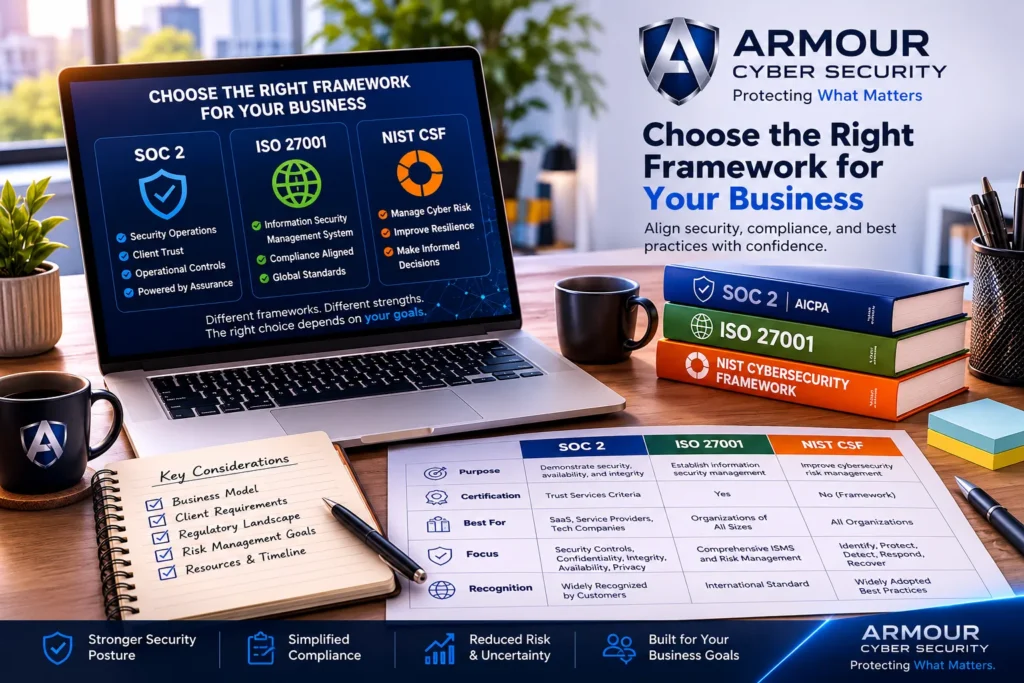
SOC 2 (System and Organization Controls 2) is an audit standard developed by the American Institute of Certified Public Accountants (AICPA). It is built for service organizations: companies that store, process, or transmit client data as part of their service delivery. A SOC 2 audit produces an independent assessment of whether your controls for security, availability, processing integrity, confidentiality, and privacy are designed appropriately and operating effectively. The output is a report you can hand to clients as third-party proof of your control environment.
ISO 27001 is the international standard for information security management systems (ISMS). Where SOC 2 focuses on a defined set of trust service criteria, ISO 27001 provides a full management system framework covering the complete range of information security controls. Certification comes from an accredited third-party body after a formal audit process, and it is often a hard requirement for contracts with government agencies, enterprise clients, and international partners.
The NIST Cybersecurity Framework (CSF), developed by the US National Institute of Standards and Technology, is a voluntary framework for managing cyber risk. Unlike the other two, it has no formal certification. It is a structured approach to assessing and improving posture, widely used across North America as an internal improvement tool and increasingly referenced by Canadian regulators examining critical infrastructure security.
SOC 2: When Is It the Right Choice?
SOC 2 is primarily relevant for organizations that deliver technology services: SaaS companies, managed service providers, cloud infrastructure providers, and any business processing or storing client data on behalf of other organizations. If enterprise clients keep asking for evidence of your security controls, or deals stall because you cannot produce a SOC 2 report, this is the most commercially valuable certification to pursue.
SOC 2 comes in two forms. Type I assesses whether controls are designed appropriately at a single point in time. Type II assesses whether they operated effectively over a defined period, typically six to twelve months. Enterprise clients almost always require Type II, because it proves sustained performance rather than a snapshot.
The time and cost to get there depends heavily on your starting point. Organizations with mature controls and solid documentation can reach SOC 2 readiness within three to six months. Those starting from a lower baseline typically need nine to twelve months of preparation before an audit can even begin. The real investment is not the audit itself but the control implementation and documentation work required to be audit-ready.
For Canadian technology companies, SOC 2 is usually the first formal compliance investment because the commercial driver is direct: clients are asking for it. Note that SOC 2 is a US standard. It is widely recognized in Canada and internationally, but it does not address Canadian-specific obligations like PIPEDA or provincial privacy legislation.
ISO 27001: When Is It the Right Choice?
ISO 27001 is the right call when international recognition matters, when government or regulated-industry contracts require it, or when you want a comprehensive management system rather than a narrower audit report. It is standard in Europe and increasingly required in procurement across financial services, healthcare, and government contracting.
Certification runs in three stages: an initial gap assessment measuring the distance between your current controls and the standard, a Stage 1 audit reviewing ISMS documentation, and a Stage 2 audit testing implementation and effectiveness. Certification is valid for three years with annual surveillance audits.
ISO 27001’s comprehensiveness is both its strength and its challenge for SMBs. The standard covers 93 controls across multiple domains, which delivers genuine assurance but demands sustained organizational commitment. Smaller organizations often lean on external GRC services to carry the management system workload, or start with the subset of controls most relevant to their risk profile and build toward full certification over time.
For Canadian organizations, ISO 27001 is increasingly valuable as a maturity signal. It also aligns well with Quebec’s Law 25 and the direction of federal regulation under Bill C-26, both of which emphasize systematic risk management over specific technical controls.
NIST CSF: When Is It the Right Choice?
NIST CSF is the right starting point when the goal is improving security posture rather than earning a certificate. Because it is voluntary and has no certification outcome, it suits organizations that need structure and guidance but are not yet at the point where a formal audit is commercially necessary or practically achievable.
The framework’s function structure, Identify, Protect, Detect, Respond, Recover, gives you a clean mental model for assessing completeness. Most organizations running a NIST CSF assessment for the first time discover major gaps in Detect and Respond, which chronically receive less investment than Protect controls like firewalls and endpoint tools. Closing those gaps is exactly what managed detection and response exists to do, and it is often the fastest way to raise scores in the two weakest functions.
NIST CSF 2.0, released in 2024, added a sixth function, Govern, reflecting how much security accountability has moved to the executive level. This matters for Canadian organizations because formal cyber risk oversight at the board level is precisely the governance expectation embedded in PIPEDA, Quebec Law 25, and the direction of Bill C-26.
NIST CSF also serves as the underlying reference for many other compliance programs. Organizations that build their security program on it are well-positioned to pursue SOC 2 or ISO 27001 later, because most of the groundwork is already done.
What About PIPEDA and Canadian Privacy Regulation?
SOC 2, ISO 27001, and NIST CSF are security frameworks, not privacy law compliance tools. They cover security controls, not the full range of obligations under Canadian privacy legislation.
PIPEDA and its provincial equivalents, Quebec’s Law 25, and the changes coming under Bill C-26 establish specific obligations around consent, purpose limitation, data subject rights, breach notification, and cross-border data transfers. A security framework supports PIPEDA compliance by structuring how personal information gets protected, but it does not cover the legal picture. Dedicated privacy compliance consulting fills that gap by mapping your security controls to the actual legal requirements, so one compliance investment covers both.
How to Choose the Right Path
The decision comes down to three factors: the commercial driver (what are clients or contracts requiring?), the current state of your controls (how much preparation is needed?), and the scope you want to cover (a defined audit period versus an ongoing management system). Whichever framework you pick should slot into a broader cybersecurity strategy rather than exist as a standalone project.
- If clients are asking for it and you are a technology service provider: SOC 2 Type II.
- If international contracts, government work, or financial services are significant: ISO 27001.
- If the goal is security improvement with structure and no immediate certification requirement: NIST CSF.
- If you are starting from scratch and uncertain: a readiness assessment first, which maps your current controls to the most relevant framework and shows the real effort required.
A readiness assessment is the highest-value first step for any organization that has never formally evaluated its controls against a recognized framework. Armour Cybersecurity’s Compliance Readiness Audit starts with a SOC 2 readiness assessment or ISO 27001 gap analysis, whichever fits your business context, and gives you a clear, prioritized view of the gap you are closing and a realistic plan for getting there.
For guidance on compliance frameworks and readiness assessment, visit armourcyber.io or contact the Armour Cybersecurity team.
Frequently Asked Questions
What is the difference between SOC 2 and ISO 27001?
SOC 2 is a US audit standard that produces a report on your controls for a defined period, mainly used to satisfy client due diligence. ISO 27001 is an international certification of your entire information security management system, valid for three years with annual surveillance audits. SOC 2 answers a client question; ISO 27001 certifies an ongoing system.
How long does SOC 2 certification take in Canada?
Plan for three to six months of preparation if your controls are already mature, or nine to twelve months from a lower baseline, plus the audit observation period itself. Type II requires six to twelve months of control operation before the report can be issued, so most Canadian companies are twelve to eighteen months from decision to report in hand.
Is ISO 27001 worth it for a small business?
It depends on who you sell to. If your contracts involve government, financial services, healthcare, or international enterprise clients, ISO 27001 opens doors that stay closed without it. If not, the 93-control scope is usually heavier than an SMB needs, and cybersecurity services for small business built around NIST CSF deliver more security per dollar until a certification becomes commercially necessary.
Does the NIST Cybersecurity Framework apply to Canadian companies?
Yes. NIST CSF is voluntary and country-agnostic, and Canadian regulators increasingly reference it in guidance for critical infrastructure and financial services. Its Govern function also lines up with the executive accountability expectations in PIPEDA, Quebec Law 25, and Bill C-26, which makes it a practical backbone for Canadian security programs.
Does SOC 2 or ISO 27001 make my company PIPEDA compliant?
No. Both are security frameworks, and PIPEDA is privacy law. The frameworks cover how personal information is protected, but PIPEDA also requires consent management, purpose limitation, data subject rights, and breach notification processes that no security certification addresses. You need the security framework plus a privacy compliance mapping to cover both.