Quick answer: Managed cybersecurity for small businesses is a service where a dedicated team of security professionals deploys, monitors, and manages your organization’s defenses on your behalf, around the clock. Rather than buying tools and hoping someone watches them, you get a full security program run by experts at a cost designed for businesses that are not enterprises.
Key Takeaways
- Managed cybersecurity replaces the security workload your IT staff cannot realistically own alongside everything else they do.
- A complete managed program covers endpoints, email, network, vulnerabilities, and people, not just one area.
- 24/7 monitoring is the capability most SMBs lack entirely when managing security in-house.
- Managed services are not a product you buy and forget. They involve ongoing configuration, tuning, and response by dedicated analysts.
- The right provider acts as an extension of your business, not a vendor who sends you reports no one reads. SMB cybersecurity services make that model accessible to organizations of every size.
What Does Managed Cybersecurity Actually Mean?
The term gets used loosely, so it is worth defining precisely. Managed cybersecurity, also called a managed security service, is an arrangement where an external team of security professionals takes ownership of your organization’s security program. They deploy the technology, configure it to your environment, monitor it continuously, and respond to threats on your behalf.
The distinction from simply buying security software is significant. Software installed and left to run on default settings provides limited protection. Attackers know which products most SMBs use and have developed techniques that bypass defaults. A managed service means the tools are configured by people who understand how they work and actively tuned as threats evolve.
It also means someone is watching. Most cyberattacks do not announce themselves with a locked screen and a ransom note the moment they occur. Attackers often spend days or weeks inside a network before triggering the visible phase of an attack, moving laterally, stealing credentials, and mapping the environment. A managed cybersecurity program with 24/7 monitoring catches that activity before the damage is done.
What Does a Managed Cybersecurity Program Include?
A complete program covers multiple layers of your environment. Any single layer left undefended becomes an entry point. The core components of a well-structured managed cybersecurity service are:
Endpoint detection and response
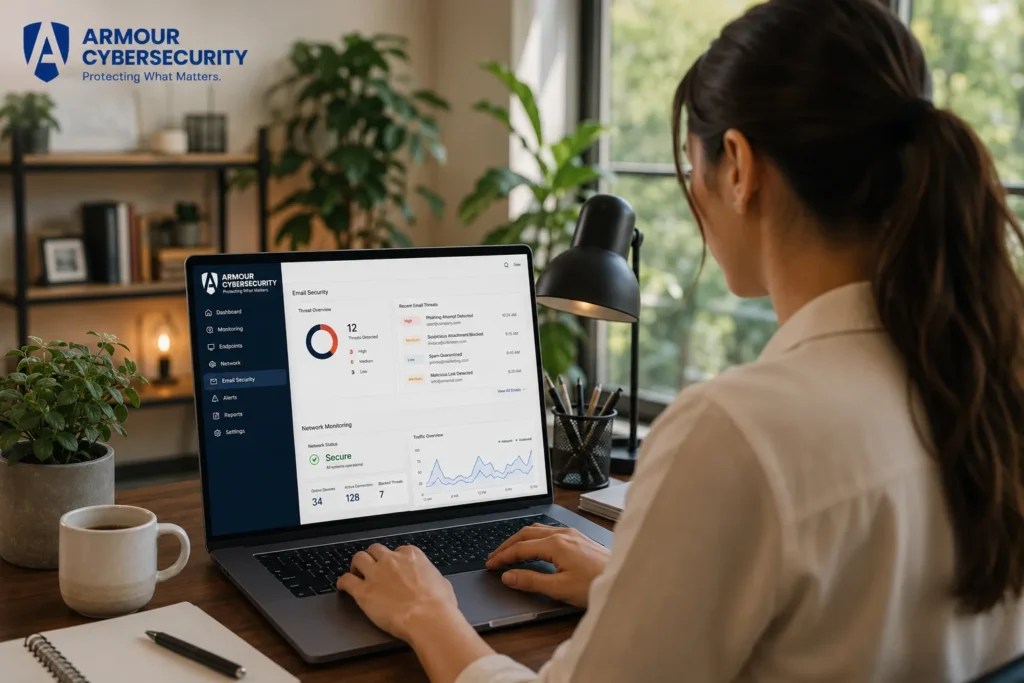
Your laptops, desktops, and servers are the most common targets in a cyberattack. Endpoint detection and response software monitors every device for malicious activity, blocks known threats, and gives analysts the visibility to investigate and contain incidents. In a managed service, this is deployed and monitored by the provider’s team, not left to generate alerts that no one has time to review.
Email and collaboration security
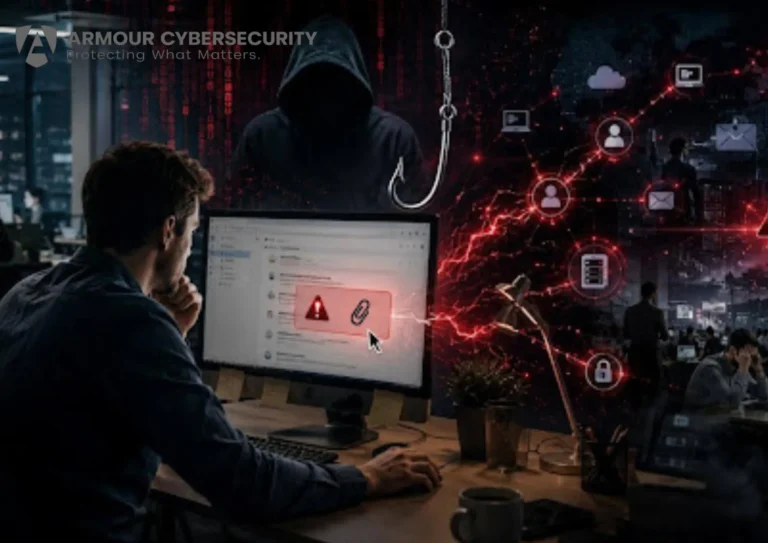
Phishing is the most common way attackers get into a business. Managed email security filters malicious links, attachments, and spoofed sender addresses before they reach employee inboxes. In environments using Microsoft 365 or Google Workspace, this also covers file sharing and collaboration tools where malicious content increasingly arrives.
Network monitoring
Once an attacker is inside your network, they move toward the data they want. Network monitoring watches traffic patterns for signs of intrusion, lateral movement, and data exfiltration. Combined with endpoint and email signals, it gives analysts a complete picture of what is happening across your environment.
Vulnerability management
Unpatched software is one of the leading causes of breaches. Vulnerability management involves regular scanning to identify exposures across your systems, prioritizing them by risk, and tracking remediation to confirmed closure. In most SMBs without a managed program, vulnerability scans happen infrequently, findings sit in a report no one acts on, and the same exposures persist for months.
Security awareness training
People are a significant part of every organization’s attack surface. Managed security awareness training delivers ongoing education that teaches employees to recognize phishing, social engineering, and risky behavior. Simulated phishing campaigns measure how employees respond to realistic attack scenarios and identify where additional training is needed.
Backup and recovery readiness
An organization’s ability to recover from a ransomware attack or destructive incident depends on having tested, ransomware-resilient backups. Managed backup review confirms that backup architecture would actually work under a real attack, identifies gaps, and validates recovery procedures before they are needed under pressure.
Managed Security Services for SMBs: How They Compare to In-House IT
This is one of the most common questions SMB owners ask, and the distinction matters. Your IT team keeps the lights on: they manage your servers, support employees with technical issues, and maintain the infrastructure that runs the business. That is a full-time job, and it is what most IT staff at SMBs are actually doing.
Cybersecurity is a separate discipline that requires different expertise, different tools, and different attention patterns. A network administrator managing 50 endpoints is not in a position to also monitor those endpoints for threat activity 24 hours a day, run vulnerability scans, analyze phishing campaigns, or respond to an active incident at 2 a.m. The skill sets do not overlap as much as the job titles suggest.
Managed cybersecurity takes the security function off your IT team’s plate entirely. Your team continues running infrastructure and supporting users. The managed security provider owns the threat detection, response, and ongoing optimization that your IT staff does not have time for and may not have the specialization to deliver.
What to Look for in a Cybersecurity Managed Service Provider
Not all managed security services are equivalent. Some providers sell a product bundle and call it managed security. The difference between a genuine managed service and a product with a service wrapper is in the people, the monitoring, and the response.
A cybersecurity managed service provider worth engaging should be able to answer clearly: who monitors your environment at 3 a.m., what happens in the first 30 minutes after a threat is detected, how are tools tuned to your specific business rather than left on defaults, and how do you see what they are doing on your behalf.
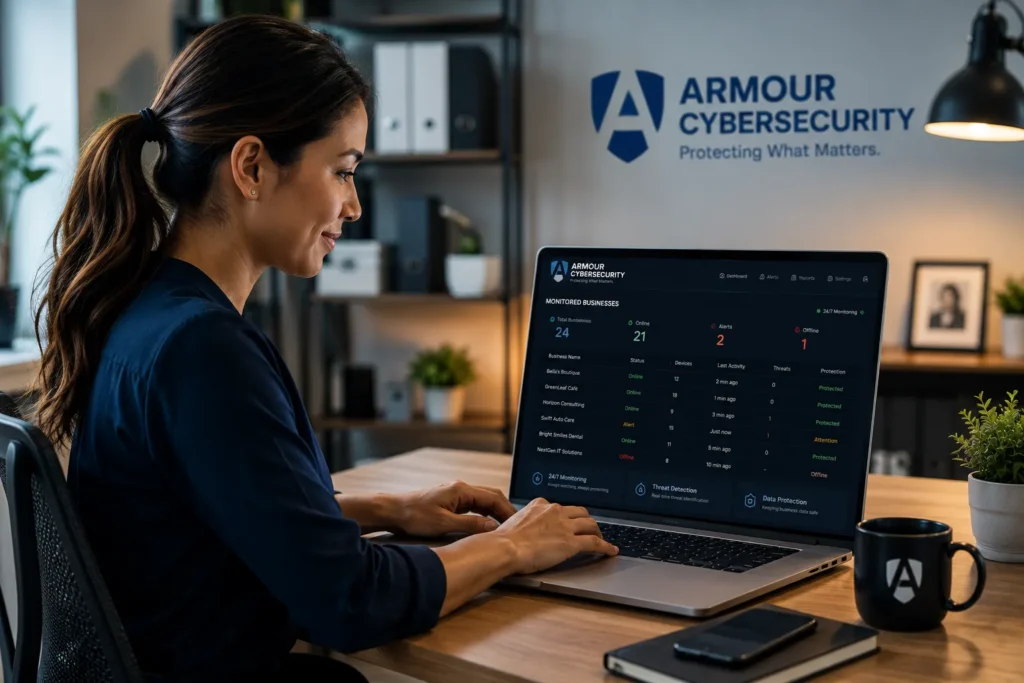
Armour 360 is built around these questions. The program includes 24/7 monitoring and response by Armour Cybersecurity analysts, coordinated across endpoint, email, and network signals. Tools are tuned to each client’s environment and communication patterns. Executive reporting translates security activity into business language so leadership can understand what is happening and why. The methodology follows six standardized phases from discovery through quarterly strategic review, so every engagement delivers consistent outcomes rather than variable results. With cybersecurity for small business as the foundation of Armour 360, more detail is available at armourcyber.io/armour-360.
Is Outsourced Cybersecurity Worth It for a Small Business?
The relevant comparison is not the cost of outsourced cybersecurity against the cost of doing nothing. It is the cost of a managed program against the cost of a breach. IBM research puts the average cost of a data breach for organizations with fewer than 500 employees above $3 million. That figure includes investigation, legal response, notifications, regulatory fines, and business disruption.
A managed cybersecurity program prevents most of the incidents that cause those costs. For the incidents that still occur despite good defenses, it dramatically reduces the time to detection and containment, which is the primary driver of breach cost. For SMBs with compliance obligations in healthcare, financial services, or legal work, a managed program also provides the documented controls and monitoring evidence that auditors require. A strong incident response capability is central to that reduction.
The question is not whether your business can afford managed cybersecurity. The question is whether it can afford not to have it.
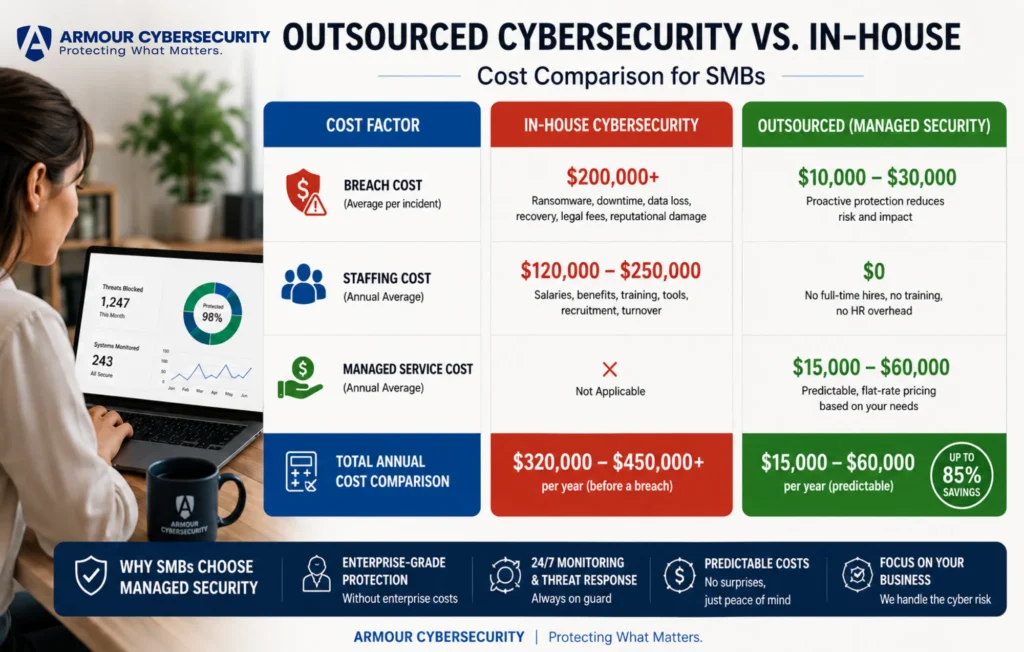
Your IT team keeps the lights on. Your managed security partner keeps the threats out. Armour 360 delivers the full cybersecurity program your business needs: endpoint protection, email security, network monitoring, and 24/7 response, without the overhead of building it internally.
See What Armour 360 Covers
Contact the Armour Cybersecurity team at armourcyber.io/armour-360 to see the full program.
Frequently Asked Questions
What is the difference between managed cybersecurity and antivirus software?
Antivirus software is a single tool that identifies and blocks known malware on a device. Managed cybersecurity is a full program run by a team of professionals that covers endpoints, email, networks, vulnerabilities, and people, with 24/7 monitoring and active response. Antivirus is a component of a managed program, not a substitute for one.
How long does it take to deploy a managed cybersecurity program?
A well-run deployment takes two to four weeks from kickoff to full operational coverage. Endpoint and email protection are typically live in the first week, with network monitoring, vulnerability management, and awareness training following on a structured schedule. The discovery and scoping phase that precedes deployment ensures the program is tailored to the organization’s environment and risk profile.
Does managed cybersecurity replace the need for compliance programs?
No, but it supports them substantially. Managed cybersecurity delivers the technical controls, monitoring evidence, and documented response activities that compliance frameworks such as HIPAA, PCI DSS, and SOC 2 require. The governance and policy layer of compliance, including formal risk assessments and written policies, typically requires additional advisory support, which providers like Armour Cybersecurity offer through their vCISO service.
Can managed cybersecurity work alongside my existing IT setup?
Yes. Most managed cybersecurity engagements integrate with existing systems and replace only what is no longer adequate. The onboarding process assesses your current environment and recommends the most efficient path to comprehensive protection without rebuilding what is already working.
What industries benefit most from managed cybersecurity for small businesses?
Healthcare, legal, financial services, accounting, and any SMB that handles sensitive client data or has regulatory obligations benefits significantly. That said, any business that relies on its systems to operate, handles payment data, or has clients who trust it with confidential information faces meaningful risk. The industry matters less than the data and access the business holds.
About David Chernitzky
David Chernitzky brings over 25 years of deep cybersecurity and military cyber intelligence experience, with a career rooted in strategic risk management and protecting critical systems against advanced threats. As CEO and Co-Founder of Armour Cybersecurity, he combines strategic vision with hands-on expertise to deliver practical, high-impact cyber defense solutions.