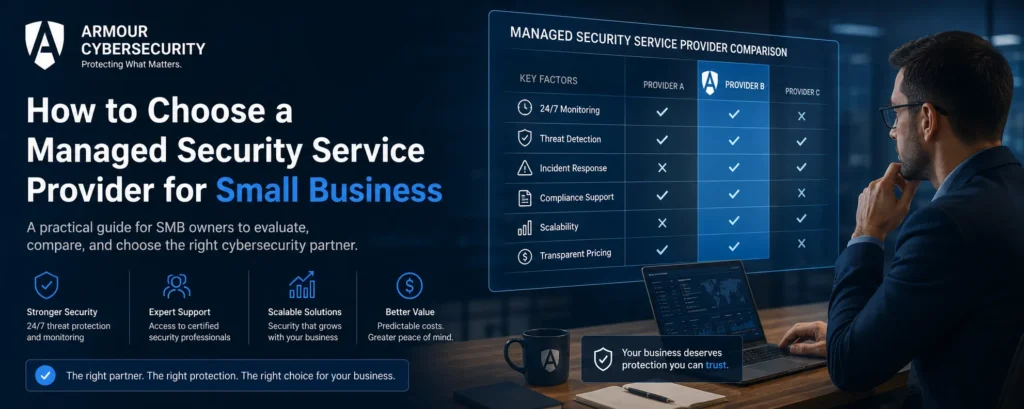
Quick answer: Knowing how to choose a managed security service provider for small business comes down to four factors: coverage breadth across endpoints, email, and networks; genuine 24/7 monitoring and response by dedicated analysts; tools tuned to your specific environment; and transparency about what the provider is actually doing on your behalf. Evaluate providers on these criteria rather than product feature lists.
Key Takeaways
- Not every managed security offering is equivalent. Many are product bundles with limited active monitoring.
- The questions to ask are: who monitors your environment at night, what happens in the first 30 minutes after a threat is detected, and how are tools tuned to your business specifically.
- Coverage should span endpoints, email, network, vulnerabilities, and people, not just one layer.
- Compliance support matters for regulated SMBs. Ask specifically how the provider supports HIPAA, PCI DSS, or SOC 2.
- Reporting quality indicates how well a provider understands your business. Cybersecurity for small business should come with business-language summaries, not raw data dumps.
Managed Security Services Comparison: Why Choosing a Provider Is Harder Than It Looks
The managed security market has expanded significantly as SMBs have recognized that cybersecurity cannot run on default settings and good intentions. That growth has produced a wide range of offerings operating under similar terminology. Managed security, managed detection and response, cybersecurity as a service, and managed SOC all describe services with meaningfully different levels of actual protection.
At one end of the spectrum are providers who bundle several security products, handle initial deployment, and respond to tickets when clients call in. At the other end are providers who operate a genuine 24/7 security operations capability, actively monitor client environments, and respond to threats as they happen. For an SMB evaluating options, distinguishing between these is the first and most important task.
What Should an MSSP for Small Business Actually Deliver?
A managed security service for a small business should cover every layer an attacker is likely to target. Securing one layer while leaving others open gives attackers a path in regardless of what protection is in place elsewhere.
Endpoint protection and response
Every device on your network, including laptops, desktops, servers, and any device connecting remotely, needs endpoint detection and response software deployed and actively monitored. The provider should handle deployment, configuration, and ongoing monitoring. Ask specifically who reviews endpoint alerts and how quickly.
Email security
Phishing is the most common initial attack vector for SMBs. Email security should filter malicious links, attachments, and sender impersonation before messages reach employee inboxes. In Microsoft 365 or Google Workspace environments, coverage should extend to file sharing and collaboration tools where malicious content increasingly arrives.
Network monitoring
Network monitoring detects threats operating inside your environment after passing perimeter controls. It should cover traffic between devices on your network, connections to external services, and any remote access points. Combined with endpoint and email signals, it gives analysts the context needed to identify multi-stage attacks.
Vulnerability management
Regular scanning to identify unpatched systems and misconfigurations, with prioritized remediation guidance and tracked closure, prevents attackers from exploiting known weaknesses. Vulnerability management from the provider should deliver findings with remediation recommendations, not raw scan output that no one acts on.
Security awareness training
Your employees are part of your attack surface. A managed security awareness training program delivers continuous education and simulated phishing campaigns that reduce susceptibility over time. Ask for evidence of measurable improvement in click rates and reporting behavior across client populations.

What Questions Should You Ask a Managed Security Provider?
The most revealing questions are operational, not product-focused. Anyone can describe features. What differentiates a genuine managed service from a product bundle with a service wrapper is how it operates at 3 a.m. on a Sunday.
Who monitors my environment outside business hours?
The answer should be specific. Named analysts on a rotating shift schedule, operating from a staffed security operations center, with defined escalation procedures. If the answer is “our monitoring systems will alert us,” that is not a 24/7 managed service. That is automated alerting with delayed human response.
What happens in the first 30 minutes after a threat is detected?
A well-run provider will walk you through a defined incident response procedure: alert triage, threat confirmation, initial containment action, notification to your designated contact for higher-impact decisions, and documentation. Vague answers here indicate the response process is less defined than the monitoring.
How do you tune tools to my environment specifically?
Default configurations generate high false positive rates and miss organization-specific threat patterns. A provider who configures tools to your business’s normal behavior, communication patterns, and risk profile delivers better detection and fewer irrelevant alerts. Ask how this tuning process works and how often it is updated.
How do you report what you are doing on my behalf?
Executive reporting should translate security activity into business language: threats blocked, incidents investigated, response actions taken, and program performance trends. Reports that consist of raw alert counts or technical summaries without context are not useful for business leadership. Monthly reports and quarterly strategic reviews, delivered in language a non-technical owner can act on, are the standard you should expect.
Red Flags When Evaluating a Cybersecurity Provider for Your SMB
Several signs indicate a managed security offering is less capable than it presents itself.
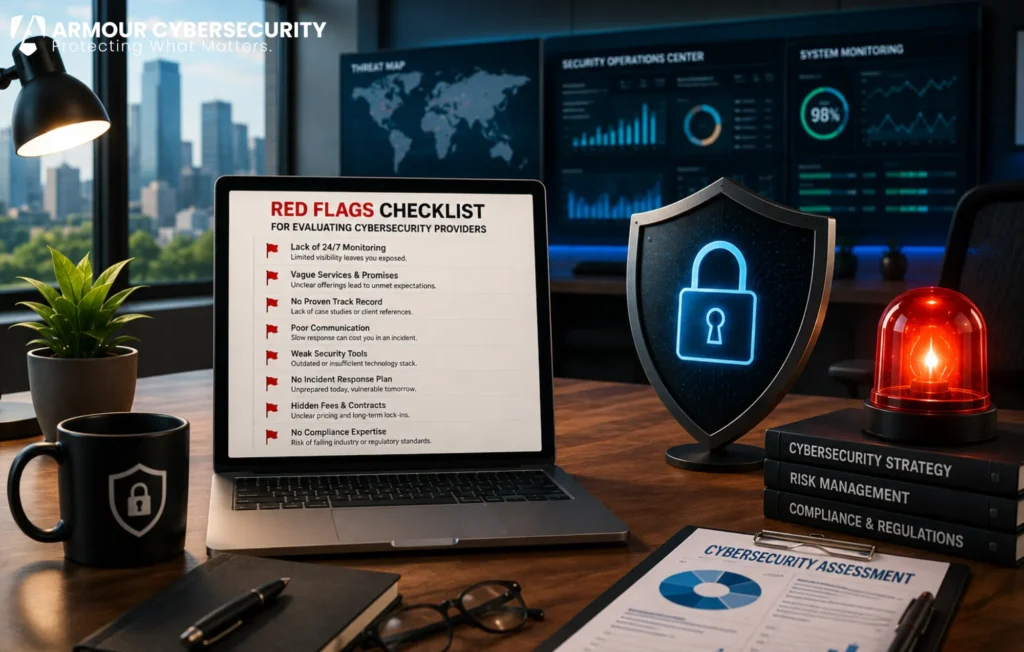
- Monitoring claims without staffing specifics. Ask how many analysts are on shift at 2 a.m.
- Response defined as “we will notify you.” Notification is not response. Containment is response.
- No onboarding process. A provider who can deploy a managed security program without assessing your environment first is deploying generic configurations that are not tuned to your business.
- Technology-first conversations. The right provider leads with understanding your environment, obligations, and risk profile before recommending specific tools.
- No compliance experience relevant to your industry. If you have HIPAA, PCI DSS, or SOC 2 obligations, the provider needs demonstrated experience supporting those frameworks.
How Does Armour 360 Address These Criteria?
Armour 360 is built for SMBs that need a complete managed cybersecurity program without the overhead of building one internally. The service covers endpoint detection and response, email and collaboration security, network monitoring, vulnerability management, awareness training, and backup and recovery readiness, coordinated as a single program rather than a collection of separate tools.
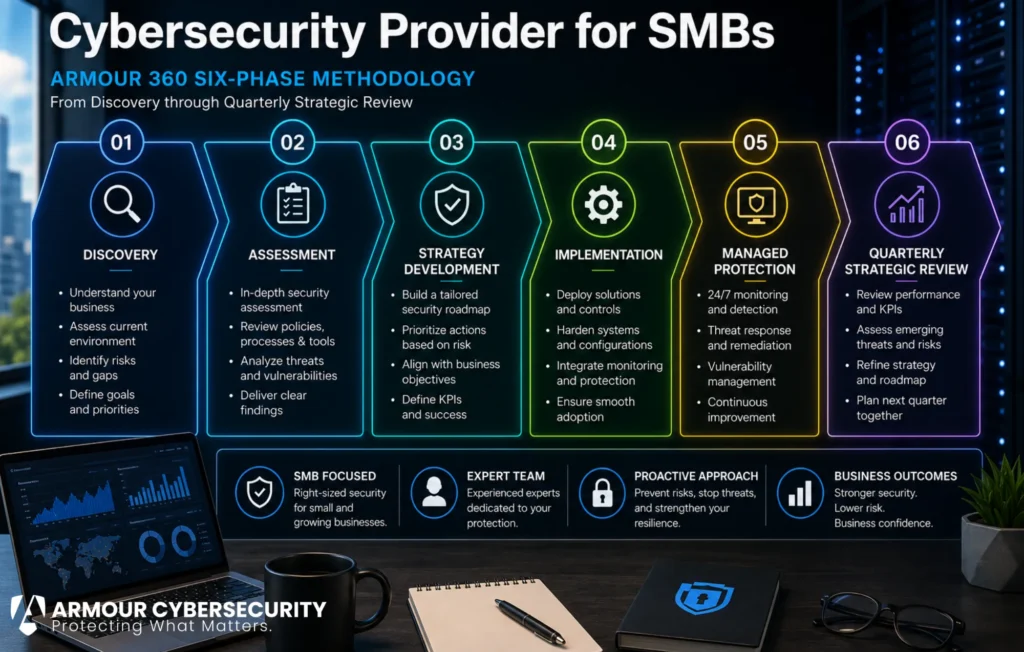
Every Armour 360 engagement follows a six-phase methodology: discovery and scoping, onboarding and deployment, configuration and tuning, active monitoring and response, optimization and reporting, and quarterly strategic reviews. The standardized process is what makes onboarding predictable and protection effective from day one rather than variable based on which analyst is handling the engagement.
24/7 monitoring and response by Armour Cybersecurity analysts is included at every service tier. Response actions happen within agreed parameters, which means threats are contained quickly without requiring client approval for every decision. Clients receive monthly threat reports and quarterly executive reviews in business language, not technical summaries.
For regulated SMBs, Armour 360 supports HIPAA, PCI DSS, SOC 2, ISO 27001, and similar frameworks by providing the technical controls, monitoring evidence, and documented response activities that auditors expect. With small business cybersecurity as a core design principle, the optional vCISO add-on extends coverage to governance and policy requirements. A full description of the program is available at armourcyber.io/armour-360.
The right managed security provider does not just sell you tools. They own your security outcomes. Armour 360 delivers coordinated endpoint, email, and network protection with 24/7 monitoring and response, built for SMBs that need real security, not a product bundle with a helpdesk attached.
Evaluate Armour 360 for Your Business
Contact the Armour Cybersecurity team at armourcyber.io/armour-360 to evaluate the right tier for your organization.
Frequently Asked Questions
What is the difference between a managed security service provider and an IT managed service provider?
An IT managed service provider manages your infrastructure: servers, networks, devices, and applications. A managed security service provider focuses specifically on cybersecurity: threat detection, response, vulnerability management, and ongoing protection. Some IT MSPs offer basic security tools as part of their service, but dedicated managed security providers operate a security operations function that IT generalists typically do not.
How do I know if a managed security provider is actually monitoring my systems or just selling me tools?
Ask for specifics on staffing, shift schedules, and response procedures. Ask what happens in the first 30 minutes after a threat is detected and what a sample incident response report looks like. Providers who deliver genuine monitoring will be able to describe their operations precisely. Providers selling tools with a service label will answer in product features rather than operational specifics.
Does a small business with 20 employees need a managed security service?
If the business handles client data, processes payments, has regulatory obligations, or relies on its systems to operate, yes. Business size determines budget, not exposure. A 20-person accounting firm holds financial data for hundreds of clients. A 15-person law firm holds privileged communications. The attack surface and data value are significant regardless of headcount.
How long does it take to switch to a new managed security provider?
Transitioning providers typically takes two to four weeks. The new provider assesses your current environment, identifies what needs to be replaced or reconfigured, and deploys coverage in a structured sequence. Gaps during transition are the primary risk, so a well-run onboarding process prioritizes getting endpoint and email protection live in the first week.
What should a managed security service cost for a small business?
Pricing varies based on the number of users and devices, coverage scope, and compliance requirements. The relevant benchmark is not the monthly cost in isolation but the cost relative to what a breach would cost the business. For most SMBs, a managed security program costs a fraction of a single significant incident. Armour Cybersecurity offers a consultation to assess your environment and recommend the appropriate Armour 360 tier for your organization’s size and risk profile.
About David Chernitzky
David Chernitzky brings over 25 years of deep cybersecurity and military cyber intelligence experience, with a career rooted in strategic risk management and protecting critical systems against advanced threats. As CEO and Co-Founder of Armour Cybersecurity, he combines strategic vision with hands-on expertise to deliver practical, high-impact cyber defense solutions.