| Quick Answer In a cyber breach, what you say, when you say it, and who approves it is as consequential as how you contain the incident. Premature statements create legal exposure. Delayed statements destroy trust. Inaccurate statements become evidence in regulatory and litigation proceedings. Effective crisis communications requires pre-approved templates, a defined approval process, and a team that has practiced under pressure. Tabletop exercises test exactly this capability. |
Key Takeaways
- Organizations that communicate poorly during a breach often face greater reputational and legal consequences than those who communicated well even when the underlying incident was more severe.
- The three communications failure modes in a breach are saying too much too early, saying too little for too long, and saying something inaccurate that later requires correction.
- Pre-approved communications templates, drafted before an incident, reduce the pressure of first-draft communications decisions and prevent the most common errors.
- Approval paths for external communications need to be defined in advance. An unresolved legal-communications standoff during a breach costs hours and produces worse outcomes than a clear process.
- Tabletop exercises that include communications injects are the most effective way to test and improve communications capability before a real event requires it.
Cyber breach crisis communications planning is the part of incident response that stakeholders actually see, and it decides the legal and reputational outcome as much as the technical fix does. Yet most organizations pour effort into containment and almost none into what they will say, when, and who signs off. That imbalance shows up in the cost: IBM’s 2025 Cost of a Data Breach Report put the global average breach at $4.44 million, and $10.22 million in the United States, and the organizations that contain and communicate fastest consistently pay the least. Planning the words in advance is how a team keeps a bad day from becoming a worse quarter, and it is a core reason to run a breach readiness assessment before an event tests the plan.
| By the Numbers$4.44M global / $10.22M US average cost of a data breach, and the organizations that contain and communicate fastest pay the least. Source: IBM Cost of a Data Breach Report 2025.Notification clocks start at awareness, not at full investigation. PIPEDA triggers on a real risk of significant harm; Quebec Law 25 requires prompt notification (with diligence), with no fixed statutory hour count. Source: PIPEDA / Quebec Law 25.Carriers require documented evidence of IR plan testing, including tabletop exercises. Source: 2025 to 2026 carrier underwriting guidance. |
Why Does Communications Matter So Much in a Cyber Breach?
The technical response to a cyber breach, containment, eradication, and recovery, happens largely invisibly to the organization’s stakeholders. Customers, partners, regulators, and the public see almost none of it. What they see is the communications: the first notification, the updates that follow, the explanation of what happened and what the organization did about it. Their judgment of how the organization handled the breach is based primarily on what was communicated, not on the technical steps taken behind the scenes.
This creates an asymmetry that most organizations underestimate when planning their incident response. Enormous effort goes into technical response capability. Comparatively little preparation goes into what will be said, when, to whom, and by whom. When the breach occurs, the technical team is executing a practiced response while the communications and legal teams are producing a first draft under crisis conditions.
The consequences of communications missteps in a breach extend beyond public perception. Statements made early in an incident that turn out to be inaccurate when the scope is better understood become evidence in regulatory proceedings and litigation. Regulator notifications that characterize the incident incorrectly may require amendment, which invites scrutiny of the original characterization. Customer notifications that include more information than required by law may create liability that a narrower, legally reviewed statement would not have.
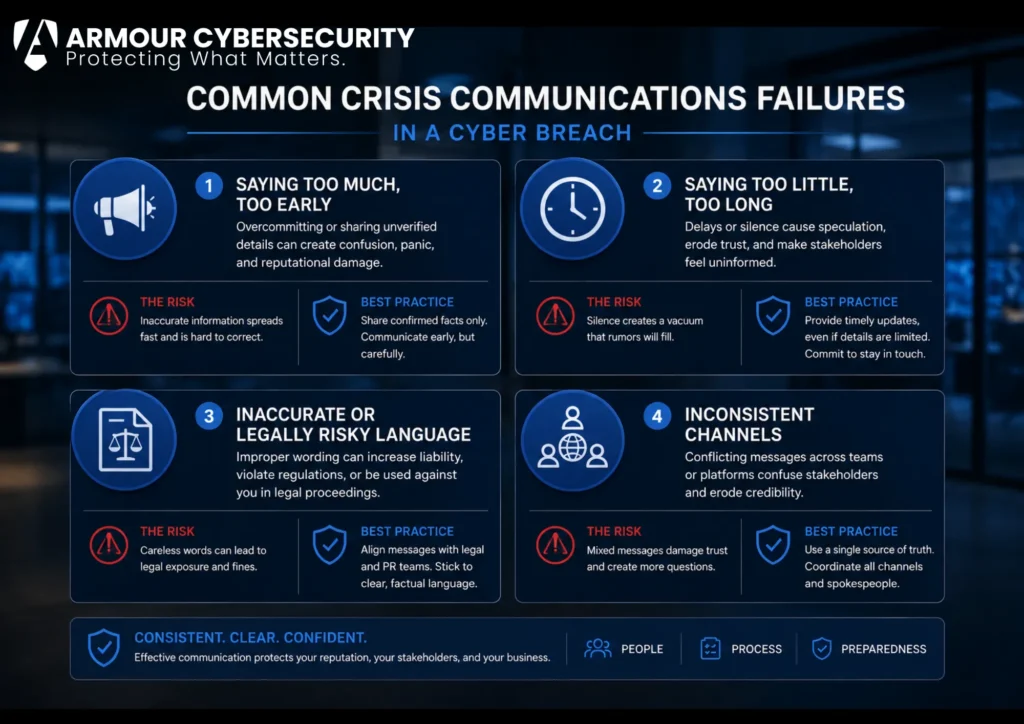
What Are the Most Common Communications Failures in a Cyber Breach?
Saying too much too early
The pressure to demonstrate transparency and control in the first hours of a breach produces statements that confirm more than the organization knows with confidence. A statement that describes the incident as limited in scope, issued before forensic investigation is complete, creates a problem when the scope turns out to be larger. The correction that follows does not undo the first statement; it amplifies the story and raises questions about whether the original characterization was genuinely mistaken or deliberately misleading. Effective crisis communications waits for confirmed facts before characterizing scope.
Saying too little for too long
The opposite failure is silence. Legal caution, uncertainty about scope, and the instinct to resolve the incident before disclosing it all create pressure to delay communications. When customers, partners, or the public discover a breach through sources other than the organization, the silence becomes the story. Regulatory notification obligations in many frameworks are triggered from the point of awareness, not from the point of full investigation, so delay can also create compliance exposure. Effective crisis communications distinguishes between external disclosure, which may appropriately wait for confirmed facts, and acknowledgment, which stakeholders need to know that the organization is aware and responding.
Using language that creates legal exposure
The specific words used in breach communications carry legal weight that non-lawyers drafting under pressure frequently underestimate. Characterizing an incident as a breach of a regulatory standard before legal counsel has assessed the facts. Using language that implies certainty about causation before forensics are complete. Making commitments about the completeness of the investigation before it is finished. Describing the security measures in place in a way that creates warranty-like representations. Each of these drafting choices creates problems that a careful legal review would catch, but that legal review requires a process and the time to conduct it.
Inconsistent messaging across channels
Large organizations with multiple communication channels, customer service, social media, investor relations, employee communications, regulator notifications, and media statements, frequently produce inconsistent messaging when these channels are not coordinated. A customer service representative who tells callers that the situation is fully resolved while the security team is still investigating a potential second stage of the attack, or a social media response that contradicts the regulatory notification, creates a consistency problem that is more damaging than any individual statement.
What Should Pre-Approved Communications Templates Cover?
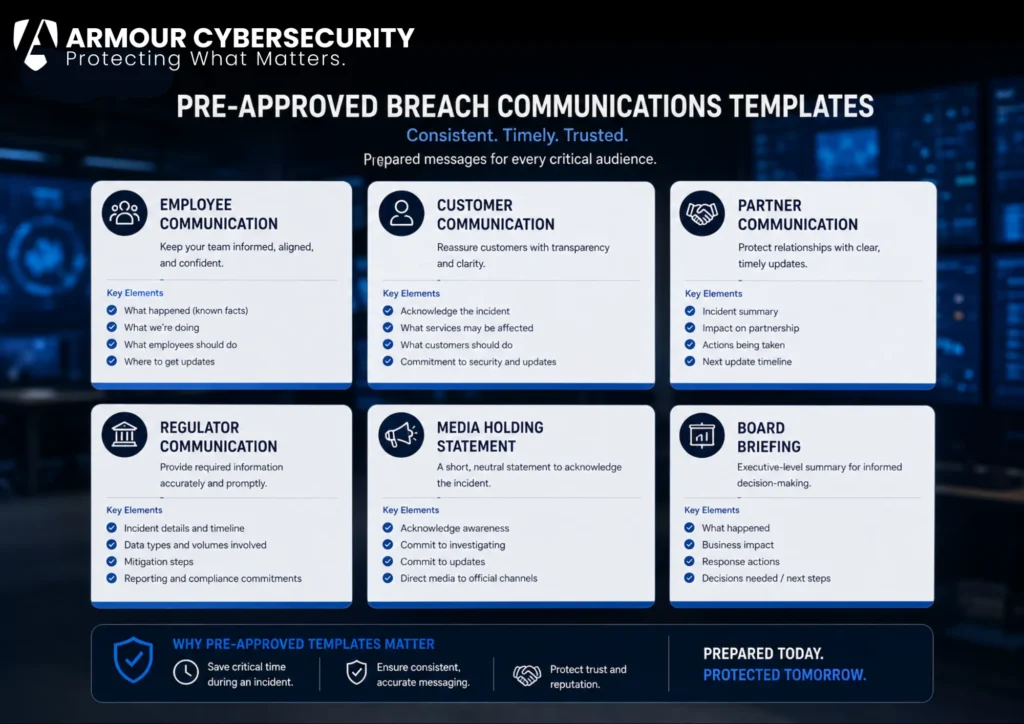
The most effective mitigation for communications failures in a breach is pre-approved templates: draft communications reviewed and approved before an incident occurs, structured to be modified with specific facts when an event happens rather than drafted from scratch under pressure. Templates cannot be fully generic, a ransomware event affecting customer data requires different language than an internally detected misconfiguration, but the approval framework, legal review, executive sign-off, and channel-specific formatting, can be completed in advance.
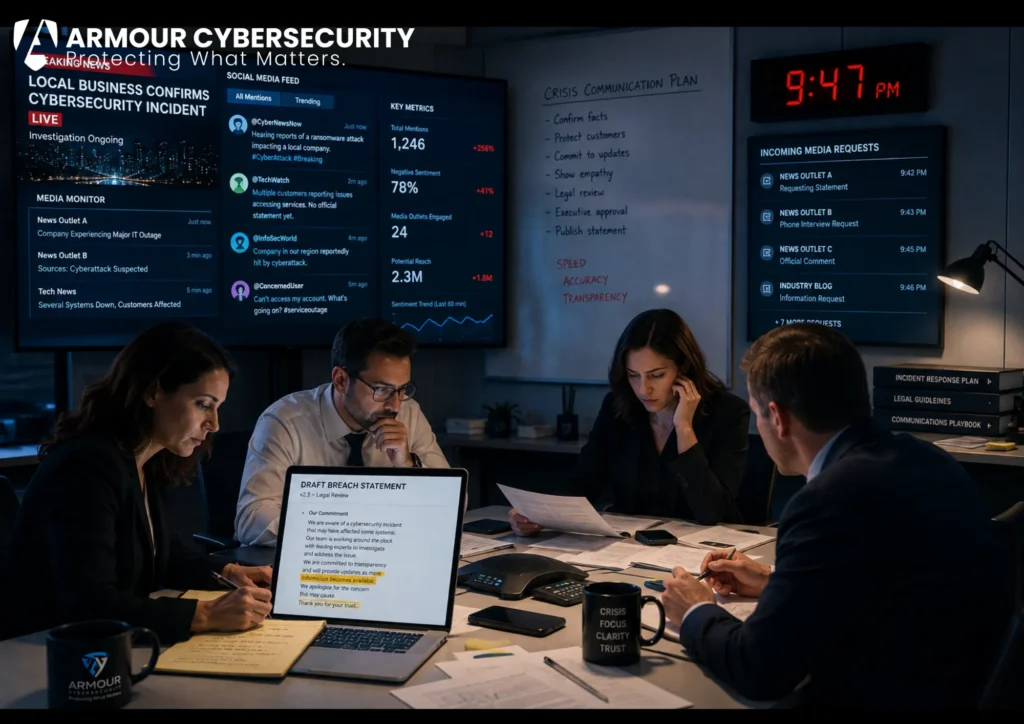
Templates should cover internal employee notification, which needs to be sent before external communications to prevent employees from learning about the incident from the news. Customer notification, structured to meet the minimum disclosure required by applicable law while avoiding unnecessary characterizations of scope or causation. Partner and supplier notification, which may have contractual requirements with defined timelines. Regulatory notification, which follows the specific requirements of applicable frameworks and should be drafted with legal counsel rather than by the communications team. Media holding statements, the cyber incident public statement that acknowledges the situation without confirming unverified facts. Board notification briefings, which translate operational facts into governance language.
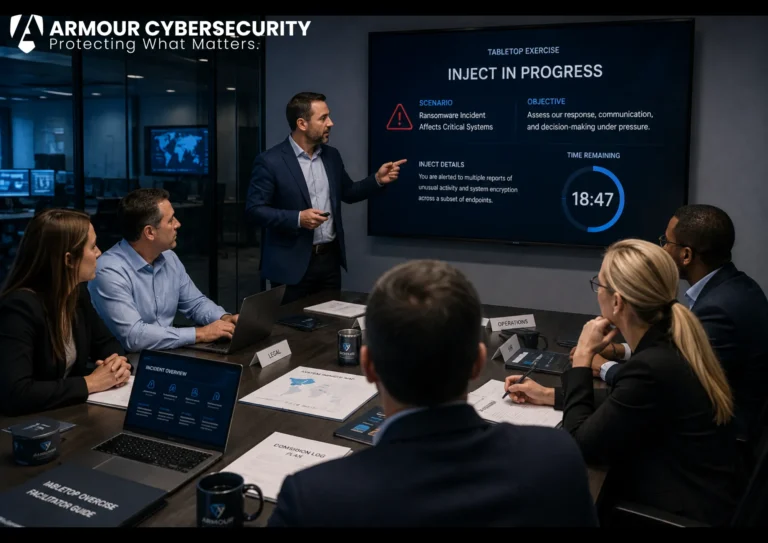
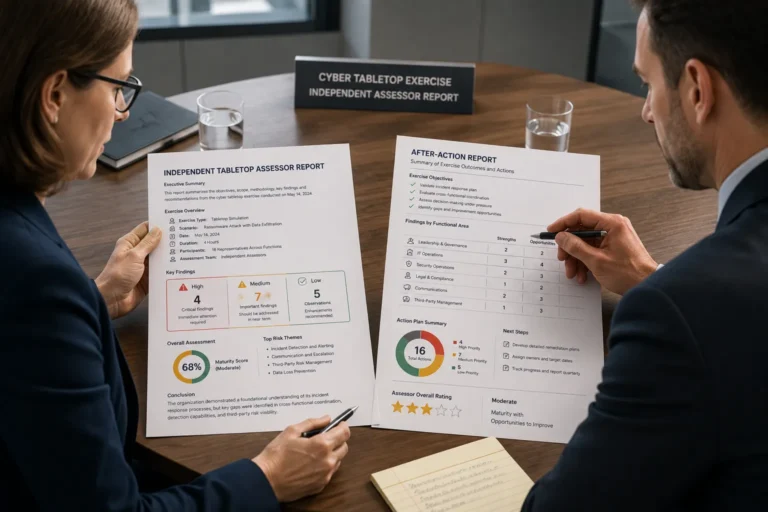
Armour Cybersecurity’s cyber simulation exercises include a communications playbook recommendations deliverable that identifies gaps in existing templates and suggests specific improvements based on what the exercise revealed. The exercise itself tests the communications capability under realistic pressure, with injects that introduce media inquiries, customer calls, employee questions, and regulatory notifications that need to be handled while the operational response is still underway.
How Does a Tabletop Exercise Test Communications Capability?
Communications injects in a tabletop exercise create realistic pressure that exposes the gaps that document review alone cannot find. A facilitator who introduces a media inquiry at the point in the scenario where the scope of the incident is still uncertain forces the communications and legal teams to work through their actual process under simulated time pressure. This is where incident response communications stop being a document and start being a capability.
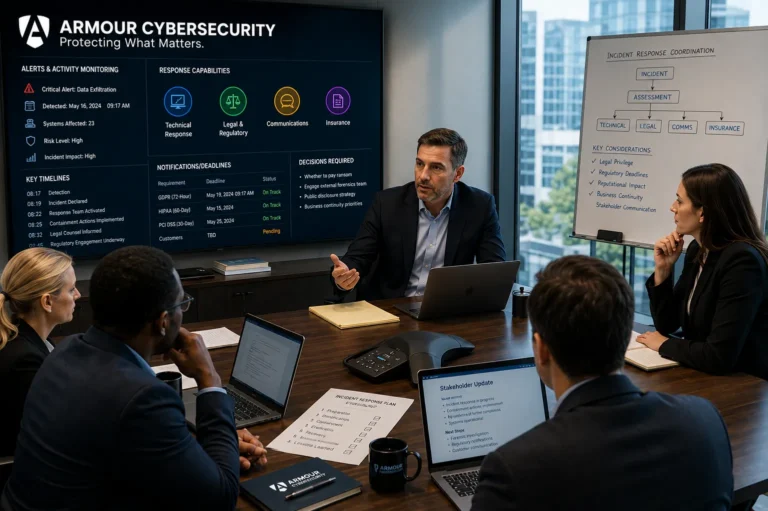
The exercise surfaces the approval path: who drafts the statement, who reviews it legally, who approves it for release, and how fast that sequence can happen when the participants are also managing other aspects of the response. It surfaces the content judgment: what facts can be confirmed, what the organization is willing to say about what happened, and how to acknowledge impact without confirming liability. It surfaces the channel coordination question: who is responsible for customer service messaging, and how is it synchronized with external statements?
Organizations that have exercised communications decisions in a tabletop are demonstrably more effective communicators during real incidents. The improvement comes from having worked through the approval process, identified the bottlenecks, and resolved the content judgment questions in a context where the stakes of getting it wrong were a debrief conversation rather than a regulatory inquiry.
Where Crisis Communications Fits in Armour’s Managed Services
A communications capability rarely works alone. It is one pillar of Armour’s managed cybersecurity services, operating alongside a managed Security Operations Center that establishes the facts a statement depends on, cyber threat intelligence that informs what the organization is facing, vCISO leadership to own the approval authority, cyber awareness training so employees know how to route an inquiry rather than answer it, and the all-in-one Armour 360 managed program. The words are only as good as the facts and the authority behind them.
The Bottom Line
In a cyber breach, the technical response protects your systems and the communications response protects everything else: your customers’ trust, your regulatory standing, and your legal position. The organizations that handle the words well are almost never improvising. They have templates, a defined approval path, and a team that has rehearsed the decisions. If your communications and legal teams have never drafted a breach statement together under pressure, a cyber simulation exercise with communications injects is the way to build that capability before a real incident demands it.
| Across the 260+ organizations Armour runs exercises for in 52+ industries, the communications gap is almost never a missing template. It is an undefined approval path, the standoff between legal and communications that no one has resolved until the clock is already running. |
Frequently Asked Questions
What is cyber breach crisis communications planning?
Cyber breach crisis communications planning is the work done before an incident to control what an organization says during one: pre-approved message templates for each audience, a defined approval path from draft to legal review to release, a named coordination owner across channels, and a clear distinction between acknowledgment and disclosure. Done well, it lets a team communicate accurately and quickly under pressure instead of drafting from scratch while the incident is still unfolding. Tabletop exercises with communications injects are the most direct way to test and improve it.
When is a business legally required to notify customers of a data breach?
Notification obligations depend on the jurisdiction, the nature of the data involved, and the risk of harm to affected individuals. In Canada, PIPEDA requires notification when a breach creates a real risk of significant harm to individuals. Quebec’s Law 25 requires prompt notification of affected individuals and the Commission d’acces a l’information when a confidentiality incident presents a risk of serious injury. There is no fixed statutory hour count the way there is under GDPR, but many organizations plan against a 72-hour benchmark. Organizations with US customers may also trigger state breach notification laws, which vary significantly. Legal counsel with privacy expertise should be engaged as early as possible in any incident to assess notification obligations.
What is the difference between an acknowledgment and a disclosure?
An acknowledgment confirms that the organization is aware of an incident and is actively responding, without characterizing the nature or scope of the incident beyond what has been confirmed. A disclosure provides specific information about what happened, what data was involved, and what the organization is doing about it. The distinction matters because acknowledgments can be made quickly and safely before the full scope is known, while disclosures require confirmed facts and legal review. Organizations that conflate the two either delay acknowledgment inappropriately or make disclosures before they have the information to support them accurately.
How do you coordinate communications across customer service, social media, and legal?
Effective cross-channel communications coordination requires a single point of authority: one person or team responsible for ensuring that every outward-facing statement about the incident, regardless of channel, is consistent with the approved messaging framework. This coordination function should be documented in the incident response plan and assigned to a specific role, not left to emerge organically during the incident. Customer service scripts, social media holding statements, and media responses should all trace back to the same approved content baseline, updated as the investigation provides additional confirmed facts.
Should the CEO be the public face of a cyber breach response?
It depends on the nature and scale of the incident and the organization’s communications strategy. For significant incidents affecting large numbers of customers or involving material operational disruption, CEO visibility signals organizational accountability and seriousness of response. For more limited incidents, a CISO or communications lead may be the appropriate spokesperson. The decision should be made in advance as part of the communications planning, not in the moment. Tabletop exercises that include a media response component help leadership teams work through this decision and practice the communications that follow from it.
Can tabletop exercise communications outputs be used in the real incident communications?
Yes, in the sense that templates and frameworks developed or refined through the tabletop process are available for real incident use. The specific draft statements produced during an exercise are typically too scenario-specific to use verbatim, but the approval process that was tested, the legal review framework that was clarified, and the templates that were identified as needed can all directly inform the real incident communications approach. This is one reason to invest in developing actual draft templates, not just discussing them, during the exercise and after-action improvement phase.
About the Author
David Chernitzky is the CEO and Co-Founder of Armour Cybersecurity, a Toronto-based firm that protects organizations across North America from advanced cyber threats. He brings more than 25 years of cybersecurity and military cyber intelligence experience, having served as an officer in an elite technology unit before co-founding Armour. Armour’s team of military-intelligence veterans and senior advisors serves 260+ clients across 52+ industries with a 97% client retention rate.