| Quick Answer Insider threats, data theft by employees, unauthorized access to confidential systems, intellectual property exfiltration, and deliberate sabotage, are among the most difficult incidents to investigate without forensic expertise. The evidence that establishes what an insider did, when, and to where requires forensic analysis of endpoints, email systems, cloud platforms, and network logs. Without forensic investigation conducted to proper standards, organizations lack the evidence needed for disciplinary action, legal proceedings, or regulatory compliance. |
Key Takeaways
- Insider threats cause significant financial and reputational harm, and their investigation challenges are distinct from external attacks: the actor had legitimate access, so establishing what was done means distinguishing authorized activity from unauthorized activity in the same logs.
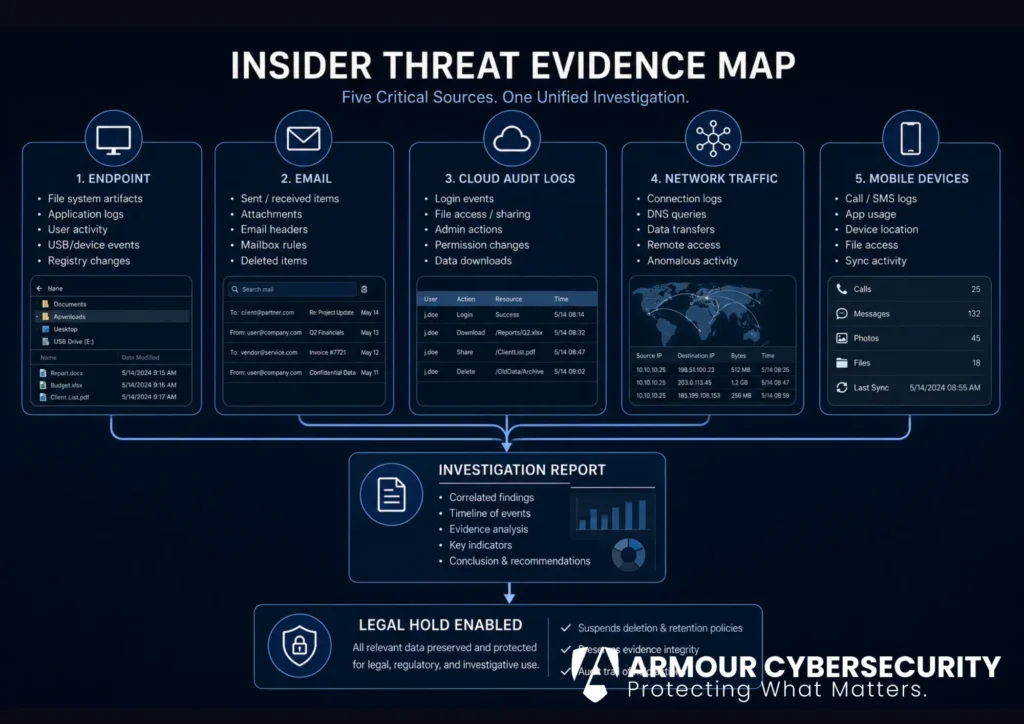
- Digital forensics for insider threats covers endpoint analysis, email and messaging forensics, cloud platform investigation, network traffic analysis, and mobile device forensics where relevant.
- Evidence collected without proper forensic standards is vulnerable to challenge in employment tribunals, civil litigation, and regulatory proceedings. Chain of custody and proper acquisition methodology matter as much here as in criminal cases.
- HR and legal teams need to be involved from the beginning. The evidence collection, the interviews, and the disclosure decisions all have employment law and legal privilege dimensions that require early legal engagement.
- The scope of insider data exfiltration is frequently larger than initially suspected. Forensic investigation regularly reveals that departing or disgruntled staff copied significantly more data than the triggering event suggested.
Insider threat digital forensics for business exists to answer a question external attacks rarely raise: what did someone who was allowed to be there actually do? When the actor is an employee or contractor with legitimate access, their misuse hides inside normal work, and a standard incident response cannot separate the two. Proving what an insider accessed, copied, sent out, or deleted, to a standard that survives an employment tribunal or a courtroom, takes forensic discipline and, from the first step, legal guidance.
| By the NumbersMalicious-insider incidents are among the costliest to resolve. The global average breach cost $4.44M ($10.22M in the US), and insider-driven cases sit at the high end because the actor already held trusted access. Source: IBM Cost of a Data Breach Report 2025.The human element is in most breaches. Verizon’s 2025 DBIR again put the human element in the clear majority of breaches, with insider misuse a distinct category alongside error and social engineering. Source: Verizon 2025 DBIR.The evidence lives in five places at once. Endpoints, email, cloud audit logs, network traffic, and mobile devices each hold part of an insider’s activity, which is why single-source reviews miss the true scope. |
What Is an Insider Threat?
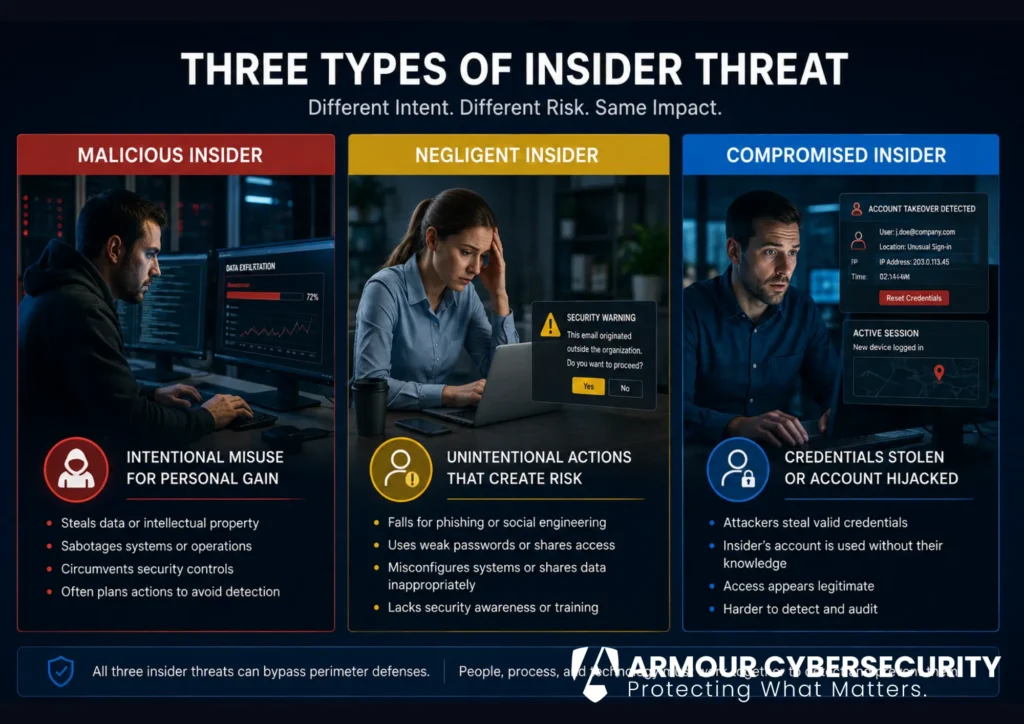
An insider threat is a security risk that originates from within the organization: a current or former employee, contractor, or business partner who uses their authorized access, or knowledge gained through that access, to harm the organization. Insider threats take several forms. Malicious insiders deliberately steal data, sabotage systems, or provide access to external threat actors. Negligent insiders cause harm through careless handling of sensitive data, weak security practices, or failure to follow policy. Compromised insiders are legitimate users whose credentials or devices have been taken over by an external attacker, making the attacker appear to be an insider.
The investigation challenge is that the actor started with legitimate access. Unlike an external attack, where the attacker’s presence is inherently anomalous, an insider’s activity is mixed with legitimate work in the same logs, on the same systems, using the same credentials. Distinguishing what was authorized from what was not requires detailed forensic analysis of activity patterns, file access records, data transfer events, and communications evidence that most organizations do not have the tools or expertise to conduct. The negligent-insider category is also the one most reduced by cyber awareness training, which is why prevention and investigation belong in the same program.
What Does Forensic Investigation Establish in Insider Threat Cases?
What data was accessed and copied
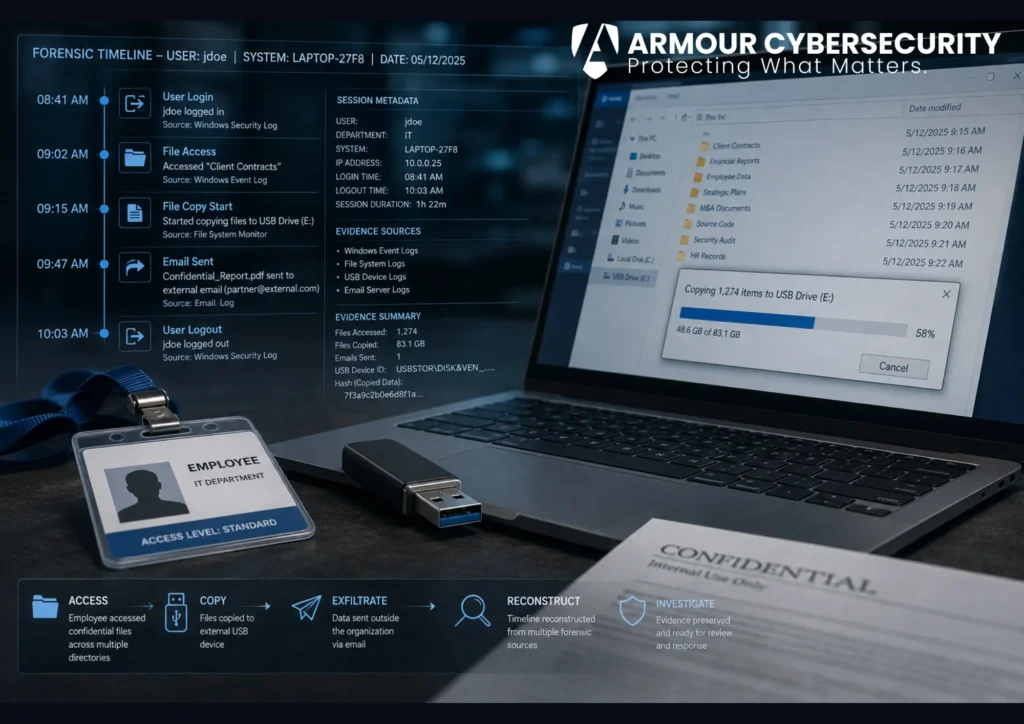
The primary question in most insider data theft cases is what the individual accessed and whether they copied or exfiltrated it. Forensic examination of the endpoint covers file access history, USB and removable media activity, document print history, cloud sync activity, and email attachment events. File system artifacts show what files were opened, when, and in what sequence. Registry artifacts on Windows systems record connected USB devices and the files transferred to them. Cloud storage sync clients log what was uploaded to personal accounts. Together, these sources establish a detailed picture of what was accessed and where it went.
Timeline of unauthorized activity
Establishing the timeline of an insider’s unauthorized activity is essential both for understanding the scope of harm and for the employment law and legal proceedings that follow. Forensic investigation reconstructs the timeline from multiple sources: system event logs, file access timestamps, email timestamps, network connection records, and authentication events. It establishes when the unauthorized activity began, how long it continued, whether it escalated, and whether specific triggering events, such as notice of termination or a particular business decision, correlate with changes in the activity pattern.
What was sent outside the organization
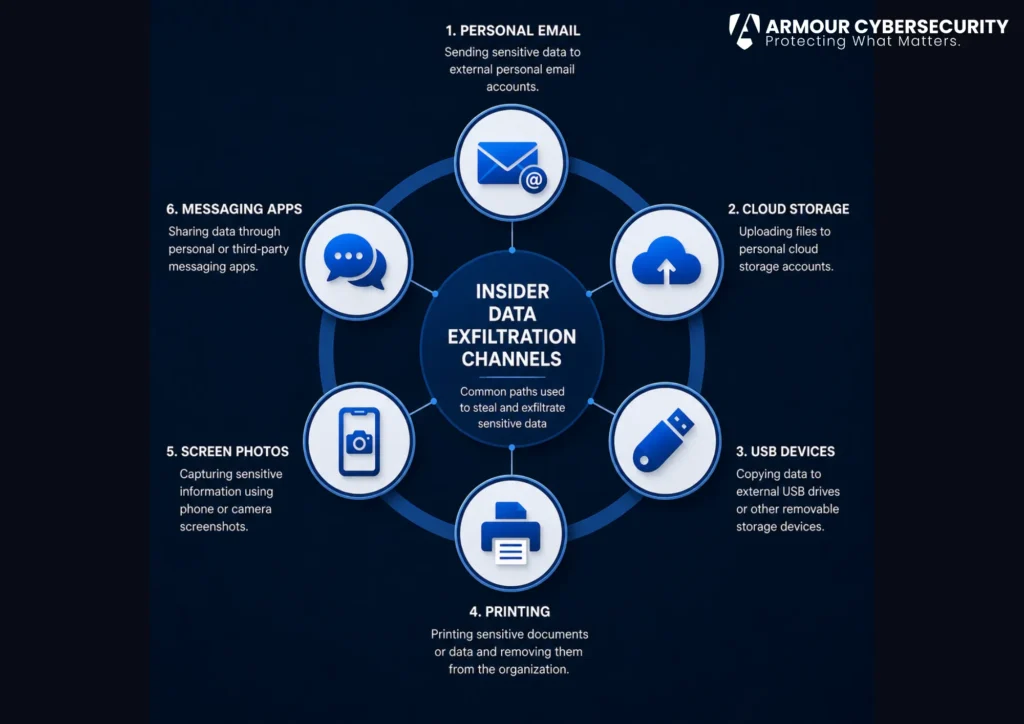
Data exfiltration by insiders uses multiple channels: personal email, cloud storage services, USB devices, printing, photographs of screens, and messaging applications. Forensic investigation examines each channel for evidence of data transfer. Email forensics establishes what was sent to personal addresses, what attachments were included, and whether communications were deleted to conceal the activity. Network traffic logs identify connections to cloud storage services and the volume uploaded. Browser history and application artifacts identify which services were used and when.
Whether data was deleted to cover tracks
Insiders who are aware their activity may be investigated sometimes attempt to delete evidence. Forensic investigation of deleted artifacts is a specialist discipline: deleted files may be recoverable from unallocated disk space, file system metadata records activity after deletion, and system log entries may record deletion events even when the files themselves are gone. Recycle Bin forensics, volume shadow copies, backup snapshots, and email server retention policies all provide additional recovery paths. The attempt to delete evidence is itself significant, as it demonstrates awareness of wrongdoing.
What Are the Distinct Challenges of Insider Investigations?
Insider investigations present challenges external incident investigations do not. The most significant is the employment law dimension. Every action, who is interviewed, when and how devices are collected, what is disclosed to the individual, and how findings are communicated, has potential employment law consequences. Steps that are sound from a forensic perspective can create legal exposure if taken without appropriate guidance, which is why breach counsel and HR belong in the room from the start.
The legal privilege dimension is also more complex here. Forensic findings that will be used in employment proceedings, civil litigation, or regulatory matters need to be structured with legal privilege considerations in place from the beginning. Communications about the investigation, decisions about evidence collection, and the forensic reports themselves may all be privileged, and that privilege has to be maintained through careful management of who sees what and when.
The scope discovery dimension is the one that consistently surprises organizations running an insider investigation for the first time. Across the 260+ organizations Armour serves in 52+ industries, insider investigations almost never end where they start. The trigger is usually a single departing employee seen copying one folder; the forensic timeline routinely shows the copying began weeks earlier and reached data no one had thought to flag. Organizations should plan for the investigation to expand well beyond its initial scope.
What Mobile and Cloud Evidence Contributes
Modern insider threats increasingly use mobile devices and cloud platforms as exfiltration channels. A departing employee who photographs confidential documents with a personal phone, uploads files to a personal cloud account from a company laptop, or uses a messaging app to send proprietary information to a future employer is using channels that require specific forensic capabilities to investigate.
Mobile device forensics extracts communications, photographs, application data, location records, and cloud account access events from phones and tablets. Where the device is company-owned and subject to a device management policy, forensic access is straightforward. Where the device is personal, legal counsel needs to assess the scope of what the organization can investigate before forensic collection proceeds.
Cloud platform forensics examines audit logs from the organization’s cloud services to identify access events, data download activity, sharing configuration changes, and connections from unauthorized IP addresses or devices. Microsoft 365 audit logs, for example, record every file download, every email sent, every sharing link created, and every login event, with enough detail to reconstruct the insider’s activity in depth, which is one reason a managed Security Operations Center that retains those logs is such an asset when an investigation begins. Armour Cybersecurity’s technical forensics service covers the full range of insider scenarios, from endpoint and email forensics through cloud platform investigation and mobile device analysis, all to criminal evidential standards with full chain-of-custody documentation, peer review, and reporting structured for the specific legal and HR proceedings the engagement supports.
Where Insider Forensics Fits in Armour’s Managed Services
Insider forensics is one pillar of Armour’s managed cybersecurity services, working next to cyber awareness training that reduces the negligent-insider category before it becomes an incident, vCISO leadership to set the access and monitoring policy that makes misuse detectable, and the all-in-one Armour 360 managed program. Prevention narrows the risk. Forensics proves the case when prevention is not enough.
The Bottom Line
An insider case is not won by catching someone in the act; it is won by proving, to an evidential standard, exactly what they did, across every system they touched, without tripping the employment-law and privilege wires along the way. That takes forensic discipline and legal guidance working together from the first step. Armour’s technical forensics service is built to deliver both, so the evidence stands up wherever the case ends up.
| Across the 260+ organizations Armour serves in 52+ industries, insider investigations almost never end where they start. The trigger is usually a single departing employee seen copying one folder; the forensic timeline routinely shows the copying began weeks earlier and reached data no one had thought to flag. |
Frequently Asked Questions
What is insider threat digital forensics for business?
Insider threat digital forensics for business is the forensic investigation of misconduct by someone with authorized access, a current or former employee, contractor, or partner, to establish what they accessed, copied, sent outside, or deleted, and to document it to a standard that holds up in HR, legal, and regulatory proceedings. The defining difficulty is that the insider started with legitimate access, so the investigation has to separate authorized work from unauthorized activity in the same logs, on the same systems, under the same credentials. It draws on endpoint, email, cloud, network, and mobile evidence, all preserved under chain of custody and legal hold.
Can we investigate an employee’s personal devices if we suspect data theft?
Investigating personal devices involves legal considerations that vary by jurisdiction and employment contract. Generally, an employer does not have the right to forensically examine a personal device without the employee’s consent or a court order, regardless of the suspicion. Investigation of company-owned devices, company email accounts, and company cloud resources is on different legal footing and is typically within the employer’s rights, subject to applicable policies and agreements. Legal counsel needs to assess the specific situation before any device collection or forensic access, so the investigation does not create greater legal exposure than the conduct it is investigating.
How do you preserve forensic evidence if the employee has already left?
Preservation focuses on the systems and accounts the person had access to: their company-issued devices, email and cloud storage, access logs across all platforms, and any backup or snapshot data captured before departure. Legal holds should be placed on all relevant data immediately, preventing routine deletion or log rollover from destroying evidence. The forensic investigation then proceeds from these preserved sources. Remote device management tools may allow forensic acquisition of a company laptop even after the employee has left, depending on whether the device is still powered on and connected to the internet.
What is a legal hold and how does it work?
A legal hold, also called a litigation hold or document preservation order, is an instruction to preserve potentially relevant evidence in anticipation of legal proceedings or a formal investigation. In an insider case, a legal hold is placed immediately on all accounts, devices, and data associated with the individual: their email, cloud storage, endpoint, and any other systems they accessed. The hold prevents routine data management, such as automated email deletion after a defined period, from destroying evidence that may be needed later. Legal counsel typically issues and manages the hold in coordination with the forensic and IT teams.
Can forensics identify whether a competitor received stolen data?
Forensics can establish where data was sent and identify the destination accounts, email addresses, and cloud services involved. Whether those destinations are associated with a specific competitor typically requires additional investigation combining forensic findings with open-source intelligence, legal process to the destination service providers, and in some cases law enforcement. Forensic findings frequently provide enough evidence to initiate civil proceedings against the departing employee, which then open legal discovery paths to the destination parties. Attribution to a specific competitor beyond what the forensic evidence directly shows usually requires legal process rather than technical investigation alone.
Is there a risk that the investigation itself will alert the employee under investigation?
Investigation steps that are visible to the subject, such as account access reviews that trigger notification emails or device collection the employee witnesses, can alert the individual and trigger evidence destruction or legal countermeasures. Professional forensic investigators and legal counsel plan the sequence of evidence collection and disclosure to minimize premature alerting. Remote forensic acquisition of devices, account preservation without visible account changes, and legal holds placed on backend systems can often be completed before the individual is informed. The specific approach is planned during engagement intake based on the circumstances of the case.
About the Author
David Chernitzky is the CEO and Co-Founder of Armour Cybersecurity, a Toronto-based firm that protects organizations across North America from advanced cyber threats. He brings more than 25 years of cybersecurity and military cyber intelligence experience, having served as an officer in an elite technology unit before co-founding Armour. Armour’s team of military-intelligence veterans and senior advisors serves 260+ clients across 52+ industries with a 97% client retention rate.