By David Chernitzky, Co-Founder and CEO, Armour Cybersecurity | Serving organizations across Canada, the US, and beyond | Last updated August 17, 2026
Quick answer: AI governance for business is the set of policies, processes, roles, and oversight mechanisms that define how an organization adopts, uses, and monitors artificial intelligence. It determines which AI tools are approved for use, what data can be submitted to them, who has authority to approve new AI use cases, how AI-generated outputs are reviewed before they influence decisions or reach customers, and how the organization detects and responds to AI-related incidents. Without AI governance, AI adoption is an unmanaged risk. With it, AI is a capability the organization can account for to regulators, auditors, insurers, and the board.
Key Takeaways
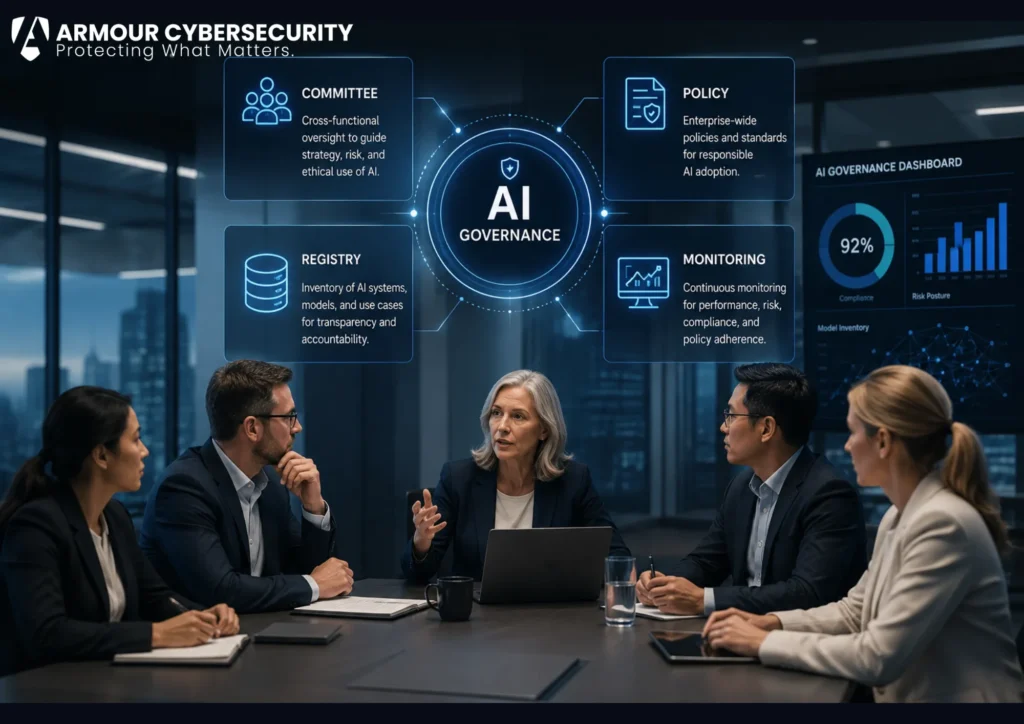
- AI governance is not the same as an AI policy document. A policy document defines what is permitted; governance is the operating system that makes the policy real: the committee that owns it, the process that enforces it, the registry that tracks it, and the monitoring that verifies it.
- Regulators in Canada, the EU, and the US increasingly expect organizations to demonstrate that they have governed AI deployment. The EU AI Act, sector-specific guidance from OSFI and the OPC, and Canada’s evolving federal AI policy direction all create expectations for AI governance that organizations in regulated industries are already being measured against.
- The AI Governance Committee is the organizational anchor of the framework. Without a named body with clear decision rights, AI governance exists only as a document; the committee is what makes it operational.
- The approved AI tool registry is the practical output that makes governance visible: a living record of which AI tools are approved, for which use cases, with which data types, owned by which business units, subject to which controls, and reviewed on which cadence.
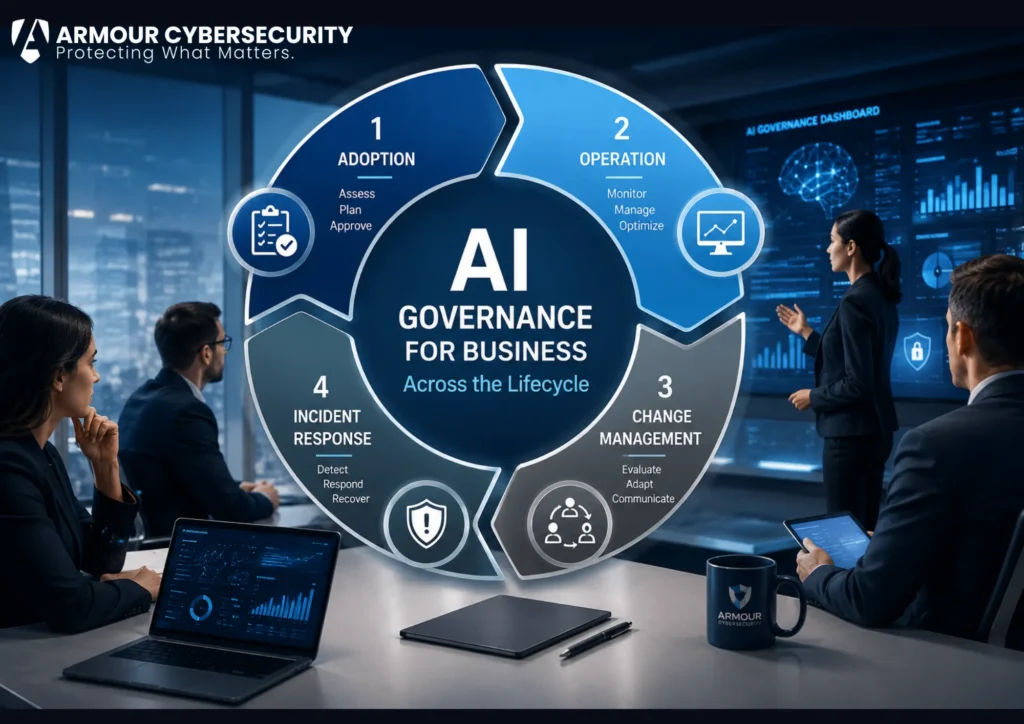
- AI governance must cover the full lifecycle of AI use: adoption, operation, change management, and incident response.
Why AI Governance Has Become a Business Requirement
A year ago, AI governance was a leading practice. Today it is a business requirement, for three reasons that are converging at once. The first is the scale of AI adoption: AI tools have moved from the domain of technical specialists into the daily workflows of every business function, which means the risk surface of ungoverned AI is no longer limited to the IT department. The second is regulatory momentum: privacy regulators, financial services regulators, and sector-specific authorities are publishing AI-specific guidance and folding AI into existing governance, risk and compliance frameworks at a pace that has accelerated significantly. The third is the insurance market: cyber insurance underwriters are beginning to ask about AI governance as part of the underwriting questionnaire, in line with the cyber insurance advisory expectations organizations now face, recognizing that ungoverned AI adoption creates new vectors for data breach, compliance failure, and business interruption.
The combination of these three factors means that the question for most mid-market organizations is no longer whether to implement AI governance but how quickly. Organizations that have not started the governance standup are already behind the expectations their regulators, auditors, and insurers are beginning to apply.
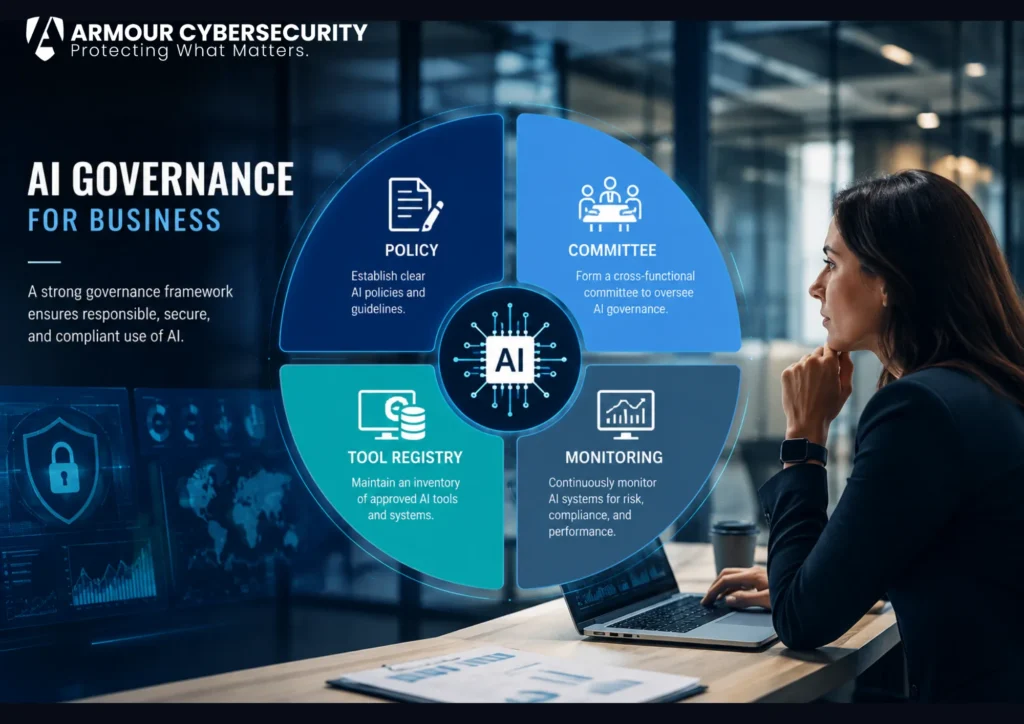
The Four Components of AI Governance for Business
Policy: the AI Acceptable Use Standard
The AI Acceptable Use Standard is the employee-facing document that defines the rules of AI use in the organization. It defines three categories of AI usage: permitted use cases, which employees can proceed with using approved tools; restricted use cases, which require review and approval from the governance committee before proceeding; and prohibited use cases, which are not permitted under any circumstances. The standard also defines data handling expectations for AI use, specifying which categories of data may be submitted to which types of AI tools and under what conditions, an extension of the organization’s privacy risk management practices. A well-designed standard is specific enough to be actionable, covering common use cases in plain language that employees in every function can understand, and flexible enough to accommodate new use cases through the approval process rather than requiring a policy rewrite every time AI capabilities evolve.
Common prohibited use cases include submitting personal information of customers or employees to public AI platforms that do not have a data processing agreement with the organization, using AI to make automated decisions about individuals in regulated domains such as credit, employment, or medical care without appropriate human oversight, using AI to generate content that will be represented as the organization’s own without human review, and using public AI tools for work involving information subject to legal privilege or confidentiality obligations.
Structure: the AI Governance Committee
The AI Governance Committee is the body that owns the acceptable use standard, evaluates use case requests, maintains the tool registry, reviews AI-related incidents and exceptions, and provides periodic reporting to leadership. Effective committee composition includes representation from cybersecurity, legal and privacy, IT and engineering, and business leadership. The committee chair typically sits in the CISO or CIO function, a role a virtual CISO can fill in organizations without a full-time security executive, though some organizations place the chair in legal given the regulatory significance of AI governance decisions.
The committee needs a defined operating cadence: a regular meeting schedule for reviewing new use case requests and tracking the policy exception log, a defined timeline for evaluating and responding to use case submissions (typically five to ten business days for standard requests, with expedited review available for time-sensitive business needs), clear decision rights that define which requests can be approved at the committee level and which require escalation to executive leadership, and a documented record of decisions and their rationale that feeds the board cyber governance reporting leadership already expects.
Visibility: the AI Tool and Use Case Registry
The AI tool and use case registry is the living document that makes governance visible and auditable. It records every AI platform approved for organizational use, the use cases each platform is approved for, the business owner responsible for each deployment, the data types that may be submitted to each platform, the risk level assigned to each use case, the controls in place, the review date, and any conditions or restrictions on use. The registry is not a static document: it is updated when new tools are approved, when existing approvals are modified, when use cases are retired, and when the annual review cycle refreshes the risk assessment of existing entries.
The registry serves multiple audiences. Employees use it to determine which tools they can use for which purposes without submitting a formal use case request. The governance committee uses it to track the cumulative risk profile of AI adoption across the organization. Auditors and regulators use it as evidence that the organization has a managed, accountable AI adoption process. Insurers use it to assess the adequacy of the organization’s AI governance program. A well-maintained registry is one of the most valuable single artifacts a governed AI adoption program produces.
Monitoring: AI usage detection and incident response
Policy and registry without monitoring is governance on paper only. Effective AI governance requires technical controls that verify compliance with the acceptable use standard and detect deviations from it. AI usage detection monitors endpoints, browsers, and network traffic to identify which AI tools are being accessed, by whom, how frequently, and what data categories are being submitted. Approved tool usage is allowed and logged. Unapproved tool usage triggers alerts and is addressed through the exception management process. Attempts to submit restricted data categories to unauthorized platforms trigger immediate alerts and enforcement responses.
AI governance also requires integration with incident response: a defined process for handling AI-related security incidents, including data submitted to an AI platform that turned out to have had a breach, an AI tool that produced outputs that caused business or reputational harm, or an employee who violated the acceptable use standard in a material way. The incident response process for AI events follows the same general structure as other security incidents, with AI-specific considerations for evidence collection, regulatory notification obligations, and the potential need for AI model provider coordination.
Building the Enterprise AI Governance Framework in Practice
The practical starting point for an organization building AI governance for the first time is an AI use case discovery exercise: structured conversations with team leads across every business function to map what AI tools are currently in use, for what purposes, with what data. This exercise consistently surfaces more AI usage than leadership expected and provides the factual foundation for designing a governance framework that addresses actual risk rather than hypothetical risk.
Following discovery, the governance committee is stood up with the representation and operating model described above. The acceptable use standard is drafted collaboratively with input from legal, privacy, and business leadership, reviewed against applicable regulatory guidance, and communicated to the organization through onboarding and awareness channels. The tool registry is initialized with the current state of AI usage discovered in the exercise, with each entry evaluated against the acceptable use standard and either approved, conditionally approved pending controls implementation, or restricted pending governance review.
Armour Cybersecurity’s Secure AI Adoption Program includes governance standup as its first and most foundational phase, ensuring that the committee, standard, and registry are in place before the technical deployment phases that follow.
Frequently Asked Questions
Does every organization need a formal AI Governance Committee?
The formality of the committee should match the scale and risk profile of the organization’s AI adoption. A ten-person professional services firm that uses one approved AI writing tool and has reviewed its data handling implications does not need a standing committee with a formal charter. A 500-person financial services organization whose employees use AI across every function, whose developers generate code with AI assistants, and whose compliance obligations include OSFI guidance on technology and third-party risk absolutely does. Most mid-market organizations with meaningful AI adoption and any regulatory exposure benefit from a governance committee, even if it meets quarterly rather than monthly and operates with lighter-touch documentation than a large enterprise would require. The committee’s value is not in its meeting cadence but in the accountability structure it creates: someone owns the policy, someone reviews new use cases, and someone is responsible when something goes wrong.
How does AI governance relate to existing data governance and privacy programs?
AI governance is an extension of existing data governance and privacy programs, not a replacement for them. The data classification framework that defines which data categories are sensitive informs the AI acceptable use standard’s rules about which data may be submitted to which AI tools. The privacy impact assessment process applies to AI use cases that involve personal data. The data processing agreement requirements that govern other technology vendors apply to AI platform procurement. The incident response process that handles data breaches applies to AI-related data incidents. Organizations that have mature data governance and privacy programs have a significant head start on AI governance because the underlying frameworks and processes transfer directly; the AI governance layer adds the AI-specific policies, the tool registry, the use case approval process, and the AI usage monitoring controls.
What does the EU AI Act require and does it apply to Canadian businesses?
The EU AI Act is a risk-based regulatory framework for AI systems that entered into force in 2024. It applies to AI systems used in the EU, including by organizations outside the EU whose AI systems affect people in the EU. For Canadian businesses with European customers, employees, or operations, the EU AI Act may create compliance obligations depending on whether the organization deploys AI systems in categories the Act regulates. The Act prohibits certain AI applications entirely (social scoring, real-time biometric surveillance in public spaces), imposes substantial requirements on high-risk AI systems in regulated domains (credit, employment, healthcare, border control, critical infrastructure), and requires transparency obligations for AI-generated content in contact with EU residents. Organizations uncertain about their EU AI Act exposure should seek legal counsel with EU regulatory expertise. In Canada, the proposed Artificial Intelligence and Data Act died on the order paper when Parliament was prorogued in January 2025 and has not been reintroduced; the federal government has signaled it will regulate AI through privacy legislation and policy rather than a single AI statute, so Canadian organizations should track the current federal direction rather than plan around a fixed act.
How should the AI Governance Committee handle a use case request it is uncertain about?
Uncertainty about a use case request is best resolved through a structured risk assessment rather than a reflexive approval or denial. The risk assessment considers: what data will be submitted to the AI tool and what are the sensitivity and regulatory implications of that data; what is the legal basis for any personal data processing involved; what are the data handling practices of the AI platform, including its data retention, training data, and data processing agreement terms; what controls can be applied to reduce the risk to an acceptable level; and what is the business value of the use case relative to the residual risk. For use cases that remain genuinely uncertain after this assessment, a time-limited conditional approval with monitoring and a defined review date is often preferable to indefinite delay. This approach lets the organization capture the business value of promising use cases while maintaining oversight during a defined evaluation period.
How does AI governance affect our cyber insurance posture?
Cyber insurance underwriters are beginning to incorporate AI governance questions into their underwriting questionnaires, driven by recognition that ungoverned AI adoption creates new data exposure risks, new vectors for social engineering through AI-generated phishing and deepfakes, and new SDLC risks from AI-generated code reaching production without security review. Organizations with documented AI governance programs, including a committee, acceptable use standard, tool registry, and usage monitoring, are better positioned to answer these questions accurately and favorably than organizations that acknowledge significant shadow AI activity without any governance structure. The governance documentation produced by a formal AI adoption program is also directly usable as underwriting evidence, which reduces the burden of questionnaire completion at renewal.
The Bottom Line
AI governance for business is what separates AI as an accountable capability from AI as an unmanaged liability. The organizations that treat governance as the operating system for AI, the committee that owns the policy, the registry that tracks it, and the monitoring that verifies it, are the ones that can answer their regulators, auditors, and insurers with evidence rather than hope. A governed AI adoption program puts that structure in place. Start with an AI use case discovery, stand up the committee and the acceptable use standard, then layer the registry and monitoring that make governance real.
About the author
David Chernitzky is Co-Founder and CEO of Armour Cybersecurity, a Toronto-based cybersecurity firm founded by military intelligence veterans and advised by senior leaders from PwC, KPMG, Deloitte, EY, and Mandiant. Armour serves more than 260 organizations across 52-plus industries, including finance, healthcare, technology, energy, legal, and government, with a 97 percent client retention rate.