By David Chernitzky, Co-Founder and CEO, Armour Cybersecurity | Serving organizations across Canada, the US, and beyond | Last updated August 17, 2026
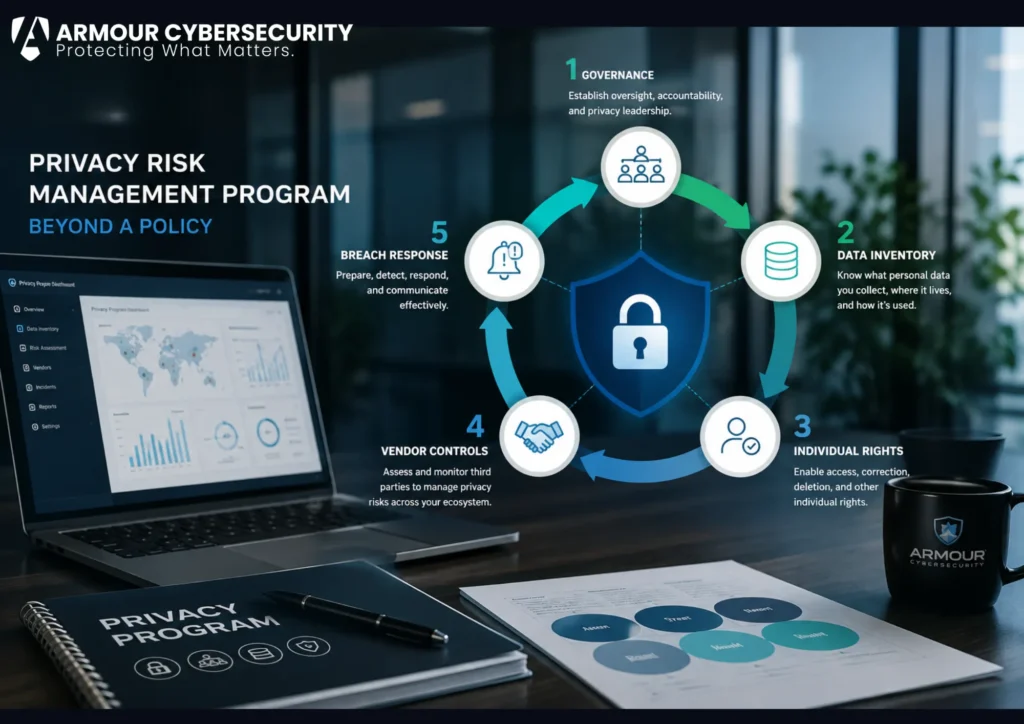
Quick answer: A privacy risk management program is the operational system that makes a privacy policy true in practice: the governance, the training, the data inventory, the individual rights processes, the vendor controls, and the breach response procedures that together produce the accountability evidence regulators expect. A privacy policy, by contrast, is only the document that describes how an organization handles personal information. The difference between having a policy and having a program is the difference between describing your privacy practices and actually operating them.
Key Takeaways
- Canadian privacy law, including PIPEDA and Quebec Law 25, does not just require a privacy policy. It requires accountability, which means documented governance, demonstrable controls, and evidence that the policy is actually enforced in practice.
- Regulators investigating a privacy complaint or breach do not read your privacy policy and close the file. They ask for evidence: the data inventory, the consent records, the individual rights response logs, the vendor contracts, the training records, and the breach assessment documentation. Organizations without operational programs cannot produce this evidence.
- Enterprise customers and procurement teams have begun asking the same questions regulators ask. A privacy questionnaire that cannot be answered with documented evidence loses deals that a policy document alone cannot win.
- Privacy incidents handled by organizations with operational programs, where classification, escalation, assessment, and notification run according to a tested procedure, produce significantly better outcomes than incidents responded to by organizations that invent their process under crisis conditions.
- Building a privacy program is less expensive before a regulatory inquiry, a customer audit, or a breach than after one. The forcing event does not create the obligation; it reveals whether the obligation was met.
What a Privacy Policy Actually Is
A privacy policy is a transparency document. Its purpose is to inform individuals about how the organization collects, uses, discloses, and retains their personal information, and what rights they have with respect to that information. A well-written privacy policy accurately describes the organization’s data handling practices, is written in plain language that individuals can understand, and is made available at the points where personal information is collected. These are necessary conditions for compliance with Canadian privacy law and with most other applicable privacy frameworks.
What a privacy policy is not is a compliance program. It does not enforce itself. It does not train employees on how to handle personal information. It does not create a process for responding when an individual asks to access or correct their data. It does not review vendor contracts to ensure they contain appropriate data processing terms. It does not trigger an assessment when a new product feature processes personal information in a new way. It does not classify a privacy incident or decide whether the regulator needs to be notified within the required timeframe. All of these functions require operational infrastructure that no policy document can substitute for. This is the distinction at the heart of privacy program vs privacy policy: one describes, the other operates.
What Regulators Actually Expect
Canadian privacy law is built on the principle of accountability. The Personal Information Protection and Electronic Documents Act requires organizations to be accountable for the personal information under their control and to designate one or more individuals responsible for compliance. Quebec’s Act Respecting the Protection of Personal Information in the Private Sector adds the requirement to publish a policy on personal information governance and to appoint a person in charge of personal information protection with defined governance authority. Both frameworks expect the organization to be able to demonstrate, with evidence, that it is meeting its obligations.
When the Office of the Privacy Commissioner of Canada or the Commission d’acces a l’information du Quebec receives a complaint or initiates an investigation, the first step is typically a request for documentation: the data inventory, the consent records for the processing activity at issue, the individual rights request logs for the past year, the vendor contracts and data processing agreements, the training records for employees in relevant roles, and the breach assessment documentation for any incidents in the relevant period. An organization that can produce organized, complete documentation in response to this request is in a materially better position than one that must compile it under investigation pressure. Building that evidence base is the core of operational privacy risk management.
The Core Operational Components of a Privacy Risk Management Program
A privacy program that can withstand regulatory scrutiny, satisfy customer due diligence, and function effectively during a privacy incident covers a set of operational domains. Eight of the most important are below.
Privacy governance and accountability establishes the organizational structure: the designated privacy officer with defined authority, the roles and responsibilities across all functions that handle personal information, the governance committees and escalation paths, and the policy framework that translates legal obligations into internal requirements. Without governance, every other component of the program lacks ownership and accountability, and it is the layer that feeds the board cyber governance reporting leadership is accountable for.
The personal information inventory documents what personal information the organization collects, for what purposes, from which sources, in which systems, shared with which vendors, retained for how long, and transferred to which jurisdictions. The inventory is the foundation of every other program component: you cannot manage what you have not mapped.
Notice, transparency, and consent covers the privacy notices delivered at every touchpoint where personal information is collected, the consent language and capture mechanisms, the withdrawal procedures, and the disclosures required by applicable law. Consent that is not captured in a verifiable way is not consent that can be demonstrated to a regulator.
Individual rights management is the operational process for handling requests from individuals to access, correct, delete, or export their personal information, or to withdraw consent for specific processing activities. The process includes intake channels, identity verification, classification, search and retrieval across systems and vendors, response drafting, timeline tracking, and recordkeeping.
Privacy impact assessments are structured evaluations of the privacy risks associated with new processing activities, products, technologies, or significant changes to existing processing. A PIA program that triggers automatically when procurement, projects, or change management activities involve personal information ensures that privacy risk is assessed before it is embedded in a deployed system rather than discovered afterward.
Third-party privacy risk management covers the assessment and oversight of vendors, partners, and service providers who process personal information on the organization’s behalf. This includes due diligence at onboarding, data processing agreements with required contractual terms, cross-border transfer review, and ongoing monitoring, and it overlaps directly with broader supplier risk management. Under Canadian privacy law, the organization remains responsible for the personal information it transfers to third parties, which means vendor privacy oversight is not optional.
Privacy incident and breach response covers the classification of privacy incidents, the escalation workflow, the breach assessment criteria that determine whether a privacy breach creates a real risk of significant harm, the regulator notification decision framework and timeline management, the breach recordkeeping required by law, and the post-incident review that improves the program for future events.
Privacy training and awareness covers general privacy awareness training for all employees and role-specific training for HR, customer support, marketing, product, IT, security, procurement, and operations teams whose work involves handling personal information. Training that is delivered once at hire and not refreshed does not address the evolving obligations that employees need to understand, which is why it pairs with ongoing security awareness training.
What Happens When the Gap Is Exposed
The gap between having a privacy policy and having a privacy program typically becomes visible in one of four ways. The first is a regulatory inquiry or complaint: a customer exercises a right the organization is not operationally prepared to fulfill, or the organization experiences a breach it cannot assess or notify properly, and the regulator asks for documentation the organization cannot produce. The second is a customer or prospect audit: an enterprise procurement team sends a detailed privacy questionnaire and the answers reveal that the described controls exist only in policy, not in practice. The third is an M&A diligence review: a buyer’s legal team reviews the target’s privacy program and finds that the policy does not reflect operational reality. The fourth is a privacy incident: something goes wrong with personal information and the organization discovers it has no tested procedure for handling it.
All four of these events are more expensive to manage when the program does not exist than when it does. Remediation under regulatory investigation timeline pressure costs more than remediation during a planned engagement. Lost deals due to failed privacy diligence cost more than the investment in building an operational program. Post-breach program remediation under media and regulatory scrutiny costs more than proactive program development. An operational privacy program is not an insurance policy against these events; it is the infrastructure that keeps them from becoming crises, and it belongs inside the organization’s broader governance, risk and compliance function rather than in a standalone document.
Frequently Asked Questions
Does every business need a formal privacy program or just large enterprises?
PIPEDA applies to any private sector organization that collects, uses, or discloses personal information in the course of commercial activity, with limited exceptions for organizations whose activities are entirely provincially regulated. Quebec’s Law 25 applies to any enterprise that carries on commercial activity in Quebec and handles personal information about Quebec residents. These obligations are not sized to the organization; they apply regardless of headcount. The scale and complexity of the program should be proportionate to the organization’s size and the nature and volume of personal information it handles, but the obligation to be accountable and to demonstrate compliance applies to organizations of all sizes.
What is the difference between a privacy officer and a privacy program?
A privacy officer is a person designated with responsibility for the organization’s compliance with applicable privacy law. Designating a privacy officer is a requirement under both PIPEDA and Quebec Law 25. A privacy officer without a functioning program is a title without operational infrastructure: the person is accountable but lacks the inventory, procedures, training, and documentation needed to fulfill the accountability the role requires. A privacy program is the operational system the privacy officer uses to meet the organization’s obligations. The privacy officer and the privacy program are both necessary; neither substitutes for the other.
How does a privacy program interact with the security program?
Privacy and security are related but distinct disciplines. Security focuses on protecting personal information from unauthorized access and breach. Privacy focuses on ensuring that personal information is collected, used, disclosed, and retained in accordance with legal obligations and individual rights. A strong security program reduces the likelihood of privacy breaches but does not satisfy the broader privacy obligations around consent, individual rights, data inventory, vendor management, and governance. The two programs are most effective when coordinated: the security team protects the data the privacy team has inventoried, classified, and established retention rules for, and the breach response procedures of both programs are aligned so that a security incident with privacy implications triggers the privacy response process automatically.
What is the accountability principle in PIPEDA?
The accountability principle is the first of PIPEDA’s ten fair information principles. It requires that an organization be responsible for personal information under its control and that it designate one or more individuals who are accountable for the organization’s compliance with PIPEDA. Accountability has two practical dimensions: internal accountability, meaning that the organization has the governance, policies, procedures, and training needed to meet its obligations, and external accountability, meaning that the organization can demonstrate to the regulator, when asked, that it is meeting those obligations with documented evidence. This second dimension is the reason operational programs matter: accountability cannot be demonstrated with a policy document alone.
How long does it take to build a privacy program from scratch?
The current-state assessment that establishes the baseline typically takes four to eight weeks depending on organizational size and the number of applicable frameworks. Implementation, which covers governance, policies, data inventory, individual rights procedures, PIA program, vendor controls, and breach response, ranges from twelve weeks to six months depending on the remediation scope identified in the assessment. The most time-consuming components are typically the personal information inventory, which requires engagement with every business function that handles personal information, and the vendor privacy review, which requires reviewing contracts and due diligence materials for every relevant vendor. Organizations with more complex data environments and more vendor relationships take longer to complete these components.
The Bottom Line
A privacy policy tells the world how you handle personal information. A privacy risk management program is what lets you prove it, with governance, a data inventory, individual rights processes, vendor controls, and a tested breach response that together produce the evidence regulators, customers, and courts actually ask for. The distance between a policy on your website and an operational program is exactly the distance between describing accountability and demonstrating it. A structured privacy risk management program closes that distance. Start with a current-state assessment, then build the governance, inventory, and rights processes that make the policy real.
About the author
David Chernitzky is Co-Founder and CEO of Armour Cybersecurity, a Toronto-based cybersecurity firm founded by military intelligence veterans and advised by senior leaders from PwC, KPMG, Deloitte, EY, and Mandiant. Armour serves more than 260 organizations across 52-plus industries, including finance, healthcare, technology, energy, legal, and government, with a 97 percent client retention rate.