By David Chernitzky, Co-Founder and CEO, Armour Cybersecurity | Serving organizations across Canada, the US, and beyond | Last updated August 19, 2026
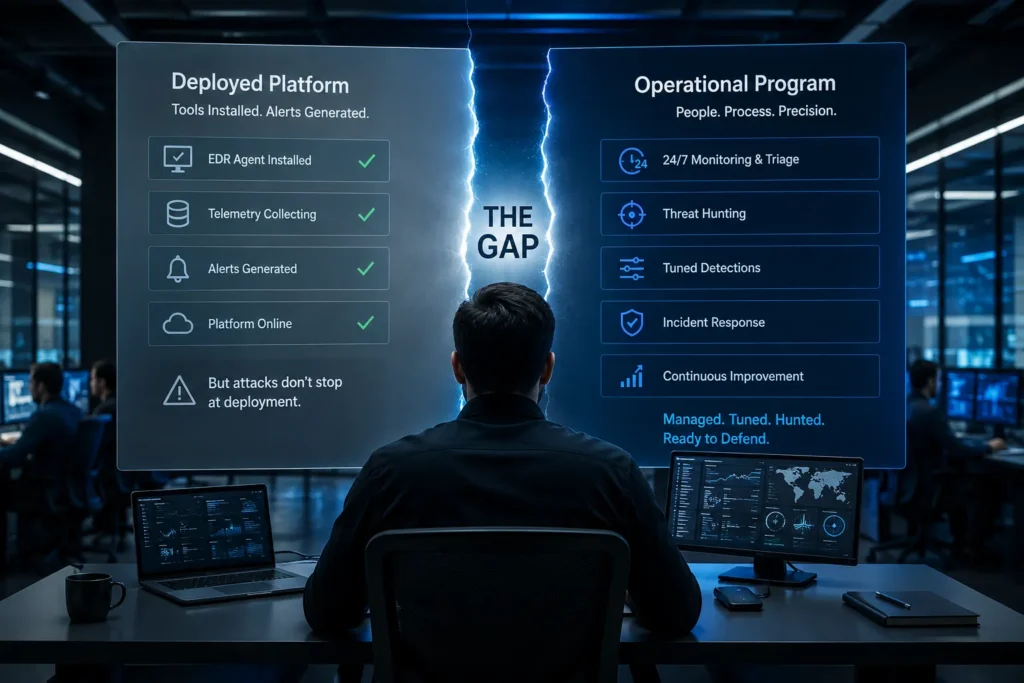
Quick answer: An EDR deployment is only the easy part of managed endpoint security. Most organizations deploy the agent, apply the default policies, and consider the EDR deployed. What they have actually deployed is a dashboard, not a defense. Default policies are not configured for the specific applications, business workflows, and risk profile of the organization. Untuned detection rules generate alert volumes that no analyst can meaningfully triage. Administrators know how to deploy the agent but have not been trained to investigate an alert. Threat hunting capability is listed in the vendor brochure but has never been operationalized. The gap between a deployed EDR and an effective EDR is where attackers operate, and it is a gap that most organizations do not close without a structured deployment and operationalization program.
Key Takeaways
- Default policies are a starting point, not a security configuration. Every EDR platform ships with default detection rules and response policies calibrated for a generic enterprise environment. They are designed to minimize false positives across the broadest possible customer base, which means they are tuned conservatively and will miss behaviors that are suspicious in the context of a specific organization’s applications and workflows. Effective EDR requires policies tuned to the actual environment: the applications used, the administrative tools deployed, the business workflows that generate otherwise suspicious process activity, and the risk appetite for alert volume versus detection coverage.
- Alert noise is the mechanism by which real threats hide in an underperforming EDR. An untuned EDR in a mid-sized environment can generate hundreds or thousands of alerts per day. A security team that cannot realistically investigate more than a fraction of those alerts learns to deprioritize the alert queue. Real threats that generate alerts identical in appearance to the noise they are buried in go uninvestigated. The attacker operates in an environment where the detection tool is present but not effective.
- Threat hunting is not a platform feature; it is a human capability. EDR platforms include threat hunting tools: telemetry queries, timeline analysis, process tree visualization. These tools enable a trained threat hunter to proactively search for attacker activity that has not triggered automated detection rules. Without threat hunting playbooks and administrators trained to run them, the threat hunting capability of the platform is never exercised. Attackers who know how to stay below the automated detection threshold operate undetected until the damage is done.
- Post-deployment hypercare is the bridge between deployment and operational maturity. The first three months after an EDR deployment generate a characteristic pattern of issues: detection rules that fire on legitimate applications the team did not know generated suspicious-looking process activity, deployment gaps discovered when endpoints not in the original inventory are identified, and administrators who are uncertain how to respond when the platform flags something real. Organizations that do not have structured support during this period commonly find their EDR program stalling at initial deployment rather than reaching the maturity that makes it effective.
- A structured EDR program covers nine domains: assessment, platform selection, pilot deployment, enterprise rollout, policy configuration and tuning, threat hunting playbook development, administrator training, post-deployment hypercare, and ongoing management and optimization. Organizations that engage only the deployment domain and skip the rest have invested in a platform without the operational program that makes the platform valuable.
The Five Ways EDR Deployments Fail
This is the practical difference between an EDR implementation that checks a box and one that defends the environment. If you are still deciding whether behavioral endpoint protection is worth it at all, what EDR is and why antivirus is no longer enough covers that ground; this article assumes the platform is bought and asks why so many of them underdeliver.
Default policies that do not match the environment
EDR platforms ship with default detection policies calibrated for a broad enterprise population. These defaults exclude detections for behaviors common in enterprise IT environments to avoid flooding new customers with false positives. The problem is that every environment is different, and the behaviors that are legitimate in one organization are suspicious in another. A healthcare organization running a specific clinical application that generates unusual process spawning patterns will generate constant false positives if the EDR policy is not tuned to exclude that application’s known-good behavior. A manufacturing organization whose production control software communicates with industrial systems in ways that look like network reconnaissance will have its EDR firing constantly on legitimate production activity. The tuning work that excludes known-good behavior while maintaining coverage for genuine threats is environment-specific and cannot be done from the vendor’s side; it requires knowledge of the organization’s specific applications, workflows, and administrative tools.
Alert volume that defeats investigation
An untuned EDR does not make the security program more effective; it makes the security team less effective by consuming investigation capacity with false positives. The mathematics are straightforward: if the EDR generates 500 alerts per day and the security team has capacity to meaningfully investigate 50, 90 percent of alerts go uninvestigated. Among the 90 percent that go uninvestigated is a proportion of real threats that look identical to the false positives they are mixed with. The team learns that the alert queue is not a reliable signal, deprioritizes it, and the EDR becomes a compliance checkbox rather than a detection capability. The solution is not a faster team; it is a tuned EDR that generates actionable alerts at a volume the team can investigate.
Untrained administrators
Deploying an EDR agent and knowing how to use the EDR platform are different skills. Most IT administrators can deploy the agent following vendor documentation. Few have been trained to investigate an alert: understanding what the alert is describing, pulling the process tree and command-line arguments to understand what happened, correlating the alert with other telemetry to understand whether it is isolated or part of a broader attack pattern, and taking the appropriate response action, whether that is isolating the endpoint, killing a process, removing a persistence mechanism, or escalating to an incident response team.
An administrator who receives a real threat alert and does not know how to investigate it has three options, none of which is good: dismiss it as a probable false positive, escalate to a vendor support line that will not have enough context to help, or begin an ad hoc investigation without a systematic process that risks missing scope or taking actions that destroy forensic evidence. When an alert does turn out to be a live intrusion, a defined path into breach response is what keeps the first hour from making things worse. Administrator training that covers the full investigation workflow, with hands-on practice on simulated alerts and documented runbooks for the most common alert types, is the operational investment that makes the detection capability actionable.
No threat hunting program
Automated detection rules catch attacks that match known behavioral patterns. Skilled attackers know what behavioral patterns EDR platforms detect and modify their techniques to operate below the detection threshold. They execute their attack activities slowly, blend their network traffic with legitimate business traffic, use legitimate administrative tools for malicious purposes, and limit the scope of their actions on any single endpoint to avoid triggering behavioral thresholds. The automated detection layer does not catch them because they have specifically designed their approach to evade it.
Threat hunting is the proactive search for attacker activity that has not triggered automated detection. A threat hunter uses the EDR’s telemetry query capability to search for indicators of attacker presence that are not captured by detection rules: unusual parent-child process relationships, commands that match known attacker tool syntax, authentication patterns that suggest credential abuse, and network connections to infrastructure that matches threat actor profiles. Threat hunting playbooks document the specific queries and analysis procedures for the threat scenarios most relevant to the organization’s industry and profile. Without playbooks and trained hunters, this capability is present in the platform and unused.
No post-deployment hypercare
The four failures above all converge in the first ninety days, which is exactly when most organizations pull back support to save cost. Detection rules fire on legitimate applications no one flagged in advance, endpoints missing from the original inventory surface, and administrators hit their first real alert without a runbook for it. Without structured support through that window, the tuning never finishes, the training never lands, and the program freezes at initial deployment. Hypercare is not an upsell; it is the phase where a deployed platform either becomes a defense or becomes shelfware.
What a Properly Run EDR Program Looks Like
A properly structured endpoint security program begins with an endpoint posture assessment that documents the full endpoint inventory, evaluates existing protection tools, and identifies coverage gaps and detection capability gaps before any platform is selected or deployed. That posture assessment is what turns platform selection from a vendor pitch into a decision grounded in the organization’s actual environment. Platform selection is vendor-neutral, evaluated against documented criteria including the organization’s operating system mix, integration requirements, the size and technical maturity of the security team that will operate the platform, and the specific threat scenarios most relevant to the business.
Deployment follows a pilot-then-rollout structure. The pilot group covers representative endpoint types across Windows, macOS, Linux, and server operating systems and runs for two to three weeks to surface compatibility issues and tune detection rules against the organization’s actual application environment before the platform is deployed broadly. Enterprise rollout follows a documented runbook coordinated with IT operations to minimize business disruption. Policy configuration and detection rule tuning are performed against the organization’s specific application environment, not the vendor defaults.
Threat hunting playbooks are built for the threat scenarios specific to the organization’s industry and business profile, written to be executable by the administrators who will run them independently. Administrator training covers the full investigation workflow with documented runbooks. Ninety days of post-deployment hypercare supports the tuning, coaching, and deployment expansion work that turns the initial deployment into an operationally mature program. Armour Cybersecurity delivers all of these components as part of its EDR Services engagement, with the same standardized methodology across every client.
Frequently Asked Questions
How do we know if our current EDR is underperforming?
Several indicators suggest an underperforming EDR deployment. If the alert queue is routinely not fully investigated, alert volume is too high relative to investigation capacity, which indicates inadequate tuning. If administrators are uncertain how to respond to specific alert types, training is insufficient. If threat hunting has never been conducted, the proactive detection layer is absent. If the EDR coverage report shows endpoints without agents, the deployment has gaps. If the detection rules have never been reviewed since initial deployment and the environment has changed, the rules may be generating false positives on new applications or missing suspicious behaviors in new tools. An endpoint posture assessment evaluates these dimensions systematically and produces a prioritized list of gaps with recommendations for closure.
How many alerts should a properly tuned EDR generate?
There is no universal target alert volume; the right volume depends on the size of the endpoint fleet, the complexity of the environment, and the investigation capacity of the security team. The practical measure is whether the team can investigate every alert that is not automatically suppressed as a known false positive within the expected response time for that alert severity. A critical alert should be investigated within minutes to hours; a high alert within the same business day; medium alerts within defined SLAs appropriate to the organization’s risk appetite. If alerts at critical or high severity are routinely aging beyond these targets because the total alert volume is too high, the EDR requires further tuning to reduce false positive rates in those severity categories. The goal is not the lowest possible alert count; it is the highest possible ratio of real threats to false positives at each severity level.
Can our existing IT team operate the EDR after deployment?
Yes, provided the team receives proper training and the platform is tuned to a volume they can manage. EDR does not require a dedicated security operations center to be operated effectively in a mid-market organization. An existing IT or security administrator who has received training on alert triage, investigation workflows, and response actions can operate a tuned EDR platform as part of their responsibilities. The requirements are: trained administrators who know how to investigate alerts rather than just observe them, documented runbooks for the most common alert types, a tuned platform that generates an alert volume the team can realistically investigate, escalation paths for alerts that exceed the team’s investigation capability, and a clear escalation process for confirmed incidents. Armour Cybersecurity builds all of these into the administrator training and hypercare deliverables. Organizations that do not have even a part-time security function available can engage ongoing managed EDR services.
What is the difference between EDR and MDR?
EDR is the platform and the program that deploys and operates it within the organization. MDR, Managed Detection and Response, is a service in which an external security operations team monitors the EDR telemetry, investigates alerts, and responds to threats on the organization’s behalf on an ongoing basis. MDR engagements are structured as retainer services where the MDR provider staffs the security operations function rather than the organization building that function internally. Organizations that want the detection capability of EDR without building an internal security operations team to operate it typically pair it with a managed SOC or an MDR service. Armour Cybersecurity offers ongoing managed EDR services as a retainer option for organizations that complete the deployment engagement and prefer to have the alert triage, investigation, and threat hunting functions operated externally rather than internally.
What should be in a threat hunting playbook?
A threat hunting playbook documents a structured investigation process for a specific threat scenario: the threat actor behavior or technique being hunted, the specific telemetry queries to run in the EDR platform to surface indicators of that behavior, the analysis steps to evaluate the query results and distinguish malicious from benign matches, the escalation criteria for results that confirm the presence of the threat, and the response actions to take if the threat is confirmed. A useful playbook is specific enough to be executed by an administrator who understands the technique at a conceptual level but does not need to design the hunt from scratch each time. Armour Cybersecurity develops up to five custom threat hunting playbooks for each EDR engagement, tailored to the threat scenarios most relevant to the organization’s industry, business profile, and the specific EDR platform deployed.
The Bottom Line
The platform is the cheap part of endpoint security; the program is where the value is, and where most organizations stop short. A deployed EDR with vendor-default policies, an alert queue no one can clear, administrators who have never investigated a real alert, and a threat hunting tab no one opens is not a defense, it is a dashboard that produces compliance evidence and a false sense of safety. What closes the gap is unglamorous: tune the policies to the actual environment, get the alert volume down to what the team can investigate, train the administrators to work an alert end to end, build the hunting playbooks, and hold the whole thing together through the first ninety days. A structured EDR Services engagement covers all nine domains with one methodology, so the platform you paid for becomes the defense you actually needed.
About the author
David Chernitzky is Co-Founder and CEO of Armour Cybersecurity, a Toronto-based cybersecurity firm founded by military intelligence veterans and advised by senior leaders from PwC, KPMG, Deloitte, EY, and Mandiant. Armour serves more than 260 organizations across 52-plus industries, including finance, healthcare, technology, energy, legal, and government, with a 97 percent client retention rate.