By David Chernitzky, Co-Founder and CEO, Armour Cybersecurity | Serving organizations across Canada, the US, and beyond | Last updated August 20, 2026
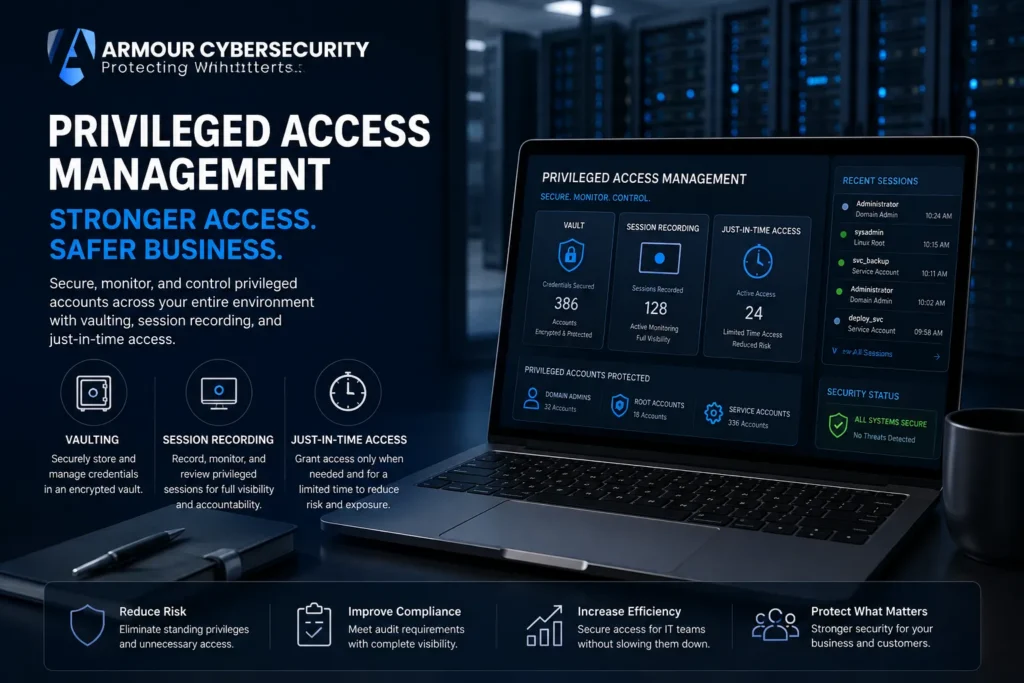
Quick answer: Privileged Access Management (PAM) is the discipline of controlling, monitoring, and auditing the accounts in your environment that can do anything: domain administrators, local admin accounts, root accounts on Linux servers, service accounts with broad system rights, database administrator credentials, and break-glass emergency accounts. These accounts are the highest-value targets in any network because whoever controls them controls everything. Most organizations have far more of them than they realize, many are shared among multiple people, most lack MFA, and almost none are session-recorded. A PAM program vaults these credentials so no individual holds them permanently, records every session where they are used, enforces just-in-time access so privileges are active only when needed, and produces the audit trail that both security operations and compliance require.
Key Takeaways
- Stolen credentials have sat at or near the top of the initial-access rankings for years. Verizon’s Data Breach Investigations Report found credential abuse was the leading initial access vector in 2025 at 22 percent of breaches, and while the 2026 report shows vulnerability exploitation overtaking it for the first time, credential abuse remained a top vector at 13 percent, and stolen credentials still featured in roughly 88 percent of basic web application attacks. Once an attacker holds a privileged credential, network-level controls become largely irrelevant: they are acting as a legitimate administrator with authorized access to everything that administrator can reach.
- Shared admin credentials eliminate accountability and magnify blast radius simultaneously. When five people share a single domain admin password, there is no way to determine which person performed a specific action using that credential. When the shared password is compromised, all five people’s sessions must be investigated, every system the shared account has accessed is potentially compromised, and changing the password disrupts all five users’ workflows simultaneously. Individual, vaulted credentials with session recording resolve all three problems.
- Service accounts are the most neglected category of privileged accounts. Application service accounts, scheduled task accounts, and integration credentials often run with permanent elevated privileges, have passwords that have not changed in years, and belong to no current owner because the person who created them has left the organization. These accounts are invisible to most access reviews and represent standing privileged access that attackers consistently target through lateral movement.
- Just-in-time (JIT) access is the principle that privileged credentials should exist and be active only for the duration of the specific task that requires them. An administrator who needs to make a configuration change checks out a time-limited privileged session from the PAM vault, performs the task, and the session closes with a full recording. The credential is rotated after use. There is no persistent privileged account sitting in the environment waiting to be compromised.
- PAM is a compliance requirement across every major framework. SOC 2, ISO 27001, PCI DSS, HIPAA, and CMMC all include explicit requirements for privileged access controls, session monitoring, and access review for administrative accounts. The privileged account inventory, vault configuration, session recording evidence, and access review records produced by a PAM program are the audit artifacts that satisfy these requirements directly.
The Difference Between IAM and PAM
Identity and Access Management (IAM) is the broad discipline of managing who can access what across the organization. It covers the full population of identities: employees, contractors, vendors, service accounts, and application identities. IAM governs how these identities are created, what access they are assigned, how they authenticate, and when their access is revoked. IAM includes the directory infrastructure that stores identity records, the authentication systems that verify identities at login, the provisioning systems that grant and revoke access, and the access governance processes that review and certify access on a regular schedule.
Privileged Access Management is a subset of IAM focused specifically on the accounts with elevated permissions. While a standard employee account can access the applications and data the employee needs for their job, a privileged account can administer systems, modify configurations, access all data on a system, create or delete other accounts, and override security controls. The higher the privilege level of an account, the more consequential its compromise. PAM applies a higher standard of control to these accounts: credential vaulting instead of user-held passwords, session recording of all privileged activity, just-in-time access instead of permanent standing privilege, and more frequent access review than standard user accounts receive.
Most organizations need both IAM and PAM as an integrated program. The IAM layer handles the full identity lifecycle for all users; the PAM layer applies additional controls to the subset of accounts that carry the most risk. An IAM program without PAM leaves the highest-risk accounts subject to the same controls as general user accounts, which is insufficient given the privileges those accounts carry. Armour Cybersecurity delivers both as an integrated program through its identity and privileged access management service, covering the full spectrum from identity architecture through privileged account vaulting to access governance and lifecycle management.
Why Shared Admin Credentials Create Unacceptable Risk
No accountability
When multiple people share a single administrative credential, the audit log records the actions of the credential, not the person who used it. Every change made using that credential is attributed to the same identity. In a normal security investigation, the question is: who made this change, when, and from which system? With a shared credential, the answer is: the shared admin account, at this time, but we cannot determine which of the five people who know the password performed this action. This is not just a security problem; it is a compliance failure. SOC 2, ISO 27001, PCI DSS, and HIPAA all require the ability to attribute system actions to specific individuals, which shared credentials make impossible. That accountability gap is one of the first things a SOC 2 readiness assessment surfaces, because the auditor cannot test a control that no one can be tied to.
Unlimited blast radius on compromise
A shared admin credential that is compromised gives the attacker administrative access to every system that credential can reach, with no way to limit the scope to a specific person’s authorized systems. If the shared domain admin password is obtained through a phishing attack against one of the five people who know it, the attacker has domain administrator access to the entire Active Directory environment. Rotating the password to terminate the attacker’s access simultaneously breaks all five users’ administrative sessions and requires immediate, coordinated credential redistribution under incident conditions, which creates pressure to delay the rotation until the impact can be managed.
No way to revoke access when someone leaves
When a team member who knows a shared admin password leaves the organization, revoking their access requires changing the password and distributing the new password to everyone who still needs it. In practice, this rarely happens promptly. The former employee’s knowledge of the password represents ongoing unauthorized access to administrative systems that the organization cannot revoke without operational disruption. Individual, vaulted credentials solve this problem: the former employee’s individual account is disabled, their access to the PAM vault is revoked, and no other user’s access is affected. The shared credential problem does not exist because there are no shared credentials.
What a PAM Program Delivers in Practice
A PAM program begins with a privileged account inventory: a complete enumeration of every account in the environment with elevated permissions, including domain and local administrator accounts, service accounts, scheduled task accounts, database administrator credentials, cloud IAM accounts with broad permissions, and break-glass emergency accounts. Most organizations discover they have significantly more privileged accounts than they believed, particularly in the service account category where accounts created for specific integrations or applications accumulate over years without systematic review. That inventory belongs on the organization’s security risk register as a tracked exposure, because standing privileged access is one of the highest-likelihood, highest-impact risks most environments carry.
Each inventoried account is classified by risk level based on its privilege scope, whether it is currently active, whether it has a known owner, and whether its password has been changed recently. High-risk accounts are prioritized for immediate vaulting. The vaulting process transfers the credential into the PAM platform, which generates a new password that no individual knows, records who checks the credential out and when, requires MFA for vault access, and rotates the password automatically after each use or on a scheduled basis.
Session recording captures everything that happens during a privileged session: every command executed, every file accessed, every configuration change made. The recording is stored in the PAM platform and searchable by session metadata including the account used, the target system, and the time. Feeding those session logs into a managed SOC is what turns the recording from after-the-fact evidence into live detection, so an anomalous privileged session is flagged while it is happening rather than reconstructed after an incident. For compliance purposes, this recording is the evidence that specific administrative actions were performed by specific people at specific times, which is the accountability record that shared credentials can never produce.
Frequently Asked Questions
How many privileged accounts should an organization have?
The principle of least privilege says that every account should have only the permissions required for its specific function, and privileged accounts should exist only where operational requirements make them necessary. In practice, the right number of privileged accounts depends on the size of the organization and the complexity of the environment, but most organizations have more privileged accounts than they need. The privileged account inventory typically surfaces accounts that were created for specific purposes and never deprovisioned, accounts whose privilege level exceeds what their current function requires, and service accounts that run with domain administrator rights because that was the path of least resistance when they were set up. Reducing the number and privilege scope of privileged accounts, alongside vaulting the ones that remain, is one of the highest-impact outcomes of a PAM program.
What is just-in-time access and how does it work in practice?
Just-in-time (JIT) access is an approach to privileged access where accounts are granted elevated permissions only for the duration of a specific task and the permissions are automatically removed when the task is complete. In a JIT model, an administrator who needs to make a change on a production server does not have standing administrative access to that server. They submit a request through the PAM platform specifying the system they need to access and the duration required. The request is approved (automatically for pre-approved task types, or by a manager for higher-risk tasks), the administrator’s account is temporarily granted the necessary privileges for the approved duration, the session is recorded, and the privileges are automatically revoked when the session ends or the duration expires. This model eliminates standing privilege, which is the primary attack surface that PAM addresses.
What is the difference between password vaulting and a password manager?
A consumer or team password manager stores passwords that users choose and know, making them accessible across devices. It is a convenience tool. A PAM vault stores privileged credentials that no individual knows: the PAM platform generates and manages the passwords, which are complex, unique, and rotated automatically. Users access the vault through authenticated sessions rather than retrieving and using the password directly; for many privileged access scenarios, the user never sees the password at all because the PAM platform establishes the privileged session on their behalf through a connection broker. The audit trail, session recording, and automated rotation capabilities of a PAM vault are not features of consumer or team password managers. They are enterprise security controls designed specifically for the accountability and rotation requirements of privileged account management.
Do service accounts need to be in the PAM vault?
Yes. Service accounts are often the highest-risk accounts in an environment from a PAM perspective because they tend to have broad permissions, unchanging passwords, and no current owner. An application service account that runs with domain administrator privileges because that was the easiest configuration when the application was deployed represents standing privileged access that is rarely reviewed and can persist for years after the application it was created for has been decommissioned. PAM programs should inventory all service accounts, classify them by privilege level and risk, reduce their permissions to the minimum required for their function, rotate their passwords through the vault, and assign ownership so that every service account has a person responsible for reviewing its continued necessity. Service accounts that can be converted to use modern authentication methods such as managed service accounts or workload identity federation should be migrated to eliminate the static credential entirely.
If credential abuse is no longer the number one initial access vector, does PAM still matter as much?
Yes, arguably more. The 2026 DBIR showing vulnerability exploitation overtaking credential abuse does not mean credentials stopped mattering; it means attackers gained a faster front door in unpatched edge devices. What happens after initial access has not changed: attackers escalate to privileged accounts and use them for lateral movement, and stolen credentials still dominate specific attack patterns such as web application attacks. PAM addresses the part of the attack chain that every intrusion has in common regardless of how it started, which is the abuse of privileged access to reach the data and systems that matter. Reducing standing privilege limits what an attacker can do once inside, no matter which door they came through.
The Bottom Line
Privileged accounts are the accounts that can do anything, and in most environments they are shared, unmonitored, missing MFA, and far more numerous than anyone realizes, especially in the service-account category no one owns. Shared admin credentials fail on all three counts that matter: they destroy accountability, they hand an attacker unlimited blast radius the moment one is compromised, and they cannot be revoked when someone leaves without disrupting everyone else. A PAM program fixes the root cause rather than the symptom: it inventories every privileged account, vaults the credentials so no individual holds them, records every privileged session, enforces just-in-time access so standing privilege stops existing, and produces the audit trail that both incident response and every major compliance framework require. Whether credential abuse or vulnerability exploitation leads the breach rankings in a given year, the privileged access it leads to is the same. Armour Cybersecurity’s identity and privileged access management program builds that control set end to end, from the first account inventory through vaulting, session recording, and access governance.
About the author
David Chernitzky is Co-Founder and CEO of Armour Cybersecurity, a Toronto-based cybersecurity firm founded by military intelligence veterans and advised by senior leaders from PwC, KPMG, Deloitte, EY, and Mandiant. Armour serves more than 260 organizations across 52-plus industries, including finance, healthcare, technology, energy, legal, and government, with a 97 percent client retention rate.