By David Chernitzky, CEO, Armour Cybersecurity · Serving Toronto and organizations across North America · Last updated August 21, 2026
Quick Answer
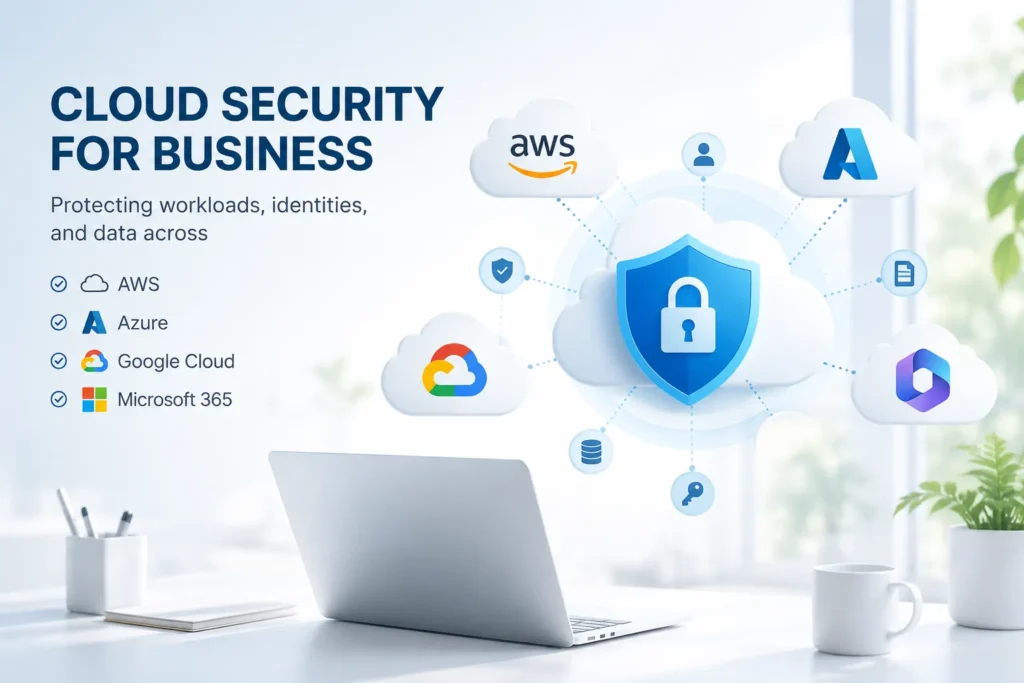
Cloud security for business is the set of policies, controls, and technical measures that protect data, workloads, and user identities running in cloud environments, including public clouds like AWS, Microsoft Azure, and Google Cloud, and SaaS platforms like Microsoft 365. It is not IT security applied to cloud infrastructure. The environment changes too fast, the attack surface is too dynamic, and the shared responsibility model fundamentally shifts which controls the organization is responsible for versus the provider. Traditional perimeter-based security, built around firewalls, VLANs, and on-premise network controls, does not follow workloads as they move to cloud. Cloud security requires a different operating model: continuous posture monitoring, automated guardrails, least-privileged identity governance, and detection logic built for cloud-specific threats rather than network-perimeter threats.
Key Takeaways
- Cloud security is not about the perimeter. Traditional IT security is built around a network perimeter the organization controls: traffic flows through firewalls, endpoints sit on the corporate network, and controls are applied at the boundary. Cloud environments have no fixed perimeter. Workloads are internet-reachable by design, the network boundary is defined by configuration rather than hardware, and the configuration changes every time a developer deploys a new resource.
- The shared responsibility model means the cloud provider secures the infrastructure, and you are responsible for everything built on top of it: identity and access management, network configuration, data classification, workload security, application controls, and compliance. Most cloud security incidents are the result of failures on the customer side of that line, not the provider side.
- Configuration drift is the defining risk in cloud environments. Cloud infrastructure changes continuously: new accounts are provisioned, storage buckets are created, IAM permissions are granted, and security group rules are modified. Each change is an opportunity for a configuration to drift from the secure baseline. Manual review cannot keep pace with the velocity of cloud change; automated posture management is required to maintain continuous visibility.
- Cloud security requires a four-pillar operating model: advisory to assess posture and design governance, implementation to deploy the technical controls, managed services for continuous monitoring, and incident response for when events occur. Organizations that focus only on the implementation layer and skip the operational layer end up with deployed controls that are not maintained, not monitored, and not updated as the environment evolves.
- CSPM (Cloud Security Posture Management) is the foundational tool layer for cloud security. It continuously monitors cloud configurations for misconfigurations, compliance violations, excessive permissions, and exposed data, providing the automated posture visibility that makes continuous security possible in an environment that changes faster than any manual review process can track.
How Cloud Security Differs From Traditional IT Security
The perimeter does not exist
Traditional IT security is organized around a network perimeter. The organization controls a physical boundary: corporate networks are separated from the internet by firewalls, traffic is inspected at defined choke points, and endpoints must be connected to the corporate network to access protected resources. Security controls are applied at the perimeter and at fixed points inside it. The threat model is defined by what can reach the network and what the network can reach.
Cloud environments operate on a fundamentally different architecture. Workloads run on infrastructure the organization does not own in data centres the organization does not control. Network boundaries are defined by configuration: security groups, virtual private clouds, network access control lists, and IAM policies determine what can communicate with what. These configurations are created, modified, and deleted by developers and operations teams constantly. The boundary is not a physical thing an attacker must cross; it is a set of policies that must be correctly configured and continuously maintained to prevent exposure. When those policies drift, the exposure is immediate and often internet-accessible.
Identity is the new perimeter
In cloud environments, the concept of the perimeter has been replaced by identity. What an entity can do in the cloud is determined by the permissions attached to its identity: the IAM policies assigned to users, service accounts, and roles. An attacker who gains access to a cloud identity with broad permissions has effectively bypassed every network-level control in the environment, because they are acting as a legitimate principal with authorized access rather than as an external attacker attempting to cross a boundary. This is why identity and access management is a primary security control in cloud in a way it is not in traditional on-premise environments.
IAM policies accumulate over time as access is provisioned for new use cases and never revoked when those use cases end. Service accounts created for temporary integrations retain their permissions indefinitely. The resulting permission sprawl means the blast radius of any single identity compromise is far larger than the minimal access required for the intended purpose of that identity. Least-privilege IAM governance, continuously maintained and regularly audited, is a foundational cloud security control.
The pace of change defeats manual review
Cloud environments change at a velocity that traditional security review processes cannot match. In a typical cloud-native organization, the infrastructure is modified hundreds or thousands of times per day through developer deployments, automated pipelines, and operational changes. A new S3 bucket is created with public access enabled. A security group is modified to allow inbound traffic from 0.0.0.0/0. An IAM role is granted administrative permissions for a quick fix and never returned to its original scope. Each of these changes takes seconds to make and may go undetected for months if the security program relies on periodic manual review rather than continuous automated monitoring.
The detection latency between when a misconfiguration is introduced and when it is identified is the window during which attackers can exploit it. Research consistently finds that a significant proportion of cloud security incidents result from misconfigurations that were present for extended periods before discovery, often found by external parties rather than the organization’s own security team. The scale of that window is not abstract: the IBM Cost of a Data Breach Report 2025 puts the average time to identify and contain a breach at 241 days, with the global average breach costing USD 4.44 million and the United States average USD 10.22 million. Reducing detection latency to minutes rather than months requires automated posture monitoring, not periodic manual review.
Across the 260+ organizations Armour Cybersecurity protects in 52+ industries, the cloud environments that avoid a serious misconfiguration incident are rarely the ones with the most tooling. They are the ones where someone owns the configuration between deployments, so a bucket opened at 2 a.m. by an automated pipeline is caught by a guardrail that same minute rather than by a researcher months later.
What Cloud Security Actually Covers
A comprehensive cloud security program covers nine domains across the full cloud environment. Cloud posture assessment establishes the current-state baseline: it identifies all cloud assets, maps their configurations against security standards, identifies IAM exposure and data classification gaps, and produces the prioritized remediation roadmap the security program needs to act on. Cloud governance and strategy design establishes the organizational structure for secure cloud operations: who owns cloud security decisions, what the review and approval process is for new cloud deployments, and how security accountability is allocated between platform and application teams.
Cloud Security Posture Management (CSPM) provides the continuous monitoring layer: automated detection of configuration drift, compliance violations, excessive permissions, and exposed data across every cloud account in scope, with real-time alerts and compliance evidence generated continuously against frameworks like ISO 27001, SOC 2, HIPAA, and PCI DSS. Security guardrails and baselines prevent risky configurations from being deployed in the first place, encoding the organization’s security standards as policy-as-code that the cloud environment enforces automatically rather than relying on manual review to catch violations after deployment.
Infrastructure hardening aligns cloud configurations with CIS Benchmarks and platform-specific guidance across identity, network, storage, compute, secrets management, and logging. DevSecOps integration embeds security into the development lifecycle so that vulnerabilities in application code, container images, and infrastructure-as-code are identified before they reach production rather than after. Managed cloud threat monitoring provides 24/7 detection and response to cloud-specific threats. Data Loss Prevention (DLP) monitors and prevents unauthorized data transfer. Cloud incident response provides breach response, forensics, and recovery planning when events occur.
Armour Cybersecurity delivers all nine capabilities across a four-pillar operating model: advisory, implementation, managed services, and incident response, technology-agnostic across all major cloud platforms. To see how the cloud security program is structured and scoped to an organization’s specific cloud footprint, start with a posture assessment rather than a tool purchase.
Frequently Asked Questions
What cloud platforms does cloud security cover?
A comprehensive cloud security program covers all major hyperscalers: Amazon Web Services (AWS), Microsoft Azure, Google Cloud Platform (GCP), and Oracle Cloud Infrastructure (OCI). Microsoft 365 and other SaaS platforms are included in the scope of cloud security because they present cloud-specific risks around identity governance, data exposure, and configuration that are distinct from on-premise equivalents. Engagements are designed to support single-cloud, multi-cloud, and hybrid environments, with tool selection that prioritizes platforms capable of providing consistent security visibility across multiple providers rather than requiring separate tooling stacks for each cloud.
What is the shared responsibility model?
The shared responsibility model is the division of security obligations between a cloud provider and its customers. Every major cloud provider publishes its version of this model, which defines what the provider secures and what the customer must secure. The provider secures the underlying infrastructure: the physical data centres, the hypervisor layer, the network fabric between data centres, and the availability of managed services. The customer is responsible for everything built and configured on top of that infrastructure: IAM configuration, network controls within the cloud environment, data classification and encryption, workload configuration, and application security. For Microsoft 365, Microsoft manages platform uptime and encryption at rest, but Conditional Access policies, Defender for Office 365 configuration, DLP policies, and privileged identity management are entirely the tenant’s responsibility. The shared responsibility model is not a risk transfer from customer to provider; it is a definition of which party controls which layer of security. Both layers must be secured for the cloud environment to be protected.
Why do cloud security incidents keep happening despite major cloud providers having strong security?
The overwhelming majority of cloud security incidents are not the result of cloud provider failures. They are the result of customer-side failures in the areas the customer is responsible for under the shared responsibility model: misconfigured storage buckets with public read access, overpermissioned IAM roles that expand the blast radius of compromised credentials, unencrypted sensitive data, publicly exposed administrative interfaces, and missing logging configurations that blind the security team to attacker activity. The cloud providers’ infrastructure is well-secured; what fails is the configuration of what runs on top of it. This is why continuous posture monitoring, guardrails that prevent misconfiguration, and regular security assessments are the core of effective cloud security, not trust in the provider’s underlying security.
How is cloud security different for regulated industries?
Regulated industries including financial services, healthcare, legal, and government face compliance obligations that explicitly reference cloud security controls. PIPEDA and Quebec Law 25 require appropriate security measures for personal information processed in cloud environments, including vendor due diligence and data residency considerations. HIPAA requires Business Associate Agreements with cloud service providers that process protected health information and requires the same administrative, physical, and technical safeguards in cloud environments as in on-premise environments. PCI DSS applies to cloud environments processing cardholder data with the same scope and control requirements as on-premise systems, and the PCI DSS cloud guidance specifically addresses the shared responsibility model for scoping and control implementation. SOC 2 and ISO 27001 assessments increasingly cover cloud infrastructure as in-scope for the certification. Organizations in regulated industries need cloud security programs designed to satisfy their specific compliance obligations, not generic cloud security programs adapted after the fact.
Can we use the cloud provider’s native security tools instead of a managed service?
Cloud provider native security tools, such as Microsoft Defender for Cloud, AWS Security Hub, and Google Security Command Center, are valuable and are often included in the scope of a managed cloud security program. They are not, by themselves, a substitute for a managed security service. Native tools require configuration, tuning, and ongoing maintenance to produce useful signal rather than alert noise. They require security expertise to interpret their findings and prioritize remediation. They do not provide the human investigation layer that converts automated alerts into confirmed incidents with actionable response guidance. And in multi-cloud environments, each provider’s native tools cover only that provider’s infrastructure, leaving no unified visibility across the cloud estate. A managed cloud security program configures and operates the native tools as part of its coverage layer, adding the expertise, process, and cross-platform visibility that the tools alone do not provide.
The Bottom Line
Cloud security is not your existing IT security pointed at someone else’s servers. The perimeter you used to defend is gone, replaced by identity and configuration that change hundreds of times a day, and the shared responsibility model puts almost all of that change on your side of the line. That is why the discipline is continuous rather than periodic: posture monitoring that catches drift in minutes, guardrails that stop risky configurations before they deploy, least-privilege identity governance, and detection built for cloud threats, not network ones, wrapped in an operating model that keeps running after the tools are installed. Armour Cybersecurity’s cloud security program delivers that across advisory, implementation, managed services, and incident response, so the environment stays secure as fast as it changes.
About the author
David Chernitzky is the CEO and Co-Founder of Armour Cybersecurity, a Toronto-based firm that protects organizations across North America from advanced cyber threats. He brings more than 25 years of cybersecurity and military cyber intelligence experience, having served as an officer in an elite technology unit before co-founding Armour. Armour’s team of military-intelligence veterans and senior advisors serves 260+ clients across 52+ industries with a 97% client retention rate. Learn more about Armour Cybersecurity.