By David Chernitzky, CEO, Armour Cybersecurity · Serving Toronto and organizations across North America · Last updated August 21, 2026
Quick Answer
Cloud misconfiguration risk for business is the leading cause of cloud security incidents. It is not a gap in the cloud provider’s infrastructure; it is a gap in the configuration of what the organization has built and deployed on top of that infrastructure, and it is the risk layer that sits underneath everything else in cloud security. Storage buckets set to public access, IAM roles granted administrator permissions for a temporary task and never returned to least privilege, security groups with inbound rules open to the entire internet, and CloudTrail logging disabled across accounts that host sensitive data. These are not rare edge cases. They accumulate continuously in cloud environments because infrastructure changes faster than manual review can track and because developers optimizing for deployment velocity rarely optimize for configuration hygiene at the same time.
Key Takeaways
- Cloud misconfiguration is the leading cause of cloud data breaches. Industry research consistently identifies misconfiguration, not vulnerability exploitation, as the primary mechanism behind cloud security incidents. The attack is not technical sophistication; it is finding a door that was left open and walking through it.
- Misconfiguration accumulates silently. Each misconfiguration introduced by a developer change, a new account provisioned without the security baseline applied, or a configuration modified for a temporary business reason and never reverted is invisible to the organization until it is discovered by a scanner, an auditor, or an attacker. The longer it goes undetected, the larger the exposure window.
- The most common misconfiguration categories are public cloud storage, overpermissioned IAM, exposed administrative interfaces, disabled logging and monitoring, and unencrypted sensitive data. These are not obscure configuration settings; they are routine aspects of cloud infrastructure that have well-known secure defaults and that routinely drift away from those defaults in environments without automated guardrails.
- Manual configuration review cannot keep pace with cloud velocity. An environment that changes hundreds of times per day cannot be audited for configuration correctness on a weekly or monthly schedule. The gap between the introduction of a misconfiguration and its detection is measured in weeks or months when review is periodic, and in minutes when continuous posture management is in place.
- Cloud Security Posture Management (CSPM) is the technical control that closes the detection gap. CSPM continuously monitors every cloud configuration against the organization’s security policies and industry compliance benchmarks, alerting on drift in real time and generating the remediation guidance and compliance evidence the security team needs to act.
The Most Common Cloud Misconfigurations
Public cloud storage
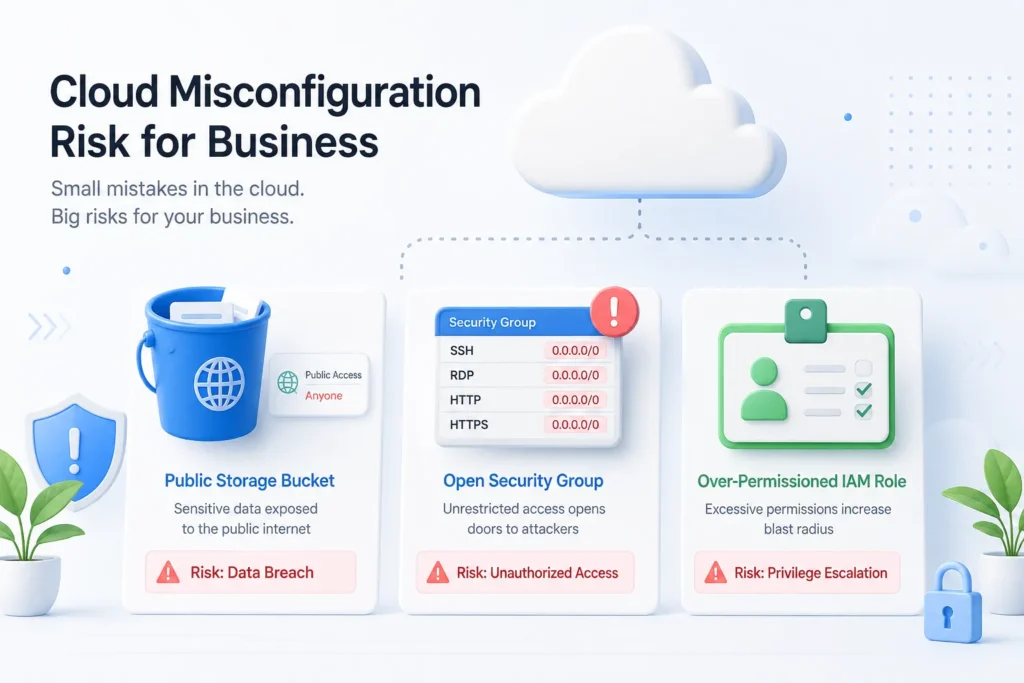
Cloud object storage, such as Amazon S3, Azure Blob Storage, and Google Cloud Storage, is designed to make data accessible. The default configuration of a new storage bucket is typically private: only authorized principals in the account can access it. But enabling public access is easy, it is sometimes done deliberately for legitimate use cases like static website hosting, and it is easily applied to the wrong bucket or left in place after the use case that required it has ended. A storage bucket containing customer records, employee data, financial documents, or intellectual property with public read access is directly accessible to anyone on the internet who discovers the bucket URL, which is not difficult given the predictable naming patterns that many organizations use.
Public storage misconfigurations are among the most frequently reported cloud security incidents in the public record. The pattern is consistent: a bucket is misconfigured, it contains sensitive data, and it is discovered by a security researcher, a journalist, or an attacker before the organization identifies it internally. The discovery triggers a breach notification process, a regulatory inquiry, and reputational damage that dwarfs the cost of the preventive control that would have caught the misconfiguration within minutes of its introduction.
Overpermissioned IAM
IAM permissions in cloud environments tend to expand over time and rarely contract. A new service integration requires specific permissions; rather than scoping the minimum permissions needed, the developer grants a broader policy to unblock the integration quickly. A user is given administrator access to debug a production issue; the access is not revoked after the issue is resolved. A service account created for a decommissioned integration retains its permissions because no process exists to review and revoke credentials when projects end. The cumulative result of these patterns is an IAM environment where most principals have far more permission than they need for their actual function.
Overpermissioned IAM is consequential for two reasons. The first is that it increases the blast radius of any compromised credential: an attacker who gains access to a service account granted administrator permissions can do far more damage than one who gains access to a service account scoped to the minimum its integration requires. The second is that overpermissioned principals create lateral movement paths: an attacker who compromises a low-privilege user can escalate by exploiting the excessive permissions of a role they can assume. Least-privilege IAM governance, continuously audited and enforced, closes both of these risk vectors.
Exposed administrative interfaces
Cloud infrastructure includes administrative interfaces that should only be accessible from specific, controlled networks: database management ports, administrative consoles, remote desktop and SSH endpoints, and Kubernetes API servers. These interfaces frequently end up exposed to the internet through security group rules that are too permissive, either because they were deliberately opened for a temporary maintenance task and never restricted back, or because the default configuration of a new resource was more permissive than intended and no automated check caught it before deployment.
An exposed administrative interface does not require a misconfiguration in the application to be exploitable. The attacker can attempt credential attacks directly against the exposed port, exploit vulnerabilities in the administrative service itself, or use the exposed interface to enumerate information about the environment. Well-configured environments restrict administrative interface access to specific IP ranges or require connectivity through a bastion host or VPN, eliminating the direct internet exposure. Security guardrails that prevent security group rules from opening administrative ports to the internet are the preventive control; CSPM alerts that detect when such rules are present are the detective control.
Disabled logging and monitoring
Cloud provider audit logs, such as AWS CloudTrail, Azure Monitor activity logs, and Google Cloud Audit Logs, are the primary source of evidence for security investigations in cloud environments. They record every API call, every configuration change, every access event, and every administrative action across the cloud account. When these logs are disabled or not configured to capture the relevant event types, the security team is blind to attacker activity. More practically, they have no forensic record to investigate after an incident is discovered.
Disabled logging is a misconfiguration that attackers specifically look for and exploit. An attacker operating in an account with disabled CloudTrail can take destructive actions with no audit trail and no detection. Enabling and protecting logging across all accounts and regions in the cloud estate is a baseline security control; the logs need to be sent to a centralized, protected destination where they cannot be modified or deleted by a compromised account-level principal.
Why Misconfiguration Accumulates Faster Than Manual Review Can Catch It
The velocity of change in cloud environments is the fundamental challenge for any security process that relies on periodic human review. In an organization with active development and operations teams, the cloud infrastructure can be modified thousands of times per week through developer deployments, automated pipeline runs, infrastructure-as-code changes, and manual operational adjustments. Each modification is a potential misconfiguration. A weekly security review that checks configurations on a sampling basis will miss the majority of misconfigurations introduced during the week, and many of those will be remediated by subsequent changes before the review occurs, creating the appearance of a clean environment while misconfigurations that happen to survive until the review date remain undetected.
Manual review also suffers from the breadth problem: a large cloud estate with multiple accounts, multiple regions, and multiple cloud providers contains tens of thousands of individual configuration settings across compute instances, storage resources, network controls, IAM policies, and managed services. A human reviewer cannot check every configuration in scope during a periodic review; they check a subset, and the configurations they do not check accumulate drift undetected.
Continuous posture management resolves both problems. CSPM monitors every configuration in scope continuously, checking each one against the defined policy rules and compliance benchmarks every time it changes. A misconfiguration introduced at 2:00 AM on a Saturday triggers an alert at 2:00 AM on a Saturday, not at the next Monday morning review. The detection latency is measured in minutes, not weeks. And because the coverage is continuous rather than sampled, no configuration setting escapes the monitoring scope.
Across the 260+ organizations Armour Cybersecurity protects in 52+ industries, the cloud misconfigurations that turn into incidents are almost never the exotic ones. They are the same handful of categories, a public bucket, an admin port open to the internet, an IAM role that kept its emergency permissions, that survived undetected because nothing was watching the configuration between reviews. The environments that stay clean are the ones where detection is continuous rather than scheduled.
Armour Cybersecurity deploys and operates CSPM as part of its cloud security services, integrated with the remediation and governance processes that turn alerts into resolved findings. The program also deploys security guardrails, policy-as-code controls that prevent risky configurations from being deployed in the first place, reducing the flow of new misconfigurations into the environment rather than only detecting them after the fact.
Frequently Asked Questions
How do we find misconfigurations that are already in our environment?
A Cloud Security Posture Assessment is the starting point. The assessment scans the full cloud estate across all accounts, regions, and platforms, enumerating every resource and comparing its configuration against security policy and compliance benchmarks. The output is a prioritized list of existing misconfigurations, ranked by severity and business impact, with remediation guidance specific to each finding. For organizations that have been running cloud infrastructure for multiple years without continuous posture monitoring, the assessment typically surfaces a meaningful number of findings that have been present for extended periods. The assessment establishes the baseline from which the remediation program and the ongoing monitoring program begin.
What is the difference between a security guardrail and a CSPM alert?
A security guardrail is a preventive control: it prevents a misconfiguration from being deployed in the first place. Guardrails are implemented as policy-as-code rules enforced by the cloud provider’s native policy engine (AWS Service Control Policies, Azure Policy, Google Cloud Organization Policies) or by a DevSecOps pipeline security gate that blocks deployments of infrastructure-as-code with policy violations. A CSPM alert is a detective control: it detects a misconfiguration that has already been deployed and alerts the security team. Both are valuable; the combination is more effective than either alone. Guardrails reduce the rate at which new misconfigurations enter the environment; CSPM catches misconfigurations that guardrails did not prevent, whether from changes made outside the controlled deployment pipeline or from gaps in the guardrail coverage.
How long does it take to remediate cloud misconfigurations?
Remediation timelines depend on the type of misconfiguration, the complexity of the fix, and the operational processes in place. Simple misconfigurations such as a misconfigured storage bucket access setting or a security group rule with an unnecessary open port can typically be remediated within hours of detection if the team has the access and the runbook to make the change. More complex misconfigurations such as overpermissioned IAM policies that require careful analysis to understand the operational dependencies before permissions can be reduced, or disabled logging configurations that require architecture changes to the logging and monitoring stack, may take days or weeks to remediate safely. The remediation roadmap produced by a posture assessment sequences the work by risk severity and remediation effort, so the highest-risk, fastest-to-fix findings are addressed first.
Which compliance frameworks require cloud misconfiguration management?
ISO 27001 Annex A 8.9 requires configuration management and secure configuration of cloud services, and ISO 27017 (the cloud-specific extension to ISO 27001) provides additional cloud-specific controls for configuration management. SOC 2 CC6.6 and CC7.1 require logical access controls and system monitoring that encompass cloud configuration controls. PCI DSS Requirement 2 requires that system components are configured securely, which applies to cloud infrastructure in the cardholder data environment scope. HIPAA requires appropriate technical safeguards for electronic protected health information, which includes configuration of cloud storage and access controls. PIPEDA and Quebec Law 25 require appropriate security measures proportionate to the sensitivity of personal information, which regulators interpret as including appropriate cloud configuration controls. In practice, any compliance assessment that includes cloud infrastructure will evaluate configuration management practices and expect evidence of continuous monitoring rather than periodic review.
What is the average time between a cloud misconfiguration being introduced and being detected?
Industry research suggests that the mean time to detect cloud misconfigurations in organizations without continuous posture monitoring ranges from several weeks to several months. Organizations that rely on periodic manual review or quarterly assessments have detection windows that match their review cadence: if a misconfiguration is introduced the day after a quarterly review, it may be present for nearly three months before the next review. Organizations with continuous CSPM in place reduce this window to minutes for configuration changes that trigger automated policy evaluation. The business value of this reduction is not only reduced breach risk; it is reduced compliance exposure, faster remediation, and a smaller forensic scope when incidents do occur. The most valuable insurance against the consequences of a cloud misconfiguration is discovering it yourself, quickly, before an external party does.
The Bottom Line
The breach that comes from a cloud misconfiguration does not announce itself with a sophisticated attack. It is a public bucket, an open admin port, an IAM role that never gave back its emergency access, sitting quietly in your environment until someone outside it looks. These misconfigurations are well understood and have known secure defaults; the problem is not knowing what secure looks like, it is that cloud changes faster than any periodic review can track, so drift accumulates unseen. Continuous posture management plus guardrails is what turns a months-long exposure window into a minutes-long one. Armour Cybersecurity’s cloud security services deploy and operate both, so the door that gets left open is the one you close first, not the one an attacker finds.
About the author
David Chernitzky is the CEO and Co-Founder of Armour Cybersecurity, a Toronto-based firm that protects organizations across North America from advanced cyber threats. He brings more than 25 years of cybersecurity and military cyber intelligence experience, having served as an officer in an elite technology unit before co-founding Armour. Armour’s team of military-intelligence veterans and senior advisors serves 260+ clients across 52+ industries with a 97% client retention rate. Learn more about Armour Cybersecurity.