By David Chernitzky, CEO, Armour Cybersecurity · Serving Toronto and organizations across North America · Last updated August 26, 2026
Quick Answer
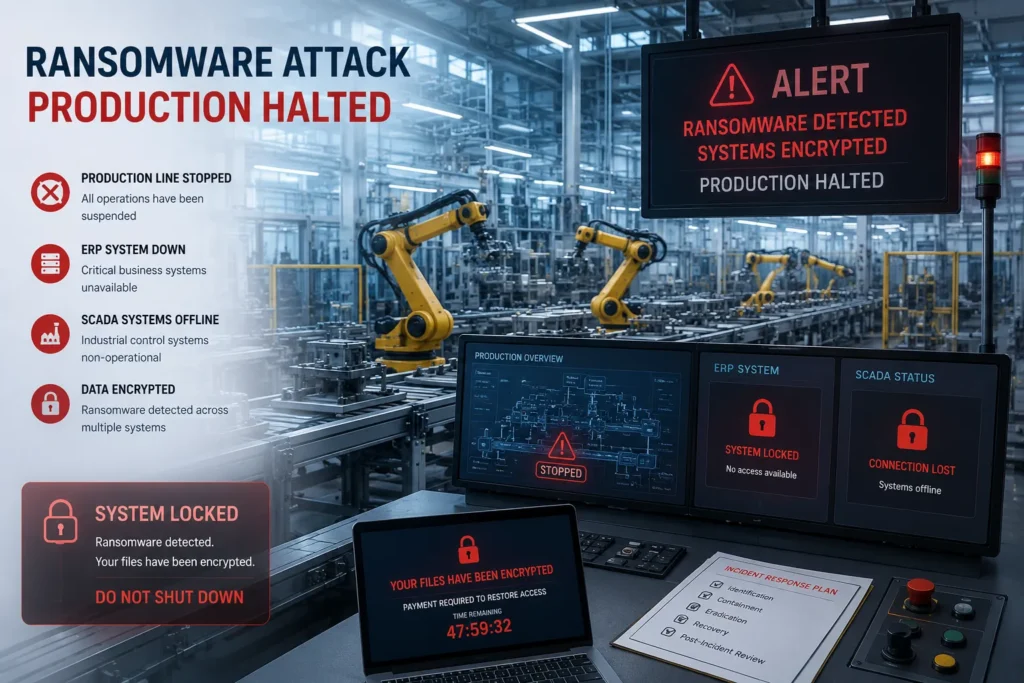
Manufacturing has ranked as the most ransomware-targeted sector for several consecutive years in industry threat-intelligence reporting. Ransomware operators deliberately target factories because production downtime creates immediate, measurable financial pressure that forces faster ransom decisions than in most other industries. A production line that generates thousands of dollars per hour cannot absorb days of downtime without significant consequence, and attackers price their demands accordingly. Understanding how manufacturing ransomware reaches the production floor is the first step to keeping it off.
Key Takeaways
- Manufacturing consistently ranks as the top ransomware-targeted sector globally, accounting for a disproportionate share of publicly reported incidents.
- The combination of IT and OT systems in modern factories means a ransomware attack that starts in corporate email can reach production control systems within hours.
- Production downtime costs are the primary leverage point. Ransomware operators calculate demands based on what a manufacturer cannot afford to lose in downtime, not the value of the encrypted data.
- Legacy OT systems with extended patch cycles and limited security monitoring create the dwell time that ransomware operators need to map the environment before deploying.
- Backup integrity, IT-OT segmentation, and tested recovery planning are the controls that determine whether an attack results in days of downtime or weeks.
Why Is Manufacturing the Most Targeted Sector?
Manufacturing organizations sit at an intersection of factors that make them consistently attractive to ransomware operators. They hold valuable intellectual property. They run production operations that cannot be easily paused. They often operate legacy OT systems that are difficult to patch and rarely monitored for security events. And they have grown increasingly connected, integrating ERP, MES, and supply chain systems in ways that create pathways between corporate IT and production floor networks.
The calculus for a ransomware operator targeting a manufacturer is direct. A factory running at capacity generates revenue by the hour. When production stops, so does that revenue, and the cost of downtime accumulates faster than in most enterprise environments. A manufacturer that produces $500,000 of product per day cannot absorb two weeks of production shutdown without consequences that far exceed most ransom demands. Attackers understand this and time deployments and set demands accordingly.
Publicly reported incidents across automotive, food processing, pharmaceutical, aerospace, and industrial equipment manufacturing have demonstrated the pattern repeatedly. The sector’s prominence in ransomware statistics is not a coincidence. It reflects a deliberate targeting strategy by organized criminal groups who have identified manufacturing as the environment where operational pressure translates most reliably into payment.
How Do Ransomware Attacks Reach Production Systems?
Initial Access Through Corporate IT
Most manufacturing ransomware attacks begin in corporate IT, not on the production floor. Phishing emails that harvest engineer or operations staff credentials, exploitation of unpatched VPN and remote access vulnerabilities, and compromise of managed service providers with access to manufacturer networks are the most common entry points. The initial access gives attackers a foothold in the corporate network that they then use to map the broader environment.
The mapping phase is where dwell time becomes critical. Ransomware operators that achieve initial access typically spend days to weeks exploring the network before deploying ransomware. They identify backup systems to encrypt or corrupt, locate domain administrator credentials that give them broad access, find the systems that operations depends on most, and position encrypted payloads to deploy simultaneously across the maximum number of critical systems.
Lateral Movement Into OT Networks
IT-OT convergence has created pathways between corporate networks and production floor systems that did not exist a decade ago. Historians that aggregate production data from SCADA systems, remote access solutions used by OT vendors and engineers, jump servers that bridge IT and OT networks, and ERP-MES integrations that pass production orders between systems all create potential lateral movement paths for an attacker who has established a foothold in corporate IT.
Once ransomware reaches OT systems, the operational impact escalates significantly. SCADA systems that cannot communicate with PLCs halt automated production processes. MES systems that cannot receive orders from ERP stop scheduling production runs. HMI workstations that are encrypted lose their interface with industrial equipment. The recovery of OT systems is typically slower and more complex than corporate IT recovery because OT environments are less standardized and OT vendors must often be involved in system restoration.
Direct OT Targeting
A smaller number of attacks target OT systems directly, exploiting vulnerabilities in industrial control systems, remote monitoring platforms, or OT-specific software. These attacks require more specialized knowledge than IT-focused ransomware but produce results that are specifically calibrated to maximize production impact. The Triton and EKANS malware families demonstrated that purpose-built industrial malware exists and is in active development by sophisticated threat actors.
What Is the Real Cost of a Manufacturing Ransomware Attack?
The ransom payment itself is typically the smallest component of the total cost. Production downtime at the manufacturer’s operating margins represents the largest category: days or weeks of lost output, missed customer deliveries, contract penalties, and expedited production costs when operations resume. These losses frequently exceed the ransom demand by multiples.
Recovery costs are substantial even when backups exist. Rebuilding domain infrastructure, restoring systems from clean backups, recertifying OT systems before returning them to production, and engaging forensic investigators to establish the scope of the compromise and the integrity of recovered systems all add cost and time. For manufacturers with safety-critical OT systems, returning to production requires validation that no persistent access or configuration changes remain.
The supply chain impact compounds internal costs. Customers who depend on the manufacturer for components or finished goods face their own production disruptions when deliveries stop. Contract penalties, expedited sourcing from alternative suppliers, and relationship damage are consequences that extend the financial impact of the attack beyond the manufacturer’s own operations.
What Controls Make the Critical Difference?
Backup integrity and isolation are the single most important determinant of recovery time. Backups that are connected to the network that ransomware encrypts are themselves at risk of encryption or corruption. Isolated, regularly tested backups that can be verified clean and restored without restoring the compromise are what separate manufacturers who recover in days from those who recover in weeks.
IT-OT network segmentation limits lateral movement between corporate IT and production floor systems. A properly segmented OT network that cannot be reached from corporate email infrastructure by a ransomware payload limits the blast radius of an IT-originating attack. Segmentation must be verified, not assumed. Many manufacturers believe their IT and OT networks are more separated than a network assessment finds them to be.
Privileged access management reduces the credential leverage that ransomware operators need to move laterally and deploy broadly. Domain administrator credentials obtained through an initial phishing compromise give attackers the access they need to deploy across an entire Windows environment simultaneously. Protecting those credentials through privileged access management limits what an attacker can do with any single compromised account.
Monitored incident detection shortens dwell time. A ransomware operator who achieves initial access and begins mapping a network leaves signals that endpoint detection and response tools can identify before the ransomware deployment phase. The difference between a detected intrusion at the reconnaissance phase and an undetected intrusion that reaches deployment is often the difference between a contained incident and a full production shutdown.
How Does Armour Cybersecurity Help Manufacturers Prepare?
Armour Cybersecurity’s manufacturing cybersecurity services address ransomware risk across the controls that matter most: backup integrity and isolation assessment, IT-OT segmentation review, privileged access controls, endpoint detection and response on both IT and OT-adjacent systems, and a tested incident response plan that includes production recovery scenarios. The programme is built around operational realities, not enterprise IT assumptions.
Ransomware tabletop exercises test leadership and operations teams against realistic production-impacting scenarios before an incident occurs. The exercise identifies gaps in decision-making, communication, and recovery procedures that paper-based plans do not reveal. Manufacturers who have run through a ransomware response exercise before an attack are measurably better positioned to make the right decisions under real pressure.
Across the 260+ organizations Armour Cybersecurity protects in 52+ industries, the manufacturers who turn a ransomware hit into a bad week rather than a lost quarter are not the ones who were never breached. They are the ones who assumed they would be: backups isolated and restore-tested so encryption is an inconvenience rather than a catastrophe, IT and OT actually segmented and not just believed to be, privileged credentials locked down so one phished password cannot become domain-wide deployment, and a response plan rehearsed against a real production-down scenario, so when the alert fires the team executes instead of improvising.
Frequently Asked Questions
Should we pay the ransom if we are hit?
Ransom payment is a business decision with legal, insurance, and ethical dimensions that require legal counsel and your cyber insurer before a decision is made. From a technical perspective, payment does not guarantee working decryption keys, does not remove persistent access, and does not prevent a second attack from the same group. Manufacturers who have isolated clean backups and a tested recovery plan have a realistic alternative to payment. Those without them face a different calculation. The best time to build that alternative is before an attack, not during one.
How long does production downtime typically last after a ransomware attack?
Industry data from publicly reported manufacturing incidents suggests that production downtime ranges from several days for manufacturers with strong backup and recovery capabilities to several weeks for those without. The key variables are backup integrity and isolation, the extent to which OT systems were affected, and whether the incident response team was engaged early enough to limit spread. Manufacturers with tested recovery plans and isolated backups consistently recover faster.
What is the difference between IT and OT recovery timelines?
Corporate IT systems, servers, endpoints, and email infrastructure, can often be rebuilt from clean backups within days using standard enterprise recovery procedures. OT systems are more complex. PLCs, SCADA servers, and HMI workstations often run proprietary software that requires vendor involvement to restore. Safety systems may require recertification before returning to production. OT recovery timelines that are not planned and tested before an incident are often significantly longer than operations teams expect.
Our manufacturer is mid-size. Are we really a target?
Ransomware operators explicitly target mid-size manufacturers. Large manufacturers are high-value but have more mature security programmes and incident response capabilities. Very small operations may not justify the effort. Mid-size manufacturers, particularly those in automotive, aerospace, food processing, and industrial supply chains, represent an attractive combination of meaningful ransom potential and recoverable security investment. The sector targeting data confirms this: mid-market manufacturers are well represented in incident statistics.
The Bottom Line
Manufacturing sits at the top of the ransomware target list because the math favours the attacker: a stopped line burns revenue by the hour, so the pressure to pay builds faster than almost anywhere else. The attack usually starts in corporate email, not on the floor, then rides IT-OT convergence, through historians, jump servers, and ERP-MES links, into the SCADA, PLC, and HMI systems that run production, where recovery is slowest. The ransom is the small number; downtime, OT restoration, and supply chain penalties are the large ones. What decides whether an attack costs days or weeks is not luck, it is preparation: isolated and restore-tested backups, verified IT-OT segmentation, privileged access control, monitored detection that shortens dwell time, and a response plan rehearsed against a real production-down scenario. Armour Cybersecurity helps manufacturers build manufacturing cybersecurity services around those controls, so a production-floor ransomware attack becomes a contained incident the business recovers from, not the event that defines its year.
About the author
David Chernitzky is the CEO and Co-Founder of Armour Cybersecurity, a Toronto-based firm that protects organizations across North America from advanced cyber threats. He brings more than 25 years of cybersecurity and military cyber intelligence experience, having served as an officer in an elite technology unit before co-founding Armour. Armour’s team of military-intelligence veterans and senior advisors serves 260+ clients across 52+ industries with a 97% client retention rate. Learn more about Armour Cybersecurity.