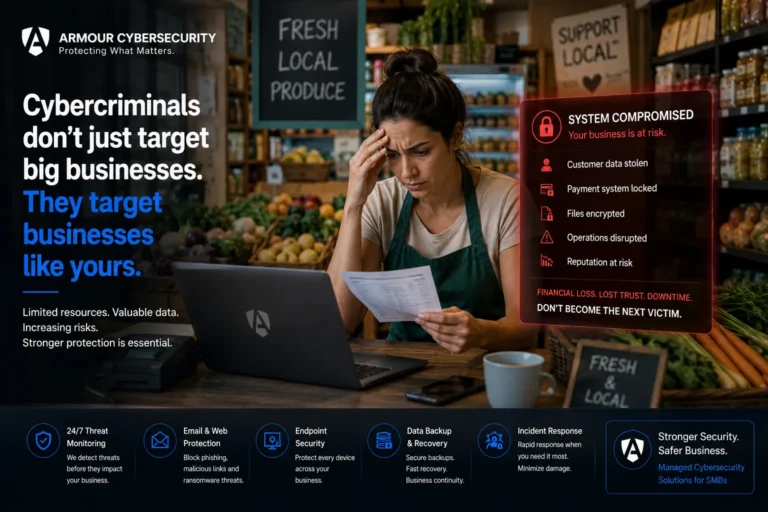
It’s a Tuesday morning. One of your staff opens an email that looks like it’s from your bank. They click the link. They enter their credentials.
By the time anyone realises what’s happened, an attacker has been inside your systems for three days.
You call your IT person. They’re great at keeping the laptops running and fixing Wi-Fi issues — but this? This is a different conversation entirely. Nobody knows who to call, what to lock down first, or what to tell your clients. Every decision is improvised. Every hour costs you more.
Now ask yourself honestly: does your business have someone whose job it is to prevent exactly this — and to lead the response when it happens anyway?
For most small and medium businesses, the answer is no. And that gap — between having IT support and having genuine security leadership — is where breaches happen.
For many growing businesses, vCISO services provide the security leadership needed to reduce risk without hiring a full-time executive.
That’s the problem a vCISO solves.
So What Exactly Is a vCISO?
A vCISO — or Virtual Chief Information Security Officer — is a senior cybersecurity leader who works with your business on a part-time or fractional basis, rather than as a full-time employee.
Think of them as your Head of Cybersecurity, just without the full-time salary, the benefits package, and the six-month hiring process.
Large enterprises have had CISOs for decades. These are the executives responsible for the organisation’s entire security posture — the strategy, the policies, the risk decisions, the board reporting, the incident response. They sit at the leadership table and make sure security isn’t just an IT problem, but a business priority.
The issue? A qualified, experienced CISO typically costs anywhere from £120,000 to £200,000+ per year in salary alone. For a business with 20, 50, or even 150 employees, that’s not a realistic hire.
A vCISO gives you that same level of expertise and leadership — without the full-time cost. They typically work with you on a retained basis: a set number of hours per month, a consistent point of contact, and a long-term relationship focused on actually improving your security over time.
“But We Have an IT Person / MSP. Isn’t That Enough?”
This is the most common question — and it’s a fair one.
Here’s the honest answer: your IT team and your MSP are invaluable. But their job is to keep things running. Servers up. Emails flowing. Laptops working. Updates deployed. That’s operations, and it’s essential.
A vCISO does something different. They focus on security leadership — the strategic, governance, and behavioural layer that IT operations doesn’t cover.
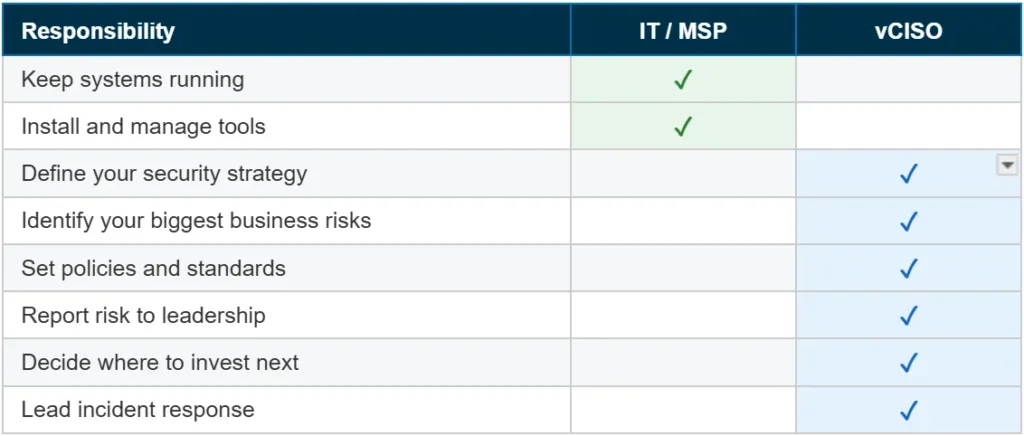
The relationship works best when both exist. Your MSP executes the technical tasks. Your vCISO decides what needs to be done and why, and holds the overall security programme accountable.
The Real Risk Isn’t What You Think
Here’s something most businesses get wrong about cybersecurity: the biggest threat isn’t a sophisticated hacker targeting you specifically.
It’s your staff. It’s the small decisions made every single day without any security guidance.
Does any of this sound familiar?
- Someone shares the admin login for your accounting software over WhatsApp “just for now”
- A team member signs up for a new AI tool and pastes client data into it to save time
- A former employee still has access to your shared drives three months after they left
- Your operations manager uses the same password for their work email and your CRM
- A new hire was given access to everything on day one “so they could get started quickly”
None of these feel like security incidents. They feel like normal, practical decisions made by busy people trying to get their work done. But together, they create exactly the conditions where a single phishing email or compromised account becomes a serious breach.
A vCISO’s job is to fix the environment that allows these habits to form — not by making life difficult for your staff, but by building simple rules, clear processes, and a culture where good security becomes part of how people work.
What a vCISO Actually Does Day to Day
Let’s make this concrete. Here’s what a vCISO engagement typically looks like for an SMB.
Month 1–2: Understand Before Advising
A good vCISO doesn’t arrive with a list of tools to sell you. They start by understanding your business — how you operate, where your data lives, what systems your staff use, what’s already in place, and where the real risks are.
This usually involves reviewing your current tools and access controls, talking to key people across IT, finance, operations, and leadership, and mapping out your biggest vulnerabilities — not in technical jargon, but in terms a business owner can understand.The output is a prioritised security roadmap: a clear, plain-language plan for the next 6 to 12 months that focuses on the highest-impact improvements first.
The First Wins: Fix the Basics That Matter Most
Before anything complex, a vCISO typically tackles the high-impact, low-cost changes that dramatically reduce your exposure:
MULTI-FACTOR AUTHENTICATION (MFA)
Turning it on for email, remote access, and admin accounts. One of the single most effective protections available, and largely free within tools you already use.
PASSWORD MANAGEMENT
Replacing shared logins, spreadsheet-stored passwords, and sticky notes with a business password manager. Every account gets a strong, unique password and nobody needs to know anyone else’s credentials.
ACCESS CONTROLS
Making sure people can only access what they actually need for their role — and more importantly, making sure access is removed the day someone leaves.
ENDPOINT SECURITY PROTECTION
A vCISO will also assess whether your business has effective endpoint security protection in place across laptops, desktops, and other work devices. This helps detect malware, reduce ransomware risk, and prevent poorly secured endpoints from becoming an easy entry point for attackers.
A SIMPLE “DO AND DON’T” GUIDE
A one-page reference for staff covering how to use email, AI tools, cloud storage, and personal devices safely. Not a 40-page policy nobody reads. One page. Clear. Practical.
Building the Structure: Governance Without the Bureaucracy
Once the basics are solid, a vCISO introduces lightweight governance — just enough structure to make your security consistent and defensible.
This means short, realistic security policies that people can actually follow. Clear procedures for onboarding new staff, offboarding leavers, and responding to a suspected incident. A vCISO also helps businesses prepare for cyber incident response by defining roles, escalation paths, and recovery priorities before a security event disrupts operations. A defined process for approving new software or cloud tools before they connect to company data.
It also means regular reporting to your leadership team — not a wall of technical data, but a clear picture of your current risk level, what’s improved, and what still needs attention. Security stops being invisible until something goes wrong, and becomes a visible, managed part of running the business.
The Long Game: Culture Change
The most valuable thing a vCISO does over time is shift how your people think about security.
Not through fear. Not through lengthy mandatory training that everyone rushes through. Through short, practical sessions. Through realistic scenarios that make the risk feel real. Through making it easy to report something suspicious without embarrassment.When that shift happens — when your team goes from “security is IT’s problem” to “this is part of how I work” — your entire risk profile changes.
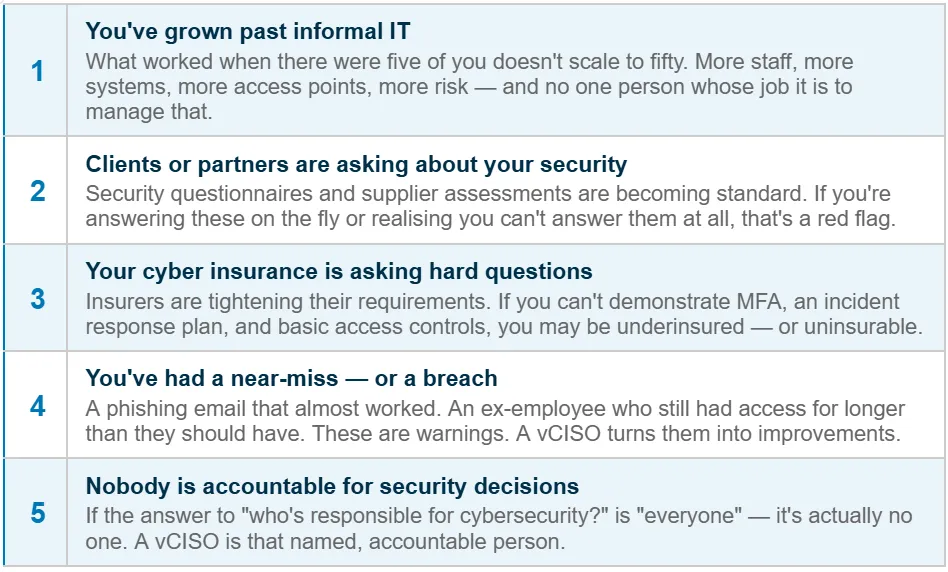
The Five Signs Your Business Needs a vCISO
You don’t need to wait for an incident to know this is the right move. Here are five clear signals:
What Does a vCISO Cost?
The economics are straightforward.
- A full-time in-house CISO: £120,000–£200,000+ per year in salary, before benefits, tax, and recruitment costs.
- A vCISO engagement for an SMB: typically £2,000–£6,000 per month depending on hours and complexity — giving you senior security leadership at a fraction of the cost.
For most small and medium businesses, that’s not just affordable — it’s the only realistic way to get this level of expertise. And when you consider the average cost of a data breach for an SMB (frequently cited above £3 million when you factor in downtime, remediation, regulatory fines, and reputational damage), a vCISO is one of the most cost-effective investments a growing business can make.
What “Good Enough” Actually Looks Like
Here’s the reassuring part: you don’t need the security programme of a FTSE 100 company. A solid baseline for an SMB looks like this:
- MFA enabled on every critical system
- A password manager in use across the business, with no uncontrolled shared accounts
- Clear, consistent processes for when people join and leave
- A basic incident response plan that’s been tested, even informally
- Short, understandable policies that people have actually read
- Regular security updates to leadership that make risk visible
- Staff who know to pause, verify, and report when something looks off
That level of security won’t make you invincible. But it will mean you’re dramatically harder to attack than the average SMB — and far better placed to recover if something does happen.
The Bottom Line
Cybersecurity isn’t a technology problem. It’s a leadership problem.
You can have the best firewall, the most advanced endpoint protection, and a state-of-the-art email filtering system — and still be breached because someone shared a password, clicked a link, or gave a former employee access they shouldn’t have had.
What changes that isn’t another tool. It’s having someone in your corner whose entire focus is on building a security programme that fits your business, your people, and your risk profile — and who stays accountable for making it better over time.
That’s what a vCISO is. Not a contractor who delivers a report and disappears. Not a vendor trying to sell you software. A security leader, working alongside you, making sure that when Tuesday morning comes and something goes wrong, you’re not improvising.
You’re ready.