What to Do When a Vendor Is Breached: A Business Owner’s Response Guide
Aug 18, 2026
When a vendor is breached, the clock starts before you know whether you are affected. This guide walks through vendor breach response...


Supply chain attacks have surged in recent years, and your security posture is now only as strong as your weakest vendor. Armour Cybersecurity builds the third-party risk management program that gives you a defensible answer to one question: which of our suppliers could take us down, and what are we doing about it? Vendor inventory, risk-based tiering, security assessments, contractual safeguards, and continuous monitoring delivered as one coordinated program.
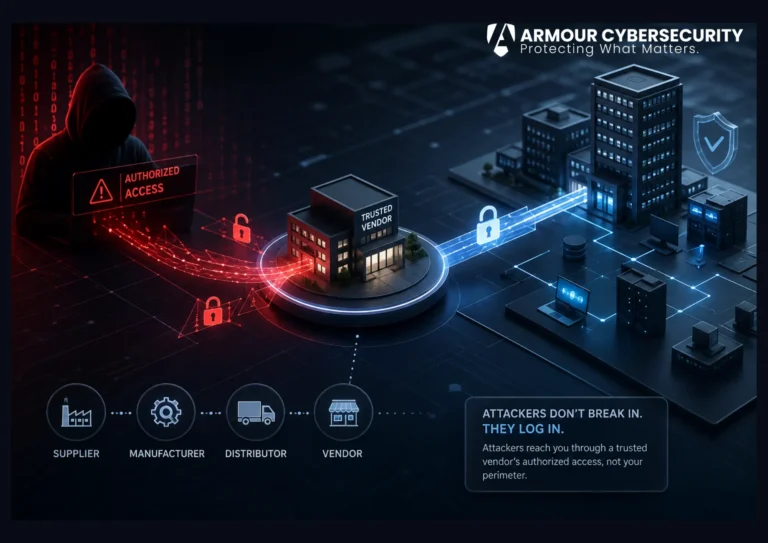
Supplier Risk Management is the structured discipline of identifying, assessing, and continuously managing the cybersecurity risks your third-party ecosystem introduces. Vendors with access to your data, your systems, or your customers become extensions of your attack surface. When one of them is compromised, the impact lands on you.
Armour Cybersecurity builds the framework that makes this manageable. We start with vendor discovery and criticality tiering so the program focuses attention where it matters, design security assessment questionnaires calibrated to vendor risk tier, review contractual security obligations, recommend continuous monitoring tooling, and define incident response protocols for critical vendors so coordination is pre-arranged rather than improvised during a crisis.
Every engagement is delivered against industry-recognized standards including NIST SP 800-161, ISO 27036, SOC 2, and the Standardized Information Gathering (SIG) questionnaire. The output is a sustainable third-party risk management program that scales with your vendor ecosystem and produces audit-ready evidence for regulators, customers, and the board.
You can lock down your environment perfectly and still get breached through a vendor. Most organizations have no structured way to evaluate, monitor, or respond to the risks their suppliers carry.
Engage individual services or a coordinated program build. Every service is delivered against the same standardized methodology so deliverables compose cleanly into a unified supplier risk function.
Structured inventory of every vendor, supplier, and partner with access to your data, systems, customers, or facilities. Documented data flows, system access scope, and business dependency for each.
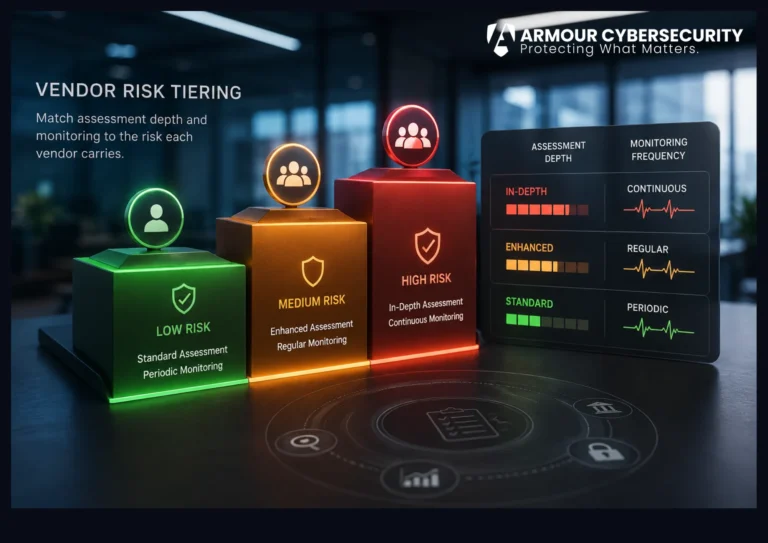
Risk-based tiering matrix that classifies vendors by data sensitivity, system access, business criticality, and replacement difficulty. Drives the depth and cadence of every subsequent control.
Documented framework covering assessment methodology, scoring criteria, risk acceptance thresholds, and remediation expectations. Aligned to NIST SP 800-161 and ISO 27036.
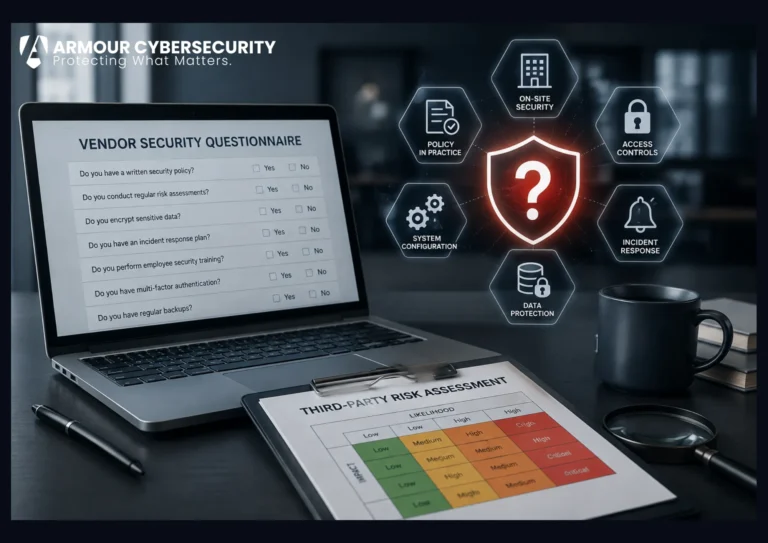
Tier-appropriate assessment questionnaires drawing on the SIG framework, customized to your industry and the specific risks each vendor tier introduces. Designed for sustainable repeat use.
Living register documenting every vendor's risk score, identified findings, remediation status, residual risk, and review cadence. Maintained for ongoing executive and audit visibility.
Review of existing vendor contracts for security clauses and gaps. Recommended language for new contracts covering breach notification, audit rights, data handling, and minimum control requirements.
Recommendations for ongoing monitoring of vendor security posture including ratings services, certification monitoring, and threat intelligence specific to your vendor ecosystem.
Pre-arranged incident response coordination procedures with critical vendors. Communication channels, escalation paths, evidence handling, and joint response playbooks defined before they are needed.
Executive summary and dashboard translating supplier risk posture into business language for board, audit committee, and procurement leadership consumption.
Procurement leaders and risk officers needing a structured, defensible framework for evaluating vendors before contract signature and managing them throughout the relationship.
Organizations preparing for SOC 2, ISO 27001, HIPAA, PCI DSS, or CMMC certification where third-party risk management is an explicit control requirement that auditors will evaluate.
Financial services, healthcare, energy, and government supply chain participants operating under regulatory obligations that specifically require documented third-party risk management.
Organizations that experienced a breach, outage, or data exposure through a vendor and need to rebuild their third-party risk discipline with structured remediation across the supplier ecosystem.
Every Armour Cybersecurity Supplier Risk Management engagement follows the same standardized phases. The discipline is what produces a program that scales with your vendor ecosystem and survives leadership changes.
Structured discovery of every vendor, supplier, and partner with access to your data, systems, or customers. Documented data flows, system access scope, business dependency, and current contractual status for each.
Tier-based classification of vendors using documented criteria including data sensitivity, system access depth, business criticality, replacement difficulty, and regulatory exposure. Tiering drives every subsequent control depth and cadence.
Risk assessment framework documented with scoring methodology, acceptance thresholds, and remediation expectations. Tier-appropriate assessment questionnaires designed for sustainable repeated use across the vendor ecosystem.
Administration of security assessment questionnaires to vendors, evidence review, control validation, and follow-up clarification where responses are unclear. Findings documented with severity and remediation recommendations.
Review of existing vendor contracts for security clauses, drafting of standard security language for future contracts, continuous monitoring recommendations sized to the ecosystem, and incident response protocol design for critical vendors.
Executive summary, vendor risk register, board-ready dashboard, and program documentation. Handoff to your procurement and security teams with the playbooks needed to operate the program independently.
Every deliverable is structured for direct use by procurement, security, legal, and executive leadership, with audit-ready format for regulators and certification assessors.
Documented framework covering assessment methodology, scoring criteria, risk acceptance thresholds, and remediation expectations across the vendor ecosystem.
Tier definitions with scoring criteria and assignment logic, applied across your vendor inventory to drive subsequent control depth and assessment cadence.
Tier-appropriate questionnaire templates drawn from the SIG framework and customized to your industry, designed for sustainable repeated use rather than one-off deployment.
Living register documenting each vendor's risk score, findings, remediation status, residual risk, and review cadence. Built for ongoing executive and audit visibility.
Recommended contract language covering breach notification, audit rights, data handling obligations, minimum control requirements, and exit and data return provisions.
Sized recommendations for ongoing vendor monitoring including ratings services, certification tracking, and threat intelligence specific to your supplier ecosystem.
Pre-arranged incident response coordination procedures with critical vendors covering communication, escalation, evidence handling, and joint response playbooks.
Board-ready summary and visual dashboard translating supplier risk posture into business language for executive, audit committee, and procurement leadership consumption.
Documentation, runbooks, and team training materials needed for your procurement and security teams to operate the program independently after the engagement.
Founded by military intelligence veterans with senior advisors from PwC, KPMG, Deloitte, EY, and Mandiant. The track record reflects the discipline.
Organizations across finance, healthcare, technology, energy, legal, and government trust Armour Cybersecurity to protect what matters.
Long-term engagements built on consistent quality, predictable delivery, and consulting relationships that compound in value over time.
Cross-sector experience spanning every major regulated industry, with operations supporting clients across North America, Latin America, and beyond.
A vetted catalogue of technology partnerships and proprietary methods deployed in support of every engagement.
Schedule a no-obligation Supplier Risk Management scoping conversation with our advisory team.
Schedule a Supplier Risk ConsultationTell us about your vendor ecosystem and what is driving the conversation. We will respond within one business day with next steps.