Quick answer: Small businesses are targeted by cybercriminals because they hold valuable data, process payments, and connect to larger supply chains, while operating with fewer security controls than enterprises. Attackers treat them as low-effort, high-reward opportunities.
Key Takeaways
- 60% of small businesses close within six months of a significant cyberattack, according to industry reporting.
- Attackers target SMBs precisely because security is assumed to be weaker than at large companies.
- The most common entry points are phishing emails, unpatched software, and weak passwords.
- Most SMBs have no incident response plan, which turns a containable breach into a catastrophic one.
- Managed cybersecurity services give SMBs enterprise-level protection without requiring an in-house security team. Investing in cybersecurity for small business is now more accessible than ever.
Do Cybercriminals Actually Target Small Businesses?
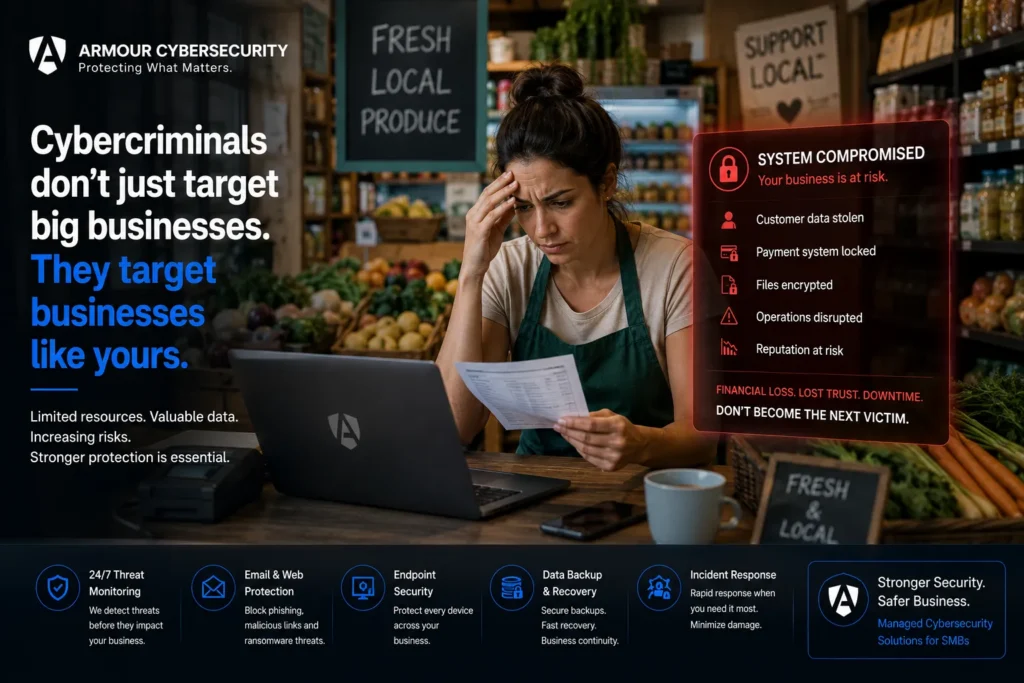
The short answer is yes, and more than most owners expect. The common assumption is that hackers focus on large corporations because that is where the money is. The reality is more nuanced, and for SMBs, significantly more dangerous.
Attackers weigh effort against reward. A large bank is a high-reward target, but it also has a 24/7 security operations center, a dedicated threat intelligence team, and incident response lawyers on retainer. A regional accounting firm with 30 employees has client financial records, payment credentials, and access to dozens of other organizations through its supply chain relationships. And it probably has none of the defenses the bank does.
According to Verizon’s annual Data Breach Investigations Report, small businesses consistently account for the majority of breach victims. The volume is high because the barriers are low. Attackers run automated scans across millions of IP addresses looking for unpatched systems, exposed remote desktop ports, and misconfigured cloud storage buckets. SMBs appear in those scans constantly.
What Makes Small Businesses Attractive to Attackers?
Three factors make SMBs stand out as targets: the data they hold, the access they provide, and the defenses they lack.
Valuable data at low cost to steal
SMBs in professional services, healthcare, financial advice, and legal work hold exactly the kind of data that sells on the dark web and powers further attacks. Client names, social security numbers, payment card data, tax records, and confidential business information all have established market value. Stealing that data from an SMB with default security settings takes far less effort than targeting a regulated financial institution with mandatory security controls. A single data breach at this scale can expose thousands of records before anyone notices.
Supply chain access
Many SMBs have trusted relationships with larger organizations. A managed IT provider with access to 50 client networks is a far more efficient target than attacking each client individually. The 2020 SolarWinds attack demonstrated this at scale, but the same logic applies to every accountant, law firm, or technology vendor with network access to clients larger than themselves.
Security gaps that attackers count on
Default configurations on firewalls and email systems. Antivirus software installed once and never updated. IT responsibilities split across staff members whose actual job is something else. No monitoring after business hours, which is precisely when automated attacks execute. Attackers do not need to be sophisticated to succeed in this environment. They just need to be persistent, and they are.
What Are the Most Common SMB Cybersecurity Threats?
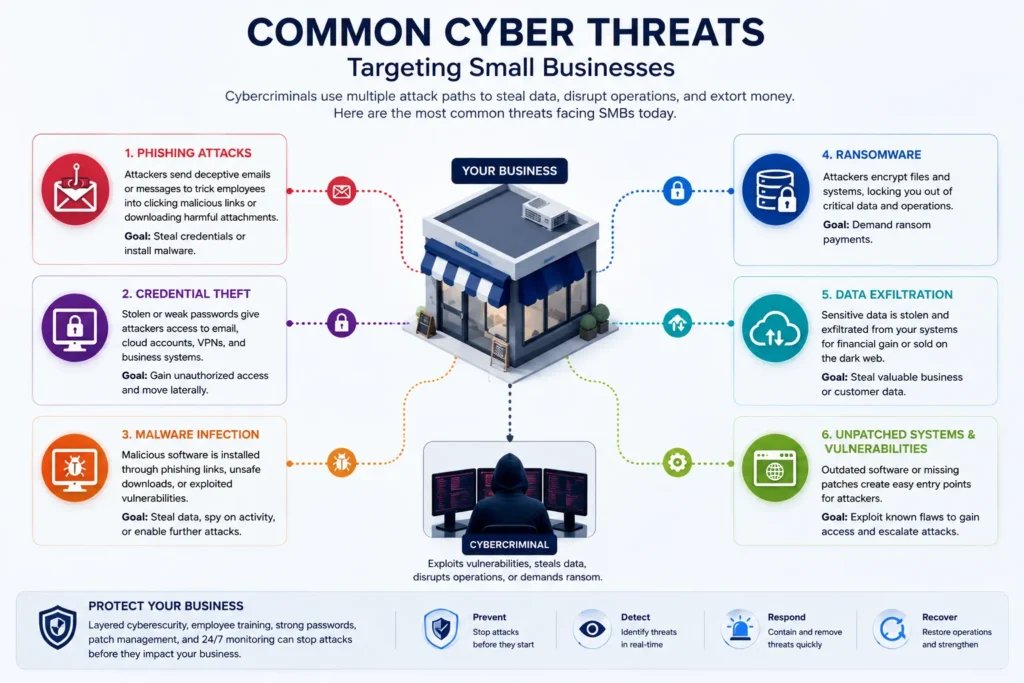
The threat landscape for SMBs is not exotic. The attacks that cause the most damage are well-understood, preventable with proper controls, and alarmingly effective against businesses that have not invested in baseline protections.
Phishing and business email compromise
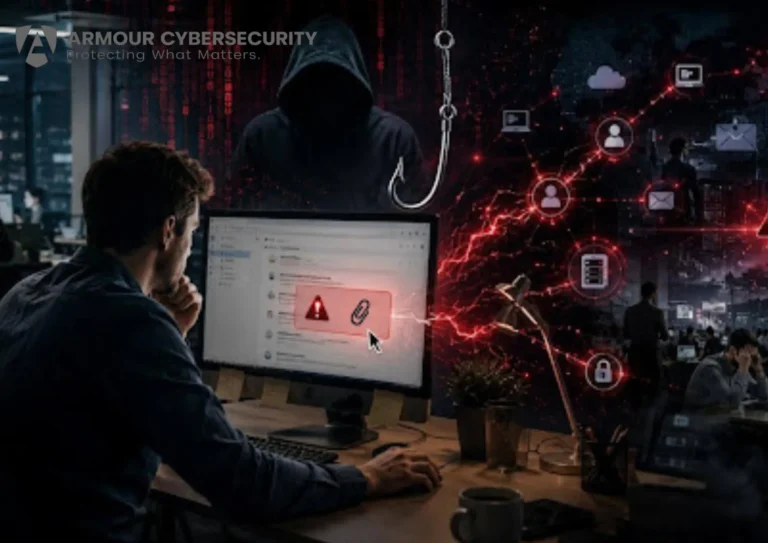
Phishing remains the leading cause of breaches for businesses of every size, but SMBs are particularly exposed because most have no formal security awareness training program. An employee who clicks a convincing invoice attachment or responds to a spoofed email from their CEO requesting a wire transfer can trigger a breach that costs tens of thousands of dollars to resolve. Business email compromise, where attackers take over or convincingly spoof executive email accounts, caused over $2.9 billion in losses in a single year according to FBI reporting.
Ransomware
Ransomware attacks encrypt business files and demand payment for the decryption key. For an SMB without tested backups and an incident response plan, a ransomware infection can mean days or weeks of downtime, ransom payments ranging from thousands to hundreds of thousands of dollars, and potential permanent data loss. Attackers increasingly combine encryption with data theft, threatening to publish stolen information publicly if the ransom is not paid.
Credential theft and account takeover
Reused passwords, absence of multi-factor authentication, and employees who have never been trained to recognize suspicious login requests make credential theft straightforward. Once an attacker has valid credentials for a business email account or cloud service, they can access everything that account touches, including file storage, financial systems, and client data.
How Much Does a Small Business Data Breach Actually Cost?
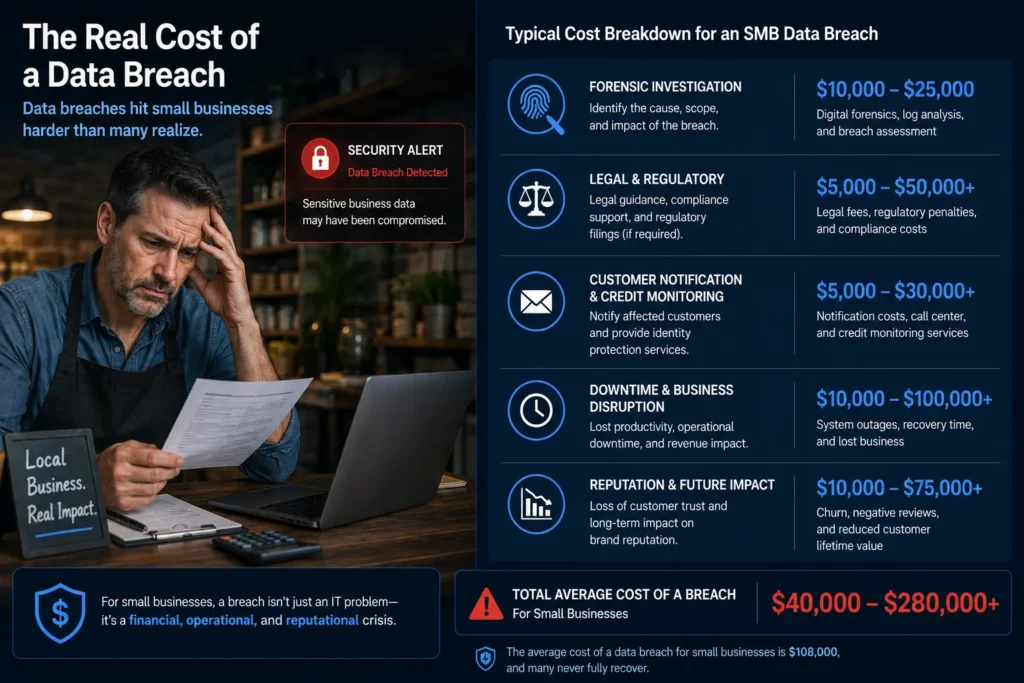
The financial impact of a breach on a small business goes well beyond any immediate ransom payment or stolen funds. IBM’s Cost of a Data Breach Report puts the average total cost of a small business data breach for organizations with fewer than 500 employees at over $3 million. That figure includes:
- Forensic investigation to determine what was accessed and how.
- Legal counsel for breach notification and regulatory compliance.
- Mandatory breach notifications to affected clients and regulators.
- Regulatory fines where applicable, including under HIPAA, PCI DSS, or state and provincial privacy laws.
- Reputational damage and lost business from clients who leave after a breach.
- Operational downtime while systems are restored.
For many SMBs, a single significant breach represents an existential financial event. The business never recovers.
Managed Cybersecurity for Small Businesses: Closing the Gap
Small businesses can defend against these threats, but not with the approaches most are currently using. The gap between what a threat actor needs to exploit an SMB and what the average SMB has in place as defenses is wide. Closing that gap does not require building an in-house security team. It requires getting the right controls deployed, configured, and monitored by people who do this full time.
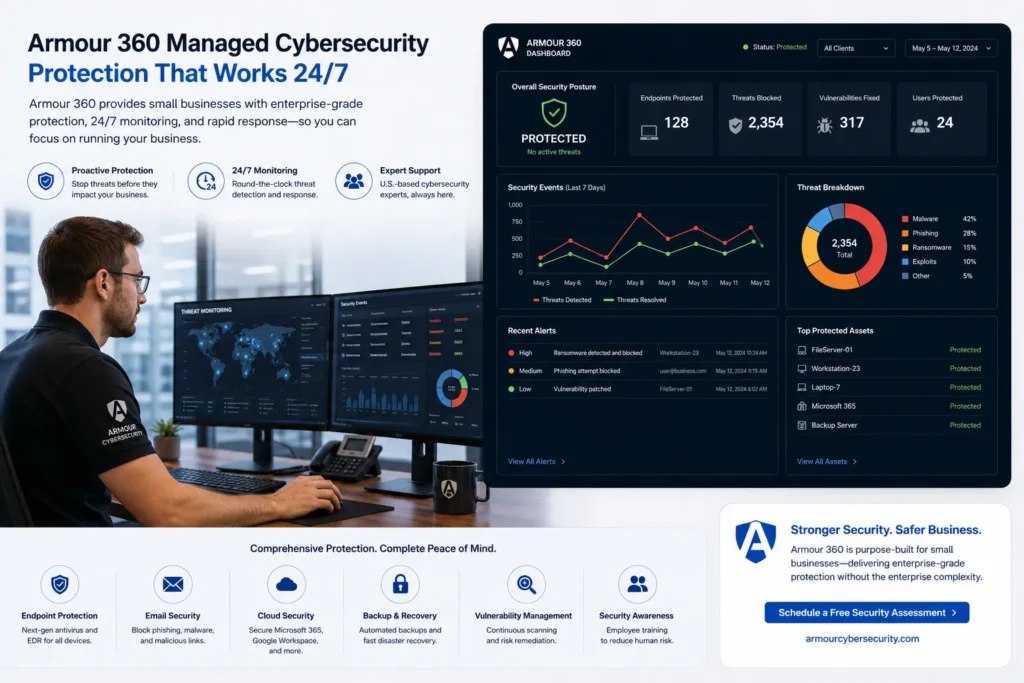
The most effective approach for most SMBs is a managed cybersecurity program that covers endpoint protection, email security, network monitoring, vulnerability management, and security awareness training under one coordinated service. That is what Armour 360 was built to deliver. With small business cybersecurity built into a single coordinated program, Armour 360 operates as the security team your business needs, available 24/7, at a cost that makes sense for organizations that are not enterprises.
The goal is not to make your business impenetrable. The goal is to make it a harder target than the next one, with the detection and response capability to limit damage when something gets through.
Your business holds data worth stealing. The only question is whether you find out from your security team or from an attacker. Armour 360 gives small businesses the 24/7 protection, monitoring, and response that closes the gap between what attackers expect and what they find.
Protect Your Business with Armour 360
Contact the Armour Cybersecurity team at armourcyber.io/armour-360 to identify the right coverage level for your organization.
Frequently Asked Questions
Are small businesses really at risk, or is cybersecurity mostly a concern for large companies?
Small businesses are at significant risk. They account for the majority of breach victims in annual industry reports, primarily because they hold valuable data and operate with fewer defenses than enterprises. Attackers target SMBs precisely because the effort-to-reward ratio is favorable.
What is the most common way small businesses get breached?
Phishing emails are the most common entry point. An employee clicking a malicious link or attachment, or responding to a fraudulent email request, gives attackers the foothold they need. Unpatched software and weak or reused passwords are close seconds.
What happens if a small business gets hit by ransomware?
Without tested backups and an incident response plan, a ransomware attack typically means days or weeks of downtime, a ransom demand, and potential permanent loss of data. Businesses with managed cybersecurity in place can contain the incident faster and recover without paying the ransom in most cases.
How does managed cybersecurity help prevent attacks on small businesses?
A managed cybersecurity program deploys and monitors the controls that close the most common attack paths: endpoint protection that blocks malware, email security that filters phishing, network monitoring that detects intrusions, and awareness training that makes employees harder to fool. The 24/7 monitoring component means threats are caught and contained rather than discovered the next morning after damage is done.
How much does managed cybersecurity cost for a small business?
Pricing varies by provider and scope, but managed cybersecurity is designed to cost less than the breach it prevents. Armour 360 packages are structured for SMBs with 10 to several hundred employees, with options that scale to the organization’s size and risk profile. A consultation with the Armour Cybersecurity team will identify the right coverage level for your business.
About David Chernitzky
David Chernitzky brings over 25 years of deep cybersecurity and military cyber intelligence experience, with a career rooted in strategic risk management and protecting critical systems against advanced threats. As CEO and Co-Founder of Armour Cybersecurity, he combines strategic vision with hands-on expertise to deliver practical, high-impact cyber defense solutions.