A cyberattack does not announce itself with clear warning and adequate preparation time. It arrives in the middle of the night, on a Friday before a long weekend, or in the middle of a critical business period. The organizations that limit breach damage are the ones that have either pre-established a relationship with an expert response team or can reach one quickly when the incident begins. The organizations that suffer the worst outcomes are the ones figuring out who to call while the attack is still progressing.
Armour Cybersecurity’s breach response services provide immediate, expert-led incident response services for organizations experiencing active cyberattack. This article explains what effective breach response looks like, what to expect from a professional response engagement, and how to ensure your organization can access the support it needs before an incident occurs.
The First Hours of a Breach: Why Speed Matters
Attackers who have gained access to an environment have a narrow window of maximum advantage: the period before the defender is aware of their presence. During that window, they establish persistence, expand access, exfiltrate data, and position themselves to execute the final stage of their attack, deploying ransomware, destroying backups, or preparing to leverage access for further compromise.
Every hour that passes between initial compromise and detection is an hour in which the attacker is expanding their foothold. Every hour between detection and effective containment is an hour in which damage is accumulating. The organizations that minimize breach impact are those that compress both intervals as aggressively as possible, which requires either exceptional internal capability or an expert response partner who can be engaged immediately.
What Armour Cybersecurity Breach Response Services Cover
Initial Triage and Scope Assessment
The response engagement begins with an immediate triage as part of an emergency incident response process designed to understand the nature and scope of the incident. What systems are affected? What access has the attacker established? What is the current threat trajectory, is the attack ongoing, is there evidence of exfiltration, has ransomware been deployed? The triage findings drive the containment strategy and determine the urgency and nature of the actions required in the first hours of the response.
Containment and Isolation
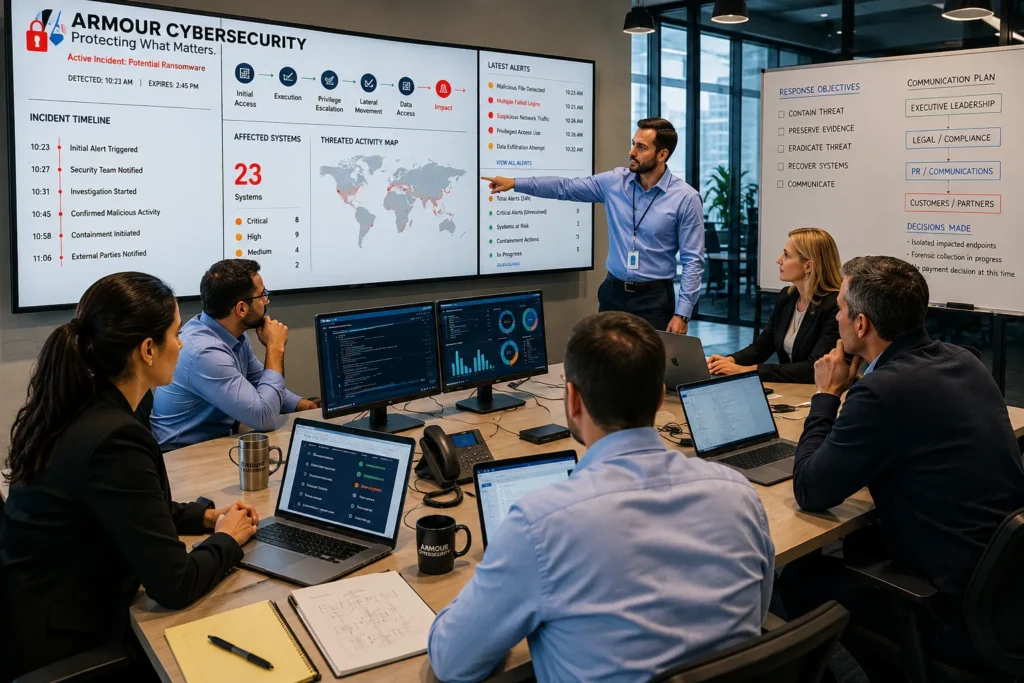
Containment is the most time-critical phase of cyber breach response, where immediate action limits attacker movement and business disruption. The objective is to stop the attacker from expanding their access and executing the most damaging stages of their attack plan, while preserving enough operational capability to maintain business continuity. Armour Cybersecurity response specialists work with your team to implement targeted containment actions, network isolation, account suspension, traffic redirection, firewall modifications, that limit attacker movement without creating more collateral disruption than the incident itself requires.
Evidence Preservation
Every action taken during breach response has the potential to affect the evidentiary record that will be required for forensic investigation, regulatory reporting, insurance claims, and potential legal proceedings. Armour Cybersecurity response specialists are trained to preserve forensic evidence as a first-order priority, ensuring that containment actions do not destroy the evidence needed to understand what happened, who was affected, and what obligations follow from the incident.
Parallel Investigation
While containment is underway, the investigation phase begins in parallel: collecting and preserving logs, analyzing indicators of compromise, tracing the attacker’s path through the environment, and identifying the initial access vector. The investigation is not a post-incident exercise, it is a concurrent process that informs containment decisions, identifies systems and accounts that may be compromised but have not yet shown obvious indicators, and generates the evidence needed for regulatory notification decisions.
Stakeholder Communication Support
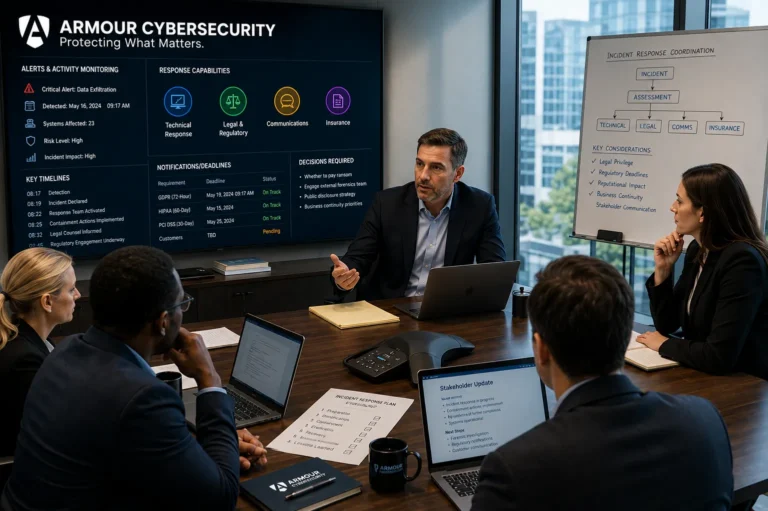
The breach response is not exclusively a technical exercise. Legal counsel, executive leadership, the board, insurers, and potentially regulators and affected parties are all stakeholders in the response, and the communication with each must be managed carefully. An experienced data breach response team provides coordination support for the non-technical dimensions of breach response, ensuring that the technical response and the legal, regulatory, and communications responses are aligned and progressing in parallel.
Eradication and Recovery
Once containment is achieved and the attacker’s access has been identified, eradication removes the malicious presence from the environment: eliminating malware, closing the access paths the attacker used, resetting compromised credentials, and validating that no residual access remains. Effective ransomware response includes restoring affected systems and data to an operational state while validating the integrity of recovered environments. verifying integrity before bringing systems back into service. Armour Cybersecurity provides structured eradication and recovery support that prioritizes critical systems and validates the security of the restored environment.
Post-Incident Review and Lessons Learned
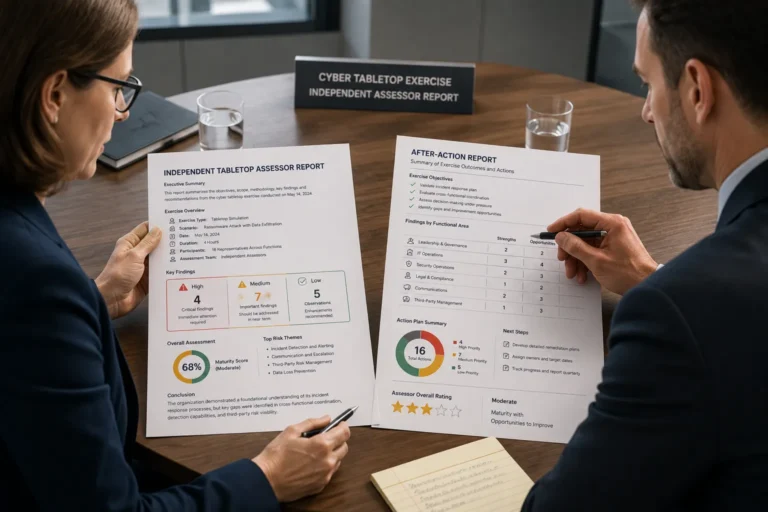
Insights gained through digital forensics services and post-incident reviews help organizations convert incident experience into meaningful security improvements. Armour Cybersecurity facilitates a structured after-action review that documents the timeline of the incident, the response actions taken, the decisions made, and the findings that emerge from the investigation. The review produces specific recommendations for improving detection, response, and recovery capabilities to reduce the likelihood and impact of future incidents.
The Case for a Pre-Established Response Relationship
Organizations that have pre-established a relationship with an incident response provider before an incident occurs experience significantly better outcomes than organizations that are engaging a response team for the first time during an active breach. The reasons are straightforward: there is no time to evaluate providers and negotiate engagement terms during an active incident, and the response team that has never worked with your environment takes time to get oriented that your organization simply cannot afford.
Armour Cybersecurity’s Zero Dollar IR Retainer program is designed to give organizations the assurance of a pre-established response relationship without the ongoing retainer cost. Qualifying organizations can establish the relationship, complete the onboarding documentation, and have response support available when needed, so the first call during an incident is to a team that already knows your environment.
What to Do in the First Hour of a Breach
- Do not power off affected systems immediately, preserve volatile memory and running process information for forensic investigation
- Do not delete logs or attempt to clean up systems before the evidence has been preserved
- Contact your incident response provider or breach coach before communicating externally about the incident
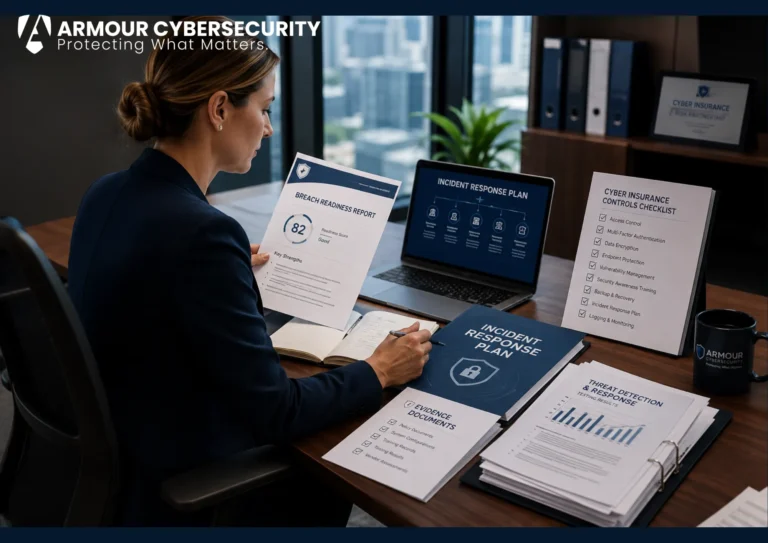
- Activate your incident response plan and initiate your communication protocols to notify the stakeholders defined in your escalation procedures
- Document every action taken from the moment of discovery, the timeline will be critical for investigation, regulatory reporting, and insurance claims
- Preserve screenshots, alert notifications, and any other indicators of the initial detection, the first evidence of the incident is often the hardest to reconstruct later
Breach Response and Cyber Insurance
Cyber insurance policies typically require notification of a breach within a defined timeframe and may specify approved response providers or require the insurer to approve response expenditures. Armour Cybersecurity works within the requirements of standard cyber insurance policies and can help organizations navigate the insurer notification and approval process during an active response. Understanding your policy requirements before an incident is essential, discovering them during one creates delays that increase damage.