Incident Response Services

When the breach happens, the next forty hours decide everything.

24/7 incident response, digital forensics, and breach recovery aligned with the NIST 800-61 framework. Containment, investigation, and restoration for organizations under active attack, delivered by responders with military intelligence and Big 4 consulting heritage.

From first alert to business-as-usual.

A typical ransomware operator logs in with a stolen credential, moves laterally inside the network for thirty to forty hours, then encrypts every workstation and server they can reach. By the time the IT team identifies the deployment, the attacker has been resident for days and the recovery clock is already running. The difference between a contained event and an operational crisis is usually measured in hours of response time.

Armour Cybersecurity's Incident Response service exists to compress that timeline. The team activates within hours, deploys monitoring across the affected environment, contains the threat, conducts forensic investigation to identify root cause and potential data exfiltration, and oversees restoration alongside the internal IT team. Every action is documented to insurance-grade and litigation-grade evidentiary standards.

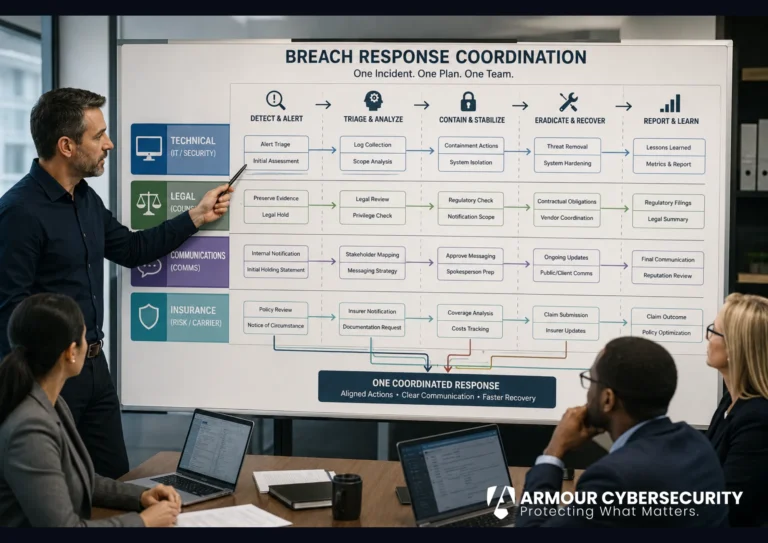
The methodology follows NIST 800-61. Investigation is informed by the Cyber Kill Chain and MITRE ATT&CK. Coordination with breach counsel and the cyber insurance carrier begins in the first hour. The engagement ends only when the organization is back to business-as-usual, with a documented post-incident review and an updated Incident Response Plan in place.

24/7
Emergency response activation for retainer clients and organizations under active attack
40 hr
Typical attacker dwell time before ransomware deployment. The earlier containment begins, the more is recoverable.

Improvised response vs. disciplined execution.

Cyber incidents do not wait for procurement cycles, board approvals, or business hours. The difference between organizations that recover quickly and those that suffer prolonged disruption is whether a disciplined response capability exists before the incident starts.

The Problem

Improvised response, lost evidence, prolonged disruption.

The incident is detected hours or days after the attacker entered. The IT team isolates devices without forensic imaging, destroying evidence. Stakeholders are notified inconsistently. Cyber insurance is engaged late. Legal counsel is brought in after critical decisions have already been made. Containment is partial, restoration is rushed, and the same vulnerability that enabled the attack remains exploitable when the environment comes back online.

The Solution

A trained team, a documented plan, and evidence preserved from hour one.

The response team activates on a defined service level. Forensic imaging precedes containment. Chain of custody is maintained from the first device touched. Breach counsel and the cyber insurance carrier are engaged in the first hour. Communications follow pre-built templates approved by legal. Root cause is identified before restoration, so the same vulnerability cannot be re-exploited. The organization returns to business-as-usual on the evidence, not on a guess.

What the team delivers in an incident.

Nine response domains, exercised across forensics, containment, communication, and recovery. Every domain is documented to insurance-grade evidentiary standards.

01 / FORENSICS

Disk, Memory & Mobile Forensics

Forensic imaging of workstations, servers, mobile devices, and system memory. Recovery of deleted and hidden data, malware reverse engineering, and analysis of attacker tooling left in the environment.

02 / LOG ANALYSIS

Log & Network Traffic Analysis

Review of system, application, identity, firewall, and endpoint logs to trace attacker movement. Network traffic analysis to detect lateral movement, data exfiltration, and command and control activity.

03 / CONTAINMENT

Containment & Quarantine

Isolation of compromised systems with forensic preservation, deployment of monitoring across the environment, and quarantine timed in coordination with investigators to prevent attacker adaptation.

04 / ERADICATION

Eradication & Remediation

Removal of malware, attacker tooling, persistence mechanisms, and unauthorized accounts. Secure rebuild of compromised systems using documented playbooks with business owner involvement.

05 / RECOVERY

Recovery & Restoration Oversight

Oversight of restoration activities, validation that recovered systems are clean, and coordination with business owners on the sequence and timing of return-to-operations decisions.

06 / INTELLIGENCE

Threat Actor & Kill Chain Mapping

Attribution of attacker behavior to known threat actor profiles and TTPs, mapped against the Cyber Kill Chain and MITRE ATT&CK to inform containment priorities and disclosure positioning.

07 / COMMUNICATIONS

Stakeholder & Regulatory Communications

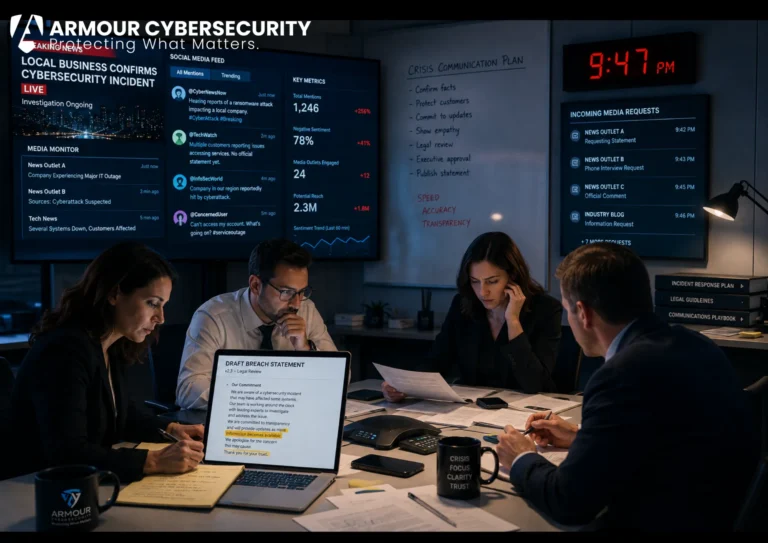
Support for internal communications, executive briefings, regulatory notifications, and customer-facing messaging, coordinated with breach counsel and aligned with disclosure obligations.

08 / INSURANCE

Cyber Insurance Coordination

Coordination with the cyber insurance carrier from the first hour, including notification protocols, claim documentation, and alignment with panel counsel and approved-vendor requirements.

09 / READINESS

IR Plan, Retainer & Tabletops

Pre-incident readiness: Incident Response Plan development, retainer onboarding, tabletop exercises, and IR readiness assessments so the team understands the environment before an event occurs.

Who this engagement serves.

Built for organizations that need disciplined response capability either pre-positioned through a retainer or activated under emergency conditions during an active incident.

Organizations Under Active Attack

Teams in the middle of a ransomware event, business email compromise, data breach, or targeted intrusion who need experienced responders engaged within hours, not days.

Regulated & High-Stakes Industries

Financial services, healthcare, legal, and government organizations subject to mandatory breach notification timelines where every hour of delay carries regulatory consequence.

Mid-Market & Growth-Stage Companies

Organizations without an internal incident response team who need a retainer to pre-position capability, guarantee response time, and pre-negotiate rates before an event occurs.

Cyber Insurance Policyholders

Organizations whose cyber insurance policy requires use of an approved-vendor responder, or who want to ensure their response partner can document evidence to claim-eligible standards.

A disciplined methodology across six phases.

The engagement follows the NIST 800-61 lifecycle, structured into six execution phases. The same phases are exercised in tabletops before an incident, so the response runs on muscle memory when a real event occurs.

1

Preparation & Readiness

Incident Response Plan development, retainer onboarding, tabletop exercises, communication templates, and pre-positioning with breach counsel and the cyber insurance carrier so response capability exists before it is needed.

2

Detection & Analysis

Activation of the response team. Scope determination, severity classification, and initial forensic triage. Engagement of stakeholders, breach counsel, and the cyber insurance carrier within the first hour.

3

Containment

Deployment of monitoring across the environment, forensic imaging of affected systems, quarantine of compromised devices timed to prevent attacker adaptation, and disruption of command and control infrastructure.

4

Eradication & Investigation

Removal of malware, attacker tooling, and persistence. Parallel forensic investigation of root cause, attacker movement, data exfiltration indicators, and attribution to known threat actor profiles.

5

Recovery & Return to BAU

Secure rebuild and restoration with business owner involvement. Validation that recovered systems are clean. Coordinated return to business-as-usual with continued monitoring through the stabilization period.

6

Post-Incident Review

Lessons-learned review, root cause documentation, communication-effectiveness assessment, and updates to the Incident Response Plan. Training and simulations to incorporate findings into ongoing readiness.

What the organization walks away with.

Nine integrated deliverables across the lifecycle, built to insurance-grade and litigation-grade evidentiary standards. Every artifact is designed to survive regulator, auditor, and counsel scrutiny.

DELIVERABLE 01

24/7 Emergency Response Activation

On-demand activation of the response team to a defined service level for retainer clients and emergency engagement for organizations under active attack.

DELIVERABLE 02

Incident Response Plan (IRP)

Documented IRP aligned with NIST 800-61, including playbooks for ransomware, data breach, and phishing scenarios, communication templates, and cyber insurance contact protocol.

DELIVERABLE 03

Digital Forensics Investigation Report

Comprehensive forensic report covering disk, memory, mobile, log, and malware analysis. Documents attacker methods, tooling, and the security weaknesses that enabled the event.

DELIVERABLE 04

Incident Timeline Reconstruction

Hour-by-hour reconstruction of the attack, from initial compromise through containment, mapped to the Cyber Kill Chain and MITRE ATT&CK to inform disclosure and remediation.

DELIVERABLE 05

Root Cause Analysis

Documented analysis of the vulnerabilities, misconfigurations, or process gaps the attacker exploited, with prioritized remediation recommendations to prevent recurrence.

DELIVERABLE 06

Chain of Custody Documentation

Forensically sound chain of custody for every piece of evidence collected, with documented handlers, transfers, and storage, ready to support insurance claims and legal proceedings.

DELIVERABLE 07

Regulatory & Stakeholder Communications Support

Drafts and review of regulatory notifications, executive briefings, and customer-facing communications, coordinated with breach counsel and aligned with disclosure obligations.

DELIVERABLE 08

Tabletop Exercise Facilitation

Facilitated tabletop exercises that pressure-test the IRP, exercise the response team, and identify gaps before a real incident exposes them. Documented findings feed plan updates.

DELIVERABLE 09

Lessons Learned & IRP Update

Post-incident review covering communication effectiveness, response time, vendor coordination, and investigation gaps, with corresponding updates to the IRP and follow-up training.

The numbers behind the work.

Founded by military intelligence veterans with senior advisors from PwC, KPMG, Deloitte, EY, and Mandiant. The track record reflects the discipline.

260+

Clients Served

Organizations across finance, healthcare, technology, energy, legal, and government trust Armour Cybersecurity to protect what matters.

97%

Client Retention Rate

Long-term engagements built on consistent quality, predictable delivery, and consulting relationships that compound in value over time.

52+

Industries ยท Worldwide Reach

Cross-sector experience spanning every major regulated industry, with operations supporting clients across North America, Latin America, and beyond.

80+

Cybersecurity Technology Solutions

A vetted catalogue of technology partnerships and proprietary methods deployed in support of containment, forensics, and breach recovery operations.

Under attack right now? Every hour matters.

Call the emergency response line or submit the form. Protecting What Matters starts with disciplined response when seconds count.

Activate Response

Frequently asked questions.

Common questions from CISOs, General Counsel, and risk leaders evaluating an Incident Response engagement or retainer.

What is the difference between incident response and threat hunting?
Threat hunting is proactive. It searches the environment for adversary activity that has bypassed existing controls, before any alert has fired. Incident response is reactive. It activates after a confirmed or suspected security incident to contain the threat, conduct forensic investigation, eradicate the attacker, and restore normal operations. Many organizations engage both, with threat hunting reducing the number of incidents and incident response handling the ones that occur.
How quickly can Armour Cybersecurity respond to an active incident?
Retainer clients receive a guaranteed response time defined in the service agreement, typically measured in hours. Non-retainer organizations under active attack can engage emergency response by calling the main number. Speed matters in ransomware incidents because attackers typically operate inside the network for hours or days before encryption, so the sooner containment begins the more recoverable the environment.
Which framework does the methodology follow?
The methodology follows NIST 800-61, the established US standard for incident response. The four-phase lifecycle (Preparation, Detection & Analysis, Containment Eradication & Recovery, and Post-Incident Activity) governs every engagement. The Cyber Kill Chain and MITRE ATT&CK frameworks support the investigation phase by mapping adversary behavior to known tactics, techniques, and procedures.
What does an incident response retainer include?
A retainer guarantees response time, pre-negotiates rates, and reserves capacity from the response team. Pre-incident hours can typically be spent on Incident Response Plan development, tabletop exercises, IR readiness assessments, and onboarding so the team understands the environment before an event occurs. Unused hours often convert to other proactive services at the end of the term, subject to the agreement.
Does the engagement support cyber insurance claims?
Yes. The investigation team documents evidence to insurance-grade standards, including chain of custody, forensic imaging, incident timeline, and root cause analysis. The team coordinates with the cyber insurance carrier and breach counsel from the first hour, and the final report is structured to support claim documentation. Armour Cybersecurity is accepted as a panel or approved vendor by multiple cyber insurance carriers.
What types of incidents does the team handle?
Common engagements include ransomware, business email compromise, data breach, insider threat, account compromise, supply chain compromise, and targeted intrusion. The team has handled events tied to organized criminal groups, nation-state actors, hacktivists, and insiders. Playbooks exist for the most common scenarios and are tailored to the specifics of each event during the Detection & Analysis phase.
How does the engagement work with legal counsel and the cyber insurance carrier?
Incident response is typically engaged under breach counsel privilege to protect attorney work product. Armour Cybersecurity works directly with the external law firm and the cyber insurance carrier from the first hour, coordinating evidence handling, regulatory notification timelines, and stakeholder communications. The work supports legal and regulatory positioning and does not constitute legal advice.

Engage the response team. Now or before.

For active incidents, call the main line for immediate activation. For retainers, tabletops, and IRP development, submit the form and a senior responder will respond within one business day.

Talk to Armour Cybersecurity.

๐Ÿ“ž
Phone (24/7 for Emergencies)
1 866 80 30 700
โœ‰
Email
info@armourcyber.io
๐Ÿ“
Headquarters
77 Bloor St West, Suite 600
Toronto, ON, Canada

Request response or readiness support.

For active incidents, please call the phone line for fastest response. For readiness, retainers, and tabletop exercises, complete the form below.

For incidents in progress, please call 1 866 80 30 700 for fastest response. By submitting, you agree to be contacted by Armour Cybersecurity.