By David Chernitzky, CEO & Co-Founder, Armour Cybersecurity · Toronto-based, serving organizations across North America · Last updated July 28, 2026
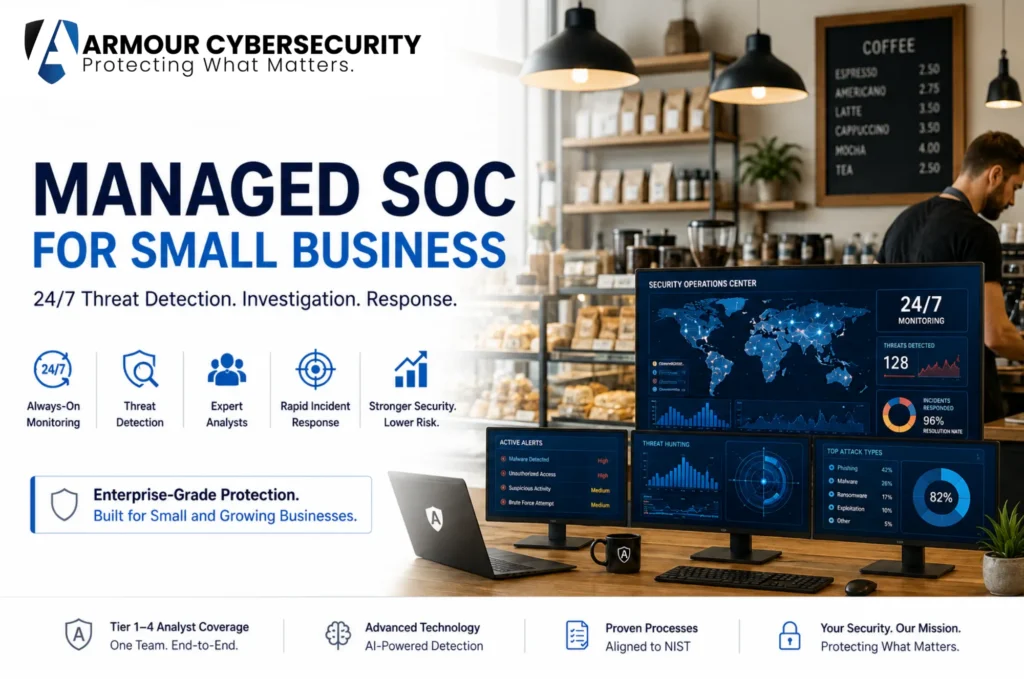
Quick answer: A managed SOC for small business is an outsourced Security Operations Center that monitors your environment 24/7, detects threats, investigates alerts, and contains incidents on your behalf. You need one when your size or budget makes an in-house SOC impractical but the risk of going unmonitored overnight is real. For most small and midsize organizations, that describes the situation exactly.
Key Takeaways
- A managed SOC runs continuous threat detection and response across your endpoints, network, cloud, and identity systems, around the clock, with no internal security team to hire.
- The line between a basic monitoring service and a real managed SOC is analyst depth. A full Tier 1-4 model covers triage, investigation, threat hunting, and incident response from one team.
- Most cyberattacks fire outside business hours. An unmonitored environment at night is an open window.
- Managed SOC is not just an enterprise purchase. Smaller organizations face the same threats with less capacity to respond, which makes outsourced coverage more valuable, not less.
- A managed SOC costs a fraction of what it takes to build and staff an equivalent team in-house.
What Is a Security Operations Center?
A Security Operations Center, usually shortened to SOC, is the team and function that watches an organization’s environment for security threats, investigates alerts when they surface, and responds to incidents once they are confirmed. Think of it as the security nerve center of the business. Threat signals from endpoints, networks, cloud infrastructure, and identity systems land here, where they are collected, correlated, and analyzed to work out whether something malicious is underway. (For a deeper look at the day-to-day, see our breakdown of what a modern SOC does.)
Inside a large enterprise, the SOC is an internal team working in shifts around the clock. It is staffed with analysts at several levels of expertise and backed by threat intelligence feeds, automated response tools, and forensic capability. Standing up and running that team costs millions a year before you count the technology.
A managed SOC delivers the same capability as a service. The provider runs the analysts, the infrastructure, and the processes. You get 24/7 coverage without hiring a single security analyst of your own.
What Does a Managed SOC Actually Mean?
The term gets stretched to cover a lot of ground. Before you compare options, it helps to know what a real managed SOC delivers versus what a basic monitoring service delivers.
A basic monitoring service staffs Tier 1 analysts who watch alerts, close the obvious false positives, and forward everything else to you. Your internal team then decides what to investigate and what to do about it. The vendor has narrowed the problem, not solved it.
A real managed SOC works across all four analyst tiers. Tier 1 monitors alerts continuously and handles initial triage. Tier 2 runs deeper investigations, correlates signals across sources, and scopes the incident. Tier 3 hunts proactively for adversary activity that has not tripped an alert yet, and resolves the complex cases. Tier 4 handles reverse engineering, custom detection development, and incident response leadership. What matters most: one team covers all four tiers, with no handoff to a separate vendor the moment an alert becomes an incident.
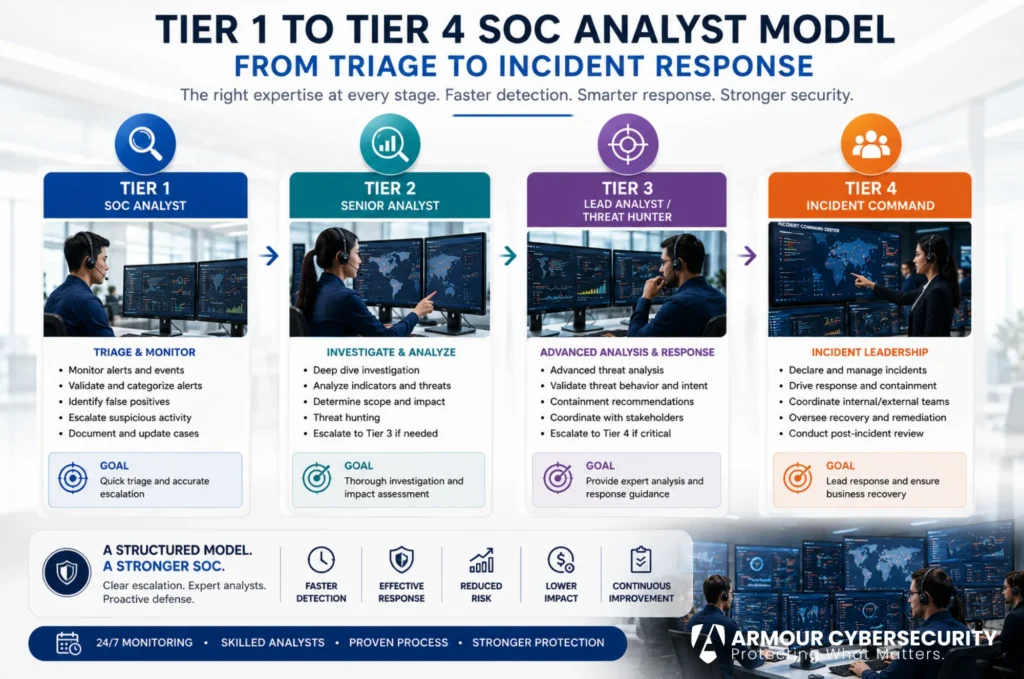
Armour’s Managed SOC runs on exactly this Tier 1-4 model. The same team that opens the alert closes the incident, with evidence preserved from the first event and a documented chain of custody the whole way through.
What Does a Managed SOC Monitor?
A managed SOC should see the full attack surface, not one layer of it. Threats ignore tool boundaries. An attacker who has taken over a user account might use legitimate remote-access tools that slip past endpoint detection, move sideways across the network on protocols that look ordinary, and steal data through cloud storage that IT already trusts. Catching that requires correlated signals from several sources at once.
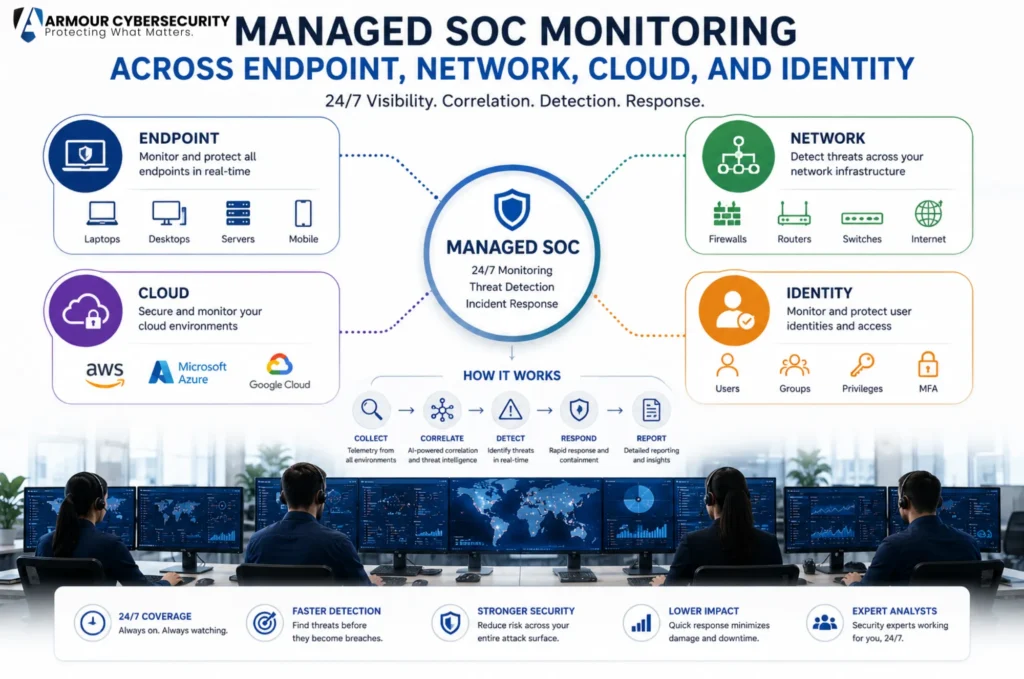
Endpoints
Laptops, desktops, servers, and mobile devices are the most common way in. Endpoint telemetry flows into the SOC from endpoint detection and response tooling, giving analysts a view of process execution, file activity, network connections, and user behavior on each device.
Network
Network monitoring captures traffic flows, connection patterns, and communication with outside destinations. The SOC reads that data to spot command-and-control traffic, lateral movement, odd data volumes, and connections to infrastructure already known to be malicious.
Cloud and identity
Cloud workloads, SaaS applications, and identity systems are increasingly the first target in a modern attack. Business email compromise, cloud storage theft, and identity-based attacks that ride on legitimate credentials never trip an endpoint alert. Watching cloud audit logs, identity provider signals, and application activity gives the SOC eyes on that surface.
SIEM correlation
Every one of these signals feeds a Security Information and Event Management platform, where rules and analytics correlate events across sources to reveal attack patterns no single feed would show on its own. Detection rules tuned to your specific environment, and enriched with current threat intelligence, cut false positives and surface the signals that actually matter.
Why 24/7 Coverage Matters
Start with when attacks happen. Ransomware is routinely timed for nights and weekends, when nobody is around to interrupt it. Automated scanners probe for exposed systems non-stop, with no regard for your office hours. Attackers who already have a foothold move laterally and escalate privileges during off-hours, when fewer processes are running and fewer people are watching. Small organizations are squarely in scope here, as our look at how small businesses get hacked lays out.
A business that watches its environment from 9 to 5 on weekdays has effectively posted its hours for attackers. The undetected-activity window runs more than 120 hours a week. An incident that could have been contained in hours if it were caught Monday morning can instead run unchecked from Friday afternoon straight through to Monday, with nobody to stop it.
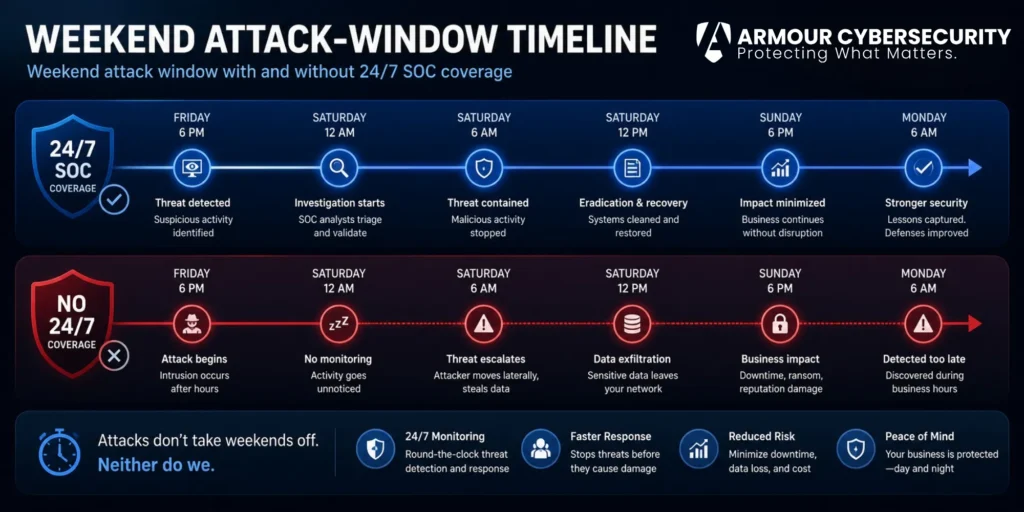
That is what 24/7 coverage changes. An alert at 2 a.m. on a Sunday gets handled by the same team that handles an alert at 2 p.m. on a Tuesday. Response is measured in minutes, not in the hours it takes for someone to reach the office and notice something looks wrong.
What Is the Difference Between MDR and a Managed SOC?
Managed Detection and Response, or MDR, is a service category that overlaps heavily with managed SOC. Both give you 24/7 monitoring and active response. The difference is mostly scope and depth. MDR is a loose term that can mean anything from a basic alert-monitoring service to a full Tier 1-4 SOC operation. Managed SOC points specifically at the delivery model of an outsourced Security Operations Center with full analyst coverage.
Whichever label a provider uses, the questions that matter stay the same. How many analyst tiers are covered? Is incident response integrated, or handed to a separate vendor? Is threat hunting proactive or only reactive? What evidence does the service produce for compliance and board reporting? Armour’s managed SOC delivers all of it inside one engagement, with an integrated incident response team that engages from the same SOC when an alert crosses the line into an incident.
When a Managed SOC for Small Business Makes Sense
Not every organization needs to outsource its security operations. A managed SOC for small business earns its place when a few things are true at once: you hold data or systems worth attacking, you cannot justify hiring and rostering a round-the-clock internal team, and you cannot accept an environment that sits unwatched every night and weekend.
That combination describes most small and midsize businesses. The threats do not scale down to match your headcount. Ransomware crews and automated scanners hit a 40-person firm with the same tools they point at a Fortune 500. What changes is your capacity to notice and respond, and that gap is precisely what an outsourced SOC closes. If you already run a small internal security team, a managed SOC can take the 24/7 monitoring and threat hunting off their plate so they can focus on engineering and response.
Frequently Asked Questions
What is the difference between a managed SOC and antivirus software?
Antivirus software detects and blocks known malware on individual devices. A managed SOC monitors the entire environment, including endpoints, network, cloud, and identity systems, correlates signals across all of these sources, and responds to threats that individual tools would not catch. Antivirus is a component of a well-protected environment; a managed SOC is the function that coordinates all of those components and responds when something gets through.
How does a managed SOC receive data from our systems?
A managed SOC deploys a log collector that connects to your data sources and forwards security telemetry to the SIEM. Data sources typically include endpoint security tools, firewalls, network devices, cloud audit logs, identity provider logs, and email security platforms. The initial onboarding phase configures these connections and validates that data is flowing correctly before monitoring goes live.
Will a managed SOC slow down our systems or disrupt operations?
No. Log collection and security monitoring are passive activities that do not affect system performance or operations. The SOC observes what your systems are doing; it does not run on them or consume their resources. Automated response actions, such as isolating a compromised device, are taken only when a confirmed threat meets the predefined threshold for that action, and always within agreed parameters that limit operational impact.
What happens when the managed SOC detects a real threat?
Tier 1 analysts triage the alert and, if the threat is confirmed, escalate to Tier 2 for deeper investigation. Tier 2 scopes the incident, correlates related signals, and begins containment actions within agreed parameters. For incidents that cross a defined severity threshold, the integrated incident response team engages from the same SOC, handling forensic investigation, full containment, eradication, and recovery. The client is notified at defined escalation points throughout the process.
How much does a managed SOC cost?
Pricing usually follows a per-asset or per-user model. Common industry ranges run about $10 to $20 per monitored asset per month, or $50 to $200 per user per month, with variation based on coverage scope, response SLAs, and compliance requirements such as HIPAA, PCI, or CMMC. Comprehensive 24/7 coverage for small-to-midmarket organizations commonly lands between $120,000 and $360,000 per year, which is still well below the cost of building and staffing an in-house 24/7 SOC, a team that needs multiple analysts across every shift to cover the clock.
The Bottom Line
A managed SOC gives a smaller organization the one thing an in-house build rarely can at a sane price: eyes on the environment every hour of every day, backed by analysts who can investigate and contain rather than just forward alerts. If your business holds data worth protecting and cannot staff a 24/7 team of its own, Armour’s Managed SOC runs the full Tier 1-4 operation on your behalf, from the first alert through to a contained incident. Protecting what matters starts with a SOC that does the work.
About the author
David Chernitzky is the CEO and Co-Founder of Armour Cybersecurity, a Toronto-based firm that protects organizations across North America from advanced cyber threats. He brings more than 25 years of cybersecurity and military cyber intelligence experience, having served as an officer in an elite technology unit before co-founding Armour. Armour’s team of military-intelligence veterans and senior advisors serves 260+ clients across 52+ industries with a 97% client retention rate.