By David Chernitzky, CEO & Co-Founder, Armour Cybersecurity · Toronto-based, serving organizations across North America · Last updated July 28, 2026
Quick answer: Here is how a managed SOC responds to threats: Tier 1 analysts triage the alert within minutes, Tier 2 analysts investigate and correlate signals to confirm and scope the incident, and the incident response team contains and remediates, all from the same team, with evidence preserved from the first event. Most of it happens before a business would even notice something was wrong.
Key Takeaways
- Alert to confirmed threat usually takes minutes in a well-run managed SOC. Without continuous monitoring, the average breach goes undetected for around 200 days.
- The Tier 1-4 model means every alert is triaged, investigated, and answered by an analyst with the right expertise, rather than forwarded back to you to deal with.
- Containment actions, such as isolating a device, blocking an IP, or disabling a compromised account, happen within agreed parameters, so no one waits on sign-off for every decision.
- SOAR automation runs the routine response steps instantly, which frees analysts to spend their time on investigation and judgment.
- Every incident leaves a documented chain of custody, from first alert through post-incident review, that stands up to legal, regulatory, and insurance scrutiny.
How Does a SOC First Detect a Threat?
Detection starts with data. A managed SOC pulls security telemetry from every layer of your environment: endpoint detection and response tools, network monitoring systems, cloud audit logs, identity provider signals, email security platforms, and firewall logs. All of it lands in a Security Information and Event Management platform, the SIEM, where it is normalized, correlated, and run against detection rules. (For the wider picture of how that operation is staffed, see our breakdown of what a modern SOC does.)
Detection rules are the logic that spots malicious behavior. One might fire when an account logs in from two countries inside an impossible travel window. Another when a server process reaches out to a known malicious IP, or when files start encrypting in rapid succession, or when an account suddenly touches systems it has never accessed before. Rules tuned to your specific environment and industry, and fed by current threat intelligence, generate far more relevant alerts than out-of-the-box analytics on their own.
Rules are only half of it. Modern managed SOCs also run behavioral analytics that learn the normal pattern for each user, device, and system, then flag the deviations. An account that has only ever opened email and a project tool, now reaching into the financial system at 3 a.m., raises an anomaly alert whether or not a specific rule exists for it. That is the SOC threat detection process working on evidence, not just signatures.
How a Managed SOC Responds to Threats, Tier by Tier
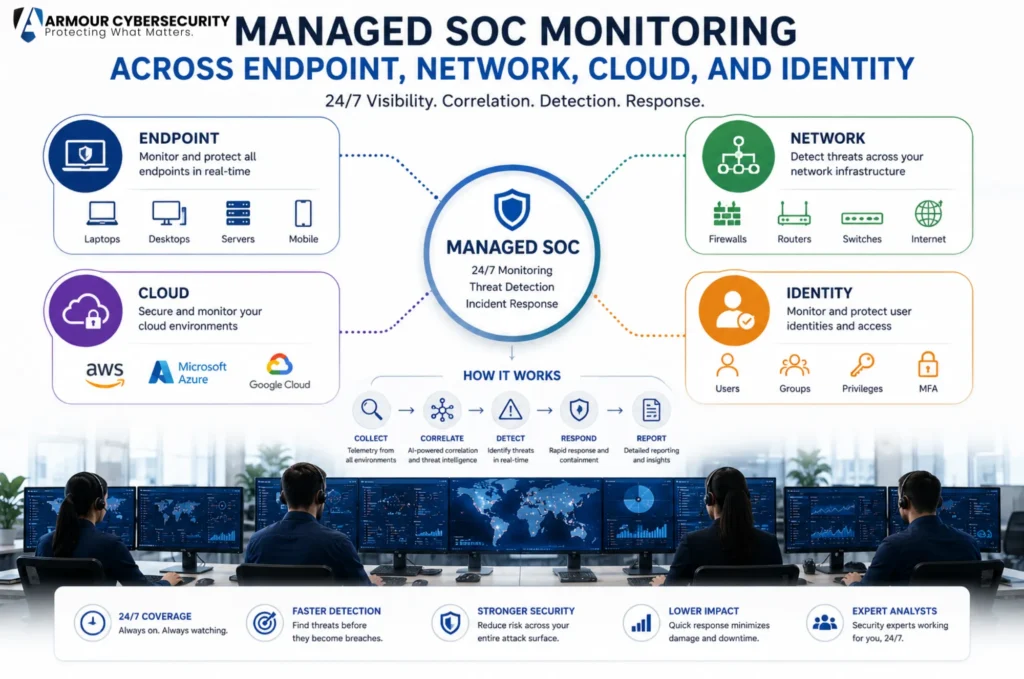
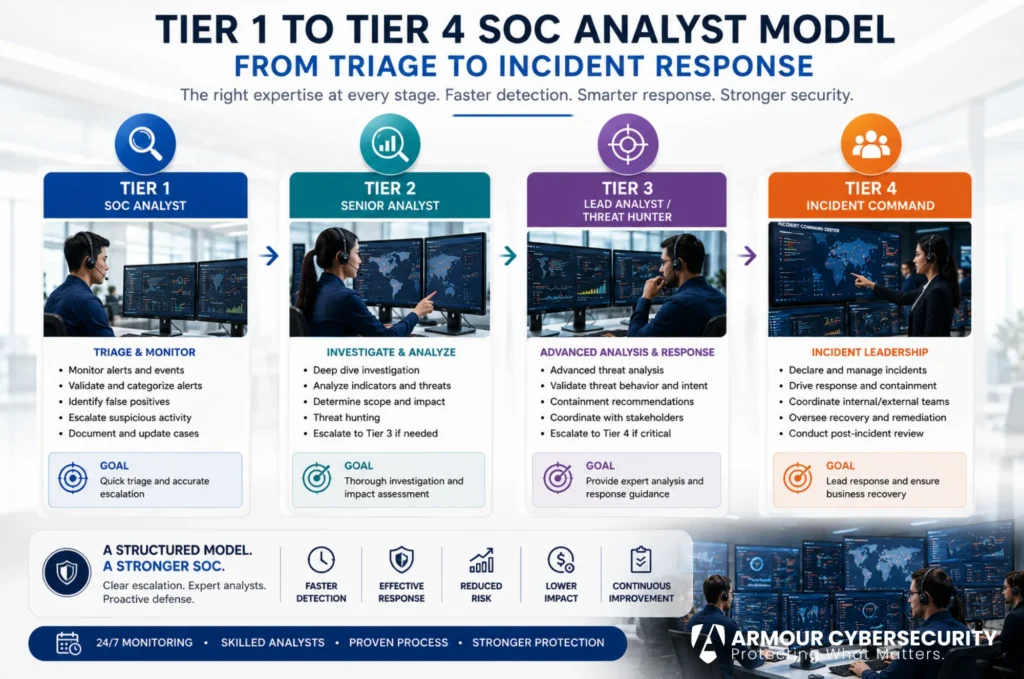
Tier 1: Initial triage
Every alert lands first with a Tier 1 analyst. They review the alert context, the data points around it, and the alert history for the affected system and user. Plenty of alerts are false positives, legitimate business activity that happens to match a rule, and the analyst closes those with documentation and moves on.
Alerts that warrant a closer look get enriched. What else has this account or system done recently? Does the destination IP show up in threat intelligence feeds? Has this pattern appeared before? The enriched alert goes up to Tier 2 with that initial analysis attached, which cuts the investigation time at the next level.
Tier 2: Investigation and scoping
Tier 2 takes the escalated alert and digs in. The work here is correlation: lining the alert up against signals from other sources. An endpoint alert might connect to a suspicious network destination and an odd authentication event in the identity logs. Each correlation either strengthens the case that something real is happening or offers an innocent explanation that closes it.
Once a genuine threat is confirmed, Tier 2 scopes the incident. Which systems are affected? What lateral movement has happened? What data may have been reached, and how far has the attacker gotten? That scope drives the containment strategy and sets the incident’s severity.
Tier 3: Threat hunting and complex resolution
Tier 3 handles the hardest cases and runs proactive threat hunting alongside live work. Hunting means searching the environment for adversary activity that has not tripped any alert yet. Attackers who use legitimate tools and stolen credentials, a technique called living off the land, can sit inside a network for weeks without triggering rule-based detection. Tier 3 analysts work from behavioral hypotheses and custom queries to surface those threats before they do visible damage.
Anything a hunt uncovers gets fed back into the detection rules, so the same technique is caught automatically next time. That feedback loop is why a managed SOC engagement gets sharper over time instead of holding at a fixed level of coverage.
Tier 4: Incident command and forensics
For serious incidents, Tier 4 takes command. This is the level that handles malware reverse engineering, memory forensics, adversary behavior reconstruction, and response leadership. With a ransomware deployment underway, a Tier 4 analyst runs the response: coordinating containment across affected systems, directing forensic evidence collection, managing communication with legal counsel, and keeping the chain of custody that regulators and insurers will ask for.
What Containment Actions Does the SOC Take?
Containment is the set of steps that stop an active threat from spreading. In a managed SOC these actions are agreed with you in advance, so analysts can move immediately instead of waiting for a decision on every one. This is what real managed SOC incident response looks like in practice.
The common automated actions, run through SOAR playbooks, include blocking a malicious IP at the firewall, isolating a compromised endpoint from the network to stop lateral movement, disabling a compromised account, triggering conditional access that forces step-up authentication, and opening a ticket in your incident management system.
Higher-impact moves, like taking a business-critical server offline, get escalated to your designated contact for authorization. The aim is to shut the threat down as fast as possible while keeping you aware of any decision that touches operations. When an incident crosses the severity threshold, the same team escalates into full incident response rather than handing it to an outside vendor.
How Fast Does All of This Happen?
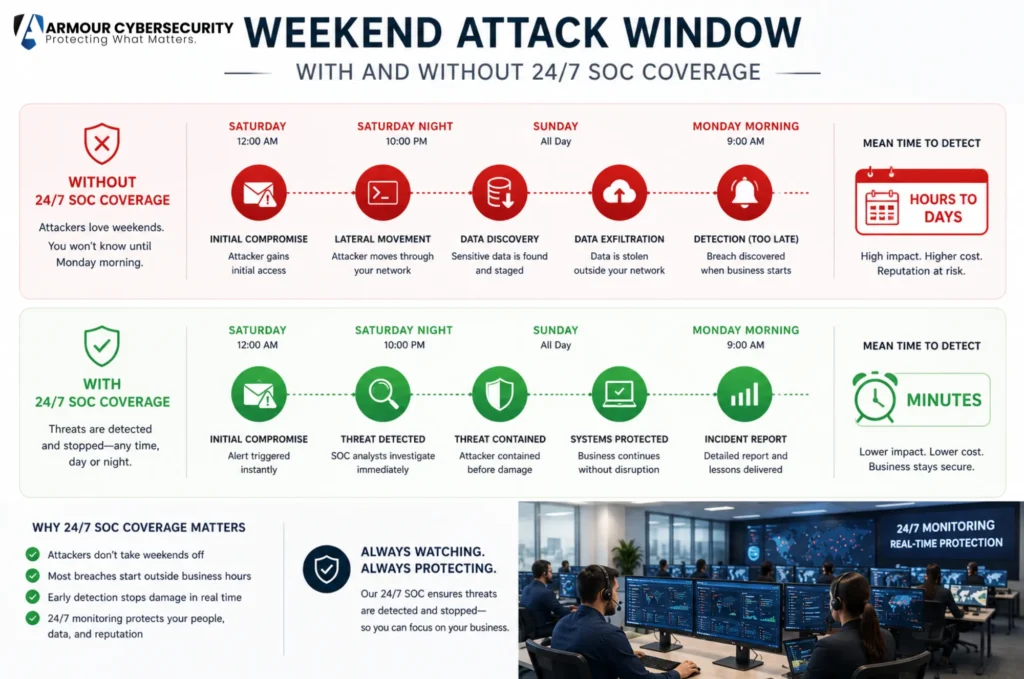
Speed is one of the biggest differences between a managed SOC and the alternatives. Mean Time to Detect (MTTD) and Mean Time to Respond (MTTR) are the industry metrics for SOC effectiveness. According to IBM’s Cost of a Data Breach research, the average organization still takes around 200 days just to identify a breach. A managed SOC running the Tier 1-4 model measures detection in minutes for most alert categories.
The money side of that gap is stark. IBM’s data shows a direct line between how long a breach runs and what it costs. Breaches identified and contained in under 200 days come in roughly $1 million cheaper, on average, than those that drag on longer. For a smaller business, that difference can decide whether an incident is a bad week or the end of the company. It is worth understanding how small businesses get hacked in the first place, because the same speed that limits cost also limits exposure.
What Documentation Does the SOC Produce?
Every alert, investigation, and incident is documented as it happens, and that record does real work. It backs legal and regulatory requirements by establishing a chain of custody for evidence. It supports cyber insurance claims with a factual account of what occurred and how you responded. And it gives your board a clear read on the threat landscape and how well it is being managed.
Armour’s Managed SOC produces weekly status reports covering alert volumes, investigations, incidents, and SLA performance. Monthly programme reports turn the operational metrics into governance language leadership can act on. After a significant incident, a lessons-learned report captures root cause, response effectiveness, and the specific rule or playbook changes made to close the gap.
Frequently Asked Questions
What is SOAR and how does it speed up incident response?
SOAR stands for Security Orchestration, Automation, and Response. It is the layer of technology that executes predefined response playbooks automatically when specific conditions are met. When an alert triggers a playbook, SOAR can simultaneously look up the associated IP address in threat intelligence databases, check the user account against directory services, create an incident ticket, notify the on-call analyst, and block the IP at the firewall, all within seconds. This eliminates the manual steps that add minutes to every response and allows analysts to focus on investigation and judgment rather than repetitive actions.
What is threat hunting and is it really proactive?
Threat hunting is the practice of actively searching the environment for adversary activity that has not triggered an automated alert. It is proactive in the sense that it does not wait for an alert to begin looking. Tier 3 analysts develop hypotheses based on current threat intelligence, adversary TTPs, and knowledge of the client environment, then use custom queries to search for evidence of those techniques in historical log data. Activity discovered through hunting is often traced back days or weeks before the hunt identified it, revealing how long an attacker had been present before detection.
How does the SOC handle a ransomware incident specifically?
Ransomware incidents trigger immediate escalation. The moment behavioral analytics or endpoint detection identifies the mass encryption pattern associated with ransomware staging, Tier 1 escalates to Tier 2 for confirmation, containment actions begin immediately, and Tier 4 takes incident command. Affected endpoints are isolated from the network to prevent lateral spread. The affected user accounts are suspended. Forensic evidence is collected from affected systems before any remediation begins to preserve data for analysis and legal purposes. The IR team contacts the client’s designated emergency contact and begins coordinating recovery.
What is the chain of custody and why does it matter?
Chain of custody refers to the documented record of who collected evidence, when, and what was done with it. In a security incident, this documentation is required if the incident leads to legal action, regulatory investigation, or an insurance claim. An integrated managed SOC preserves chain of custody from the first alert because the same team that observed the initial event also investigates and responds to it, with every action timestamped and logged. Organizations that use separate monitoring and response vendors often have chain-of-custody gaps when evidence is transferred between teams.
Does the managed SOC integrate with our existing security tools?
Yes. Armour Cybersecurity’s Managed SOC offers two engagement models. The service-only model utilizes the organization’s existing SIEM and security tools, optimizing the rules, correlations, and playbooks from an offensive perspective. The turnkey model deploys a fully licensed monitoring platform with custom connector development. In either case, the SOC ingests data from the organization’s existing security tools rather than replacing them.
The Bottom Line
The value of a managed SOC is not any single tool. It is the way detection, investigation, containment, and forensics run as one continuous motion, handled by one team, fast enough to stop an incident before it becomes a headline. If you want to see how that operating model is structured end to end, Armour’s Managed SOC runs the full Tier 1-4 process on your behalf, with evidence preserved from the first alert. Protecting what matters comes down to speed, and speed comes from a SOC that does the work.
About the author
David Chernitzky is the CEO and Co-Founder of Armour Cybersecurity, a Toronto-based firm that protects organizations across North America from advanced cyber threats. He brings more than 25 years of cybersecurity and military cyber intelligence experience, having served as an officer in an elite technology unit before co-founding Armour. Armour’s team of military-intelligence veterans and senior advisors serves 260+ clients across 52+ industries with a 97% client retention rate.